Meaning of Cells.VIETNAMESE TRANSLATE ENGLISH BY=VIETNAMESE BUDDHIST NUN=THICH CHAN TANH.
Phuoc Dien is the Sangha, the religion represents many virtues and freedoms. "Try at the center of appearance of external appearance" - liberated by the mind manifests the liberating form, in which the things of monks like y and bowls are also monotonous and simple.
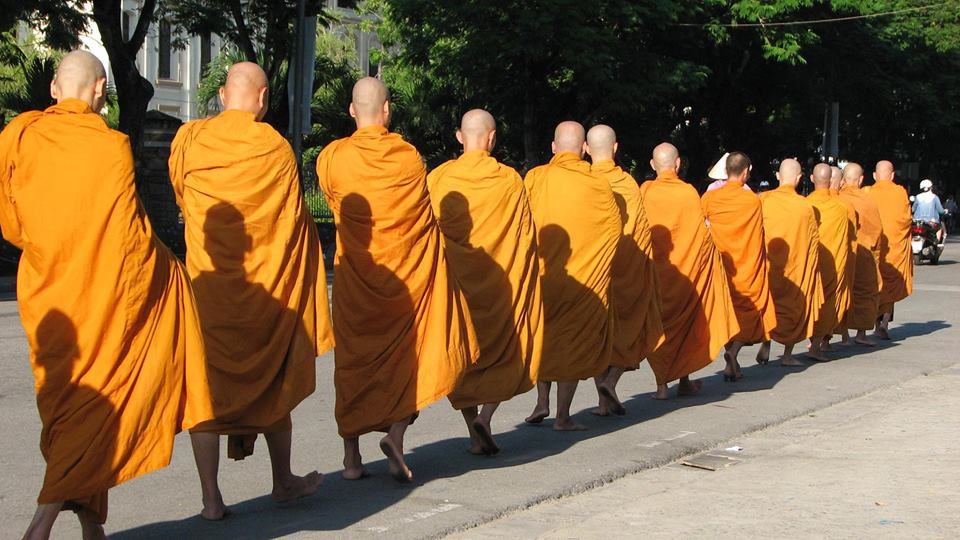
From secular to religious, there are even associations, military ... all have different colors, uniforms and uniforms. Immediately look at to differentiate between organizations, organizations or religions, even in a religion there are many different uniforms for each sect, religious order ... The monks are also called forensics, forensics of monks. Buddhist house.
From the time of the Buddha, called y ca sa, the latter called "liberation shirt, also called Phuoc Dien y". Ca sa is pronounced by the word kasaya, which means fading color, ruined color, is not a clear orthodox color, proving that the monk's dress is not flashy of the world, is simple and simple. , elegant.
***
At the beginning of the establishment of the Sangha, the monks still had to use the same clothes as the pagan monks, to distinguish the monks of Co Dam from the monks of other religions, King Tan Ba Sa La suggested to the Buddha for permission. Practitioners are dressed differently so that everyone can easily recognize them. According to the Venerable Vinaya Volume 2, “At that time, the monks of the group of six monks wore uncut ivory robes. The people complained, criticized and disparagingly saying: "Just like the people in the house enjoy sex". They have reported the matter to the Blessed One, he taught: "Monks, should not wear uncut robes; Whoever wears it is guilty of dukkata. "
At the same time, Buddha and Anan preached at Dakkhināgira, when he saw that the rice fields in Magadha were squares separated by the dike line, he told Anan in that pattern to sew the monks' robes: the ability to create medical models like that for monks? Bach The Ton I have ability. " Anan immediately modeled according to Buddha's teachings, Buddha was very pleased and praised, "Ananda is a skillful person, even in the field of sewing! A Venerable monk is a person who knows how to sew his own robe, does not let thread sprout out, and is never criticized for being a waste of offerings from good men and women. Buddha recalled in the past, "The Buddhas all took the form of the field as the general of Y, from now on must also take this form as the general of Ca Sa ...".
Y ca sa of a bhikkhu has three types: “five y, seven y and great y (25 things). He does not use luxurious flamboyant brocade, does not use fur fabrics, silk to harm creatures; just cloth is often rudimentary from the wastage of the identity. Therefore, in the Vinaya states that: "Buddha processing three y use, primitive ma father, animal mao damage from the damage, y is not able to residual world?"
Three y includes "primary, middle and great". According to the mendicant law prescribed by the ancestor Minh Dang Quang, the three robes include the upper robe when performing the ceremony or go out for alms, the chinese medicine is the type to wear inside and the lower robe is worn below.
Nuns Nuns Essential Law called Five y (forensic 5 things), consisting of 5 pieces, the whole plate consists of 10 pieces, each long piece assembled with a short vertical piece is called one thing.
Chinese medicine wears above. This medicine consists of 7 pieces, so it is also known as medical failure, the whole y plate consists of 21 pieces, for every 2 long pieces, 1 short piece assembles one thing.
Great medicine is the outer cover of monks. This medicine consists of 9 pieces so it is also called yu thing. The whole y plate consists of 27 pieces, each row two pieces long a short piece together called one thing. Vinaya also stipulates that, depending on the rank and virtue that the Sangha-old-le may have from 9 to 25 things. The more highly moral those who are, the more important they are in Sangha.
Also according to Northern Buddhism, Y Ca Sa has 3 levels: Upper, Middle and Lower, divided into nine products:
- Lower Level: from 9 to 13 things. These three men each have 2 long terms, 1 short paragraph.
- Middle level: Y 15 to 19 articles. These three men each have 3 long terms, 1 short paragraph.
- Superior: from 21 things to 25 things.
These three physicians, each with 4 long terms, 1 short paragraph. Y is Y Ba Fetch, because in 4 long, 1 short paragraphs, there are more than 100 pieces of small fabric assembled, so it is also y Ba Fetch. Ba y, because the Bac passed down inside the underwear to wear cauldron, short clothes, the other three doctors to go out, when receiving guests or at the ceremony.
Originally before inventing the form of the thing, the monks picked up cloth from the graveyard, from the main street, from the feces, from the child's bed, the disinfectant cloth, the cloth from the bath, the cloth on the way to the cemetery, the burnt cloth, eaten by cattle, eaten by ants, rats, torn cloth, flag cloth, cloth dropped from the temple, cloth of the ascetic house, cloth from the ceremony, fabric transformed by divine powers, cloth for the wind The angel of alms, the cloth drifted in the middle of the sea, taking one of these fabrics, he should tear away the torn pieces, wash the healthy pieces to make a y, called the algae chalk. Nowadays, monks in some big monasteries in Sri Lanka or Burma still keep that tradition.
Why must three y? According to legend, the Buddha saw some monks with robes on the head, armpits, with a taste in the shoulder roll, some taste in the waist, the Buddha immediately restricted y for monks. On a winter night, the snow is very cold, at the beginning of the night, The Ton put on a robe to enter the meditation, there is a shop, at midnight, it feels a bit cold, The Ton adds a second robe, but at the end of the night , feeling colder again, and put on a third robe. Then, he thought: "My disciples only need to wear three robes (in the old days, monks only put on robes but did not wear clothes like the North Vietnamese) is enough to prevent too cold, too hot, to be wary. mosquitoes, cover up shame, do not hurt the holy body. If anyone can not stand the cold, Moi will allow to add more old robes. "
Early the next morning, the Blessed One went to the place where he had ordained that each bhikkhu should only purchase and wear three Y: “From today on, I allow monks to keep only about three yr. If the new fabric is available, then one robe will be sewn by two layers, one y Uat da la will increase one layer and one y An da hoi one layer. If anyone does not tolerate the cold, then I allow at will to use more old robes. "
***
After manipulating the "medical things", Tang Huy signed to explain: "In a field that holds water, grows rice germs, nourishes his life with rice, and Phap Medicine is a field by absorbing water from Tu Tu Luong:
1. Phuoc Duc Tu Luong, the good root of giving, Tri-world, etc ... practice 5 Dharma in the Continent.
2. Tri Duc Tu Luong, ie by practicing the sixth law in the continent, practicing the Dharma righteousness so attained magical knowledge.
3. Tien The Tu Luong, due to a previous life practice accumulating good roots, so this life is full of solemn blessings.
4. At present, Judicial Tu Luong, due to the capacity to practice in this life, is fully blessed. Increasing the germ of Tam Thien (ie no greed, no anger, no ignorance, that causes immeasurable good law) to take these dhammas as nutrients to nurture Dharmakaya.
Staining y to ca sa color no longer retains the main color, has been dyed with water by crushing bark, especially from wood and jackfruit bark, chopped, boiled in a pot, the color decaying. is not green, yellow, red, white, black ... In the past, due to the collection of patchwork, the color was not uniform, so it was not necessary to dye it as later. Thich Thi Weak Lam recorded: “Ca La Sa Due where the color is called, the full Pham called Ca La Sa Due. This country is called no righteousness ". In the Four Sections of Laws teach: "All colors of righteousness are not used as the color of Ca Sa robe, the color of Ca Sa robe used is the color of ruin color ...". In Kamma Says: "The color of Ca Sa was determined in the time of Luong Vo De, using red to add black ink to brown, this is the color of the religion of monks and nuns.
Later, the social integration and exchange around the world, depending on the climatic and soil customs, the robe was also somewhat reformed, from sewing to color to differentiate the religious sects of each country. family. In India and countries that follow the Theravada tradition, dye is brown and red; in Vietnam and China, the saffron stained bright yellow deep yellow; in Korea y robes are dyed blue; in Japan the robe is dyed black or black brown (tea color); In Tibet, the robe is dyed reddish-brown ...
Due to the value of the Sangha, there are many different definitions in the Northern Laws such as: Y Ca Sa is also called Liberation, which is the leprosy.
Sutra Hien Ngu Buddha taught: "Ca Sa is an outstanding shirt". The Sutra As Huyen Tam Muoi Buddha taught: "Ca Sa is Y Inconstructive, also known as Patient Medicine, Y Lien Hoa because he is not infected with mud, Y Trang General because he is not made by evil, Y Dien General because when People see not born evil mind, Y Tieu crocodile because this robe can eliminate defilements, also known as Y Ly Tran, Y defilement.
According to the book of Buddhist processing Monk Luc Vat, there are 12 names: 1.Cà sa; 2.Direction (clothes of the Buddhist practitioner); 3. Subrogation (the shirt of the secular person); 4. Forensic medicine (in accordance with the legal regulations); 5. Cup of bare clothes (shirt of the renunciant); 6. Super sorrow (shirt has the ability to eliminate defilements); 7. Lotus dress (shirt like lotus without mud); 8. Cockroach uniform (the shirt does not use five main colors to dye); 9. Loving kindness (the shirt of the practitioner of compassion); 10. Fill in the general medical (shirt according to the field); 11. Crouching tools (tools for sitting); 12. Tools (tools used to cover).
Due to the mighty value of monks using y, the next life to increase the value of medical physicians, so, the Sutra of Bi flower talks about the 5 virtues of y such as:
1. If a secular person respects Ca-sa, he will receive the Three Thua (ie, Thanh Van Thua, Dependent Origination and Bodhisattva)
. ,
3. Demons and sentient beings need only four inches of cloth of the robe to be satisfied,
4. Beings who keep on mindful of the robe will generate Compassion
5. In the middle of the battle If you have a small piece of the cassock and you will respectfully win the match.
In the Heart Sutra, the 10 benefits of the robe are raised, they are: Covering the body from embarrassment; avoid flies, mosquitoes, heat; denote the forms of samādhi; birth blessed realm of heaven; arose stupa generals destroy all crimes; a color that is not radiant does not give rise to desire; permanently eliminate defilements; eliminate sin, generate good things; like a good place that can give birth to bodhicitta; like armor, arrow poisonous afflictions do not harm.
***
Thus, the merit of medicine is the Sangha, the religion represents many virtues and liberation general virtues. "Try at the center of appearance of external appearance" - liberated by the mind manifests the liberating form, in which the things of monks like y and bowls are also monotonous and simple.
Since Buddhism was introduced to China, influenced by indigenous beliefs and religious rituals, the Zen style has faded before the trend of court music. The monks largely influenced the funeral funeral to become a flashy color dress. The back of the dress with fluttering hands like the king's dress, forensicism are brocade silk fabrics combining worldly colors. The appearance is almost like a vest, the music ceremony is not far from the royal tone. True cultivators keep strictly the Buddhist precepts to hide in the mountains and mountains. Therefore, believers no longer know what orthodox Buddhism is. Looking back at the image of the Buddha and the Sangha, barefoot and barefoot.
A bowl of rice for thousands of houses,
Than playing for miles,
Green eyes see the world,
White clouds ask for directions
***
Those who have a will to emerge from the three realms choose to live a "often irregular three" lifestyle, a simple and poor life. Monks have three meanings: Khat Si, Bo Ma, Destroying Evil, then the legal general is the prerequisite to show bare centrifuges. Today, monks are concerned about the heterogeneous dress, difficult to distinguish order. among the clergy, the sects ... so there have been seminars set out from the field of medicine to the forensic dress. In the ancient Buddhist tradition, the blue "Japanese robes" are often worn by novice monks, and the yellow "robes" are used by the monks or go out. Yellow robes and forensics are used for rituals. So the three doctors are only used for the ceremony, unlike the mendicant sect and Theravada Buddhism, forensicism is an inseparable object.
The Venerable Thich Thien Sieu said, in the Law of Nghien, "The Buddha's practice of the three forensic medicine is the only dress of the Sangha when he is ordained and also to make clothes for daily activities such as ceremonies, the teaching of longevity," alms ..., because it is medical blessings, liberation medicine in the aristocratic world expressing jewelry, is the most beautiful dress of a Buddhist monk ".
In the life of integration, the Vietnamese Buddhist Sangha is no longer an isolated oasis, so many factors are set out, including the unification of the law dress, but the color of blessing and filling is important; But honestly, if only focusing on solving the foreign appearance called unifying the dharma dress, it will be difficult to succeed without paying attention to promoting education and improving the will to emerge, maybe Buddhism can control the muddy mundane
The forensic phenomenon is no longer manipulated in accordance with the law of suspicion, not only that, the ceremony is also manipulated too camels to secularize in some places. There was also a monk holding a ceremonial position in the current Buddhist Sangha, making Buddha statues with a horse to burn like once burned. Has Buddhism gone so far from its roots? No wonder they put the sutras at a price for each funeral funeral! Then the famous worldly colorful fire-dancing cloak is just a fun game, no longer is the expression of the liberating personality of the Buddhist disciple.
***
The original Phuoc Dien y, was reinstated by Patriarch Minh Dang Quang in the semi-twentieth century in South Vietnam, then in 1930, Nam Tong Buddhism appeared to have the image of the Buddha Sangha reappear. Although the original Sangha appeared quite late in Vietnam compared to the Buddhism of Southern countries, nonetheless it still has passed down its value so that the masses can understand what it means to be a "liberation of robes - blessings of medicine". The Buddha taught in the past:
"Whoever wears the robe
Tam has not left the defilement
without making up, not really
Not worthy of the robe".
(Phap, 9)
"Whoever leaves the impoverishment of the
precepts skillfully observes
Self- discipline , lives honestly
It's worthy of a cassock". END=NAM MO AMITABHA BUDDHA.( 3 TIMES ).PRAYED AMITABHA MONASTERY=VIETNAMESE BUDDHIST NUN=THICH CHAN TANH.AUSTRALIA,SYDNEY.11/11/2020.

No comments:
Post a Comment