STANDARD
In Original Doctrine
Buddha's.VIETNAMESE TRANSLATE ENGLISH BY=THICH CHAN TANH.

who want to learn, study and practice according to the Dhamma can not not know the Five Aggregates. It is one of the most important teachings and must be understood thoroughly and accurately in order to practice effectively and ultimately. So what are the five aggregates? How are they related? How will understanding them help us with our practice?
Before going to the topic, the writer would like to express a few words as follows:
_ You may find that the five Aggregates' interpretation of this article is very different from that in many Buddhist textbooks. If so, please don't be caught up in the difference and come to a conclusion about what is right and what is wrong. In fact, there is no right or wrong here, but only suitability or irrelevance to one's enlightenment root. Both interpretations, albeit distinct, derive from a common source - the teachings of the Buddha for 45 years (with the book as 49 years) of his propaganda. The Dharma work he always meets both elements contractual justice (right to truth) and contract muscles(consistent with the inborn power of the listener). So on the same subject, but He preached differently for each object to be taught: crude or subtle, simple or sublime ... depending on the root of each person.
_ The purpose of this article is not to persuade readers to accept what is presented here, but rather to present a very specific and practical aspect of the Five Aggregates, based on the teaching of the Five Aggregates. Theravada of Buddha in the Pali Canon. The writer expects that you objectively comment on whether this interpretation is plausible or not, and if it is reasonable, then verify it personally.it by my own experience. Only when both of these conditions are satisfied should one accept.
This article will discuss the five aggregates from a human perspective, so they do not cover all beings. We know that man is made up of two parts: BODY (material) and MIND (mental). However, when it comes to human structure, the Buddha analyzed these two parts into five elements, called the five aggregates : Sac, consciousness, perception, feeling and action. "Aggregate" means group, Pali: khandha. The following is a breakdown chart to make it easy to follow:
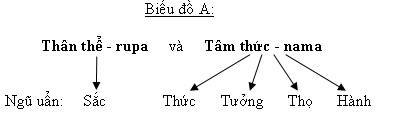
First, IDENTITY aggregates are all that constitute the entire body of the man from head to toe, inside and out in terms of material : arms, legs, skin, flesh, teeth, hair, bones, blood , water, air, energy ... etc. The aggregates are easy to understand so the article from here will focus on the other four aggregates - the four aggregates belonging to the spiritual sphere - MINDFUL.
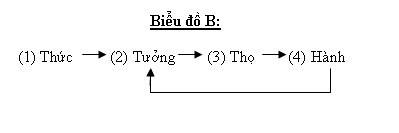
The Buddha stated that consciousness is the most important factor in every human being because it governs and dominates everything; and it is also very complex, immense, deep! Therefore, when teaching about the mind, he must present it so that it is specific, clear, easy to understand to fit the cognitive level of the majority of the audience at that time. That is why He analyzed the mind into fourAggregates for explanation. Four aggregates completely different, but interrelated extremely parcel to form a chain reaction (chain reaction): (1) Food -> (2) Ideas -> (3) Life - > (4) Onions . They will be interpreted in sequence from 1 to 4 as follows (this order shows which one happens first, which happens later in an extremely quick reaction sequence; the words in brackets are copper words. (meaning of Pali):
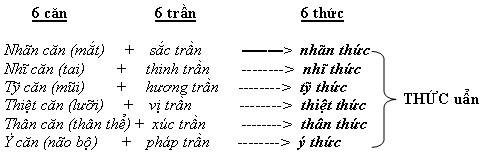
1 - PRACTICE (viňňāna): cognition / consciousness - is what the mind feel, perceive through the six official: manual mode (the knowing eye), consciousness (the knowledge of the ear), tongue-consciousness (the knowledge of the tongue), consciousness (knowledge of the nose), consciousness (knowledge of the body) and consciousness(the knowing of Italy). These six consciousness are the result of the contact between the six senses (the six senses) and the corresponding six ceilings (see the graph illustrated in the legend). (first)
Readers may disagree with the above explanation of the Aggregates, because many Buddhist textbooks have explained the Noble Aggregates in a much broader and broader way. awake ... etc). If so, please put this disagreement aside for now, and continue reading with an open mind, not obstinate. Of course, that difference cannot be ignored, so it will be discussed further in the commentary .
Let's take an example to illustrate (this is to make the presentation clearer, not to "prove"): Driving on the way home, we suddenly Remembering the incident today at work, I was scolded by the other person in my face, and I got angry again when I thought about that. In this example, the aggregates are the sounds and images that are appearing in our memories of being scolded at work, and they belong to consciousness .
2 - THOUGHT (saññā): perception - is the identification, evaluation, judgment of the mind (perception) of what has been perceived by MOST in step 1. The assessment is very diverse and plentiful. , but overall there are only three general categories: good, bad, and not good, not bad.
3 - THO (vedanā): sensation - is the feeling of the body that arises based on
according to the perception that happened in step 2. Therefore, they also include three general types: pleasant ( blissful) - if perception is good; unpleasant ( unpleasant feeling ) - if perception is bad ; and not uncomfortable not unpleasant ( equanimity ) - if perception is not good, not bad. Please note: Because THO is the feeling in the body so it involves both physical and psychological aspects (it must take the mind to "feel" okay!). It is the bridge connecting THAN and TAM.
A few examples of THO: hunger, thirst, drowsiness, itchiness, stuffiness, numbness, burning, burning, lightheadedness, relief ... etc. Don't misunderstand that THEM aggregates also include psychological feelings (anger, joy, misery, nostalgia, lust ... etc), because psychological feeling (emotion) belongs to the aggregates. This is a very important point!
Also use the example above: after the THOUGHTS (perception) that we were humiliated by the other person, offended at work, immediately suffering- unpleasant sensations in the body - immediately arise, for example: in an uneasy person, boiling in the gut ... etc. The writer confesses that this is a very difficult place to describe, because myself There are not enough words to use, and more often we do not pay much attention to the sensations of the body in everyday reality. One thing to note is: at this time, no psychological emotion has emerged.
4 - ONION (sankhāra): mental volition / reaction - are psychological or emotional phenomena that the mind arises based on the agitation of THO that happened in step 3. If excited by pleasure , the This psychological phenomenon will be craving - craving - for example, pride, gloating, yearning, lust, laziness, arrogance, greed ... etc. If agitated by suffering , they will be aversion, aversion (aversion) - for example, anger, sadness, bigotry, boredom, anxiety, jealousy, misery ... etc.
Please note: There are psychological phenomena that arise completely beyond the agitation of THO (whether bliss or dukkha are present), such as: calm, diligent, joyful, compassionate. ..vv Although not in the reaction chain (1) Consciousness -> (2) Thought -> (3) Life -> (4) Onions, these psychological phenomena also belong to the Aggregates . They are the beautiful qualities that each of us is trying to develop in our practice. Therefore, the aggregates take on a broader meaning than THAN, THOUGHTS or THO aggregates.
Returning to the example above, our anger while driving is ON, it arises because of agitation by the longevity (in irritability, intestinal boil ... etc) happened. out in step 3. Read up to here, you may have the question: How can we be assured that miseryThis must happen first and then anger, which cannot be the opposite or are both happening at the same time ? This is something we should not argue with, because only thinking and reasoning will never come to a satisfactory answer, like a group of blind people who argue about each other. color. Only realization can clear all doubts.
The four aggregates of consciousness, perception, feeling and action always operate in the order from 1 to 4 as above, but not in such a simple way! Their subtle correlation is more fully illustrated by the following chart (please understand this point very well):
Means: ONION, after it has arisen based on the indirect stimulation of Thought & Thought and the direct stimulation of THIRD, turning back to reinforce the Thought (perception). The stronger the IDEA, the stronger the THEM (the feeling of the body), and the more THE OF (psychological phenomenon) IS! ONions then keep coming back to reinforce THOUGHTS .... As such, they keep repeating, creating a cycle of self-consolidation, growth itself (self-feeding cycle).
Thus we have a general understanding of consciousness, perception, feeling and action; However, what was presented above, even though sounded reasonable, was still a mere theory. You readers are of course still skeptical or even dismissed (especially the THO and its third place in the chain). Therefore, the next thing is that each of us should personally verify this chain of reactions to see if this is true of reality; and that is very difficult to say, but it can be done, if there is a clear practice method (will be mentioned in the paragraph below)! The reason is very difficult because of the following two reasons:
1-Reaction sequence (1) MODE -> (2) THOUGHTS -> (3) THEM -> (4) ON happens very quickly, like an electric current or lightning. Therefore, for every event in our daily practice, most of us do not feel the activity of all these four aggregates and the order in which they operate. Normally, we only know the first (Conscious), the second (Tuong) and the fourth (Action), we don't know or pay attention to the third (Tho). Returning to the example above: when driving a car and suddenly recalling being scolded at work (the activity of WAKE-UP), we feel that "we have been insulted, insulted" (IDEAS) and angry again! (OF). In the process, we did not notice or did not know anything about feeling uncomfortableemerging in the body (THROAT). It is these miserable feelings that are the most direct stimulus to cause our anger.
2-Activities of THOUGHTS, LIFE and ADMINISTRATION always occur at 2 levels as follows:
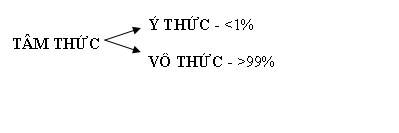
First, they occur in UNIQUE (2) , that is, not being perceived or perceived, which is beyond the control of our will. Then, when they had enough power through the cycle of repetition (see chart B) over and over again, they began to surface on the surface of the mind - the surface layer of the mind - called Italy. AWAKE , that is, at this stage they are truly perceived, perceived, and controlled by our will . (Please note: the word " ItalyTHE KNOWLEDGE ”here belongs to Western Psychology, which is roughly translated from the word" conscious mind ", so it has a different meaning from the word" consciousness "in the Aggregates in the previous paragraph.)
However, in terms of the consciousness of the majority of people, part SENSE just have not been accounted for a mere 1% ; all the rest, more than 99%, belongs to UNIQUE .
The writer does not expect readers to believe the data immediately, but also wishes that you do not dismiss it simply because it has not been verified. Here are a few examples to demonstrate the workings of the unconscious immense depths of every human being:
-About the body: breathing, heart rate, digestion of food, excretion, activity of all internal organs (liver, lungs, kidneys, intestines ... etc), the activity of billions of cells in the body ... etc.
-Consciousness: dreaming, remembering the past events clearly when hypnotized, sleeping very deeply but still feeling bitten by mosquitoes, knowing that drinking alcohol is harmful but an addict is still keep drinking, being lazy should not but continue to be lazy, knowing not to be angry but still angry, knowing not to be anxious but still anxious, still knowing that you should be less educated but still desires, desires ... etc
It is the UNIVERSAL treasure that contains what Buddha called "ignorance".(Pali: anusaya or anusaya-kilesa). And precisely because UNIVERSE controls over 99% of our entire being from body to mind, we have never been our true "masters" . So it would be foolish to think that we can cultivate milk, convert our xinxing from the top to the industry, if we are just struggling in the mind.AWAKE, the tiny, small 1% of consciousness!
Now, let's go into the most practical goal of the article: Understanding what consciousness, perception, feeling, and action are and how they work in relation to each other, how they help their practice. ta?
First of all, we realize that the aggregates (sankhāra) are exactly what we have to cultivate and purify on the way of practice, because they are the place where all the bad habits, afflictions and miseries arise. pain in us.
Like a physician, once we know where the boil is located, we must find the cause of it and stop the cause.
Based on the reaction chain: (1) Consciousness ---> (2) Thought ---> (3) Life ---> (4) Onions, we see that consciousness, perception and feeling are all causes for to ON, but THO is the most direct , so also the most important . Moreover, the LIFE ---> ON stage is the easiest stage we can stop, don't let disturbing mental states arise according to THIR agitation. Why is this stage the most easily prevented? Because we can't stop the MODE (unless we have to destroy all 6 senses !!!); how can we get rid of the thought (perception) when we are human and not inanimate ?! and we can not stop THO because it is forced to arise when there is the presence of perception, our human body is like that!
Therefore, we come to the conclusion that: The direction to practice is most effectivewe must do it so that the mind does not get excited by THO, that is, if there is pleasure, then do not indulge in it, if there is misery , don't be upset, miserable .... Of course, there must be a The method is so specific and clear so that we can practice like that. That method is Vipassana meditation (3) , taught by the Buddha himself. This is a Quan Yin Method of meditation, in which the object to be contemplated is THO - sensation in the body. This article does not discuss Vipassana in depth, but will outline the following two core points in practicing this method (if one of these two elements is lacking, it is definitely not Vipassana meditation):
1.GET UP:
Practitioners of Vipassana meditation must follow and observe the bodily sensations continuously and deeply with a mind full of awareness . Such observation must be cultivated and constantly developed not only in meditation but also in all daily activities of life. By maintaining constant awareness, the mind of the practitioner will become more and more sensitive, subtle and profound, making the UN Awareness less and less, and the CONSCIOUS consciousness growing more and more (according to ratio %). However, that is just the number, just half of the problem! If the practice only brings about a reduction in the unconscious and growth in consciousness, it is not the "eradication of MINH" as the Buddha advised. Here, he speaks of both aspects: quantity and quality. Therefore, while contemplating bodily sensations, one must use its sharp, sensitive mind to do one more thing. That is the second point below.
2.EASE:
Must try to maintain a calm and objective throughout the observation process. Thus, the practitioner will realize the NON-NATURAL nature of all sensations. They arise and will then vanish, no matter how intense or persistent, regardless of pleasure or discomfort! The more you experience this UNIVERSE, the more you realize how miserable it is (so that you can escape from suffering) and the more you can penetrate the absurd truth. Of course, in the process of transformation, the mind of the practitioner will become more and more free, peaceful and contempt. Idea should also add that: impermanence (anicca), suffering (dukkha), non-self(anattā) - the three Dharma seals of Buddha - are the truths that lead to liberation, but if we only know the thinking, reasoning and reasoning, then we will never realize what they are. . It is like a sick person will never be cured if he or she does not take a single pill but only takes care of the study, research, and explanation of the medicine scale. Roll up your sleeves and practice, ladies and gentlemen, because only practice will bring enlightenment and liberation. Do not let the knowledge of thinking (literary & intellectual) become an obstacle to yourself if it makes you satisfied and proud. Use it as a road map for us, as a motivation to keep us diligent in our practice!
The two factors awakening and tranquility above must be developed in parallel, cannot just focus on one and ignore the other if you want to go far on the path of liberation. Like the wings of a bird, both wings must be equally healthy for it to fly far.
May all of you build your wings like that, always nourishing it, and using it to fly far away, to overcome the afflictions of everyday life, and to fly forever to the ultimate destination of liberation. It is beyond all reasoning, thought, beyond the description of words, words, and beyond the small, narrow framework of the sensual world, which sentient beings, due to ignorance, are bound. , confining himself in it, and then rolling forever immersed in the flow of samsara, endless suffering and endless. END=NAM MO SHAKYAMUNI BUDDHA.( 3 TIMES ).WORLD VIETNAMESE BUDDHIST ORDER=GOLDEN AMITABHA MONASTERY=VIETNAMESE BUDDHIST NUN=THICH CHAN TANH.AUSTRALIA,SYDNEY.15/9/2019.


No comments:
Post a Comment