The main content of the first sermon: Zhuan Falun.
The Four Noble Truths is the experience of Enlightenment Buddha Shakyamuni in Bodh Gaya and is also the main content of the first sutras, entitled Dhamma Dhamma which He came to Sarnath, Isipatana, near Benares, to preach to the five fellow ascetic before. These were the five brothers, Kanda Tran Nhan, Kondana, Bhaddiya, Vappa, Mahanama, Asaji, and afterwards, all five were enlightened according to the teachings and became the first disciples of the Buddha.
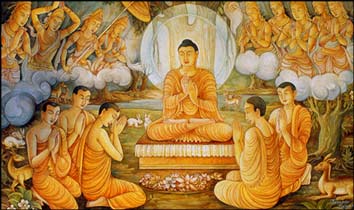
The Dhammacakkappavattana Sutta is called the Dhammacakkappavattana Sutta. This is a recapitulation of three words: Dhamma means French. Cakka has the following meanings: Circle, wheel, circular plate, circle, center of spiritual energy or physiological hidden in human body ... Pavattana is motion, rolling, spinning, rolling ... Sutta is business. On the grammatical phrase Dhammacakkappavattana, there are two letters p, but the phrase analysis: dhamma + cakka + pavattana, there is no letter P in front of the word pavattana. The problem of the grammatical structure of this sentence has not been clearly explained by the linguists, but the content of the prayer is not changed.
Business content:
The Buddha begins by advising the monks not to become entangled in two extremes: One is the pleasures of the pleasures of the world, for it is temporary, transient, mediocre, which prevents all spiritual progress. The second is ascetic pressure, it mental fatigue, confusion intellectual and He advised them to follow the middle way leading to a pure life, wisdom, wisdom, ultimate liberation. It is the 8th branch.
The Buddha is followed by the Four Noble Truths. The four truths speak about suffering, the truth about the cause of suffering, the cessation of suffering, and the path of cessation.
After hearing the second sutta of the Anttalakkhana Sutta, speaking of the doctrine of non-self means that there is no self and the five aggregates are impermanent. liberated, five former ascetic initiates with Lord Kodanna, Vappa, Bhaddhiya, Mahana and Assaji respectively attained Arahatship.
The original Pali text
Preamble :
Anuttaram abhisambodhim sambujjhitv and tathàgato. Pathamam yamadesesi, dhammacakkam anuttaram. Sammadeva pavattento loke appativattiyam.
Yathākkhàtà ubho antà, patipattica majjhimà. Catùsvàriàasaccesu, visuddham nànadassanam.
Desitam dhammaràjena. Sammàsambodhikittanam. Namena vissutam suttam.
Dhammacakkappavattanam. Veyyakakarapapththena, sangitantam bhanatase.
The Buddha was completely enlightened, he discovered the essence of truth to turn the Falun in this world through the talk about the two poles that should not be followed is the benefits and ascetic. Then he traces the path that is extremely practical, rational, and helpful, a path in the middle (Majjhima Patipada) capable of helping the mind and the wise, seeing the true nature of things.
This is the only path leading to complete purity and absolute liberation with the insight of understanding, with the pure and perfect insight of the Four Noble Truths that people need to apply in the spiritual life. .
Evam me sutam. Ekam samayam bhagavà bàrànasiyam viharati isipatane migadàye. Tatra Warehouse bhagavà pancavaggiye bhikkhù àmantesi. Dveme bhikkhave antà pabbajitena na sevitabhà. Katame dve? Yo plunge kàmesu kàmasukhallikà nuyogo hìno, gammo. Pothujjaniko, anariyo. Anatthasanhito. Yocayam attakilamathànuyogo dukkho. Anariyo. Anatthasanhito. Ete kho bhikkhave ubho ante anupagamma majjhimà patipatà. Tathagatena. Abhisamnuddhà cakkhukaranì nànakaranì upsam ya abhinnàya sambodhàya nibbànàya samvattati. Katamà casà bhikkhave majjhimà patipadà tathàgatena abhisambudhh cakkhukatanì nànakaranì upasamasasambodhayaa nibbàya samvattati. Ayameva ariyo atthangiko maggo. Seyyathidam? Sammāditthi, Sammàvàcà, Sammākammanto, Sama jjìvo, Samàváyamo, Sammàsati, Sammàsamàdhi.
Mr. Nan said. At that time I heard something like this: One day, when the Buddha dwells in the garden of the fortune, the land of Isipatana, near Benares, he taught five brothers Mr. Kieu Tran as he is living there as follows: Do you know, in human life has two measures that religious practitioners should avoid.
Five brothers Kieu Tran Nhu asked the Buddha. Which are two methods?
The Buddha replied: One is to make the mind centered on sensual pleasures. His dharma, unworthy of the saint's virtue. Futile. Second is the passion attached to the ascetic, not the quality of the holy. Futile. By renouncing these two dharmas, I have realized the "Path of the Majesty" (Majjhima Patipada), the path that gives rise to the cakkhu, the tranquility of wisdom (nana) , understanding of righteousness (abhinnaya), enlightenment (sambhodhaya), and nibbana (nibbana).
The Buddha asked the Five Brothers Mr. Kieu Tran As you know, the Middle Way that I have realized by arising through the cakkhu, , the understanding of righteousness (abhinnaya), enlightenment (sambhodhaya), and nirvana (nibbāna) is nothing? That is the Noble Eightfold Path, the path has eight branches.
Five brothers Kieu Tran Nhu asked the Buddha. What is the Noble Eightfold Path?
The Buddha's Way, which has 8 branches, includes: Sammāditthi, Sammāsankappo, Sammàkàcà, Sammākammanto, (Sama j ì ovo), Right Effort (Samàvàyamo), Right Mindfulness (Sammāsati), Pure Mindfulness (Sammāsamādhi).
The Buddha, the Noble Eightfold Path is the middle path, which I went and was enlightened, is the practice for achieving arisen consciousness, the understanding of the real generalization, intellectual peace , right understanding, the end of suffering.
Jaràpi dukkhà, maranampi dukkham,
Sankhittena pancuppàdanakkhandhà dukkhà.
Idam pana bhikkhave dukkhasamudayam ariyasaccam yayam tanhà ponobbhavikà nandiràgasahagatà.
Tatra tatràbhinandinì seyyathi damkatatanhà bhavatvà vibhavatan
Idam pana bhikkhave dukkhanirodhayam ariyasaccam yo tassayeva tanhàya asesaviràganirodho kawgopatinis saggo mutti anàlayo.
.
The Buddha speaks again with the five brothers Tran Nhu as: The teacher, birth is suffering, old is suffering, illness is suffering, death is suffering, memory, exasperated in the heart, not showing up, living with people I do not like suffering, away from loved ones is suffering, desire is not suffering ...
Clinging to the five aggregates is the Truth of Suffering and this is the Noble Truth of the Origin of Suffering.
The Buddha continued, "You know, rebirth in samsara is due to inner compassion. So what is that education?
The Buddha replied: Craving is the cause of rebirth and there are three types of craving:
Sexual world sex education (Kàmatanhà) is the heart desire craving, grasping this or that in life.
Enlightenment in the rupa (Bhavatanhà) is attached to existence.
Enlightenment in the formless world (Vibhavatanhà) is attached to the non-existence.
Thanks to the Noble Eightfold Path that leaves, the eradicating of Divine Being at its roots. This is also the Truthful Truth of Killing.
The Buddha said: Now, you know, the Noble Eightfold Path is the cessation of the Noble Truth, by righteous knowledge, righteous thoughts, righteous words, true righteous care, nourishing true righteousness, diligence Righteousness, righteous thoughts, right mindfulness.
The Buddha continued to explain clearly to the teachers to understand the truth of the following four: Suffering, Practice, Destruction, Dao and each is divided into three wheels. Three people turn four things into 12 things called 12 can. He uses a phrase, repeats, repeats many times in the three syllables of each, to emphasize things unprecedented, unheard of before.
1. Idam dukkham ariyasaccan ti me bhikkhave pubhe ananussutesu dhammesu cakkhum udapàpi, udangàdi, pannà udapàdi, vijjà udapàdi, àloko udapàdi.
2. There is a padidam dukkham ariyasaccam parinneyan ti me bhikkhave pubhe ananussutesu dhammesu cakkhum udapàpi, udana udapàdi, pannà udapàdi, vijjà udapàdi, àloko udapàdi.
3. There is a padidam dukkham ariyasaccam parinnatan ti me bhikkhave pubhe ananussutesu dhammesu cakkhum udapàpi, nanaam udapàdi, pannà udapàdi, vijjà udapàdi, àloko udapàdi.
The three wheels of Suffering
Birth is suffering, aging is suffering, illness is suffering, death is suffering, memory, exasperated in the heart, not showing up, living with the person is not love is suffering, away from loved ones is suffering, Desire is not suffering ... Clinging to the five aggregates is the source of suffering. This is suffering.
1. Things never seen, never heard before, now have been born, by the clear, know, not mistaken, no longer skeptical. This is true suffering.
2. When suffering is real, one should know that there is suffering.
3. The suffering that he saw clearly.
1. Idam dukkhasamudayam ariyasaccan ti me bhikkhave pubbe ananussutesu dhammesu cakkhum udapàdi, ian udapàdi, pannà udapàdi, vijjà upadàdi, àloko udapàdi.
2. There is a panidam dukkhasamudayam ariyasaccam pahātabban ti me bhikkhave pubbe ananussutesu dhammesu cakkhum udapàdi, uana udapàdi, pannà udapàdi, vijjà upadàdi, àloko udapàdi.
3. There is a panidam dukkhasamudayam ariyasaccam pahìnan ti me bhikkhave pubbe ananussutesu dhammesu cakkhum udapàdi, uana udapàdi, pannà udapàdi, vijjà upadàdi, uloko udapàdi.
The three cycles of the Noble Truth
Ai in the heart is a reincarnation in samsara and there are three types: sexual desire world sex (Kàmatanhà) is heart thirst quencher, cling to this or that in life. Enlightenment in the rupa (Bhavatanhà) is attached to existence. Enlightenment in the formless world (Vibhavatanhà) is attached to the non-existence. This is the cause of suffering.
1. Things never seen, never heard before, now have been born, by the clear, know, not mistaken, no longer skeptical. This is the cause of suffering.
2. When you know the cause of suffering, you should understand the face of the sex.
3. The desire that he has seen clearly.
1. Idam dukkhanirodham ariyasaccan ti me bhikkhave pubbe ananussutesu dhammesu cakkhum udapàdi, udana udapàdi, pannà udapàdi, vijjà upadàdi, àloko udapàdi.
2. There is a panidam dukkhanirodham ariyasaccam sacchikàtabhan ti me bhikkhave pubbe ananussutesu dhammesu cakkhum udapàdi, uana udapàdi, pannà udapàdi, vijjà upadàdi, àloko udapàdi.
3. There is a panidam dukkhanirodham ariyasaccam sacchikàtan ti me bhikkhave pubbe ananussutesu dhammesu cakkhum udapàdi, nanaam udapàdi, pannà udapàdi, vijjà upadàdi, àloko udapàdi.
Three Sutras of the Extermination
By virtue of the Noble Eightfold Path, all roots of craving are completely eradicated, suffering is eradicated. This is the Destruction of Suffering.
1. Things never seen, never heard before, now have been born, by the clear, know, not mistaken, no longer skeptical. This is the real Destruction.
2. When Killing is real, understand Killing.
3. That he had understood.
1. Idam dukkhanirodhagàminì patipadà ariyasaccan ti me bhikkhave pubbe ananussutesu dhammesu cakkhum udapàdi, ian udapàdi, pannà udapàdi, vijjà upadàdi, àloko udapàdi.
2. There is a panidam dukkhanirodhagàminì patipadà ariyasaccam bhàvetabban ti me bhikkhave pubbe ananussutesu dhammesu cakkhum udapàdi, nanaam udapàdi, pannà udapàdi, vijjà upadàdi, àloko udapàdi.
3. There is a panidam dukkhanirodhagàminì patipadà ariyasaccam bhàvitan ti me bhikkhave pubbe ananussutesu dhammesu cakkhum udapàdi, ian udapàdi, pannà udapàdi, vijjà upadàdi, àloko udapàdi.
Three Wheel of the Tao
The method of attaining the cessation of suffering is the path of extinguishing the suffering of the eight branches, namely the Noble Eightfold Path and includes: Right View, Right Thought, Right Speech, Right Action, Right Livelihood, Right Effort, Right Mindfulness, and Right Mindfulness. This is the Path.
1. Things never seen, never heard before, now have been born, by the clear, know, not mistaken, no longer skeptical. This is the true religion.
2. When the Tao is real, you should understand the Tao.
3. Dao that people understand, full already.
Suffering should, therefore, be understood in an indisputable way and it is necessary for the cessation of craving in order for Nirvana to be recognized. The path to cessation of suffering is properly developed. The Buddha did this, so he could boldly claim to be completely enlightened.
Yàvakivanca me bhikkhave imesucatùsu ariyasaccesu evam tiparivattam dvàdasàkàram yathàbhùtam nànadassanam na suvisuddham ahosi.
.
Yato ca kho me bhikkhave imesu catùsuariyaccsu tiparivattam dvàdasàkàram yathàbhùtam nànadassanam suvisuddham ahosi.
.
Nananca you me dassanam udapàdi acuppa me vimutti, ayamantimà jati natthi dàni punabbhavoti.
Idamavoca bhagavà attamanà panca vaggiaa bhikkhù bhagavato bhàsitam abhinandunti.
Imasmimca, veyyàkaranasmim bhannassa virajam vtamalam dhamma cakkhum udapadi, yamkinci samudayyadhammam sabbantamnirodhadhamman ti.
Pavattile ca bhagavatà dhammacakke bhummà deva sadamanussà vesum etam bhagavatà bhagavatà yrrrrrrrrrrrrr.
The Buddha said: When you have no understanding of the Four Noble Truths in three aspects and twelve ways, you must try to understand, to know, to see, to know and to understand. , know, see, comprehend this wall, is also not called himself the degree of complete results.
The Buddha said: All teachers, when attained to this complete result, then within the necessary beings, all things are impermanent, not self and not only stop here but also go further ...
The Buddha says: There is a great difference between the theoretical understanding and the actual practice. Understanding, Seeing as thoroughly as the original is the basis for the path of intellectual growth. It is to improve the knowledge and inner vision of each person to bring peace.
After the explanation, in the forests of Isipatanamigadayavana, near the city of Ba Ria. The Buddha said: This is my last life, no longer life in the birth. The brother of Mr. Kieu Tran Nhu expressed the joy of infinite.
His devotional scripture was praised by all the people and viewed as a transformational wheel that could not be changed to attain Nirvana.
Etam bhagavatà anataramam isipatanamigadaya anuttaram dhammacakkam pavattiyam appativattiyam samanena and bràhmanena and devena and thatrena and brahmunà andkate and lokasmin ti.
.
I am saddam sut and yamas dev saddamanussàvesum.
I am saddam saddam sut and tusidà dev saddamanussàvesum.
Tusita suam saddam sut and nimmawarea deva saddamanussàvesum.
Nimnànaratìnam devànam saddam sut and paranimmitavasavattì devà saddamanussàvesum.
Saddam sutva Devanam Paranimmitavasavattinam brahmakayika devasaddamanussavesum: Etam Bhagavata baranasiyam ispatane migadaye anuttaram dhammacakkam pavattitam appativattiyam samanena and brahmanena and devena and Marena vabrahmuna and kenaci and lokasmin ti.
Itiha tena khanenatena layenatena muhuttena yâva brahmalokà dasasahssì lokadhàtu sankampi sampakampi sampavedhi.
Appamàno ulàro obhà loke pāturahosi atikkamma devànam devànubhàvanti.
.
Iti hitam ıasmato kondannassa annàsi kondanna tveva nànam ahosìti.
Through the ardent blessings of the people, the kings of the four directions, teachers, sages, saints, scholars, Brahmins ... La mon ... Different fields, together to praise the same praise.
The chorus of succession, the more resounding, vibration, all the way. At that time, the Buddha said that: Kieu Tran As the great enlightenment, A Kieu Tran As the great enlightened. From here, you are called Kieu Tran Nhu..END=NAM MO SAKYAMUNI BUDDHA.( 3 TIMES ).VIETNAMESE TRANSLATE ENGLISH BY=THICH CHAN TANH.THE MIND OF ENLIGHTENMENT.VIETNAMESE BUDDHIST NUN=GOLDEN LOTUS MONASTERY=AUSTRALIA,SYDNEY.23/3/2018.

No comments:
Post a Comment