Gautama Buddha.

Who Was Buddha?
Buddha is purported to have been born in 563 BCE in the area of India now known as Nepal. Buddha is a title which means “The Awakened One” or the “Enlightened One.”
The actual name of Buddha is Siddhārtha Shakya, but he came to be known as Gautama Buddha (the Sanskrit form of his family name), Mahatma Buddha (Mahatma is a title for a good and wise person) or sometimes, Shakyamuni (a honorific meaning Sage of the Shakyans). He was born into a prominent family. His father was Śuddhodana, an elected chief of the Shakya clan. His mother’s name was Maya. From the time of his birth, Siddhārtha was seen as being destined to be a great king.
Buddha’s mother died within a few days of his birth, and he was raised by his mother’s younger sister. At the age of 16, his father arranged his marriage to a cousin who was his same age, Yaśodharā. They had a son named Rāhula.
The family was wealthy enough so that Siddhārtha’s father could provide for his son’s every need and want. Siddhārtha led a sheltered life never being allowed to leave the palace walls so that his father could shield him from knowledge of human suffering.
How Did Siddhārtha Become Buddha?
At the age of 29, Siddhārtha set out to discover the “real world.” For the first time, he encountered suffering, disease, and death. He rejected material wealth for the life of a mendicant living as an ascetic. He disdained worldly goods and at one point he took austerity so far that he nearly died of starvation.
He had studied with various teachers of enlightenment, but was always dissatisfied with their teachings and moved on to a new teacher. He eventually sought enlightenment on his own through meditation. He sat under a pipal tree—now known as the Bodhi tree—and vowed never to arise until he had found the truth.
At the age of 35, after six years of searching and five weeks meditating under the tree, he attained enlightenment. He came to an understanding of the “The Middle Way,” a path of moderation between the two extremes of self-indulgence and austerity. He now understood the cause of human suffering and how suffering could be ameliorated. He developed the “Dharma”—the universal doctrines for a good life, based upon the “Four Noble Truths” and the “Eightfold Path.”
Buddha feared others would not be able to properly practice this way of life since they were so immersed in ignorance, greed, and hatred. Nonetheless, he set out to become a teacher. For the remaining 45 years of his life, he traveled great distances across India with various disciples (Buddhist monks who were collectively known as the “sangha”) to teach others the Dharma—a kind of “cosmic law and order” which includes duties, rights, laws, conduct, virtues and ‘‘right way of living.’’ Eventually, Buddha decided to allow women to become nuns because he came to believe they were just as capable as men of understanding the Dharma.
Buddha returned home twice: once when his son was seven years old and again when his father was dying. Buddha taught the Dharma to his family and they became practitioners.
At the age of 80 he predicted his own death and declared himself ready for death.
Buddha in Meditation

Was the Dharma a New Concept?
Like all great teachers, Gautama Buddha built upon the philosophies and religions of the past, and created something new. Some ideas are discarded, some ideas are reinterpreted, and some ideas are added. The result is a new philosophy which catches hold because it is ideally suited for the times. New philosophies often emerge in times of social turmoil when people are seeking something new.
Buddha was born a Hindu, and his philosophy reflects Hindu teachings. There are also strains of Jainism, another ancient religion in India, in the teachings of Buddha.
Gautama Buddha was seen as one in a long series of Buddhas who emerge at intervals to teach the same doctrine. After the death of each Buddha, the teachings flourish for a while and then fade away. After it is forgotten, a new Buddha arises to revive the Dharma. (One text names 24 Buddhas before Gautama Buddha.)
What Are the Four Noble Truths?
The Four Noble Truths are:
1. Suffering
We must acknowledge the existence of suffering--the unavoidable suffering (pain, disease, aging, death) and the psychological suffering caused by emotions (anger, jealousy, fear, frustration, etc.) Simply put: Into each life a little rain will fall.
2. Cause of suffering
We must acknowledge that the cause of suffering is wanting—we want good things in our lives and we want bad things out of our lives. We must understand that loss and gain and comfort and discomfort come and go. Simply put: If you want what you have, you will have what you want.
3. Cessation of suffering
Suffering can be overcome by giving up useless craving and by living in the present. We can also overcome suffering by silencing the mind that seems to want to constantly focus on the negative emotions and thus remove these emotions as a source of suffering. Simply put: Let it go. Just be.
4. The path that leads to the cessation of suffering
The Eightfold Path provides moral guidelines for each area of life. Simply put: Do unto others as you would have them do unto you.
The Buddhist Dharma Wheel

What is the Eightfold Path?
The Eightfold Path divides life into three main areas—wisdom, conduct, and concentration. It then divides each of those three into two or three subgroups.
“Wisdom” includes “right view” and “right intention.” These mean seeing things correctly and acting with good intentions.
“Conduct" is concerned with your relationships with others. It includes “right speech”, “right action,” and “right intention.” These mean speak honestly, behave with compassion towards others, and earn your living in an ethical way.
“Concentration” is about mindfulness. It includes “right effort,” “right mindfulness,” and “right meditation.” These mean do everything to the best of your ability. Keep your attention on what you are doing. (No multi-tasking.) Use meditation to clear your mind to improve your focus.
For a complete description of the Eightfold path, please see The Buddhist Eight-Fold Path for Modern Times.
What are the Five Precepts?
The five precepts are the moral and ethical code of Buddhism. They are guides for training one’s behavior—not commandments. They are warnings to not act in a way that will cause regret.
1. Avoid killing or harming other beings. Respect the right of all living beings, both human and non-human, to live their lives.
2. Avoid taking things not given. It warns against stealing, of course, but also of taking things that have not been freely given to you or are not meant for you to take.
3. Avoid sensual misconduct. This applies to sexual misconduct, but also to any overindulgence (such as gluttony).
4. Refrain from false speech. This means no lying, no deceiving, and no slandering of others.
5. Abstain from intoxication. This precept exists because intoxication could cause you to break the other four precepts.
The Conception of Buddha

Are There Mythical Elements to the Story of Buddha?
There are some mythical elements to the story about Buddha. Despite Buddha’s non-theistic teachings, it seems people have a love for superstition and will attach mythical elements to any revered person. There seems to be a need for a Teacher-God, a super-human being to lend authority to the teachings devised by men.
A story is told that his mother had a dream that a white elephant descended from heaven and entered her womb. This signified that she had conceived a child who was a pure and powerful being. In one story, she gave birth painlessly, as the gods, Brahma and Indra, removed the child from her side and then honored the infant with ritual ablutions. In another story, the queen is traveling with her courtiers and stops in a grove where trees are blossoming. As she touches the blossoms, her son is born. The infant takes seven steps and says, “I alone am the World-Honored One” as two streams of water descend from the havens to bathe them.
Buddha was described as an exceptionally intelligent child, so intelligent that he learned all the arts and sciences (including learning to speak 64 languages) without studying. He was also described as supremely skilled at sports, martial arts, and archery.
At the age of 29, Buddha disobeys his father and escapes the palace walls by using his magical powers to put all the palace guards to sleep. He learns for the first time that there is sickness and death in the world, and he is struck by a need to leave the palace and find a way to end human suffering. There are gods who help him on his journey and demons—especially one called Mara-- who torment him and try to prevent him from attaining enlightenment.
There are also super-powers and miraculous deeds attributed to Buddha. It is said that when Buddha attained enlightenment, rays emanated from his body to the very edges of space. It was believed that anyone who reached a sufficiently high state of enlightenment would be super-human.
However, Buddha is reported to have disdained miracles. He wanted people to adopt his philosophy by using their reason and not because of miracles.
Is Buddha a Myth or Did He Actually Exist?
Most scholars think that Buddha was a real person. I like to think that the bio above accurately recounts his life. Although we have nothing in writing that dates to his lifetime, the accounts of his life and teaching were related in epic poems, memorized by his followers, and passed down orally. There is not much variation in the factual accounts of Buddha's life--this unanimity suggests that the accounts are true. Moreover, there are a couple of mentions of Buddha in some documents going back to the third century BCE.
The Pali Canon is the earliest known written Buddhist text. It dates to 29 BCE, putting to paper the oral tradition that had been passed down for centuries.
What did Buddha Believe?
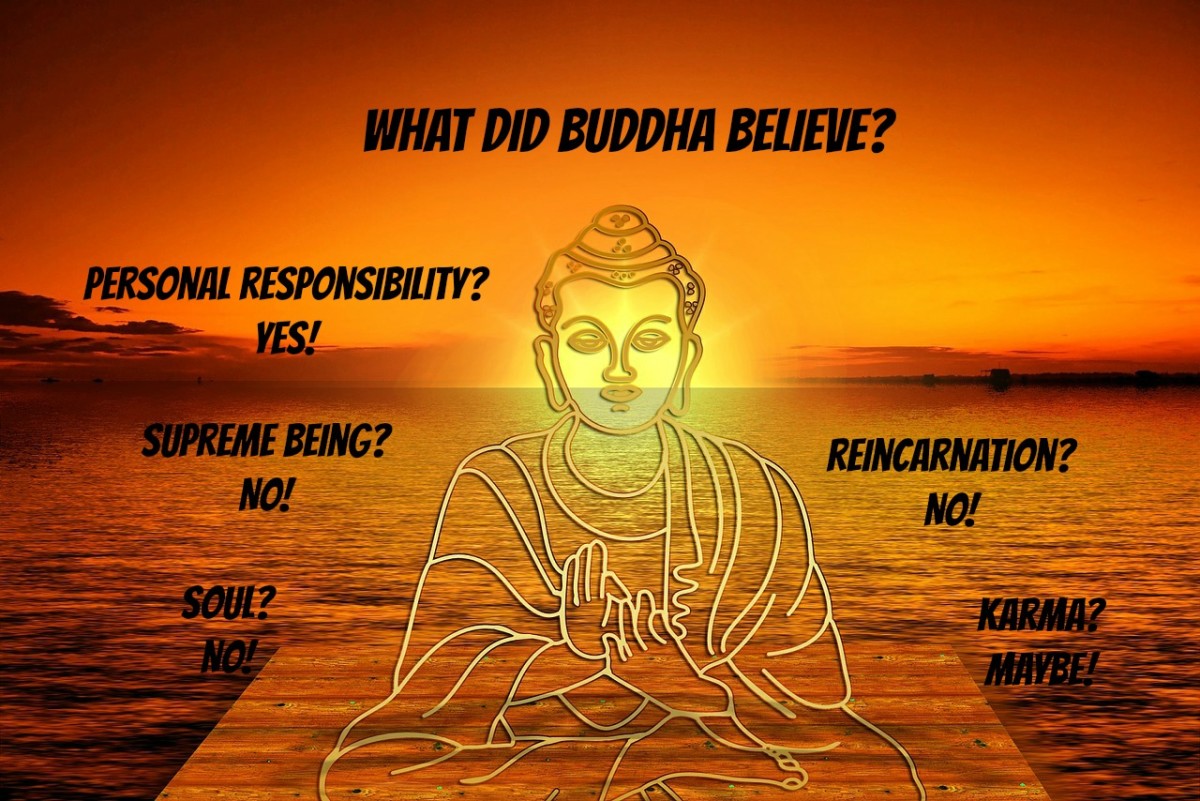
Is There a Supreme Being in Buddhism?
Despite the mythological elements added to the life story of Buddha, he did not teach the existence of a Supreme Being. He never declared himself to be a god, or a representative of a god, or as someone who could perform miracles. He was simply a human being teaching other human beings how to minimize suffering in their earthly lives.
Buddhism emphasizes the way of inquiry—using your intellect and reason to investigate claims. Buddha warned against forming beliefs based on tradition or because others say so (even if they are people in authority like your elders, your teachers, or your priests.) He urged people not to accept something because it is written in a Holy Book or because it is purported to come from a Supreme Being.
Buddhists believe that our universe is but one universe in a constant cycle of universes. When one ends, a new one simply begins. One cycle takes about 37 million years. A Creator God is not needed.
Our purpose in life does not come from outside of ourselves. Our purpose is to live our lives as well as we can while minimizing our suffering and maximizing our happiness by following the Eightfold Path.
Did Buddha Believe in a Soul?
There is no soul as we understand the term today. Buddhism understands the soul to be consciousness. It is not a permanent thing that can exist outside of the body—it is a manifestation of the thoughts and actions of a being and it ceases to exist when the being dies.
Although Buddha didn’t have the word “ego,” the sense of self that we call ego might be akin to a soul. The ego is the source of all human suffering because it is the ego that leads to the desire to control and acquire. It seeks gratification and feels disappointment. Buddhism wants to eradicate the “me-ness” of people through meditation so we can experience the peace of “one-ness.”
Did Buddha Believe in Karma and Reincarnation?
The law of karma says that actions have consequences. It we do bad (unwholesome) things, we will suffer. If we do good (wholesome) things, we will be happy. If we suffer a misfortune, we should look to our past actions for the cause.
Karma is an affirmation of the need to take personal responsibility for your life. It is a “reap-as-you-sow” philosophy. Simply put: "You get what you give," or "What goes around comes around."
Karma is also tied into the concept of reincarnation—the belief that a person is born many times until he reaches perfect enlightenment and the cycle ends. Reincarnation is incompatible with the teachings of Buddha which stressed a focus on the here-and-now and "anatta," the loss of the concept of self-hood.
I think reincarnation might have been incorporated into Buddhism after the time of Gautama Buddha. There are no references to it in his teachings.
Was Buddha an Atheist?

Buddha could be called an atheist in that he did not believe in any deities or in a soul that survives death.END=NAM MO SAKYAMUNI BUDDHA.( 3 TIMES ).VIETNAMESE BUDDHIST NUN=THICH CHAN TANH.THE MIND OF ENLIGHTENMENT.GOLDEN LOTUS MONASTERY=AUSTRALIA,SYDNEY.27/5/2018.

No comments:
Post a Comment