History of the Inheritance Lineage of Theravada Buddhism.VIETNAMESE TRANSLATE ENGLISH BY=THICH CHAN TANH.AUSTRALIA,SYDNEY.


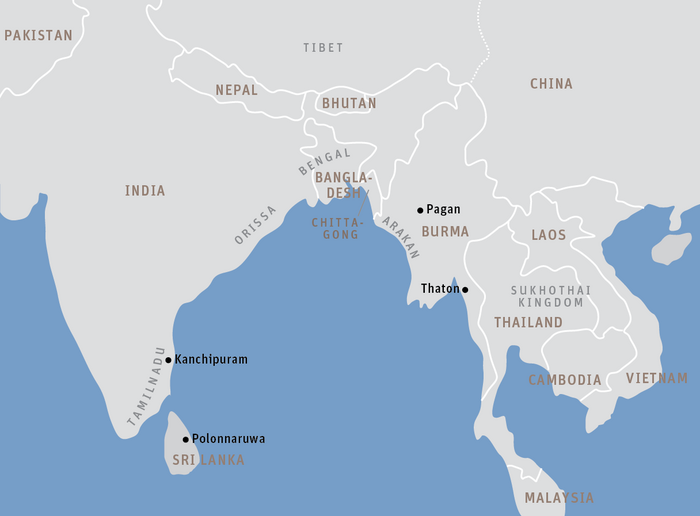
Buddhism was first introduced to Sri Lanka (Sri Lanka) in 249 BC, through Mahinda's mission - the son of the Indian Emperor, Ashoka (Ashoka). The first Sri Lankan monk was ordained at that time. Although time called Theravada Buddhist ( Theravada ) is started using is still in dispute, for convenience, we will use the word "Theravada" to refer to this lineage . Later, the Bhikshuni lineage was transmitted to Sri Lanka in 240 BC, during the visit of the daughter of Ashoka, Sanghamitta, to the island nation. By 1050 AD, this monastic lineage ended because of the invasion of Tamils, and then the domination of the Chola Empire in Sri Lanka.
According to the oral tradition, Ashoka sent two envoys, Sona and Uttara, to the Suwannaphum kingdom (Sanskrit: Suvarnabhumi ), and they established Theravada Buddhism and the monastic lineage there. Most scholars identify this kingdom with Mon (Tailang) and Thaton's port city in Southern Burma (Burma). However, it is unclear whether the lineage of the monks and nuns has been introduced at this time or later.
Although already present in many Pyu cities in Northern Burma at least since the first century AD, Theravada Buddhism mixed with Mahayana Buddhism, Hinduism (Hinduism), and Local religion Ari, a religion that uses sacrifices. In the middle of the 11th century AD, King Anawrahta united North Burma, conquering the Mon kingdom in Thaton, establishing the capital in Pagan, inviting the monk Mon, Arahanta, to establish Theravada Buddhism and lineage. monastic ordination everywhere in your kingdom.
Along with the defeat of the Sri Lankan Chola in 1070 AD and the newly established capital in Polonnaruwa, the original lineage of Buddhist monks was reestablished in Sri Lanka, due to their merits. The monks are invited from Pagan. However, King Anawrahta doubted the purity of Mon monks and nuns, so he did not send a monk to re-establish the monastic lineage. Therefore, the Theravada Buddhist monk lineage was not restored in Sri Lanka at the time. The last relic of inscriptions about a Bhikshuni monastic congregation was in 1287 AD, when Pagan was invaded by Mongol (Mongol).
King Magha of Kalinga (now Orissa, East India) dominated Sri Lanka most of the time when the country was invaded from 1215 to 1236 AD. During this period, the Sri Lankan monk Sangha was severely weakened. In 1236 AD, when King Magha fell, the original Buddhist monks from Kanchipuram, a weakened Buddhist center of the Chola Kingdom, now Tamilnadu, South India, were invited to Tich. Lan to restore the monks' lineage. The absence of any Tamil Bhikkhu has been shown that the Theravada Buddhist monks were no longer present in South India at that time. The last relic of the inscription remains about a congregation of monks in North India, including Bengal, since the end of the 12th century AD.
In Thailand, King Ramkhamhaeng of Sukhothai Kingdom established Theravada Buddhism from Sri Lanka at the end of the 13th century AD. Since the monks and nuns were no longer present in Sri Lanka at the time, the Theravada Buddhist monks and nuns were unable to enter Thailand. Only the lineage of monks has been transmitted to Thailand. Because Theravada Buddhism was established in Cambodia (Cambodia) originating from Thailand in the early 14th century AD, and soon after it was established in Laos, originated from Cao Mien, the lineage of the monks. Bhikshuni has never entered these countries.
In countries following the Theravada tradition, only Sri Lanka officially re-established the Theravada Buddhist monk lineage in 1998. Previously, women in Sri Lanka were only allowed to become dasasil matas , "ten-year practitioners," not monks and nuns. Even though these lay Buddhist women cover medicine and live alone, they are not considered members of the nunnery in the monastery. In Burma and Cambodia, women are only allowed to be "practitioners of eight precepts," in Burma called silashin and in Chaoyo called donchi or yieychi . Some women in Burma also receive ten precepts. In Thailand, they can become "practitioners of the eight precepts," called maechi ( maeji). In 1864 AD, Theravada Buddhism in Chittagong District and Chittagong Hill Areas of Bangladesh revived from the Arakan district of coastal Burma, so women there became practitioners of eight precepts. END=NAM MO SAKYAMUNI BUDDHA.( 3 TIMES ).VIETNAMESE BUDDHIST NUN=THICH CHAN TANH.GOLDEN AMITABHA MONASTERY=AUSTRALIA,SYDNEY.28/2/2019.

No comments:
Post a Comment