Ashoka - a Buddhist king.VIETNAMESE TRANSLATE ENGLISH BY=THICH CHAN TANH.AUSTRALIA,SYDNEY.


Emperor A-sex ruled India in the third century BC and was also one of the most brilliant figures in Buddhist history. The most famous emperor of the Maurya dynasty, he unified the whole Indian continent.
Under his reign, culture was highly developed and also for the first time in the history of India, the richly written data recorded in writing remains to this day. The most typical and characteristic art for Indian culture in general has also arisen during this period.
As for Buddhism, Emperor Ashoka was the most famous Buddhist, and he took refuge after conquering Kalinga territory with horrifying battles. He was very enthusiastic in spreading the Dharma and spreading Buddhism farther out of the Ganges valley, beyond the Indian border, especially in the northwest, ie, the Near East, the Middle East and the border. European circles.
Resources
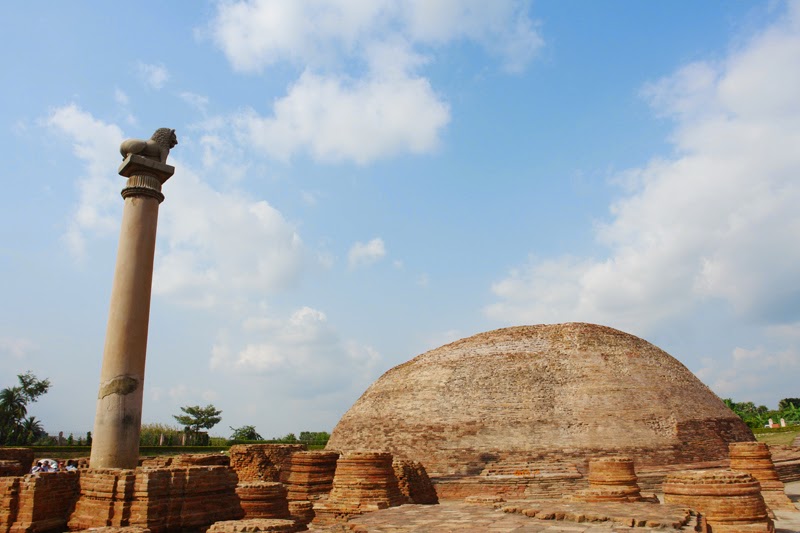
The Ashoka Dynasty is one of the rare dynasties in ancient history of India that has saved both accurate and rich data. However, it was not until 1837 that Western and Indian historians and scholars began to understand this historical period, thanks to the curiosity of a very simple administrative official of the city. Calcutta is James Princep. He was the first to try to interpret the inscriptions written on two stone pillars, one in Delhi and the other in Allahabad in northern India in Uttar Pradesh state. On these two pillars he read the name of a king, Devanampiya. When looking up the data, James Princep saw in Sri Lanka there was a king named Devanampiya Tissa.
It was not until 1915, an English mining engineer named C. Beadon found in Maski in southern India a different stone pillar with inscription. On this stone pillar, the name of a king belonging to the Maurya dynasty is read, Devanampiya Piyadasi, the title is Azoka (A-sex). Since then it has been known that the name of King Devanampiya inscribed on the previously discovered stone pillars and the king carrying the A-sex title is only one person. In fact, the A-sex emperor had many different names, among them the name Devanampiya coincided with the name of a Sri Lankan king and thus confounded the administrative official James Princep. From these discoveries, historians gradually discover the history of one of India's oldest and most brilliant dynasties.
The material in Western languages about King Ashoka is very rich, this short article has no ambition to summarize the work of historians, scholars and archaeologists but only want raise a historical event, a typical case of the relationship between politics and Buddhism for reflection and discussion.
The most reliable sources of help for scholars and historians to study and learn about the Aoka Emperor were written records at that time. These documents are of two types: the first is the official documents of the court inscribed in stone and the second is the documents and cultural monuments that are not administrative.
a) Stone inscription documents
The types of documents inscribed on the stone face also include two types: the first type is the edict which is engraved solemnly on the stone pillars or on the cliffs, the second type includes all kinds of documents, in addition to the just the instance of the court.
The edict is the documents published by the court or the proclamations of the A-sex emperor given to the entire people. The content of the edicts is very transparent and detailed, demonstrating that the A-sex emperor was a very careful person, explaining his political orientation so thoroughly for the people to know. The examples are inscribed with the local languages of the time, brahmi and karosti, including Greek and aramene, a very old language of the Middle East and Africa.
In addition to the above examples, there are also many non-administrative documents, which are royal and official records of merit, such as offerings, pilgrimages, holidays great, formal meetings and communication between the court and Buddhist Sangha ...
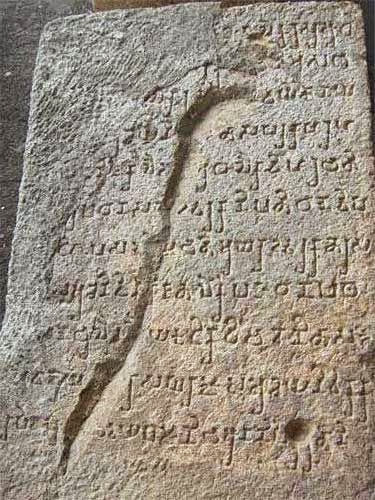
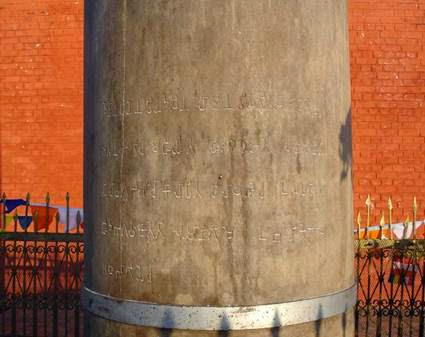
Asoka's edict in Greece
b) Cultural resources
There are many stories and traditions in folklore that contain the moral character and teachings called avadana that are carefully recorded and retained to this day. Usually the main characters in these stories are saints, exemplary masters ... However, there are many stories where active characters are A-king emperors, his actions are modeled. described in stories with the intention to set an example for kings of contemporary kingdoms, these types of things are collectively referred to as asokavadana.
Chinese masters such as Phap Hien (early V century), Huyen Trang (7th century), when going to India to study, also told stories about the A-king emperor in their diaries. However, the stories told by them as well as other documents about the A-sex emperor recorded after many hundred years, do not have much historical value because they contain too many conflicting events, The reason is easy to understand because most are based on legend and not historical studies.
Some texts (Tanjur) of Tibetan Buddhism and the books of the famous Tibetan Buddhist historian, Jetsun Taranatha (XVII century), also mention the A-sex emperor. In addition, the archives of Khotan have a number of valuable documents. However, it is in the giant scriptures of Sri Lankan Buddhism that many of the richest and more detailed materials and data have been found, and it is understandable because the Asojus emperor is a person. spread Buddhism into this land. In addition to written materials, the research department of the Maurya Empire's ancient coins also brought many valuable facts, because under the reign of the A-sex emperor not only Buddhism and culture developed. The economy is also very prosperous, and the currency issued by the Maurya Empire is widely used and popular.
India and the Maurya Empire before the A-dynasty
Throughout the history of Buddhism development in India, Ma-master-da territory (Magadha) has occupied an important position. From the time of the Buddha's existence, this territory was once a large, powerful kingdom, now in the state of Bihar, a very poor state. The capital of the kingdom of Ma-masterpiece-da is the Royal Palace (Rajagriha), but later moved to Hoa Thi Thanh (Pataliputra), the name today is Patna. Archaeological excavations in 1912 in Hoa Thi Thanh discovered many relics of a huge real mansion, perhaps the palace of the Maurya Empire.
The kingdom of Ma-da-da was placed under the rule of the Nan-da (Nanda) dynasty before the army of Alexandre the Great of the Macédoine empire today was Greece, taking over Indian territories into the year -327 to -326. There is an anonymous person, but many «chalice», whose origins and origins are not clearly recorded, stand up and exhort against foreign invaders, some documents indicate that this person belongs to a class low in society, others are considered to be children of a prince in the Nan-da family, for the part of Buddhist legends, this person is descended from a genus of Shakya family. left Ca-tì-la-guard (Kapilavastu) when this city was devastated by the king of Kieu -át-la (Kosala). People who have many «breeze» just said that before the invasion, initiated by Alexandre Dai Emperor, the country must be united. but he could not persuade the royal court of Nan-da to flee to northwestern India. Here he founded an army and, thanks to a famous strategist at the time, helped live in Taxila, the territory of Alexandre the Great, a place just a few days from Islamabad, the capital of Pakistan. now several kilometers. He pulled the army to recapture many parts of India but was seized by Alexandre the Great and later took over the kingdom of Ma-master-da to overthrow the imperial court of Nan-da in -313. This hero named Candragupta Maurya, he was crowned and founded the Maurya dynasty. a place just a few kilometers from Islamabad, the capital of Pakistan. He pulled the army to recapture many parts of India but was seized by Alexandre the Great and later took over the kingdom of Ma-master-da to overthrow the imperial court of Nan-da in -313. This hero named Candragupta Maurya, he was crowned and founded the Maurya dynasty. a place just a few kilometers from Islamabad, the capital of Pakistan. He pulled the army to recapture many parts of India but was seized by Alexandre the Great and later took over the kingdom of Ma-master-da to overthrow the imperial court of Nan-da in -313. This hero named Candragupta Maurya, he was crowned and founded the Maurya dynasty.
During the 25 years of reign, Emperor Candragupta Maurya summarized most of northern India to expand the realm. Diplomatically, he deals with European countries in the Mediterranean region, especially signing peace with the emperor Seulokos who succeeded Alexandre the Great. The envoy of Seleukos emperor Megasthenes was sent to Hoa Thi Thanh, who was a scholar and writer, and took the opportunity to work on a set of books called Indus, including four studies of culture and calendar. history, geography, plants and animal varieties of India, this volume is a precious document that contributes to understanding the Maurya Empire at that time. The Emperor Candragupta, when he was old and before his death, followed the religion of Jaïn, a very old tradition before Buddhism, Buddhism and austerity, and strictly forbidden to kill.
Candragupta's son took the throne as Bindusara. Very little is found about this successor emperor, only to know that he is a very devout Hindu, and in terms of rule, he can eradicate a few rebellions. He ruled the Maurya Empire for about 25 years. Ashoka is the second son of this emperor, so on the principle of not being the next prince.
Youth of A-sex emperor
The stone pillars and steles do not see any record of the young age of the A-sex emperor, the rare material outside of Buddhism related to his pedigree also has many inaccuracies and inconsistencies. Scholars must rely on Buddhist scriptures to learn about the young age of Aoka.
The teenage boy's teenage age did not seem happy because he was hated by his father, and according to some scriptures the reason was because he had an ugly appearance. However, there was an ascetic monk named Ajivika who predicted and let his mother know that his future would be brighter. Some materials also indicate that this ascetic sect of the monk had much influence on A-sex when he was young.
According to scholars, the A-sex king appeared very late, rarely seen inscribed on stone pillars and stone faces. Usually in the examples and texts people only see the inscription of his name «Devanampya», which means «The beloved of the gods». Buddhist scriptures often refer to his name as «Dhammasoka» (Dhamma is Dharma, Dhammasoka means Aya of the Dharma or A-moral virtue), or sometimes write his name Piyadassi. One finds a cliff with an insignificant example but has recorded his full name as follows: Devanampiyasa Pidayasino Asokaraja, and in another instance it is called Raja magadhe which means King of the land. Ma-master-momentum.
There are many records of the history and biography of the A-sex emperor, of which there is a more reliable inscription indicating that he was born in -299 in Huaihua, a different mother from the prince. will inherit the father's father Susima (or Sumana). Ashoka had a half-sister, but the names of the notes were not the same.
In Adolescence, it seemed that Ashoka stayed for a while in Taxila, but it was unclear why he came here. He may have come here to suppress the rebellion, or he may have been sent by his father as a viceroy to rule the region, after all, there is no record. Apparently he was also a viceroy in Aventi, a western region of India.
If his presence in places like Taxila and Aventi is not confirmed with certainty, on the contrary all documents have a record of the fact that he served as viceroy for ten years in Ujjain, a place of residence. Central India, today has become one of seven holy cities. He took office as viceroy Ujjain in -280. According to the Buddha-da Co-da (Buddhaghosa, the 5th century), a great monk of the Theravada sect, it was A-sex who brought the conquest of this place, but according to the Pali scriptures, his father was Bindusara. sent him here to take office.
In Ujjain, Ashoka married a wife named Vedisa-devi, the daughter of an entrepreneur who was president of the merchant association. The wedding is organized according to the «traditional rituals», which means to be formal. When I went to Ujjain Aoka, I stayed for a while in the mansion of this wealthy businessman. Vedisa-devi gave birth to two children, one boy and one girl. These two children were later ordained and sent to Tich Lan to propagate Dharma and spread Indian culture.
However, some Western historians who have studied the previous Emperor Ashoka considered the marriage unofficial, so the two children are not considered orthodox. The reason for this misunderstanding is because recent historians brought a false prejudice that they did not believe in sources of origin that originated in the Sri Lankan scriptures and at the same time speculated according to the Western conception of events A- sex left Ujjain to bring two children back to the capital of Hoa Thi Thanh, but left his wife Vedisa-devi behind. The ancient Indian society divided the marriage into ten different ranks, all of which were officially married without the consent of the two families and called this case "gandharva". The wedding of A-sex is taken out by the parents of the wife's house in accordance with the traditional ceremony, In addition, it is worth mentioning that in Indian society at that time there was no concept of formal or informal children. In short, when the Emperor of Ashoka accompanied his two elders in the Dharma mission in Sri Lanka, this proved his intention and determination. The two children were born in Ujjain before he was crowned, but that still increased the significance and importance of the mission.
In addition to the fact that Aoka married in Ujjain, there were no other recorded material during the ten years of being a viceroy and ruling here, so no one knew clearly about the actions of he has just mentioned.
Hold the opportunity and inherit the father's father
Documentation of the events that occurred during this period was richly recorded by the Sri Lankan scriptures, with full details and very reliable, compared to what was found in the materials found in the north. Indian continent.
According to the custom of the time, the king had many wives, some documents said that Bindusara's father of Ashoka had 101 sons. A-sex is not an inheritance nor is the eldest, meaning that the successor prince is not A-sex. However, it is quite possible that the experience of ten years as a viceroy who ruled Ujjain and the victories he gained in conquests and rebellion ensued, especially in Taxila, made the court and the people they pay more attention to him than the other princes.
When his father died, A-sex was backed by the gods and took the throne. He killed all or at least most of his brothers, except for his brother and mother. According to some documents, it looks like A-sex took the throne when it was announced that his father was seriously ill and had not yet appointed his successor prince.
The materials in northern India tell the story of inheritance that blends some magical and mythical events. Those documents affirmed that Aoka's mother was the official queen, but before she was recruited into the palace and bestowed by the queen, King Bindusara also had a son with another woman, who was This one is called Susima and has been chosen as the successor prince. Right from the time of Susima, he was disliked by the court's prime minister, because he had a mess and slapped him. When he was an adult, he was sent to a rebellion in Taxila and while he was in Taxila, his father Bindusara fell ill, he sent Susima to the court and sent Aoka to replace him. The prime minister feared later that when Susima came to the throne, he would eliminate himself and plotted with some of his deputies to the king that A-sexual was ill and could not be replaced. Then this group of people dressed up for Aoka and brought it to appear to their father, they asked Bindusara to grant A-sex to be the emperor before Susima returned to the capital. Emperor Bindusara was enraged, and Ashoka pleaded with the gods to help him, and soon his father Bindusara took blood and died. Susima often believed in the imperial capital and fell into the trap of the minister and other officials in the court. The above is a story summarized from Indian materials, Western scholars and historians do not believe in such a fanciful mix of legendary personalities. For the events related to the ascension of A-sex, scholars believe in the Sri Lankan scriptures more,
No matter how true the event of Aoka takes place, inheritance is not an easy thing. Self-defeating the emperor is one thing, but reassuring the people, controlling the mandarins and eliminating every conspiracy to power to rule an immense empire is another matter. Certainly Aoka must confront his brothers and his ministers. Some of the recorded material is that Asooka kills all his half-brothers and his ministers, however, according to Western scholars, that fratricidal war has much exaggerated personality. rather than the fact, the goal of exaggerating Aoka's violence is to prove his nickname is Chandasoka: the Asoka Cruel. According to Western scholars, this name may well have been set in the purpose of contrasting with another of his nicknames, Dharmasoka:
Take the throne and rule the country
About four years after seizing power and consolidating the power of iron and blood, A-sex held a feast of rituals perhaps according to rituals and Ba-la-Mon customs. However, there are some documents that suggest that the Maurya empire has its own set of ritual ceremonies, in which the presence of Brahmin is present and the representation of all Three major class members in society.
The registration ceremony was held in the year -267 before the Western calendar, when A-sex was about 35 years old. This event holds an extremely important position for Buddhist history, since the official Buddhist date is based on the above timeline as a benchmark. In a book of 675 pages of Aoka biography of the famous Sri Lankan Buddhist scholar Ananda Guruge, it is -265 before the Western calendar, not in -267.
After being officially enthroned, he gave the younger brother and mother the viceroy and placed the son of his former prime minister in the position of prime minister. Although all the documents recognize that Ashoka used cruel means to seize government, these events did not appear to be recorded on stone faces or stone pillars with those the section where A-sex Emperor formally expressed regret and regret for his actions in the past, the inscription only mentioned violence in the wars but did not mention his behavior. when appropriating power. Most historians, however, want to keep their impartiality ahead of history, so most have accepted that the seizure of power is rarely avoided from violence.
In the first years of the dynasty, it seemed that the Asojus emperor also expanded the territory, merged some new territories, and according to traditional traditions, he also announced the freedom of belief for Brahmin people and other sects. Particularly, the Sri Lankan material revolves around understanding the causes that prompted the Asoka emperor to follow with Buddhism and conclude that it is a personal determination and that the Emperor of Ashoka Think carefully from before. Also according to these documents, he had long been interested in religious matters and thoroughly studied all beliefs at that time.
Buddhist refuge and Kalinga war
Almost all of the histories noted that the A-sex Emperor's Buddhist choice was more personal, for himself and for his own ideals. However, after the throne, he began to become more aware of the duty of a Buddhist in propagating the Dharma. However, the data did not fully agree on the motives that motivated A-sex's Buddhist choice. Some legends such as in the Divyavadana, or according to the narrative in the memoir of Xuanzang, the Buddhist refuge of the Emperor A-sex is miraculous and mysterious. However, most other data agree that the violence in the bloody war in Kalinga is the most important and direct motive that has motivated the A-emperor to become a Buddhist.
«Eight years after the throne, the king's friend Priyadarsin conquered Kalinga territory. One hundred and fifty thousand people were exiled; one hundred thousand people were killed in battles; some others many times larger than that number were killed. After Kalinga was captured, now is the time to enthusiastically apply the Dharma Realm, to respect the Dharma Realm, to follow the precepts written in the Dharma Realm applied throughout the territory of the heavenly friends. Regret does not spare the friends of the gods after conquering Kalinga. Indeed, conquering an independent country is a murderous act, causing many deaths and exile for many people: those thoughts are so intense and tormenting friends of the gods ... »(Translated according to scholar Jules Bloch)
Therefore it is thought that the act of Buddhist refuge of the emperor is the result of a long process of thought and regret. According to the contents of Pali texts and edicts, the determination of the A-sex emperor may have come directly from his nature and character and from the trends already available in him. After seizing power by force, he immediately selected the gods based on their morality, interacting with the sages who could be called saints at that time. He learned about Buddhism when he accidentally met a sa-di (samanera) named Nigrodha around -262. Most likely, he was stunned when he first saw another humble and composed expression from the face and gesture of a young sa-di. After contacting him, he was even more respectful of his exemplary actions and pure attitude,
Immediately after the enthronement ceremony, the Ashoka emperor began to study and understand all the great beliefs of the time, and at the same time he contacted Buddhist practitioners, among them Nigrodha monk whom he met before. After taking the throne for four years, he took refuge. However at first he was only interested in giving, building temples and providing the necessary needs for the Sangha and then invited the monk Nigrodha to be his advisor.
From the seventh year of the reign (according to Ananda Guruge scholar, year 259), he began to be more active and enthusiastic, especially since his two children were Mahinda and Sanghamitta renunciation. These are his two children with his "official" wife, Vedisa-devi, married according to traditional custom when he was a viceroy in Ujjain. The two older monks made him feel closer to the Sangha, and perhaps also the motive for him to be more active in protecting and developing Buddhism. He started to study hard scriptures, learn and comprehend very quickly the Buddhist teachings. He also selected and gave some scriptures as the standard for learning for monks.
In the ninth year of the dynasty, around -257, the conquest of Kalinga occurred. Although he was an imbued Buddhist and non-violent advocate, he still accepted to start the war because it was unavoidable, according to the inscriptions of stone carving. After all, the aftermath of conquering Kalinga affected all his strength and shocked his conscience.
In the eleventh year of the dynasty, the first time he made a pilgrimage to the Bodhi kingdom where the Buddha became enlightened. One finds a small, unimportant example that is clearly recorded by the A-sex emperor as a "Buddhist" and also a "teacher who teaches true acts". However, there are no examples that formally raise the motive that motivated A-sex to become a Buddhist. The Sri Lankan Pali texts do not mention the Kalinga war, but only mention other conflicts, but these conflicts are not recorded in the examples. Anyway, the refuge of the Emperor A-sex is an undeniable fact.
According to the French scholar Robert Lingat in his famous work of studying Buddhist monarchs in the world, even using the nouns that some scholars have used, in itself has been abusive or excessive, ie «going too far» and unsuitable to refer to the case of the A-sex emperor following with Buddhism, because at that time «Buddhism» was still «primitive» , there are no colorful forms of religious rituals like today. The Sangha is only a group of monks who live on alms and are quite isolated from the world. As for the "secular followers of Buddhism", they are lay people (upasak) and nothing different from other people in society. They are only obliged to respect, help and provide the minimum needs for monks.
The Ashoka Emperor was just a Buddhist, a layman like the others, without any bondage that required him to exercise more than others to match his authority. Regretful because of his Kalinga battle, his reverence for the Sangha and his devotion is definitely his own, rooted in his heart, it can be said that he was born with a seed already available in heart to direct him to the path of Dharma.
Dharma and management of the country
In the examples of inscriptions on stone pillars, people often see the words of Dharma or Dharma, which the former Western scholars used to translate as Law, such as the case of scholars. Jules Bloch translated an example of the regret of the Ashoka emperor that a passage was quoted in the above presentation. When translating into Vietnamese, the word "Law" in Jules Bloch's translation is proposed to be changed to Dharma realm, though not completely meaningful but perhaps more suitable for the meaning in the example. When translating dharma or dhamma, scholar Jules Bloch may have thought of the word Svadharma, which means the rules or discipline that every Hindu must follow in accordance with his class in society. Western scholars today do not seek to translate Dharma anymore but use Sanskrit straight.
In another instance, Emperor Ashoka clearly defined the meaning of what Dharma is: Dharma means «there is no cause that gives rise to sin, full of virtuous acts, hearts. compassion, almsgiving, honesty, purity », that definition recalls a lesson in the Dhammapada as follows:« Avoid doing sinful things, practicing virtuous things, purifying consciousness, these are the Buddha's teachings ». There are also many passages in other examples that have the same meaning as the sentences in the scriptures of behavior that secular people must keep. So Dharma according to the A-sex emperor has a virtuous meaning and contains the principles of social morality, there is no sacred or mystical character contained in the rules of ritualism of the Lady- la.
In addition, it is worth noting that no examples of any direct inscription on the Buddha's teachings are found, including suggestive or suggestive sentences. Enemies of Buddhism, including words such as Enlightenment, Liberation, Samsara, Nirvana ... also do not see inscription. This is understandable because the edicts are published to the general public, regardless of any belief. The Emperor of Ashoka used a universal language that was easy to understand for all members of society, just as the case before the Buddha had preached to secular people.
According to most Western scholars and historians, even though the Kalinga battle is not the only motive to decide on the refuge of the A-sex emperor, it has played a pivotal role in the whole navigation. set of politics and how to manage his country. He decided to give up violence, cunning and lies in managing and operating the country and insisted on using honesty and morality to conquer the entire people. That determination of the A-sex emperor was clearly noted starting from the tenth year of the dynasty, about two years after the end of the Kalinga battle. During nearly two years of regret and learning more Dharma beside the Sangha, the A-sex emperor completely changed his direction of governance, honoring ethics, encouraging people to stay healthy. to live long, advise them to focus on spiritual values and happiness in the ultimate bliss realm. Those ideals are not necessarily Buddhist specifics but all other religious traditions at that time.
The administrative apparatus is completely reformed. The authorities must absolutely enforce the moral and righteous undertakings he proposes. A number of new positions and bureaucrats have just been established, such as officials called dharmamahamatra, who hold the responsibility of educating, guiding and explaining ethics to the people. Other officials in the court must also take turns approaching and interacting with the people, explaining and convincing the moral line initiated by the imperial court and at the same time taking moral actions to set an example. People with occupations require frequent moves, such as horse-drawn carts, ox-carts, traffickers, including those who live by singing and dancing and telling stories in folk. use,
The Ashoka Emperor advocated persuading and encouraging the people rather than coercing and using the law. Laws and prohibitions are only enforced in very difficult circumstances, which cannot be resolved by voluntary, such as banning sacrifice for sacrifice. Killing animals for sacrifices is a custom of Hinduism and has been deeply rooted in the custom of society at that time, the A-sex emperor had to make a specific example to ban it. He also set up very active and flexible inspection committees to control the implementation of the royal court.
A Buddhist king
Emperor Ashoka supported Buddhism in many areas. First and most noticeable is his real-scale plan aimed at the construction of temples, monasteries and stupas. The document at the time said that the title of A-sex had done 84 000 works all, of course this figure is somewhat exaggerated in the purpose of promoting the merit of A-sex. Pali scriptures record the great architectural works rushing to the pagoda in Ceylon, initiated by the A-sex emperor, while on the continent put all efforts into building stupas everywhere. The construction of stupas is intended to disperse and bring relics closer to the people in remote areas throughout the territory. He opened the stupas built after the Buddha passed away to bring relics distributed to the new stupas.
As for himself, the A-sex emperor regularly communicates with the Sangha, seeking the monks to learn. He listened to the guidance of the Sangha, for example, a great master at that time based on a prophecy that advised Aoka to open the ancient stupas to distribute relics. So the relics were previously kept hidden in the first stupas were divided into 84 000 new stupas. Abhidharma also obeys the advice and instructions of the La-Han-pro-da-da-da (Upagupta) and goes on pilgrimages throughout the holy places of Buddhism. He also expressed the custom of organizing a very solemn yearly ceremony to dedicate with a character that symbolizes all the women, mandarins of the court and the national territory for the Sangha, the ceremony ended with the scene. The king took out the money to offer the Sangha to redeem. It is a form of help for monks with a spending budget. That thought is also a way to help the Sangha openly and at the same time also be an example to the people. Buddhist kings everywhere in Asia at that time followed this custom. The Ashoka Emperor also often proclaimed that on the offering side, he also wanted to be on par with the Auntapindika (Anathapindika) who had offered the Garden of the Elder to the Buddha to restrain and Extensively support the needs of the Sangha.
Pali documents are accurate and meticulous about dates. After the A-sex emperor met again Nigrodha monk, he began to pay more attention to the Sangha. In successive years in his family there were many monks and his own, launching the program to build 84 000 stupas. In addition to each of the stupas built with a monastery, each monastery was entrusted with the task of studying a clear theme in the sutras. In the year of 256, a great master died in the country because of a lack of a refined medicine from the buttermilk, which caused the Ashoka emperor to be greatly shaken and he increased offerings to the Sangha. more and more. Subsequently, he pointed out an example of expanding free health care and health care for the people across his empire regardless of who.
However, the generosity and care of the A-sex emperor for the Sangha gave rise to an inevitable event, which could be viewed as an unfortunate evil, that is the easy life of the Sangha. Attracting some unworthy people. The indirect consequence of that event is the frequent occurrence of doctrinal arguments and quarrels about the observance of the precepts among the members of the Sangha. This event caused the union to be divided internally for many consecutive years. At the seventeenth year of the dynasty, the Ashoka emperor found it necessary to directly intervene because then there was a neglected locality in coming to the temple on holidays called uposatha to meditate, repent and self vow to keep some more precepts on the full, first and eighth and twentieth days and twenty-two in the month. Before that, he sent an official to this place to inspect and advise, but perhaps because of being too clumsy or misunderstood, his intervention turned into violence that caused opposition and Deadly. This event shocked the Emperor of Ashoka.
A year later he was determined to personally study and cultivate more of the Dharma under the guidance of a great teacher named Section-Sutra-Sutra-Tu (Moggaliputtatissa). Next, he personally interrogated and examined clergy, searching for those who had a tendency to deviate from the heresy and «heresy» to eliminate from the Sangha. It can be seen as a «purification» campaign for the ranks of the Sangha. He entrusted to the Section-Sutra-monastic order organized and presided over the third Dharma assembly. The majority of Western scholars think that the «Third Episodes of the Dharma» may have happened many times and in many different places, because many scriptures record the time and place of organization are not the same with «the third episode», also the discussion content is different.
According to the material in the Pali language of Ceylon, the third episode is entrusted by the Emperor Ashoka to the Section-Sutra-Sutra-Sutra which is held in the City of the City for the following purposes.
- re-regulate the Commentary (Kathavatthu), ie one of the seven volumes of the Abhidhamma-pitaka
- collect and retain official texts in all scriptures while eliminating evil or heretical additions.
- send nine mission missions to France abroad, each consisting of five instructors. Particularly the mission was brought to Tich Lan with two children of the Emperor A-sex accompanied.
All three projects above are due to Section-contemplation-inter-Soles-tu initiated and presented before the congress, Emperor A-sex is the only person to organize, provide facilities and ensure safety for conference. The events related to this episode and the mission of the nine missions have been engraved everywhere and remain to this day. In those documents, it was noted that after completing the work the monks had to return to their old pagoda.
The above reforms took place between -249 and -248, and the mission sent to France was sent to Ceylon on the road in -247.
Finally in the nineteenth year, the nun Sanghamitta, the daughter of the A-sex emperor, brought a branch of the Bodhi root where the Buddha attained Enlightenment to bring it to Sri Lanka. In Ceylon she met again the brother who was teaching the Fa here. Her part set up a monks and nuns.
However, scholars today also find a few points that do not coincide between materials and stone inscriptions. The plaque engraved and praised the merits of the A-sex emperor, but did not see anything to say about the constructions of the stupa and the pagoda initiated by him and did not mention the worship of Xa. profit. Official documents inscribed on the stone face only indicate the policy of the imperial court for the monks to be completely free in all areas of religious activity. Meanwhile, some other materials and especially Pali scriptures of Sri Lanka refer to the reform and purification of the Sangha, eliminating the impatient and evil doctrines of the doctrine, state the adjustment of the scriptures due to the third episode.
A Buddhist as king
Anyway, Emperor Ashoka was still a king like other kings, following the pattern of the Indian tradition, being ordained according to the traditional Brahmin ritual. He has a lot of wives, the documents have recorded the names of some queens as follows: Mrs. Asandhimitta, the first queen asked when the Emperor A-sex was concerned; Ms. Tisyraraksa (Pali texts say Tissarakkha) later she was promoted to first queen after Mrs. Asandhimitta died; Mrs. Kaluvaki, the mother of Prince Tivala, seems to be living in a harem of the A-sex emperor in the town of Kausambi, a wealthy, noble and luxurious town of the day, now devastated. and only archaeological remains, near the city of Allahabad today; Mrs. Padmavati mother of Prince Kunala etc ...; and most notably, Mrs. Vedia-devi,
The great-grandchild of the A-sex emperor is also very crowded, among these there is a man named Sumana, son of Prince Sanghamitta, who is also ordained. Two other grandchildren, a man named Samprati son of Prince Kanula and another man named Dasaratha, were both included in the list of people who could succeed the Emperor of Ashoka.
The moral principles in the stone inscriptions include tolerance and tolerance for all religions, the king's duty to take care of the well-being and harmony of all people. they must defend the religion for the nation, etc. In fact, these general principles have existed in the Indian tradition, prescribing the quality of a moral king. The Emperor of Ashoka followed suit to become a monarch in the name of a "universal Emperor" (Cakravartin) in the Indian tradition. Please also note that the word Cakravartin, the Chinese translation of Zhuan sam, according to the specific concept of Buddhism, has a different meaning, appointing a saint to carry outstanding qualities like a buddha.
Emperor Ashoka's conception of violence is also inscribed on stone pillars, but the interpretation is often inconsistent. The same sentence in the example but some people interpreted it as a resolute attitude to give up force, some people explained that the Ashoka emperor advocated first persuasion but did not give up the force. when you need to. As for scholar Robert Lingat, he claims that Aoka is an eminent emperor, consciously transparent of his responsibility to the well-being of the whole people, but in fact he sometimes does not completely keep according to the ideal principles he raised, for example, he did not cancel the death penalty but only introduced measures and procedures to help relatives appeal and establish super-rituals for the dead. evening.
While regretting and feeling the cruelty caused by himself, the Ashoka emperor continued to succeed in the battle of Kalinga, because he thought it was an indispensable necessity, meanwhile. Many people still think that Kalinga victory is not a completely glorious victory as people often think. Historians and scholars have said that no one outside the pre-existing territory of the Maurya Empire has ever found a stone pillar that inscribed the regret of the A-sex emperor in the border area. Kalinga extension.
Religious harmony
After conquering Kalinga, Emperor Ashoka limited the use of force to the maximum and tried to resolve all disputes by persuasion and dialogue. An immense empire is inevitable from divisions and insurgencies, so the Asok emperor has sought to unite the whole people with a common ideal, and that ideal must be supported by religious groups . According to scholar Robert Lingat, the policy of religious harmony is aimed at managing and ruling the country. Of course, when he was a prince, Aoka had to be educated about how to rule, which means to respect all the people regardless of their beliefs. According to the famous Indian historian Romila Thapar, the direction of the A-sex emperor is to find ways to reassure other faiths, indirectly letting them know that it was not because of the Buddhist preference that he would dismiss them from the national community. Moreover, not only did he expect religious movements to flourish fully, but also encouraged religions to come together, learn and live together harmoniously.
That harmony can be called a policy of "multiple religions" in today's political institutions. The Ashoka emperor enforced this policy specifically, such as the publication of a formal example of putting monks from other religions into a high class, favored and respected in At the same time, he also made offerings to all other religions. In -253 he dedicated two very famous natural caves to the ascetic monks of the Ajivika sect, which advocated all due to the fate and the conversion of the soul depending on into a completely universal and non-individual operating principle.
According to the above-mentioned remarks, the Emperor Aoka is both a sincere Buddhist and a wise leader. He always wished the Dharma would last forever in his family. He expressed in some editions his desire to see the Dharma transmitted to his life, his life, his great-grandson and forever as the sun and the moon. That desire was engraved on the stone face and helped us more than two thousand years later still see his earnest heart for Buddhism.
According to the data, no significant disturbance occurred during his reign, but some Western scholars still do not believe it because the data is too abundant to exploit. One thing is certain, however, is that the generous heart of A-sex emperor to Buddhism and other faiths has made the country poorer, and that could be one of the reasons to explain the decline. Rapid destruction of the Maurya Empire after his death.
Monarchy and Buddhism
Compassion and non-violence, if kept in accordance with Buddhist ideology, are difficult to go with the expression of the power of the rulers. When the king needs to use strength, even to protect the people, it is inevitable that the consequences of the violence caused by themselves, and that is the law of cause and effect in Buddhism. However, in the course of history, not only in India but also in other countries in Asia, Buddhist dynasties still promoted, promoted, praised the policy of tolerance, compassion and morality, from abandon violence and honor spiritual values.
Stories about the Buddha's predecessor (Jataka) and numerous other scriptures «praise» or «erect» on the moral mirrors of saints, monks, and kings are aimed at building a moral nation, both benefiting the people and strengthening the kingship. The Ashoka Emperor was a king who was very interested in the two-way correlation between the Sangha and secular people, and he was aware of his position in that correlation. The material needs of the Sangha depend on the offerings of the secular and the king is the head and represents the masses. People will naturally look at the king's actions, attitudes, and treatment of the Sangha and the Dharma to evaluate the zeal of the royal court. So is an institution of monarchy of Buddhism, or any power that governs the worship of another religion. All of them more or less used religion or considered religion as a tool to strengthen their power. Throughout human history, the relationship between politics and religion is almost an obvious event, but there are also institutions that do not see that correlation and have failed badly. Typical examples are indeed not rare.
The case of the A-sex emperor was a great success because he created the two-way correlation as mentioned, a great resonance between the people and the royal court, between secular and the Sangha, between spirituality and material. That correlation towards a noble ideal is a power that brings solidarity to society, happiness for people and liberation of sentient beings. The success of the A-king emperor was due to the ruling policy built on the true monk, coming from his heart. His honesty with religion has been duly compensated by people's trust.
When studying literature and scriptures concerning the A-sex emperor most scholars saw his position at a crossroads, he stood before two institutions of Buddhism: one on the monastery and the other on the Sangha. one side is secular. On the one hand, he wanted to establish a Buddhist country completely for monastic monks, and on the other hand a nation of secular Buddhists. The scholar Robert Lingat remarked and presented these two forms clearly, saying that the A-sex emperor had built society on two different Buddhist models: first is a model of a nation that If everyone knows how to practice, typical of a large Sangha, the second model is a large group of secular people that he is the leader to set an example and guide them. The first model directs his empire to Nirvana, the second model is still entangled in our world but can help people to be satisfied in the context of a Paradise. The two words Nirvana and Heaven are the words used by the scholar Robert Linga to indicate the position of Ashoka before the crossroads. Using the word Paradise is a bit Western, but the way of giving two scenes of Nirvana and Paradise expresses quite accurately and specifically the way of the A-king emperor and what he wished for. for all the people in your kingdom.
The last years of the A-sex court
The Great History (Mahavamsa) of the Ceylon by the great master Ma-ha Na-ma (Mahanama) recorded in the sixth century is a valuable historical record, and is also the only historical record of some transparency. major events within the last ten years of the A-sex dynasty, which may extract some of the following remarkable events:
- the first queen died in the twenty-ninth year of the dynasty, which was about -236.
- The first Queen's enthronement ceremony was Mrs. Tissarakkha (Sanskrit material on the continent was written as Tisyaraksa) in her thirty-second year. She was always jealous of the A-sex emperor because he was passionate about pilgrimage, cultivating the Bodhi tree where the Buddha had attained Enlightenment and regularly celebrated the Buddha's memory under this tree. . The recent activities of the A-sex emperor occurred during the period from -232 to -230.
- In the thirty-fourth year of the reign, Queen Tissarakkha sought to kill the Bodhi tree.
- A-sex Emperor died in the thirty-seventh year of the dynasty.
The aforementioned History is quite objective, presenting the events and events so accurately, including the crazy acts of the first queen. The scriptures often refer to this queen's cruel case when Prince Kunala was sent to eradicate disorder in Taxila between -230 and -228. At the imperial palace, she plotted to send a man to Taxila to blind both eyes of the prince, whose material was said to be both eyes. When people discovered that the main conspirator was the first queen Tissarakkha, she was sentenced to death.
The throne of the king, the conspiracy and the dispute in the harem and the imperial court are inevitable when the A-sex emperor enters old age. On the IV stone pillar, there was a small special edict for Queen Kaluvaki, the mother of Prince Tivala, who had the right to list all the merits and offerings that she had made. Scholars deduced and thought that even in the aspect of offering, there was dispute and jealousy in the royal family. Western scholars have also questioned that in the quiet period of three years from the time of the first queen's death to the time of final selection and post-election, the replacement queen was likely to have making fierce competition.
Documents and scriptures show that there are a number of dissenting views regarding a number of events, and the reason for dissent is because scribes tend and motivators different. However, all sources of data are acknowledged as the Bodhi root where the Buddha attained Enlightenment in the righteous mind (Bodh Gaya) was destroyed. Scriptures on the continent said that the Bodhi tree was sprouting back miraculously. The Sri Lankan material is pouring all respect into the tree branches extracted from the Bodhi tree by the daughter of the A-sex emperor Sanghamitta brought to Sri Lanka and not much interest in the Bodhi tree on the continent. location. Buddhists of Sri Lanka see the original Bodhi in the Land of Sri Lanka is a revival of what was destroyed.
There are some speculative materials that raise the mental state of A-sex emperor before he dies. The Mahavamsa in Pali language reflects honestly the view of the Venerable monk (Theravada), saying that the A-sex emperor as well as any other sentient beings, no one would avoid the law of nothingness. often. The texts on the continent claimed that the Ashoka emperor died in joy and happiness because he achieved the purpose of his life: his offering of merit could be on par with his merit. Her poison, and his blind, beloved son naturally miraculously returned his eyes.
Pali texts are only concerned with the fact that Buddhism was introduced to Ceylon, and said nothing about the events that occurred after the A-sex emperor died. The records on the continent note that there are six generations of successive rulers of the Maurya empire, but the genealogy is inaccurate and confusing. Historians today also succumbed, failing to establish the genealogy of the A-sex emperors since his death until the Maurya dynasty was overthrown and Sunga's reign took place around the year -185 Western calendar.
Epilogue
Looking through the achievements and rulings of A-sex emperor 23 centuries ago, we today, with more knowledge and more experience, try to reflect on and compare what about which we call the progress of human history in modern societies.
Religion and politics have created a fairly close correlation throughout human history since social organizations and nations were formed. Rather, it must be said that the concept of religion, although still vague, has arisen before politics for a long time, since the time when people still sold out, lived in groups before being organized into tribes, and then decided to settling into villages and delimiting boundaries to form «nation». In modern history, the relationship between religion and politics is sometimes broken because of competing for power or for advocating that religion is an obstacle to social progress.
The concept of "secular" (laïc, laïcité, laique) is a rather peculiar concept of France and the French people. The word arises in the XIII century from the Latin word laicus, which means that the common, folk or people (laos), the word lacus derived from the Greek word laikos has the same meaning. Actually, the word "secular" at that time was little known, it was a rather peculiar word set by the Christian Church to mark a border that distinguishes between clergy responsible for leadership and others. religion but belong to the folk group, including the civil rights authorities. If you want to see the dispute over the old power, then another event may be held in the V century, Pope Gélase I wrote a letter to the emperor Anastase of Persia (Perse) to explain and warn the emperor of the empowerment as follows: temporary power that the kingship must submit to the power of mind spiritual power This letter signaled the later birth of the two-sword theory (the théorie de deux glaives) initiated by Pope Boniface VIII in the 13th century, a sword that symbolizes royalty and a symbolic sword to the theocracy. The two powers that oppose each other both lean on each other to strengthen their position. a sword symbolizing royal authority and a sword symbolizing the righteous god. The two powers that oppose each other both lean on each other to strengthen their position. a sword symbolizing royal authority and a sword symbolizing the righteous god. The two powers that oppose each other both lean on each other to strengthen their position.
It was not until the modern period of the late eighteenth century and especially since the beginning of the nineteenth century, a new trend was formed in French society, that was the revolutionary movement against both kings and gods. The word "secular" also follows that changes the meaning and designates the population to stand out of religion and oppose the influence of religion in the areas of national life. A very important law voted by the French parliament on September 9, 1905, separated the church from politics. More than a century after the 1959 constitution began with the following sentence: «France is a secular Republic» («La France est une République laïque»).
The separation of religion from politics in the nineteenth and twentieth centuries made most people breathe and saw it as a remarkable advance of Western societies. However, in another aspect or another perspective, it was also realized that such a separate event coincided with the disastrous decline that occurred to the theocracy, and the other side was the «secular» block. , representation by non-religious political institutions is also no better. Although extremely powerful in terms of military and economic aspects, these societies have lost their «soul» and become unfocused, lacking a beautiful ideal, losing their values. virtue, dignity and justice are promoted and promoted by ourselves. Under the pressure of economic development and material values,
In addition, in the twentieth century, there were also some countries in the world advocating that the power of divine power was an obstacle to social progress, so it was necessary to eliminate religion in society and in reality. It has proved to be a very naive and short-sighted adventure. If we turn back the history of Chinese Buddhism during the twenty centuries, we will see that Buddhism has brought about practical benefits that are moral for folk life and for both kings, and more another has opened a depth for Chinese culture. The Chinese kingship for nearly twenty centuries knew how to exploit those moral values and deep thought of Buddhism. However, the development of Buddhism in the Chinese country is not an obvious and easy event, Many times Buddhism has been mistreated and almost disappeared. The two Indian and Chinese cultures are completely different, moreover, when Buddhism is transmitted to China, Taoism and Confucianism are traditions that were deeply rooted in Chinese society. The development of Buddhism in China is due to the broad and solid foundation of morality and the depth of philosophical thoughts. Buddhist Compassion goes beyond the discriminatory moral values aimed at social arrangements and strengthening the Confucian monarchy, the Liberation of Buddhism goes well beyond the longevity remedies and the old ways of Taoism. Most of the Chinese kings in the past saw and exploited that power of Buddhist beliefs. moreover, when Buddhism spread to China, Taoism and Confucianism were traditions that were deeply rooted in Chinese society. The development of Buddhism in China is due to the broad and solid foundation of morality and the depth of philosophical thoughts. Buddhist Compassion goes beyond the discriminatory moral values aimed at social arrangements and strengthening the Confucian monarchy, the Liberation of Buddhism goes well beyond the longevity remedies and the old ways of Taoism. Most of the Chinese kings in the past saw and exploited that power of Buddhist beliefs. moreover, when Buddhism spread to China, Taoism and Confucianism were traditions that were deeply rooted in Chinese society. The development of Buddhism in China is due to the broad and solid foundation of morality and the depth of philosophical thoughts. Buddhist Compassion goes beyond the discriminatory moral values aimed at social arrangements and strengthening the Confucian monarchy, the Liberation of Buddhism goes well beyond the longevity remedies and the old ways of Taoism. Most of the Chinese kings in the past saw and exploited that power of Buddhist beliefs. The development of Buddhism in China is due to the broad and solid foundation of morality and the depth of philosophical thoughts. Buddhist Compassion goes beyond the discriminatory moral values aimed at social arrangements and strengthening the Confucian monarchy, the Liberation of Buddhism goes well beyond the longevity remedies and the old ways of Taoism. Most of the Chinese kings in the past saw and exploited that power of Buddhist beliefs. The development of Buddhism in China is due to the broad and solid foundation of morality and the depth of philosophical thoughts. Buddhist Compassion goes beyond the discriminatory moral values aimed at social arrangements and strengthening the Confucian monarchy, the Liberation of Buddhism goes well beyond the longevity remedies and the old ways of Taoism. Most of the Chinese kings in the past saw and exploited that power of Buddhist beliefs.
Just turn out the first few pages of Buddhist history in China, we will also find countless anecdotes praising the emperors. Buddhism passed into China in the middle of the 1st century under the reign of Eastern Han Ming Emperor, so quote a passage in the legends concerning the Eastern Han Dynasty as follows:
«… One night, Han Ming dreamed of a high-school god, two bodies covered in gold and gleaming… He flew before the palace in the Palace… The next day he dreamed of this god, immediately he go to ask the gods ... There is a man named Murder, who is a deep learner ... immediately replied: "I heard that in the Western Heavenly Kingdom there is a leader, all people claim to be Buddha, He could fly gently ... Immediately he sent an envoy named Truong Shield with Vu Lam .... to the west of the Dharma sphere »(Excerpt in the book of Buddhist Kings, author Vuong Chi Binh, translation of Dao Nam Thang)
According to Western scholars, the first monks to China to teach the Fa in the middle of the 1st century are those of the Western region, which is the region of Xinjiang and the near-eastern region today, not Indians as in the Chinese materials, furthermore, teaching the Fa to Chinese people imbued with Confucianism and Taoism is not an easy thing. The myths as cited above are purposely made by Han Ming Emperor. The ruling method of antiquity and monarchy in general is often based on persuasion and mandarins must set an example for the people. That method is equivalent to what today's terminology calls propaganda.
The Ashoka Emperor also used that rule to convince and set the example for the people by means of "propaganda products" that included stories, stories that gave examples of compassion and affection. draft, sacrifice and morality. These good stories or stories are collectively called avadana, but if the main character in the story is the A-sex emperor, it is called azokavadana. Even the booklet recounts the stories of the Precursor Buddha (Jataka) is also very likely to be done in this purpose. Please also demonstrate that the venerable version is called the sutra and belongs to the classic Tripitaka, but not the teachings of the Buddha, and this volume of stories may have been written in the fourth century BC calendar. The moral stories from ancient times that today when we reread, we still see there is a bit of attachment, on the contrary, the propaganda products available today are also obsolete the next day. That is not to mention the deception, lies, cruelty and agitation that make people crazy, to commit suicide bombs to kill more people.
When comparing the propaganda of today with the persuasive and exemplary way of the A-sex emperor, people will immediately see the difference and will have to recognize the Emperor A-sex as a leader with real talent. , creating a balance between religion and politics, that success is not entirely due to moral stories and persuasion, but also to propaganda but also through honesty and kindness. his own mind and morality.
Buddhism is a way of life, a method of thinking and real awareness of phenomena in this universe. All of these things, from the way of life and the way of thinking as well as the way of feeling about every event in the universe goes beyond and above all the concepts of politics. The Buddha went barefoot, holding hands to make an example for His disciples, and at the same time creating a way of life for them. That lifestyle does not stand up, nor does it stand in the center but just stand by or outside this society. The main purpose and concern of that way of life is to understand the functioning of the mind before all phenomena to analyze and break down all totals, to remove all the false connections of imagination, to defeat the flickering of hallucinations. That purpose and that concern are not the same as those of political activity.
Political doctrines often compare a nation, or a society with a great structure, a "collective individual" in which each person transforms into a division of units, combining to create one «Large individual». The inference process of Buddhism goes against that concept and is directed to a one-sided opposite using prajna to divide the human individual into organs, cells and finally empty space between atomic particles. «The I» is just a name because it is not found under the blade of wisdom. So the national structure or a social group of innumerable «me» that people mistakenly think is a solid entity is actually just the movement of hallucinations and ghosts that the main players ceaselessly chasing after to chase, and certainly they never catch, Because this illusion has not ended yet, another illusion was born. So for a practitioner, «political talk» doesn't mean anything. Calls and exhortations, programs, achievements, goals ... are completely empty for them.
Buddhism does not seek to admit more and more, but only to analyze all phenomena to the void between moving atomic particles, to assimilate itself with every human being, with humanity and all. sentient beings in thousands of worlds. Meanwhile politics distinguishes and stops in human classes, admits and organizes parties, assigns national territory to oppose and aggression against each other.
However, in a different perspective, we also need to understand that for a human being, Buddhism is not just a random and random mixture of body tissues, cells and whole grains. death. The overall composition is the result of many causes and conditions, which contain instincts, senses and trends that help it feel and cling. The feeling and attachment create the illusion of a "self" or a "self" that is free, long-lasting and unchanging, making the origin arise suffering. The empty space unites the atomic particles without suffering, the whole illusion that always moves of a national or social institution is not suffering, but each individual person creates giant structures That giant must suffer directly.
Here we try to borrow an example of a rope of the Body (Vasubanhu), a fourth-century discourse of the University of Na-Lan-da, mentioned in the episode of A-ti-hit-ghost His Abhidharmakosa is as follows: the rope consists of a multitude of tightly woven coir fibers, if removed from each coir, it will lose the length and strength of a rope. rope. Certainly each coconut fiber cannot be used to pull a car or column of a buffalo, the correlation between the individual person to a social structure or a national community is like the correlation between stems coconut fiber and rope.
However, whether each coconut fiber or the whole rope, both are the aggregate whole, only the difference is that the two are in two different levels of aggregation and contain functions different features. When an individual person identifies and identifies himself or herself with a social whole or a national community, he or she will automatically feel the collective position and function of that society or that nation. .
Buddhism points to the four core principles that all sects and denominations agree and accept, those four principles are called the four imprints, the first is: all phenomena of unity often, and the second mark is: all fiction (or pretense) is suffering. So if you have assimilated yourself with the society as a whole, each individual person has to suffer two kinds of suffering: his own suffering and the suffering of «collective individuals» ie society or nation. These two sufferings can be seen as the result of each person's karma and karma.
If the collective suffering of a social community or a nation is a fact, then the suffering must have a cause, if there is a cause that causes suffering, even if suffering no matter how big it is, it can still stop it. The Buddha preached to us the path to ending suffering. However, if there is a collective suffering, it must definitely arise from a certain cause, that cause is collective ignorance.END=NAM MO SAKYAMUNI BUDDHA.( 3 TIMES ).VIETNAMESE BUDDHIST NUN=THICH CHAN TANH.GOLDEN AMITABHA MONASTERY=AUSTRALIA,SYDNEY.22/2/2019.


No comments:
Post a Comment