Although Buddhism never developed a missionary movement, but over the centuries, the Buddha's teachings spread again: first to Southeast Asia, then through Central Asia to China and the rest of the East Asia, and finally to Tibet and remote areas in Central Asia. Often, Buddhism develops in these areas naturally, due to the local people's interest in the foreign trader's faith in Buddhism. Sometimes, the rulers accept Buddhism to bring morality to the people, but no one is forced to convert. By bringing the Buddha's message to the public, people are free to choose what is useful.
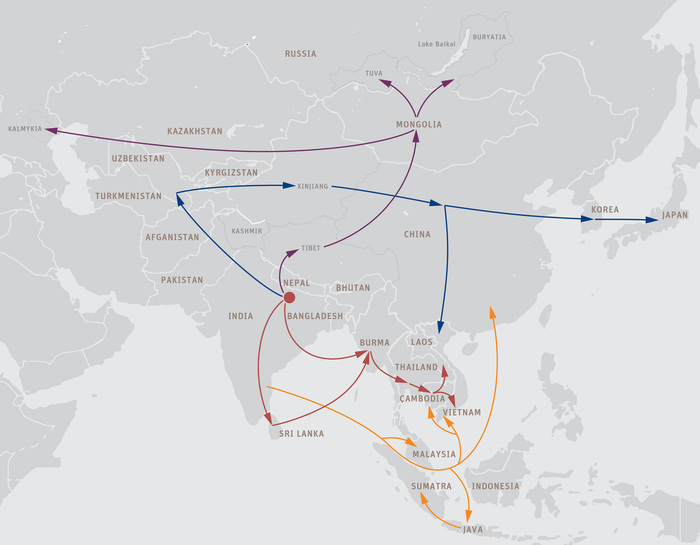
The Buddha's teachings spread smoothly throughout the Indian subcontinent, and since then spread widely throughout Asia. Whenever coming to a new culture, the means and styles of Buddhism will be modified to suit the psychology of the local people, without affecting the intellectual and heart points bi. Buddhism never developed a religious system of authority in general, with the supreme leader. Instead, every country that Buddhism spreads will develop its own forms, its own religious structure, and its own spiritual leader. Currently, the most famous and respected person at the international level among Buddhist leaders is the Dalai Lama of Tibet.
History Summary
There are two major divisions of Buddhism: Hinayana (the Modest Vehicle), which emphasizes the liberation, and Mahayana (the Vast Vehicle), which is stressed to become a fully enlightened Buddha to others. Both mod and vehicles have many sub-divisions. At present, only three major forms survive: one Hinayana sub-division in Southeast Asia, known as Theravada, and two Mahayana divisions, the Chinese and Tibetan traditions./ Buddhism has two main branches. Hinayana (Small Vehicle), emphasizing personal liberation, while Mahayana (Big Vehicle), emphasizes the practice to become a fully enlightened Buddha, to be able to universalize beings. Both Small and Big vehicles have many small branches. Currently, only three main forms exist: a small branch of the Hinayana in Southeast Asia,
- The Theravada tradition spread from India to Sri Lanka (Sri Lanka) and Burma (Burma) in the 3rd century BC. Since then, Buddhism has traveled to the rest of Southeast Asia (Thailand, Laos, Cambodia), South Vietnam, including Indonesia (Indonesia).
- Other schools of Hinayana spread to Pakistan, Afghanistan (Afghanistan), the East and coastal areas of Iran and Central Asia today. Except for Central Asia, these schools spread to China in the 2nd century AD. Later, these Hinayana forms were combined with Mahayana nuances, which came here following the same path from India, and the Mahayana eventually became the dominant form of Buddhism in China. China and most of Central Asia. Later, the Chinese Mahayana form spread to Korea, Japan and Northern Vietnam.
- The Tibetan Mahayana tradition began in the 7th century AD, inheriting the entire history of Indian Buddhism. From Tibet, it spread throughout the Himalayas and to Mongolia, Central Asia, and parts of Russia (Buryatia, Kalmykia and Tuva).
How to spread Buddhism
The spread of Buddhism in most of Asia took place smoothly, and happened in several ways. A master of traveling everywhere to share wisdom with those who are interested and want to learn from neighboring kingdoms, Shakyamuni Buddha established precedents. He instructed monks to travel around the world to explain his teachings. He did not call others to condemn and renounce their religion, then follow the new religion, because he did not seek to establish his own religion. His goal is to help others overcome the unhappiness and suffering they create for themselves, because of a lack of understanding of reality. Later generations of disciples felt the inspiration from Buddha's example, and they shared with others his means that they found useful for their lives. This is how it is today, what is called "Buddhism",
Sometimes, this process also evolves naturally. For example, when Buddhist merchants visit and settle in different lands, some local people will naturally care about the beliefs of these foreigners, as well as how Islam is brought to the South. Yang and Malay later. This process also happened to Buddhism in the oasis countries, along the Silk Road in Central Asia, two centuries before and after AD. When local rulers and people learned more about this Indian religion, they invited monks from the indigenous areas of these merchants to be advisers or lecturers, and eventually, many people accepting Buddhist beliefs. Another natural method is the long-term cultural assimilation of those who invade other countries,
Often the popularity is due to the influence of a powerful monarch, who accepted and supported Buddhism. In the middle of the 3rd century BC, Buddhism spread throughout North India, thanks to the support of the individual Ashoka (King Ashoka). The king who built this powerful empire did not force his subjects to have faith in Buddhism, but by giving ordinances carved on iron pillars all over his kingdom, shouting to the people. living a moral life, and he himself followed those principles, the king made others accept the teachings of the Buddha.
Ashoka also actively preached outside his kingdom by sending missionaries to distant lands. Sometimes, the king did this at the invitation of foreign rulers, such as Sri Lanka's King Devanampiya Tissa. On other occasions, the king took the initiative to send monks as diplomatic envoys to him. However, the monks visiting foreign countries did not exert a strong pressure, making others convert, but only giving the teachings of the Buddha, so that people could make their own choices. This is evidenced by events in places like South India and South Burma, where Buddhism was quickly rooted, while in other places, such as Greek colonies in Central Asia. There is no record of such an immediate effect.
Other devout kings, like the Mongolian ruler Altan Khan, in the 16th century, invited Buddhist masters to their kingdom, and proclaimed Buddhism as the country's official belief, to unifying the people and strengthening their rule. In this process, they may have banned some religious practices of non-Buddhists, indigenous religions and even abused those who followed these religions, but those heavy acts mainly due to political motives. These ambitious rulers have never forced their subjects to accept Buddhist forms of worship or worship. That is not in the beliefs of this religion.
Sometimes, this process also evolves naturally. For example, when Buddhist merchants visit and settle in different lands, some local people will naturally care about the beliefs of these foreigners, as well as how Islam is brought to the South. Yang and Malay later. This process also happened to Buddhism in the oasis countries, along the Silk Road in Central Asia, two centuries before and after AD. When local rulers and people learned more about this Indian religion, they invited monks from the indigenous areas of these merchants to be advisers or lecturers, and eventually, many people accepting Buddhist beliefs. Another natural method is the long-term cultural assimilation of those who invade other countries,
Often the popularity is due to the influence of a powerful monarch, who accepted and supported Buddhism. In the middle of the 3rd century BC, Buddhism spread throughout North India, thanks to the support of the individual Ashoka (King Ashoka). The king who built this powerful empire did not force his subjects to have faith in Buddhism, but by giving ordinances carved on iron pillars all over his kingdom, shouting to the people. living a moral life, and he himself followed those principles, the king made others accept the teachings of the Buddha.
Ashoka also actively preached outside his kingdom by sending missionaries to distant lands. Sometimes, the king did this at the invitation of foreign rulers, such as Sri Lanka's King Devanampiya Tissa. On other occasions, the king took the initiative to send monks as diplomatic envoys to him. However, the monks visiting foreign countries did not exert a strong pressure, making others convert, but only giving the teachings of the Buddha, so that people could make their own choices. This is evidenced by events in places like South India and South Burma, where Buddhism was quickly rooted, while in other places, such as Greek colonies in Central Asia. There is no record of such an immediate effect.
Other devout kings, like the Mongolian ruler Altan Khan, in the 16th century, invited Buddhist masters to their kingdom, and proclaimed Buddhism as the country's official belief, to unifying the people and strengthening their rule. In this process, they may have banned some religious practices of non-Buddhists, indigenous religions and even abused those who followed these religions, but those heavy acts mainly due to political motives. These ambitious rulers have never forced their subjects to accept Buddhist forms of worship or worship. That is not in the beliefs of this religion.
Summary
Shakyamuni Buddha told people not to listen to his teachings just because of blind faith, but to carefully examine them, before accepting his teachings. If so, how can people accept the teachings of the Buddha, only because of the forced missionaries, or because of the royal decree. At the beginning of the 17th century, Toyin Neiji tried to bribe Buddhism from the Eastern Mongol nomads, by giving them animals, with every passage they memorized. Nomads complained to the government, and the overbearing teacher was punished and exiled.
In many ways, Buddhism has spread to most of Asia smoothly, bringing the message of compassion and wisdom, and in accordance with the different needs and causes of the people.END=NAM MO SAKYAMUNI BUDDHA.( 3 TIMES ).VIETNAMESE BUDDHIST NUN=THICH CHAN TANH.GOLDEN AMITABHA MONASTERY=AUSTRLIA,SYDNEY.24/2/2019.

In many ways, Buddhism has spread to most of Asia smoothly, bringing the message of compassion and wisdom, and in accordance with the different needs and causes of the people.END=NAM MO SAKYAMUNI BUDDHA.( 3 TIMES ).VIETNAMESE BUDDHIST NUN=THICH CHAN TANH.GOLDEN AMITABHA MONASTERY=AUSTRLIA,SYDNEY.24/2/2019.


No comments:
Post a Comment