Commentary on "Soi Giac Lights".VIETNAMESE TRANSLATE ENGLISH BY=THICH CHAN TANH.AUSTRALIA,SYDNEY.


Khunu Lama Rinpoche
Boudhanath, Nepal, 1975
A discourse was given to the monks and nuns at the International Mahayana Institute in Boudhanath, Nepal, February 2, 1975. Nicholas Ribush corrected.See the Appendix 1 Illuminating the Path to Enlightenment of His Holiness the Dalai Lama, or www.lam-rim.org , for a translation of the text. Lama Zopa Rinpoche translated Tibetan language into English.
This lesson was published in 2005, in publisher Teachings from Tibet , LYWA. You can read more articles from Khunu Lama Rinpoche and other noble Tibetan lamas at TeachingsFromTibet.com .
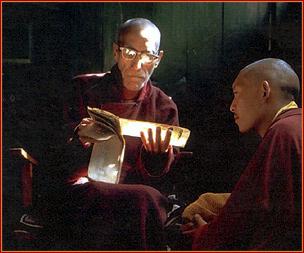
Khunu Lama Rinpoche
Before listening to this sermon, first give out bodhicitta by thinking, "I want to attain enlightenment for the benefit of all sentient mothers." In other words, before listening to the sermon, it is necessary to think of all sentient mothers.
Topic today is Lam-Dron, Lamp of the Realm of Enlightenment ( A Lamp for the Path to Enlightenment ) , led by Mr. Atisha great (Dipamkara Shrijnana) composed in Tibet, he was the son of a King Bengali, was the life in northeastern India, in 982.
ATISHA AND THE TRANSMISSION OF THE TEACHER AFTER THIS IN TIBETAN 1
The Dharma was established in Tibet before Atisha came there, but a cruel king named Langdarma (Udumtsen), who was thought to have horns growing on his head, was hostile to Buddha Dharma, and caused the Dharma to fail in Tibet. However, although the teachings have been harmed, they still exist, just not being as pure as before. It took nearly 60 years to help the dharma restore the original purity, and they are considered the spread of later teachings in Tibet.
The fact is that in the Western part of Tibet, in the Kingdom of Gugé, there was a Tibetan king, Lha Lama Yeshe Ö, and his grandson, Jangchub Ö, lived there. They decided to invite an enlightened, learned teacher from the great Indian monastery of Vikramashila, to spread the dharma in Tibet.When they learn to see who is the best and the most enlightened person there, they find Atisha the best person to invite.
However, before Lha Lama Yeshe Ö could request Atisha from Vikramashila to Tibet, he needed to find gold to donate properly, so he went to a place called Garlog to find gold. However, before he could complete his mission, the authorities in Garlog made him go to prison, and he died in prison. So Lha Lama Yeshe Ö sacrificed her life to bring Atisha to Tibet.
Then his nephew, Jangchub Ö, sent messengers to India to invite Atisha to Tibet. Finally, when he met Atisha, he explained how the Dharma had fallen under Langdarma's rule, the right teachings no longer existed in Tibet, and asked Atisha to give the Tibetan people. basic teachings on refuge, bodhicitta and so on, because they are so ignorant. Therefore, Atisha composed a valuable lesson of the End of Light Enlightenment . This text is based on Shakyamuni Buddha's sermon of the Prajna Paramita, and is the origin not only for all of Gelug's lam-rim teachings, but also the source of the teachings from all other schools of Tibetan Buddhism, all practiced the path to enlightenment, and cited this work in their teachings.
After distributing the bodhicitta above, our main task is to attain enlightenment. Currently, although one may think that life in reincarnation is pleasant, it is not. There really is no comfort in reincarnation. I can only achieve enlightenment by practicing the Dharma. So we should all practice Dharma.
In terms of Dharma in general, there are two types: the Dharma and the teachings of the pagans [Sanskrit: tirthika ; Tibetan: mu-teg-pa ] 2 , and the pagan teachings are based on false faith and understanding, contrary to the belief and understanding of the Dharma. If you believe in the non-Dharma teachings, you can be born anywhere, from the lower realms to the top of samsara, the highest realm of the four realms, but never escape suffering .
In Dharma there are also two categories: Hinayana and Mahayana. If you practice according to Theravada teachings, you can escape samsara, but you cannot attain enlightenment. If you want to attain enlightenment, you must practice the Mahayana dharma. In Mahayana, there are teachings taught by the Buddha himself, and later by his learned followers, outstanding Indian scholars, including six jewels and two supreme things. , 3 and the great Tibetan masters.
The Dharma we are discussing here is Lam-drön , composed by the scholar, Dipamkara Shrijnana. What is this teaching about? It originates from The Strictly Contemplative of the Maitreya ( Abhisamayalamkara ), and explains the three levels of dharma: the path of the lower, middle and upper-level practitioners, especially the class practitioners final.
THESIS AWARD LIGHT NEO OUT BY EACH verse
The text begins with the title of this sermon in Sanskrit, which in Tibetan is Jang-chub lam-gyi drön-ma . Next is the respect for the Manjushri Master.
1. The first verse consists of three points. The first is to have the Three Jewels homage: the Buddhas during the three times, the oral teachings and the realization of these teachings, and the Sangha - you have received unshakable or noble paths. Secondly, he said that his pure disciple, Jangchub Ö, requested him to give this teaching. Third, he promised, or vowed that he would write this dharma, the work of Soi Giac Giac, Lam-dron.
2. In the second verse, Atisha explains what he will write about: the sequences of sequences of people of the lower, middle, and upper realms.These are also the paths that Lama Tsongkhapa lectures in short, medium and long Lam-rim teachings - sequential lines of these three types of practitioners.
3. At first, the followers at three levels, Atisha explained the path of the subordinates. Such people think, "No matter what kind of suffering or happiness you will experience in this life, I must avoid rebirth in the lower realms, and attain a rebirth in the higher realms. ". With this in mind, the lowly practitioners will avoid negative behaviors and practice good deeds.
4. The people of the middle are not only disgusted with the suffering in the lower three realms, but also dislike suffering in the three higher realms; fear the whole reincarnation. These practitioners will avoid evil deeds to escape samsara, but not much attention to other beings.
5. So who is the supreme being? They are those who, after understanding their own suffering, will see it as an example of the suffering that other sentient beings are also experiencing, and vow to excel, to end suffering for all beings. .
6-11. There are six preparatory practices. First, visualize the blessing field and make offerings, then kneel, bow and prostrate and take refuge in the Three Jewels. After that, please give kindness to sentient beings, by thinking about the sufferings of death, old age, sickness and rebirth, as well as the three types of suffering and the common suffering of reincarnation. Give bodhicitta that way.
12-17. It is necessary to vow to achieve enlightenment, and the benefit of this is explained in the Precepts of the Dharma Realm . Atisha also quotes three verses from another sutra, Viradatta Sutra , to further explain the benefits of bodhicitta.
18-19. There are two types of bodhicitta, relative and absolute. In the relative genre, there are two more categories, bodhicitta, which is the desire to attain enlightenment for the benefit of sentient beings, thinking, "If you do not attain enlightenment, you cannot help others become enlightened. ", And bodhicitta acted, truly following the path of the Bodhisattvas by taking the bodhisattva precepts, and embarking on the bodhisattva of happiness, thinking," I will practice the hexadecimal mantra, to commit myself. into good deeds and avoid evil. "
20-21. The dharma explained that in order to practice bodhicitta, we should take the Bodhisattva monastic ordination, but to do this we should keep one of the seven levels of liberation of liberation , such as gelong , gelongma , getsul , getsulma and so on. 4 Ideally, one of these basic ways of renunciation should be kept, before receiving the bodhisattva gender, but scholars say that in general, those who avoid evil karma and create good karma can become a bodhicitta. , even though they do not hold any Liberation Specialists.
22. Bodhicitta may arise without any lama, but the bodhicitta act must rely on a lama. To find a lama to receive bodhisattva precepts, we must know his level.
23-24. First of all, the lama should thoroughly understand the renunciation and the transmission of ordination. Moreover, he himself should live according to the Bodhisattva's virtue, and have compassion for his disciples.It is the kind of lama that we need to seek for ordination. But what if you can't find such a perfect lama? Atisha explained in that case what should we do.
25-31. Manjushri Buddha Dhamma Enlightenment explained how Manjushri had distributed the mind in ancient times. That's what we can do. Visualize the blessed field with all the Buddhas, and give bodhicitta to their presence, which is the intention to attain enlightenment. Then promise, "I invite all beings to be guests to attend the noble happiness of liberation and enlightenment. I will not be angry or be born of mercy, greed, jealousy and so on. I will not harm other beings in any way. You will live in pure precepts by avoiding all evil and evil karma, even worldly aspirations and sensory objects, which are objects of craving, such as charismatic sounds and beautiful appearances. Well, and so on. I will give up such things. Like the Buddhas have followed the pure virtue, I will do the same.
“I will not try to achieve enlightenment for myself. I will stay in samsara, even though it takes an infinite amount of time to work because of one being. I will make the impure realms of beings become pure, places with bad thorns, stones and mountains. I will also purify my three doors of body, speech, and mind, and keep calm. From now on, I will not create more evil karma. ”
32-35. The best way to keep the three doors pure is to deliver the bodhicitta prayer, practice bodhicitta and follow the path of enlightenment. This is based on observing the three levels of virtue, Special liberation of gender, Bodhisattva precepts and Confidentiality. If this is done correctly, it is possible to fulfill the two merits and merits of transcendental wisdom.
One thing that really helps us achieve the fullness of two payouts is the ability to predict the future; So, try to get clairvoyance. Without this ability, I would be like a young bird, the wings have not yet developed, the feathers have not grown enough and live in the nest, unable to fly. Without the ability to be clairvoyant, it is impossible to work for beings.
36-37. People who have attained spiritual power to predict the future can one day create more merit than a person who creates merit in a hundred years, without this ability. Therefore, in order to quickly accomplish the merits of merit pay and transcendental wisdom, it is necessary to have spiritual power to see the past, present and future.
38. To accomplish this, the attainment of single-pointed concentration [Sanskrit: samadhi ; Tibetan: ting-nge-dzin ] is essential. For this, we must understand the details of the mind-centered method of accomplishment, such as the nine stages, the six forces and the four attentions. 5
39. In order to practice meditation properly, the conditions must be ensured.Otherwise, even if we have a hard time cultivating for a thousand years, we will never reach the goal. So, find a perfect environment, keep quiet and avoid doing things like heal the sick and astrological divination, any activity that keeps you busy.
40. The way of meditation to attain concentration is to focus on a good object, such as the image of the Buddha. I will visualize such an image in front of me, and merely focus on it. When I focus on the object over and over again, gradually, I will be able to preserve it for longer periods of time, and by continuing to practice like that, in the end, I will achieve calm calm abiding [Sanskrit: shamatha ; Tibetan: shi-né ] and the most concentrated.Therefore, we will have "higher vision" [Tibetan language: ngon-she ], which is the spiritual power to see the future and so on.
41-43. However, that is not the point. Next, you have to practice Vipassana meditation [Sanskrit: vipashyana ; Tibetan language: lhag-tong ]. Without vipassana meditation, concentration cannot eliminate afflictions. We must attain the wisdom of realizing what I do not exist, in order to subtract two levels of haunting, that is defilements [Sanskrit: kleshavarana ; Tibetan: nyon-drib ] and mindfulness , or omniscient mind [Sanskrit: jneyavarana ;Tibetan language: she-drib]. Doing this also relies on having a means, such as compassion and so on. If you only practice wisdom without practicing the means, then it is a mistake. This can make us fall into personal liberation, or lower nirvana. Similarly, if you just practice the vehicle without practicing wisdom is also a mistake, making you stay forever in reincarnation.
44-46. The Buddha taught in the third continent, the last of the six paramas is the path of wisdom, and the first five, giving, maintaining the world, the patience, the diligence and the meditation, are the path of means, then intellect, then combine the two. We can attain enlightenment by combining both practices; If you only practice selflessness, you cannot be enlightened.
47-49. Mind realizing the five aggregates [Sanskrit: skandhas], the twelve kingdoms and the eighteen precepts without self-righteousness are considered higher intellectuals. There is existence and non-existence: nothing is the production of the existing Dharma, and there is no such thing as the production of non-existent dharma. Nothing is the production of both dharmas that exist and do not exist, nor do they have the birth of what is neither the present or the non-existent. It is a logical form that denies the production of both existences and non-existences. There is another logical form that denies the production of a word itself, from another, from both and not both, four extremes. The main point to discover here is the injustice. This can be found through the first logical reasoning line, denying the production of the existing and non-existent dharma, and through the second line, denying the production of four extremes.
50-51. This can also be explored through the third line of reasoning, examining things to see if they are one or more. These lines of reasoning were developed by Long Life in Thất Thập Không Tánh Luận and other works, such as Trung Quán Luận .
52-54. These are explained in these works, but here, they are mentioned only for the purpose of meditation. Meditation on the inherent injustice of the I and the injustice of all other methods is meditation on shunyata , or emptiness. When the enlightened mind does not analyze the subject and the object, it cannot find the self-righteousness of one of these two things.Moreover, it cannot find self-righteousness in emptiness. Therefore, we will realize emptiness of even emptiness.
55-58. Because this world is created from superstition, or the concept of [Tibetan: nam-tog ], if you eliminate the creator, the superstition, then you can achieve liberation. The Buddha said that it was superstition that made us fall into the sea of reincarnation. Therefore, what must be avoided is superstition, and the emptiness of superstition, like the sky, as empty space, which must be practiced. When this is achieved, we will be able to see the absolute nature of existence. Therefore, the practice of the Bodhisattvas is to avoid superstition, thus achieving a non-superstitious mind. Through various modes of logic, by realizing the emptiness of the dhammas produced and the inherent existence we can avoid superstition, and gain emptiness.
59. Then we can also achieve the different levels of the Family Path [Tibetan:jor-lam ], the second path of the five elements . We will attain four levels of this path and will eventually attain the [Tibetan: sa ], or bodhisattva sites.Finally, we will attain the eleventh place, which is enlightenment.
60-67. When we have realized emptiness, we can also obtain the common realizations of tantra, such as the four forces of security, wrath, control and growth, and other achievements, such as "the A good vase ". The achievement of a good vase means practicing a certain meditation while retreating for a long time, and if it succeeds, you will be able to just put your mouth into the mouth and say something like " May I become king of this country ”, will fulfill the wish.
Or we can get the Tantra force of "eye remedy". If this is achieved, it is only necessary to put a special oil in your eyes to see precious things, such as gold, jewels and so on, even if they are hundreds of miles below the ground. ; No matter how far away, we can still see them.
Through tantric practice, one can attain enlightenment without having to go through many great austerities. The way of Tantra practice to attain enlightenment is through happiness; while other pathways to enlightenment must undergo difficult and ascetic practice.
There are four different tantric levels: Action (Action), Performing (Performance), Elder Yoga (Yoga) and Highest Yoga Tantra. First, to receive initiation. To do this, we must offer material, such as gold or even our family members, a spouse or brother, and ask our teacher to give initiation 6 , with great devotion. If you feel satisfied, you will give us initiation, with compassion. When we received the empowerment, we also received great luck to be able to attain enlightenment and all the noble realizations accompanied it.
There are four different initiations in the Divine Dhamma: the point of peace, the secret, the transcendental wisdom and the word, the last initiation is when the guru transmits interpretation, or proof, through explanationHowever, it is not advisable to give secret initiations to monks. For example, if monks receive a secret initiation, then they must leave the Sangha, because those who have received secret initiations must practice with a consort. If they practiced this practice and did not return the monastic precepts before, they would lose the precepts, and the consequence of this would be to be reborn in hell.
If I want to receive the tantra comment, I must first receive the initiation.Without initiation, I cannot receive Tantric teachings. Nor can I perform the fire offering [Tib: jin-sek ], or give the tantric teachings.
68. In the last shelf, Atisha ended this text by describing himself as an elder [Tibetan: nä-tän ], a monk, in the first twelve years after ordination. , never committed any precepts; a chief monk. He claimed to have given this brief explanation of the steps on the path of cultivation, according to the request of Jangchup Ö, a noble of his.
CONCLUDE
Each of the Lam-rim teachings that have been composed refer to this text, the Cross-Enlightenment Lamp , regardless of which Tibetan Buddhist tradition, Nyingma, Kagyu, Sakya or Gelug. What about the Soi Soi Sensory Lamp? It is the most profound three -fold teachings of the Buddha.Regarding the Prajñā texts, there are long, medium and short versions, but the author of all these suttas is the Buddha. So all Lam-rim versions originate from the Buddha's teachings.
If you want to understand Lam-rim, you should research as much as possible. When I thoroughly understand Lam-rim, I will understand the Cross Lights . Once you understand, you should teach it all over the world.
There are many aspects of the Mahayana tradition, but in general it contains great knowledge. However, the main point, the basic is the concern for others, working for others, benefiting others. The Hinayana followers mainly care only about the suffering in their own reincarnation, and in order to get rid of this, they will practice according to the path of uneducated learning: gender, concentration, and wisdom. How many ways to explain Mahayana is different from the Hinayana, and higher than the Hinayana, but the difference is mainly that Mahayana practitioners are interested in acting for the welfare of many others. more for yourself.
Today, people can think of helping others, but Mahayana practitioners not only benefit others, but also help beings suffering in hell, hungry ghosts, animals and each another being. No one who has never been his mother, all sentient beings have been our mothers countless times, so we should be concerned about their welfare, to make them enlightened as quickly as possible. good. So this is the fundamental difference between Theravada and Mahayana, especially the interest in others more for ourselves, the universal aspiration of all beings to enlightenment. That is what makes the difference.
You are studying the vast and profound Dharma of Mahayana, intentionally thinking, analyzing it is excellent, and should continue to do so. In general, there are many religions, and everyone thinks that the teachings in their religion are the best, but just say that their religion is best not to prove that it is the best; that makes no sense. So simply saying that Buddha Dharma is the best religion in the world will not make it the best. However, there are many good reasons you can use to prove that in fact, Buddha Dharma is the best.
For example, even accepting and practicing bodhicitta is very different from not accepting and practicing bodhicitta. Even for this, there is a big difference between Buddhism and other religions; the fact that the presence of bodhicitta practice shows that Buddhism is higher than other religions, that Buddhism is the best. Buddhism also talks about interdependent origination and emptiness; it explains dependent origination as it exists, right there.Then Buddhism is very different from other religions, not only about virtue, but also about knowledge, and therefore, Buddhism is best. There are many ways to prove this.
However, the Dharma is something that the more you study, the deeper you become, the more profound it will become. This is a specific quality of Dharma. For other teachings, the more they study, the more they become more relaxed.
If you understand anything I have taught here, then keep it in mind and build upon these things. Once you understand more, keep it as your foundation, and build on it. In this way, your knowledge will continue to grow. Then as the sun rises, spread the Dharma in the West.
There are many countries, such as Vietnam, where Buddhism has existed for centuries, but not like Tibet. In those countries, there is only one aspect of the Buddha Dharma that exists, not the whole, but in Tibet, all aspects of the Dharma exist, Hinayana, Sutrayana and Kim Cang. In order to study all these teachings, I should learn Tibetan, study Tibetan grammar, and follow my lama properly.
[Reflection prayer is recited, then the monks and nuns make offerings to Rinpoche.]
Please don't offer anything to me. He has enough to eat and drink; that's all he needs. The reason that I gave you this teaching is not to receive anything, but to let you practice in a pure way. He did not build a monastery or make offerings to statues and so on, so he did not need money. He only offered offerings when he lacked something. When enough, he did not receive offerings, especially from monks and nuns. The idea of Master's wealth is different. Otherwise, teaching and receiving money will be a bit like business.Now, I just want you to practice, but if things go bad and you don't have enough food or drinks, then maybe you will receive something. END=NAM MO SAKYAMUNI BUDDHA.( 3 TIMES ).VIETNAMESE BUDDHIST NUN=THICH CHAN TANH.GOLDEN AMITABHA MONASTERY=AUSTRALIA,SYDNEY.23/2/2019.


No comments:
Post a Comment