The meaning of prayer, prayer and prayer .VIETNAMESE TRANSLATE ENGLISH BY=THICH CHAN TANH.


In Buddhism, the words "pray," "pray" or "wish" are synonymous with the terms "pràrthanà" (Sanskrit) or "patthanà" (Pali). Pràrthanà comes from the root "pra + arth" which means aspiration, desire, desire, and prayer.
I. The meaning of prayer
In Buddhism, the words "pray," "pray" or "wish" are synonymous with the terms "pràrthanà" (Sanskrit) or "patthanà" (Pali). Pràrthanà comes from the root "pra + arth" which means aspiration, desire, desire, and prayer.
Prayer, prayer or wish is a psychological state that longs for something to be done, will be accomplished or done according to the will of the expectant. It reflects an attitude of expecting an event to take place according to the intention of the person who wishes.
According to Buddhism, depending on the object and the goal of the wish, prayer can become a psychological state of "greed", that is, desire to include it for yourself, your family, your loved ones, or a state of mind. "altruistic" psychology for others, beings get benefits, peace and happiness. In other words, the prayer itself is morally neutral. The moral character of prayer is determined as good or bad depending on its purpose as well as its consequences on the desired object. If the aspirations of prayer are directed towards self-interest, self-interest, self and self-possession, then prayer in this case is a greed, synonymous with craving (patthanà vuccati ta.nhà, Mahà Nidesa I. 316-37). In other words, pray for evil for selfish, private, then prayer is synonymous or greedy (patthana lakkha.no lobho, Nettippakara.na, p. 27). In contrast to the favorable rain and wind, peasants with good harvest, peaceful country and the end of the world war are "good" (kusala) because of the altruistic nature of the desired goal. Here, prayer towards the welfare and happiness of others, hope for happiness and peace to human society, completely without the shadow of selfishness, acquired for themselves. Such a wish is a righteous and helpful wish. Prayer towards the welfare and well-being of others, hope for happiness and well-being to human society, completely devoid of selfishness, summed up for oneself. Such a wish is a righteous and helpful wish. Prayer towards the welfare and well-being of others, hope for happiness and well-being to human society, completely devoid of selfishness, summed up for oneself. Such a wish is a righteous and helpful wish.
II. Low prayer and noble prayer
As just stated, the moral nature of prayer will be discerned according to the idea or intention of the prayers. If the object and goal of the wish are divided into good and bad, prayer or wish is also divided into two categories: inferior and noble.
Low prayer is the desire for unrighteous things, what is harmful to the people, the society, and what goes against the interests of the majority. A desire to kill (even an enemy), to rob another person's property, to possess another's spouse, to deceive others verbally etc. are morally inferior desires. Praying for war, for others being killed, sickness, bankruptcy, for illicit and illegal benefits for yourself, your family, your loved ones, your community, your commune our congregation and our country, etc., are all prayers or desires contrary to the moral development of ourselves and the community, so they are considered lowly desires or prayers. There are so many bad prayers that have become curses, curses, mums, to harm others. There are prayers that reflect a mean, selfish attitude, personal and not happy with the success and happiness of others. All such wishes are lowly, and have no moral value.
Noble prayer, on the contrary comes from selflessness, selflessness, from love regardless of gender, social class, regardless of family, friend, just for benefit and welfare. and happiness for others etc. Those are prayers or desires of goodness and morality. Wishing for war to end, no more bloodshed, no more killing for people, animals and the environment; the desires for the happiness of the other's couple to last long, the fragmentation, division become reunited, united; desires for everyone to have a stable job, no one to rob anyone of their labor and wealth, people to love, support and help each other etc. are noble wishes or prayers, and have moral values.
According to the Buddha's teaching, there are many causes for low and noble wishes or prayers. In the discourse on the mind seeds of the Sangha (AV 213) Buddha gave people the profound cause of low wishes and prayers. The ten reasons are: (1) misconceptions, (2) wrong thinking, (3) wrong words, (4) wrong behavior, (5) illegal establishment, (6) effort. wrong force, (7) wrong mindfulness, (8) wrong meditation, (9) wrong knowledge, (10) wrong freedom. These ten causes are actually deeply rooted in the wrong perspective. It is "opinion" that is the brain of awareness and action. Once wrongly perceived, action becomes detrimental to the morals and well-being of others. For example, when someone has a false perception that murder, robbery, illegal sex, lying to deceive people, drink alcohol, smoking and luxury play, which is neither harmful nor contrary to the basic moral principles of human society, certainly that person not only has evil desires, harms to others and society but he may also commit unwholesome deeds to bring selfish benefit to himself. In this case, the person who prays or lowly wishes will disregard the law, do unrighteous things, harm social morality. Therefore, to stop those evil prayers or desires, first and foremost, we should develop a righteous view (sammà-di.t.thi). In other words, a righteous view is the focal point of all moral conduct that benefits oneself and others. then it is certain that he not only has bad desires, harms to others and society but also can commit unwholesome actions, to bring selfish benefits to himself. In this case, the person who prays or lowly wishes will disregard the law, do unrighteous things, harm social morality. Therefore, to stop those evil prayers or desires, first and foremost, we should develop a righteous view (sammà-di.t.thi). In other words, a righteous view is the focal point of all moral conduct that benefits oneself and others. then it is certain that he not only has bad desires, harms to others and society but also can commit unwholesome deeds, in order to bring selfish benefit to himself. In this case, the person who prays or lowly wishes will disregard the law, do unrighteous things, harm social morality. Therefore, to stop those evil prayers or desires, first and foremost, we should develop a righteous view (sammà-di.t.thi). In other words, a righteous view is the focal point of all moral conduct that benefits oneself and others. Therefore, to stop those evil prayers or desires, first and foremost, we should develop a righteous view (sammà-di.t.thi). In other words, a righteous view is the focal point of all moral conduct that benefits oneself and others. Therefore, to stop those evil prayers or desires, first and foremost, we should develop a righteous view (sammà-di.t.thi). In other words, a righteous view is the focal point of all moral conduct that benefits oneself and others.
Also in the above sutta, the Buddha presented 10 causes of noble desire or prayer, which are: (1) righteous thoughts, (2) righteous thoughts, (3) righteous words, ( 4) righteous conduct, (5) righteous karma, (6) righteous effort, (7) righteous mindfulness, (8) righteous meditation, (9) righteous knowledge, (10) true freedom.
The righteous concept is considered to be the leading element of the remaining nine types of righteousness. According to the Buddha's teaching, the right view is the view of people and things in the light of the principle of dependent origination or interdependence, without a primordial cause, producing all things. Such a concept completely overturns a false belief about a creator, creating the cosmic mountain and thus seizing the balance of punishment and morality of man. The righteous person will control himself, not lamenting the earth for objective suffering, because he is fully aware that its causes are greed, anger, ignorance and craving. present or past. One who has a righteous view also sees another aspect of life, a state of happiness and bliss due to complete absence of physiological mental suffering. To achieve this bliss,
In short, if the ten evil acts are causes, catalysts, leads, are the source of low wishes or aspirations, then 10 true causes are the opposite causes, resulting in peaceful results. and happiness for ourselves and for the people, this life and the next. A disciple of the Buddha in particular, and a person who yearns for moral progress in general should develop 10 righteous thoughts to lead a peaceful life.
III. The concept of praying and praying
Buddhism does not focus on pure desire. Buddhism advocates practical action. Although in Buddhism there are many suttas on how to achieve peace and happiness in life, as well as how to practice to be born into the world of the Buddha, the concept of "praying and praying" not only does it not reflect the above, it can also be misleading that Buddhism is the religion of prayer and pleading, depending on one's own strength.
In terms of etymology, the concepts of "pray for peace" and "pray for prayers" have recently appeared in Vietnamese Buddhist circles. "Pray" means black to "pray for someone healthy and peaceful," while "pray" means "pray for the dead to be supreme, to be reborn in the world of the Buddhas." . "
So praying is the desire, the desire to be healthy, peaceful and happy. It is not limited to praying for a healthy person to get well soon, as many people have misunderstood. In order to be healthy, suffering from suffering and inner peace, according to the Buddha, each person must cultivate a moral and intellectual life, promote the welfare of others, help people, live in peace, mindfulness and awakening in every moment of the present. No ambition about the past to rid the world of traumatic experience. Don't be hopeless about the future so you don't worry and be afraid. Live wisely and calmly in the present to overcome all the desires of life. People who live like this are always "healthy", always healthy, happy, no need to pray and expect. On the contrary, if we live in a depraved, depraved, abandoned place, not doing good things, on the contrary, falling in the path of sin, no matter how much you pray, it cannot be safe. In that spirit, in order to avoid misunderstandings, prayers for peace should be changed to "peaceful pleasures."
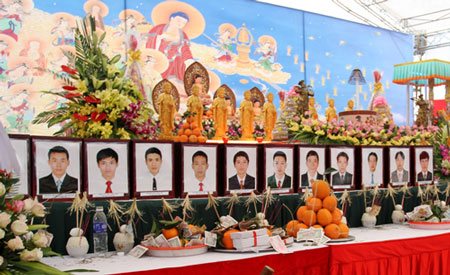
Praying is the aspiration or desire for someone to be freed or born to the world of Buddhas. Therefore, the word "pray for" can be a shortened form of the word "pray for super-speed" or "pray for super-born" or more fully than "pray for the pureland." So praying for prayers and wishes targeting mostly the deceased. In the Theravada Buddhist countries influenced by the Pure Land method, the sutras recited at funerals and commemorations are usually Amitabha, Ksitigarbha and Yulan. Chanting of the Amitabha Sutta is primarily to remind the dead of reciting the Buddha's recitation of "one-pointed-mindless meditation" as a prerequisite for rebirth in the Pure Land, so that the incense of the princess can follow and recite the Buddha's rebirth. . Chanting of Jizō on the one hand to review the filial merit of this Bodhisattva, on the other hand, promote and practice the land of the mind. When chanting this, Descendants of the deceased have the opportunity to learn about filial piety and also have the opportunity to cultivate their mentality to maturity. Read the Sutras to learn the special example of filial piety of Mr. Maudgalyayana. In general, the above sutras not only work well for the deceased, but above all do to educate the relatives of the dead on methods of practice and merit. According to Buddhism, no one can be super smart for anyone. No one can free anyone. Prayer is only symbolic, showing compassion and gratitude to the deceased, and in other ways to remind the deceased about the law of birth and death without attachment to the world, Easy to leave or to be reborn. Therefore, in order to avoid misunderstandings, the term "super prayer" should be changed to "supreme experience" or "transcendental prayer." Read the Sutras to learn the special example of filial piety of Mr. Maudgalyayana. In general, the above sutras not only work well for the deceased, but above all do to educate the relatives of the dead on methods of practice and merit. According to Buddhism, no one can be super smart for anyone. No one can free anyone. Prayer is only symbolic, showing compassion and gratitude to the deceased, and in other ways to remind the deceased about the law of birth and death without attachment to the world, Easy to leave or to be reborn. Therefore, in order to avoid misunderstandings, the term "super prayer" should be changed to "supreme experience" or "transcendental prayer." Read the Sutras to learn the special example of filial piety of Mr. Maudgalyayana. In general, the above sutras not only work well for the deceased, but above all do to educate the relatives of the dead on methods of practice and merit. According to Buddhism, no one can be super smart for anyone. No one can free anyone. Prayer is only symbolic, showing compassion and gratitude to the deceased, and in other ways to remind the deceased about the law of birth and death without attachment to the world, Easy to leave or to be reborn. Therefore, in order to avoid misunderstandings, the term "super prayer" should be changed to "supreme experience" or "transcendental prayer." In general, the above sutras not only work well for the deceased, but above all do to educate the relatives of the dead on methods of practice and merit. According to Buddhism, no one can be super smart for anyone. No one can free anyone. Prayer is only symbolic, showing compassion and gratitude to the deceased, and in other ways to remind the deceased about the law of birth and death without attachment to the world, Easy to leave or to be reborn. Therefore, in order to avoid misunderstandings, the term "super prayer" should be changed to "supreme experience" or "transcendental prayer." In general, the above sutras not only work well for the deceased, but above all do to educate the relatives of the dead on methods of practice and merit. According to Buddhism, no one can be super smart for anyone. No one can free anyone. Prayer is only symbolic, showing compassion and gratitude to the deceased, and in other ways to remind the deceased about the law of birth and death without attachment to the world, Easy to leave or to be reborn. Therefore, in order to avoid misunderstandings, the term "super prayer" should be changed to "supreme experience" or "transcendental prayer." and on the other hand to remind the deceased about the law of birth and death without attachment to the world, easily leaving or being reborn. Therefore, in order to avoid misunderstandings, the term "super prayer" should be changed to "supreme experience" or "transcendental prayer." and on the other hand to remind the deceased about the law of birth and death without attachment to the world, easily leaving or being reborn. Therefore, in order to avoid misunderstandings, the term "super prayer" should be changed to "supreme experience" or "transcendental prayer."
In short, to be healthy and peaceful, according to Buddhism, we must practice merit, do good deeds, live moderately, sleep and eat properly, stay in the present, take mindfulness and Awakening is the motto of life. In this way, peace will be like our companion in life. Similarly, in order to be transcendent, each person must equip himself or herself with moral possessions when he is healthy, so that when the impermanence comes, close his eyes and his hands, our good karma will lead us to rebirth. about the good realm or rebirth in the realm of the Buddhas. Here, there is no element of energy. It all depends on our moral life, our wisdom and our wise attitude.
IV. Prayer and results
In Buddhism, prayers or desires, even moral and noble, have very limited value, within the scope of the will, but have not yet been specifically shown in action. Buddhism therefore promotes the doctrine of intentional ethical behavior (cetana) as the basis of success and contentment in life. In other words, no matter how good it is to pray or wish without specific action or application. The doctrine of ethical behavior of Buddhism on this basis has played an important role in human moral life. Buddhism does not teach us to live with empty wishes or prayers, but instead teaches us specific methods to turn true and noble dreams into reality.
In the spirit of action is important, desire is dependent, Buddhism has taught us to live with an attitude of confidence in our good deeds and morals in bringing happiness and satisfaction in life. . Once one understands the Buddha's cause and effect, that is, understand that no one balances the life of reward and punishment, other than our own good and evil deeds, Buddhists do not have to waste time in praying or desiring this. the other. If the gods cannot help them in their unwholesome deeds, try asking how they can help us. Gods and gods, if any, do not live outside the law of causal interdependence. Therefore, Buddhists are not foolish to rely on an untrue power of god, god, mother, mother, lords, lady, etc. Buddhists are deeply aware that, once they have created karma evil, Even if we beg, we must be the ones who reap the results of its suffering. No one can demolish this eternal law. The following is a passage that clearly shows that:
“If anyone does 10 evil karma, then a large crowd pleads to him, sincerely hoping that he will be born of good beast. Such pleas are useless. Making 10 evil karma must fall into the land of origin. It was as if a person had thrown a rock into the lake, and many came to beg for it to float. Such pleas are useless. Because the rock, with its weight, cannot float, cannot float ashore as a plea. Also, creating 10 evil karma must fall into the land of origin ”(Samyutta IV, 313).
Here the Buddha's words are intended to affirm that evil and unwholesome actions are the cause of the consequences of suffering, which the person who created it must suffer in his life, whether present or later. Blessing and praying in this case have no moral value at all. Because, if praying results, then surely the millionaires, billionaires in this world must be the first super-born, get off first, by their money out of the sea religious prayers.
According to the Buddha, causality is a judge who condemns suffering for the person who created the evil karma and bestowed the happiness of the meek. This judge cannot be influenced by worldly forms of bribery, to turn black into white, to acquitted, as in the case of the laws of life. The judge of cause and effect is fair, accurate and unmistakable in judging the karma of good and evil deeds.
In terms of praying or wishing for good, the Buddha also asserted that praying for good without effort to do good is also futile and has no fruit. In the beautiful prayers, people often long for their health, longevity, good reputation, beauty, happiness, etc. The Buddha asserted that these things could not be done by him. to pray or wish without success:
“Gentlemen, the following five things cannot be acquired by prayer or desire: (1) longevity (àyu), (2) beauty (va.n.na), (3) happiness ( sukha), (4) fame (yasa) and (5) heavenly birth (sagga). ”[Tang Chi, A” nguttara Nikàya, III. 47]
That is, according to the Buddha, in order to be healthy we must live a peaceful life, meditate, not be immersed in sexual desires, do not drink alcohol, smoke books, work hard, and sleep properly. If you want to be beautiful, you must know how to keep healthy, eat and drink well, take a good rest, work in moderation, etc.In order to have a happy life, you must do good, abandon evil, obey the law, live for the benefit. his and others. In order to have a reputation, we must diligently study, work hard, live a conscience, morality, integrity, integrity, fairness, generosity, generosity to help others and do many good deeds. Want to be born in heaven, you must cultivate virtue, develop 10 virtues, practice meditation, make alms offerings and do many charitable works. In general, all these things cannot be obtained by prayer or desire. Here,
The Buddhist scriptures also affirm that a peaceful, happy and liberated life is not the result of beautiful desires but the result of an effort to cultivate morality, meditation and wisdom:
"A person who does not pay close attention to the practice, even if he arises the desire to be liberated from piracy or, no longer grasping, that desire is definitely not fulfilled" (Sangha III A, 123. Samyutta III, 184).
In other words, the beautiful desires or prayers contrary to the cause and effect of karmic retribution are merely a waiting, useless, and unnecessary weariness, and sometimes brings frustration and disappointment:
Milking where the "horn" of the cow
Find oil where the sandbox has water
Oil aspiration also does not achieve - (Kinh Trung Bo I, 103).
Enlightenment, liberation or attainment in Buddhism is the result of the process of hard practice, burning, burning afflictions, gonorrhea. The eradication of defilements is the source of Nirvana, of the Bodhichitta result. But that is not the result of prayer or salvation:
"Wanting to witness the Supreme Bodhi without eradicating Dao Dao Vong, is like cooking sand to make rice, even if you spend thousands of memories, it is impossible to achieve it" (Lang Nghiem, VI, 234-242 ).
In the process of going to the liberation of all practitioners, the Buddha declared that he only played the role of the leading guru, unable to give us the result of liberation. Therefore, in order to attain the truth of liberation, we must be a practicing practitioner, as the verse below, the Buddha advised:
"Please cultivate yourself diligently,
Tathagata teaches only.
Self-meditation,
Self-liberating evil karma ”(Dhammapada, verse 276)
Tathagata teaches only.
Self-meditation,
Self-liberating evil karma ”(Dhammapada, verse 276)
The practice on the basis of self-effort is also compared to the solid oasis of the Buddha, on this basis the awakening flowers will bloom, negativity karma is eliminated:
"Make the island yourself,
Need urgent urgency,
Except unclean structure: purity.
To the holy places of the Buddhas ”(Dhammapada, verse 236).
Need urgent urgency,
Except unclean structure: purity.
To the holy places of the Buddhas ”(Dhammapada, verse 236).
And the Buddha also noted us, not from Him, not from the redeeming grace of God, not by anyone, but by our own self-discipline leading us to enlightenment. Thus, the enlightenment is solid:
"It is not up to others,
But to attain Nirvana,
By self-regulation, to rely on oneself,
That solid destination".
But to attain Nirvana,
By self-regulation, to rely on oneself,
That solid destination".
Therefore, when Buddhists master the principle of karma and retribution, the balance of reward and punishment is accurate and fair, so they do not bother to expect and hope. On the contrary, when they do any good deeds, they become indifferent, leisurely, do not wait for the results, because they know for sure that good results will come, sooner or later. The following two anonymous verses show that true belief:
Maintenance of ill-conceived
Tri-Tri to become self-hybrid
Tri-Tri to become self-hybrid
Provisional translation is:
Dig a pond without waiting for a moon and stars
When a pond with moon water comes on!
When a pond with moon water comes on!
In short, prayer has very limited value in the moral life of Buddhists. Buddhists who follow the Buddhist spirit are those who act by good deeds, not those who only desire good deeds. It is the act of good that determines moral life, not sincere prayers or wishes.
V. Prayer, vow and dedication
In Mahayana Buddhism, there are two concepts related to prayer: "aspiration" and "dedication" or "dedication of merit." These two concepts contain very high moral significance and have become sticky. The life of Buddhists follows the tradition of Mahayana or Mahayana.
In many cases as we witness in life, prayer often reflects the psychological attitude of wanting or expecting benefits or happiness for ourselves, our family, our country. Whether desire or desire for good, it often revolves around the self, for the self, small or large. It can take on the appearance of selfishness, in the deepest of the soul. People often pray for their loved ones, but few think about praying for the good of their enemies, for those who harm themselves. This psychological attitude confined to relatives, people who do good for themselves, people who have a favor for themselves have become habits and practices of sentient beings for many generations.
Bodhisattvas of Buddhism are different. They no longer have an attitude of cognitive awareness on the body. For them, all sentient beings are close relatives of many lifetimes in the past. We have been parents, brothers, friends, acquaintances, husband and wife of each other in the beginningless series of samsara. Love for relatives and kind cannot stop them. Their compassion has transcended the boundaries of trial, human beings, friendliness, friendships, but also extended to animals and plants, insects. Such a boundless love has prompted them not to soon attain enlightenment to attain supreme bodhicitta to save sentient beings in the three realms.
The Bodhisattva teaching has taught Buddhists to extend love and wisdom to people and all beings. Once engaged in the path of bodhisattva, Buddhists must first know "generating mind." The giving of mind consists of 2 steps: firstly, to generate enlightened mind like Buddha and bodhisattva (generate bodhicitta). ) after that is the attitude of being. Emitting sentient beings mind is the "vow" of the learners following the Bodhisattva. Generating the mind of enlightenment is a process of self-cultivation and self-improvement. Generating the mind of sentient beings and the process of benefiting others, and saving others. Almond Bodhisattva embraces both self and tha, containing full of almonds and results.
In addition, Buddhists must also dedicate their practice of merit to all sentient beings in the three realms of the six paths. If the mind of enlightenment and the vow of birth and birth are the hearts of great virtue and mercy for sentient beings, the dedication of merit is a concrete manifestation of that enlightened and vast heart. It means that Buddhists practice not for themselves but for people, enlightened results and harvested merits are not for their own use, but they are equally shared for beings. Sharing such merit is to make one's mind enlightened, to make love transcend boundaries, time and space.
In other words, Buddhists who understand the Buddha's morality will no longer pray in a "narrow" way to benefit themselves, their families, and their countries, but above all, must know how to make a vow to "open" the heart out, towards the benefit of others and all beings; to have specific activities, enlightenment of oneself and others. The egoistic and limited nature of "prayer" has been replaced by the love of "vow". Make aspiration for enlightenment to be self-sufficient The vow to dedicate merit to others and to sentient beings is forgiveness. These are two characteristics that completely replace restrictive prayers and desires.
There is nothing more beautiful than when a Buddhist does any good deeds not just for himself, for himself, but for others, for others and to extend to all sentient beings. The career as well as the greatest goal of Buddhists is to aim for the enlightenment of oneself and beings. The aspiration and dedication of merit of Buddhists also do not go beyond the goal of full enlightenment, that is, to practice together and become Buddhas:
May this merit be directed
towards all the
Disciples and sentient beings
Fully enlightened into Buddhism.
towards all the
Disciples and sentient beings
Fully enlightened into Buddhism.
VI. Conclude
Thus, the morality of Buddhists does not lie in ethical acts for oneself, but for human society and animals. Such broad moral goals clearly cannot arise out of mere desires, but must come from a specific awareness of enlightenment, specific acts of self-seeking, so that all of us and sentient beings will steps towards and accomplishes the path and enlightenment path, permanently escaping suffering.
This is the most fundamental and important difference, between Buddhism and other religions, not only in the meaning of prayer but also in the altruistic, egoless nature of virtuous and helpful acts. of Buddhists on the path of practicing the bodhisattva conduct: generating enlightened mind, making vows of being born, practicing merit and dedicating that merit to all beings, only to enlighten oneself, oneself and all beings. END=NAM MO SHAKYAMUNI BUDDHA.( 3 TIMES ).WORLD VIETNAMESE BUDDHIST ORDER=GOLDEN AMITABHA MONASTERY=VIETNAMESE BUDDHIST NUN=THICH CHAN TANH.AUSTRALIA,SYDNEY.26/11/2019.


No comments:
Post a Comment