Science explains that we are born from a parent, through a combination of eggs and sperm that form the fetus. However, this explanation seems to be limited, inadequate, because humanity still wonders: before the harmony of the mother and father, where were we? After we die, "dust and dust return to dust," where will we go?
The answer lies entirely in the picture of the cycle of reincarnation, a classic work of Buddhism depicting and explaining the process of birth and death and the profound philosophies about life and the universe. The reincarnation picture not only illustrates the natural universal truth of life about samsara and its mechanism of action with the nature of ignorance, suffering, impermanence that governs beings of the six realms, it also shows the true nature of reincarnation, the method of treating suffering as well as the way to true happiness. By understanding the underlying causes of human suffering, the right wheel of reincarnation also shows how to transform unwholesome causes and their results through spiritual growth. , practice Dharma to attain enlightenment. Describing the stages of samsara is our call to action, turning our narrow personal motives into the selfless self-motives in order to benefit sentient beings from suffering. The picture shows the profound view of Buddhist philosophy of an ever-changing universe, campaigning dialectically according to the law of cause and effect.
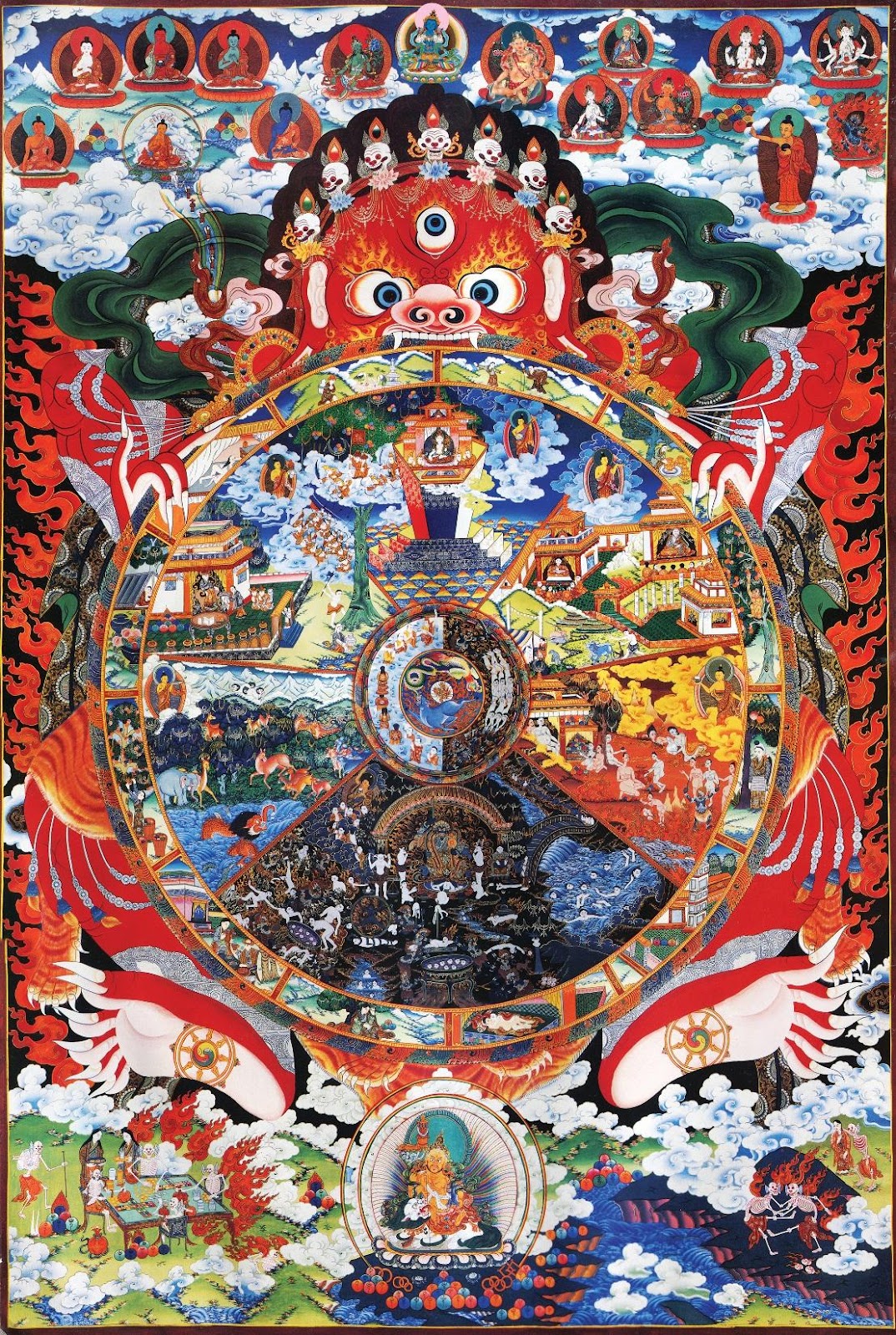
Reincarnation table
5.1 Duyen Khoi
At the time of the Buddha Shakyamuni, the Buddha's great disciple, Maudgalyāyana, was able to travel throughout the different realms, clearly seeing the suffering nature of the life of the hell realms, the demons. ... including the gods. He then returned, describing the suffering in the six paths to fellow practitioners and Buddhists, so that everyone was aware of the suffering of samsara, generating training and some won awards. exit. Seeing so the Buddha taught that to benefit all sentient beings, his disciples in the temples follow and draw a samsara to describe the whole operation of life, the operation of all things & the operation of cause and effect.
5.2 Reincarnation picture
You can see, the wheel of reincarnation has four layers or four concentric circles: the circle or the central axis, the second is the cycle of karma, the third is the circle of suffering and the fourth is the round of twelve conditions. At the center axis of the wheel are the three syllables OM AH HUNG, which symbolize the body of enlightenment, the pure essence of the three defilements of attachment.
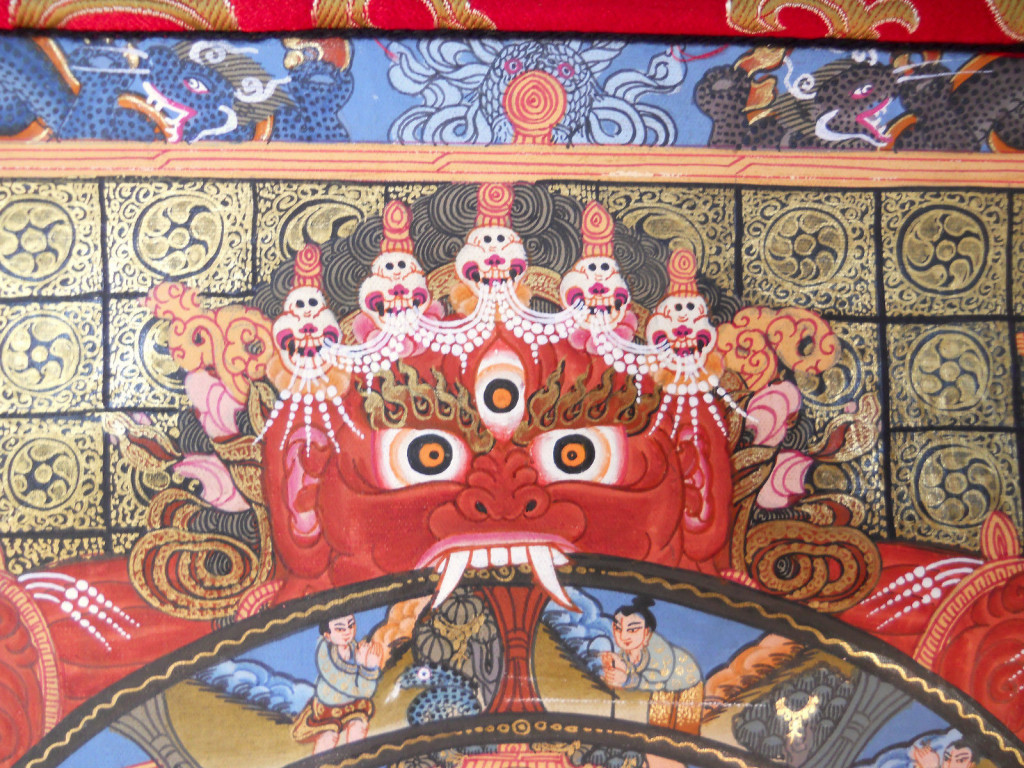
The whole wheel held by the Impermanence (ie Death) held by the fangs and sharp claws of the limbs, surrounded by the burning fire symbolizing the impermanence of impermanent suffering. All Samsara - Or, Karma, Suffering, 12 Causes and Conditions - falls within the claws of an impermanent devil, stating that the whole of samsara is governed by impermanence, reincarnation only means suffering and impermanent.
The skull cap on the Devil's head also expresses the meaning of impermanence, at the same time, its tail is endlessly long indicating the infinite beginning of samsara. The impermanent Devil has three eyes in which the third eye is the wisdom eye, implying that the awakening of the transient impermanent nature of samsaric existence will create the impetus to awaken the supernatural wisdom that will motivate human beings suffering goes on the journey to liberation to become enlightened Buddha.
Below the Impermanent is the cemetery, the skeletons are gambling, stating that the life of all happiness, suffering, fame and fortune is just luck and gamble. On the right corner, there are paintings of skeletons fighting over each other, indicating that we have abandoned our bodies and then accepted our bodies.
Thien Vuong's treasures in the middle of the graveyard with the surrounding pearls and jewels: In the midst of such impermanence of death, there is still the greatest wealth, that is enlightenment.
Above the Impermanence is the realm of liberation, the pure lands of the Buddhas. We can see the Buddha holding out his hand to lead us, but we are not seeing because we are engrossed in samsara.
Although the realm of reincarnation, there is still a path of light to come out - that is, thanks to the wisdom of Dharma practice to overcome suffering samsara, Buddhas are still ready to wait for the teachings.
T thirstily wheel bearing layers of meaning as follows:
Circle Or (delusion) : also known as the affliction. This circle is located at the central axis of the picture, stating that the three defilements are the underlying cause and motive for the operation of samsara. This round will command the remaining rounds and draw the whole picture of samsara. The three animals in the circle, or the rooster, the pig and the snake, symbolize the three defilements, which are basically greed, confusion and anger. These three negative afflictions with each intimate relationship should be represented by the image of three animals biting their tails to run around. This is the origin of the endless afflicted and unwholesome world that Buddha called samsara .
At the center of the whole cycle of samsara is the symbol of the primordial purity mind, which is the basis for reversing or breaking the wheel of birth and death. It also embodies a profound philosophy that, ultimately, negativity or enlightenment are just two unifying aspects of a reality. Defilements of defilement will lead to samsara, and if one realizes the immaculate mind's pure nature, the cycle of reincarnation will be broken, and there will be peaceful liberation.
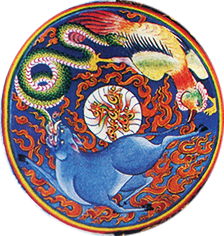
Round Or
Virtuous Karma: Greed and hatred are the causes of all actions, speech and actions that lead to the creation of karma. Karma is shown as the second circle dividing the black and white halves surrounding the Or. The left half has a white background of sentient beings. The right side has a black background of evil karma beings. The two halves of the same circle of meaning of good karma and negative karma are always alternating and parallel, exchanging one another in the life of samsara of sentient beings, just like the reality of life that we are always creating at the same time. both bad karma and good karma. Whether it is good karma or bad karma, it is still dominated within the karma, the result of these karma still only engulfing sentient beings in samsara.
However, there is a thin line that symbolizes the Middle Way, connecting from the Karma circle, leading sentient beings to the realm of the Buddhas outside the cycle of reincarnation. The rope symbolizes the only way to lead beings beyond samsara to attain happiness and true liberation.
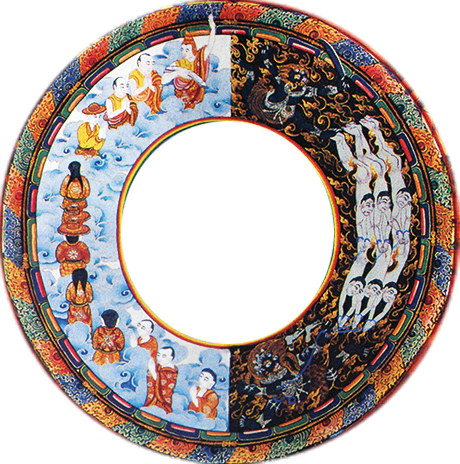
Karma
The Suffering Circle: is the third circle, surrounding the Industry cycle, divided into six parts corresponding to the six realms of reincarnation, that is, the heaven, the astral world, the human realm, the hell realm, the ego realm, and the animal realm .

The lower ring of the Suffering Circle is the realm of Hell, which is felt by the negative karma of sentient beings. This realm is the place where sentient beings' suffering goes to extremes and lasts endlessly, with two typical types of hot and cold hell. The negative karma created by the mind of hatred, extreme anger is the cause of this.
Human life in this realm is committing 5 karmic actions (killing the father, killing the mother, destroying the Sangha, making the Buddha's body bleed) and 10 negative karma (killing, lusting, evil, double-edged, weaving, lying) , greed, hatred, si).

The Hell realm is illustrated with monstrous images, large heads, large bellies, small necks like needles, and mouths often spewing red flames. This realm is made up of bad karma due to the greedy and miserable mind that is pushed to the extreme.
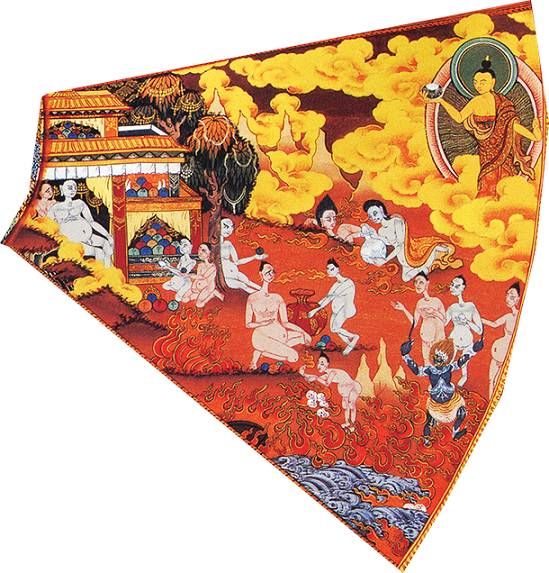
The animal realm has its origins mainly caused by ignorance and delusion. Beings in this world suffer from hunger, maltreatment, killing each other and being mercilessly killed by humans.

The Human Realm is established on the basis of desire and desire to discover and enjoy. This is a place where happiness and suffering are perfectly interwoven together to inspire people towards a spiritual journey. The cause for birth into the human realm is the observance of the five precepts (no killing, no drinking, no adultery, no stealing, no lying).

The realm of Atula is characterized by the mind of jealousy, so the beings in this realm always struggle but always lose. An interesting illustration is that the Wish Tree (the Tree of Life) grows in the Atula realm but bears Longevity in Heaven, which makes Atula jealous, always at war with the gods. The cause leading to rebirth in the Atula realm is the creation of kusala kamma but there is still jealousy and envy.

Above the Circle of Suffering is the heavenly realm, characterized by a full and joyful life and a long life. Beings are born here by 10 good karma, which is not to kill lust (evil, two tongues, weaving, lying), greed and delusion.
However, the devas suffered in great suffering upon the retribution, they were faced with death and debauchery to the lower realms. This realm is symbolized by arrogant mind. Doing good, but lacking in wisdom, is still attached to what you do, which leads to rebirth in this realm.

Each realm has a Buddha standing in the clouds, implying that all the realms of samsara, no matter how terrible and painful, always have the opportunity to free the internal evidence. All sentient beings in samsara, no matter where they float, are always ready to have Buddhahood and can become Buddhas!
The above is an explanation of the cycle of reincarnation in the sense of describing the realms of samsara as the result of the respective karmic causes. However, on a deeper, more subtle level of meaning, the Suffering Circle is also a description of mental states. In this respect, we can say that every day, even in every moment, we have enough experience of the six realms of samsara. When we initiate anger, it is the experience of hell in ourselves. When arousing greed, we become a being of the Devil. When we start in the ignorance and delusion, we experience the state of Animal birth. When pride takes pride, we experience the state of mind of the devas. If there is jealousy, jealousy, we will become Atula. Thus, if we reflect on reflection every day, we find our mind constantly reincarnating in the six paths. So,
Round twelve predestined
This cycle is like the chain of twelve interdependent links, illustrating the process of birth and death and the explanation for the functioning of the mind. Ignorance ignorance is mentioned first because that is the basic cause, then, in order of predestined, we have: Onions, Consciousness, Identity, Six Names, Contact, Accept, Love, Prime, Huu, Sinh, Geriatric sickness.

Round Twelve predestined
1. Ignorance:
Ignorance is ignorance, no wisdom, does not comprehend the natural truth. Those are the truths such as the Four Noble Truths, Twelve Causes and Conditions, ... enlightened and enlightened by the Buddha for sentient beings. That ignorance, delusion includes three basic aspects of body, mind and sight. Specifically, the physical body is mistakenly perceived as the "I", but in reality it is only a combination of the five "aggregates" of materiality, perception, perception, action and consciousness. The mind is always changing, the states of mind are arising and falling away, but we mistakenly believe that there is a permanent mind, that is "my mind". External factors such as the environment of environment, phenomena in life also constantly undergo the processes of arising, transformation and destruction but we always tend to think that they exist and do not exist. can be lost. Such as my house, my property, ... Collectively, impermanence, non-self , misery and nonness of all phenomena. That is ignorance, the basic motive that causes sentient beings to be stuck in samsara.
Ignorance is illustrated by the image of the blind old lady walking in the middle of the bone forest: blindness is the lack of wisdom, the bone forest represents countless countless lives rolling in samsara.

Tears of Ignorance
2. Onions
Ignorance is the cause of erroneous artifacts, called "Ignorance of Action".
All our actions are accompanied by motivation (good, unwholesome or unscrupulous ), creating corresponding karma.
The present results are caused by the corresponding actions of body, speech and mind created in the past. Verbal actions in the present will bring about corresponding results in the future. All created karmas are accumulated as seeds in the tantric disciple , which is the potential karmic energy that leads the journey to arise later.
The image of the craftsman making jars of pottery implies that the craftsman can shape them into different shapes and sizes, just as different practices will give different results. The one who moldes us is ourselves, responsible for our own actions and speech.

Onion
3. Consciousness
Consciousness is the whole of our consciousness consisting of the Eight Conscious Realms, indicating that the discriminating knowledge remains in a deluded state.
In the cycle of birth and death, under the guidance of Karma, the consciousness goes to find the womb to be reborn, to find a new life for itself. So called "Onions of Consciousness". After entering the fetus, the Tibetan consciousness first, then in turn arise the remaining seven consciousness.
The consciousness is illustrated by the image of a monkey holding fruit in its palm, jumping from tree to tree, implying that due to karma, the mind moves from the past to the present, from the present to the future, creating countless rebirths in samsara.

Ring
4. Identity
Indications for psychological and mental factors. Sac only for physiological and physical factors. In the journey of rebirth, the consciousness rejoices to see the image of future parents communicating and immediately into the womb, clinging to the fusion of the father and mother's blood drops, forming the fetus and creating a new life. The spirit is Danh and the parent spirit is Sac. So called "Awakened and Beautiful Names".
Danh and Sac are illustrated with the image of a boat driver, carrying four containers (earth, water, wind, fire), indicating the four elements. The boatman stated the combination of names (including eight consciousness) in which the Tibetan consciousness held the mission to steer the boat. Our physical body is merely a means, while the one who controls it is mentally or mentally. Thus, our boat of life goes to the path of happiness or suffering, liberation or destruction that is determined by the mind - the boatman - deciding.
Or another example, the image of a person with a tree, naming the mind. Sac symbolizes the four great geomancy of fire, ie the human body. The tree symbolizes everything, since the mind and body have formed then there will be a scene of life.
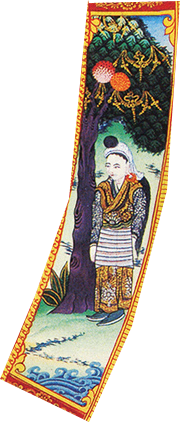
Identify Identity
5. Luc green
The six types of sense perception are for the six senses of perception, namely the eyes, ears, nose, tongue, body and mind. Once the fetus is formed, then there will be the development of the senses, so called "The list of charming coast".
Six bases like six direct door to receive the object of cognition, such as images, colors, flavors, ... (ie six ceiling ). Therefore, the Green Six is represented by the image of a house with six doors.
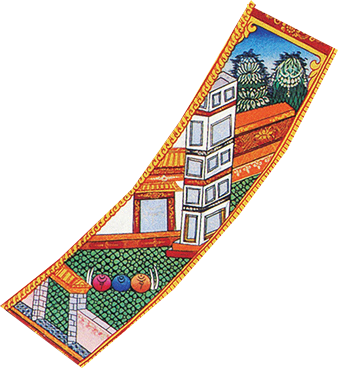
Enter the ring
6. Contact
People come into contact with the external world through the six senses, the six sense-seeing eyes, the sound-seeing ears, the smell of the nose, the taste of the tongue, the body sensing touch, the thought of things, and so on. called "Sixteen conditions to coast contact".
Of all the "contact" mentioned above, the most dangerous is the male and female body contact. Therefore, contact is depicted by the image of a man and a woman touching, implying that this awareness is the source of samsara samsara.
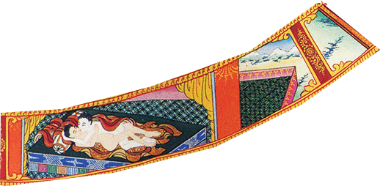
Eyelet
7. Receptor
Acceptance is feeling, sensuality. Sensuality consists of three main types: the feeling of joy (pleasure), the feeling of suffering (suffering) and the feeling of unhappiness and unhappiness brought about by the ignorant mind (called discharge).
When the six senses come into contact with external objects and there is awareness, it will lead to sensation. That's why it's called "Love contact."
Acceptance is just the feeling of causal arising and vanishing. Firstly, it must be full of elements: senses, externalities, discriminatory awareness to have senses. Secondly, that perception is illusory, it has no substance because it has to rely on many conditions and conditions, and is determined by the past karma. For example, two people taste the same food or smell the same aroma, but one person may be uncomfortable and the other may feel interested, the third person may have a neutral, dislike or dislike feeling.
Receptor is depicted in the image of a man with an arrow in his eye, implying that sensuality always leads to suffering. A pleasant, pleasant feeling will lead to the misery of losing that pleasure. Feelings of suffering, unpleasantness will give rise to anger and anger, causing a person to suffer two levels of suffering (called suffering). Feeling neutral but still dominated by delusion will still lead to the misery of creating karma in samsara. In short, whatever sensation leads to suffering.
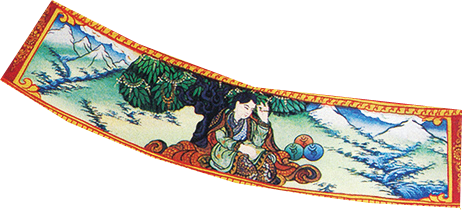
Eyelet Acceptance
8. Ai
When there is a sense of sadness and joy, there will be a desire, attachment, or rejection, called "Loving love". There is hatred will have attachment and vice versa, there is attachment to all there is hatred.
A pleasant feeling of pleasure leads to the desire of the mind. Unpleasant sensations lead to dislike.
Among the types of love, the affection of men and women is more intense and dangerous because it is related to the deep instinct of man. Behind the love praised by mankind with so much ink is the motive to possess, possess and the silent urge of sexuality, the source of the machine that ceaselessly rotates the wheel of samsara.
Craving is depicted by the image of a man who is drinking, the more thirsty (ie, not satisfied) the more he drinks (the more infatuated, the more clinging).
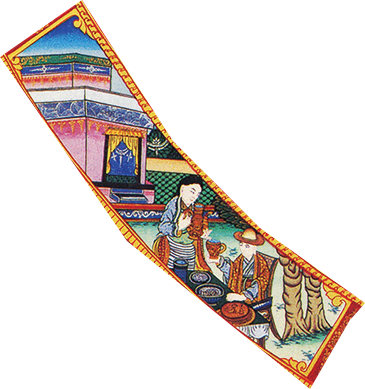
Loving
9. Prime
Player means grasping, holding on, causing attachment. Because of love, attachment should arise attachment, mind grasping, called "Love and Love". That grasping mind is most evident in the attachment, loving the self, taking the five aggregates as me.
The figure is depicted by the image of a woman picking fruits whose fruit may be poisonous or wholesome.
Player can have many types such as clinging to "ego", clinging to personal opinions, clinging to external objects, ...
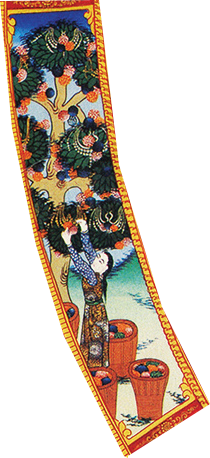
Eyelet Craft
10. Friendship
Friendship means yes, existence or life. Because the attachment must create karma, be the motivation for rebirth, a new existence or a new life. Attachment to the mind of attachment to a single person is the basis for formation in the next life. So it should be called "Prime charm".
Huu is depicted in the image of a woman with the symbol that Huu is a human, like a pregnant woman, later forming a new life. Humanity is to keep the five precepts, the ten virtues are to heaven. With more meditation, the form and formlessness. All good deeds without the enlightened wisdom of Prajna, there is a hidden capacity to bear fruit in the future, extending the path of birth and death, that is, when we are a Buddha or good deeds anything without contemplating the three lifeless virtues (we don't, people don't and giving is not).
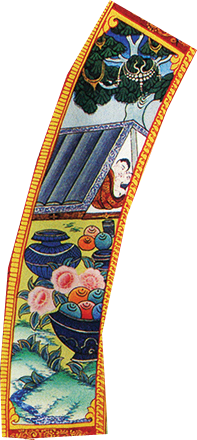
Friends
11. Born
Because the cause has been formed, it will surely lead to the result, which is the rebirth when the predestined relationship is ripe, called "Friendship".
Birth here does not mean the act of giving birth to a specific baby, but rather the resulting formation when the cause of the condition is sufficiently ripe. The result is manifested as a new body carrying a new desire to continue the constant cycle of reincarnation.
The image representing this link is a woman giving birth.
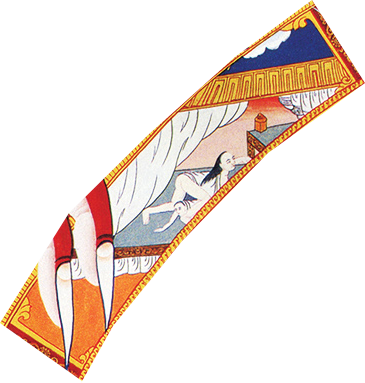
Birthplace
12. Geriatric sickness
There has arisen, forming a life that will surely be old, sick, dead, so it should be called "Born predestined to old, sick, dead."
The sick man is represented by the image of a man walking with a cane and carrying a corpse, and then there is a great burial, the vultures preening.
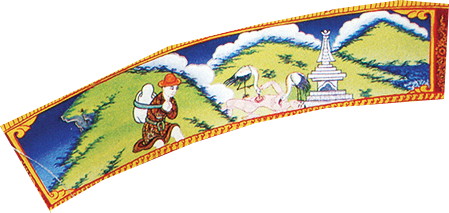
Tearing the disease of death
The cycle does not end here because the element of ignorance always accompanies and is the underlying cause of the cycle of birth and death. Each of the twelve links is very difficult to break together, forming the prison of samsara, so even if we practice virtue, accumulate merit, we can only reap a few results in Samsara.
The twelve conditions are illustrated above in a descriptive perspective explaining the operation of samsara life. At a deeper level, the twelve conditions can be seen as the process of the mind, the subtle cause of samsara.
Looking at the details of the painting, the four cycles of Or, Karma, Suffering and the Twelve conditions are surrounded by the outside of the five-pointed fire. This implies that sentient beings, though immersed in suffering, still contain the possibility of enlightenment. Just transform the delusion, transform the consciousness into the mind, then it will be liberated, end samsara and attain the true happiness. END=NAM MO SHAKYAMUNI BUDDHA.( 3 TIMES ).WORLD VIETNAMESE BUDDHIST ORDER=GOLDEN AMITABHA MONASTERY=VIETNAMESE BUDDHIST NUN=THICH CHAN TANH.AUSTRALIA,SYDNEY.13/11/2019.VIETNAMESE TRANSLATE ENGLISH BY=THICH CHAN TANH.


No comments:
Post a Comment