Buddhist architecture in Vietnam - The soul of the nation.
Most of the Asian Buddhist countries, whether Buddhist or traditional Hebrew, have pagoda architecture with their national identity very clear. Although the architecture of the Theravada Buddhist countries is largely influenced by Chinese culture, Japan, Korea, Mongolia, Tibet, and Bhutan have their own unique architecture.
The same Buddhist traditions in India, but with the influence of Indian culture, Sri Lanka, Myanmar, Thailand, Laos, Cambodia, Malaysia and Indonesia all have their own architectural styles.
Of course, the North American Buddhist system, though unique in architecture, has a common style influenced by Chinese culture. And so is the Buddhist system of Nam Theri, so it is easy to see that besides the pagoda architecture of each peoples in Southeast Asia, there is a common origin from the Indian culture, which is impossible. avoided. Therefore, it should not be confused between the common and the individual, that is, not to try to find a particular eccentric, nor to assimilate to the common but lose its special nationality.
.jpg)
About 100 years ago, in the reign of King Hung, Buddhism was introduced to Vietnam by sea from India by Asoka emperor's mission consisting of many Tay Truc monks, so sure temple architecture Vietnamese early influenced Indian culture. At that time, China did not have Buddhism sent people to study Buddhism with the Indian and Vietnamese monks at the Buddhist cultural center flourished from Co Loa to Luy Lau. Dau Pagoda is one of the vestiges of the prosperity of Buddhism in our country at that time. Later, when Chinese Buddhism developed, during the Northern domination, Vietnamese Buddhism also began to be influenced by Chinese Buddhism.
China is a country with a long history of culture, with their native pride, so when they imported Buddhism from Vietnam or India they also converted into their own Buddhism. It is clear that Chinese Buddhism is influenced by the ideas, rituals, customs and practices of Confucianism and Taoism so that the architecture also tastes temples in accordance with their principles of the Three Jewels. Under thousands of years of domination of the North, Vietnamese Buddhism is inevitably avoided by the influence of Chinese Buddhism, so its original Buddhist influence is increasingly fading, which should be reconsidered. of the original source of Buddhism.
Conscious of this, the Vietnamese monks have the national spirit to try to localize Vietnamese Buddhist architecture, but each time the North was invaded, the Vietnamese style temple was ruined or Destroy and rebuild the model of Chinese temples!
Depending on the national independence of each dynasty, such as Dinh, Le, Ly, Tran, Le, Nguyen or modern, Buddhist architecture in Vietnam also have different towers. For example, the Tran dynasty, the Nguyen dynasty was less influenced by Confucianism, the pagoda's architectural style displayed higher national independence.
Especially the Tran architecture - the time when Buddhism was considered the state religion, not only the flourishing period of Buddhism but the whole Vietnamese nation. King Tran Nhan Tong, a monk who was hiding on Yen Tu Mountain and Mount Vân Vân, the founder of the Trúc Lâm Zen school, had a very real Buddhist understanding of the Buddha's Zen Meditation. With the Zen development of the Chinese Patriarch into a unique Vietnamese-style meditation. Politically, too, over the course of the repulsion of the Northern invaders, the king thought of breaking away from China by linking with Southern countries, then the Phu Nam (Suvannabhumi) - today's Southeast Asia - is directly influenced by the spiritual culture of India.
Thus, the Tran had diplomatic exchanges and cultural exchanges with the Southern peoples such as Champa, Thuy Lap, etc. The wedding of Princess Huyen Tran and the invitation of Buddhist monks to the south consulted, At the same time, the king left home in traditional Theravada Buddhism, learned to pray the Pāli and especially the pagoda construction combined with the culture of the South that most today was destroyed or ruined to rebuild. According to the northern culture (archaeological relics from ancient temples of the Tran dynasty proved to be eloquent).
Due to the continuous devastation caused by the war, there are rare temples that can survive through the ages, and we are dominated by the Northern culture and, later, by the influence of Western culture. It is said that Vietnamese Buddhist architecture not only influenced the great Indian culture but also from Western culture. Therefore, to retain the national identity in the architecture of Tower Vietnam is not easy, everyone can be aware.
Buddhism has many sects, each sect has its own rites, rituals and habits of practice, so the architecture of each temple pagoda should also show their particularity.
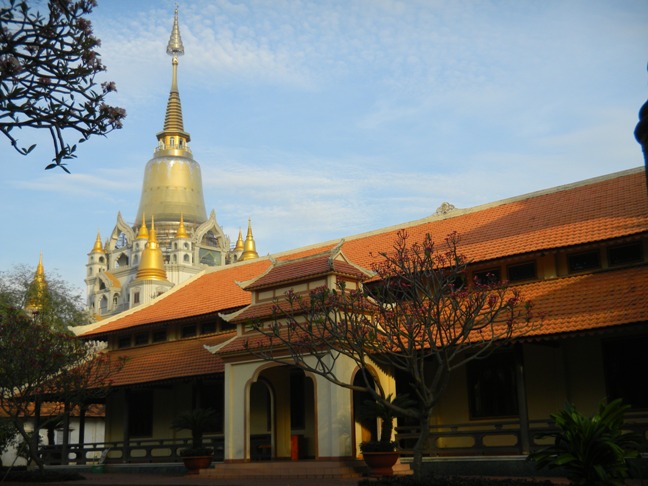
As Nam Tong pagoda should express the strictness, elegance; Pure Temple should be pure, faithful; Tzu teng must be hidden confidential, dignified; The Zen temple should be innocent, clear, etc. .. But generally Buddhist temple inevitably need to excel the superior virtues of Buddhism such as pronouns, great compassion, great wisdom and courage, at the same time express The three criteria of general use are foot, fine, good. The foot is not fake, fine is not rude, good is not useless - new reflects the architectural style is true Buddhist style.
The temple is a guide to the spiritual life of the masses, the lecture is not telling any words so that anyone who just steps into the door of the Buddha will feel a peaceful space calm, a gentle air, such as removing all sorrow. The temple needs to look solemn but not purely solemnly unexplainable mystical superstition fear; Sophisticated but thoughtful, but not too cumbersome to distract the mind; It should be beautifully harmonious but not too luxuriant to express a shallow plain; It should be magnificent majesty but not too ostentatious form to lose simplicity simplicity; need great power hero but not too hard to remove the loss of compassion magnitude; Ordered orderly but not too dry craving lost the natural beauty of the old scene;
A temple of superstitious, luxury, cumbersome, flamboyant, ostentatious or dry, crude, bursting ..., despite the attraction to the masses is not a pagoda expressions true spiritual culture of Buddhism.
Vietnamese gentle, intelligent, simple, outspoken of an agricultural culture and civilized furniture, although modest but very sharp, crystal clear. Particularly, the Vietnamese people have the spirit of openness, generosity, hospitality, studiousness should be ready to receive the beauty or beauty of many foreign cultural flows. It can be said that Vietnamese culture is a multicultural character - a combination of harmonious, timeless beauty of the ancient West and West of the multicultural, multi-directional. However, from that openness it is sometimes easier to imitate, stereotypically than to acquire the creative to suit the national identity. The national spirit of Vietnam is not a form of regulation but the expression of the soul of the Vietnamese. It can be said, architecture that expresses the spirit of Buddhism, and at the same time in accordance with the spirit of the Vietnamese, it is the architecture of Vietnamese pagodas.
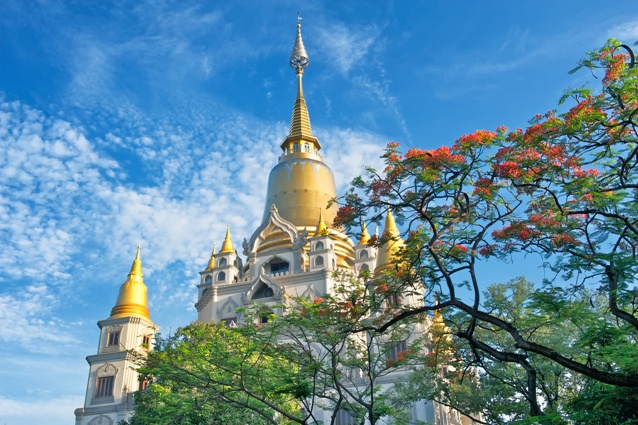
In addition to Buddhism, ethnicity, Buddhist architecture also expresses the age. The ancient architectural culture - the palace, the tomb, the shrine - our ancestors are mostly made of wood in the style of house, stilt house, pavilion, bell tower, etc. with patterns, Sculpture carved extremely sophisticated, beautiful, should be preserved, embellished and promoted. However, if we keep repeating the old pattern, it does not represent the culture of contemporary architecture. In addition, the wood is increasingly rare, the higher the cost, the more likely to be termites, fungus and fire, while wooden houses occupied many columns, although there are hundreds of space, the use of space is limited. Wood substitute with wooden fake concrete. It is also an expression of the era that retains the old-fashioned, worthy of attention development.
Today, due to the needs of the Buddhists, many Festivals, the Buddha's name was erected between the city streets, so the majority of the campus is narrow, lacking space for the natural context of an old monastery . Not long ago, the characteristics of the temple Vietnam is always in harmony with nature and away from the mass a necessary distance as the Buddha taught, but due to population development, crowded population, so the temple pagoda gradually encroachment, narrowing and encroachment between households. Houses, pagodas, parks, natural or man-made forests should be preserved among the city's residential areas so that the ecological environment for all is right. Therefore, the temples still have the condition to maintain a minimum of 50% of the area for the forest or garden rather than dense construction and overdone.
In short, Buddhism is not only the way out of suffering, but also the beauty of the spiritual life, the intellectual and moral foundation of social and human activities: psychology, education, culture, art. , including the field of natural sciences, etc., has brought about a happy life for the whole country - where the pagoda is the place where the spirit of selflessness, Vietnamese history through thousands of years. END=NAM MO SAKYAMUNI BUDDHA.( 3 TIMES ).VIETNAMESE TRANSLATE ENGLISH BY=THICH CHAN TANH.THE MIND OF ENLIGHTENMENT.VIETNAMESE BUDDHIST NUN=GOLDEN LOTUS MONASTERY=AUSTRALIA,SYDNEY.30/9/2018.

No comments:
Post a Comment