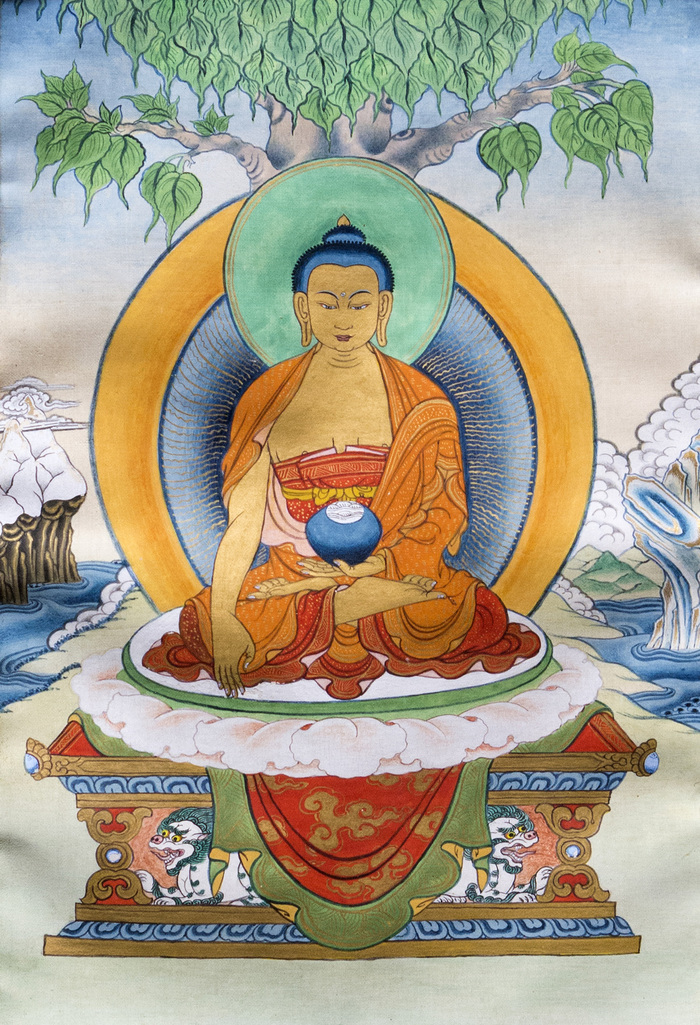
According to the dating tradition, Buddha Shakyamuni ( Shakya thub-pa ), also known as Buddha Gotama ( Gau-ta-ma ), living in the period from the year 566 to 485 BC Native in North Central India. The sources of Buddhism have many different accounts of his life, over time, more and more details appear. Since the earliest Buddhist literary materials were written only three centuries after the Buddha's passing away, it is difficult to ascertain the accuracy of the details found in these accounts. Also, just because some details in the text form appear later than the other details, there is not enough reason to ignore their value. More details may have been given after the other details were written. Moreover, the traditional biographies of great Buddhist masters, including the Buddha himself, are often compiled for the purpose of teaching, not for archival material. More specifically, the biographies of great masters have been written in a way that teaches and inspires Buddhists who are pursuing the path of spirituality, liberation and enlightenment. So, in order to benefit from the story of the Buddha's life, we need to understand the story in this context and analyze the lessons that one can learn from it.
Origin of material
The earliest sources on the life of the Buddha include, within the Theravada Buddhist scriptures, a few texts from the Pali Majjhima Nikaya ( The Collection of Middle -Length Discourses , Pali: Majjhima Nikaya, and from the various Hinayana schools, some of the Discourses on the Vinaya, concerning the monastic rules of conduct. However, each of these sutras points to small pieces of the Buddha's life. The first narrative more extended appearance in the Buddhist poetry in the late second century BC, as Business Ambassadors ( Great Matters, Sanskrit: Mahàvastuof the Mahasanghika school of Hinayana. It does not belong to the Tripitaka ( Three Sutras , Tripitaka , Three Baskets , Sanskrit: Tripitaka , Three Baskets ), this text adds details, in addition to the Tripitaka ( sDe-snod gsum , Sanskrit: Tripitaka , Three Baskets ), such as the Buddha was born Prince in a royal family. A contest that appeared in the texts of Sarvastivada schools, belong to Theravada are: Universal Dieu Kinh ( The Extensive Play Sutra , Sanskrit: Lalitavistara Sutra). The later Mahayana texts of this work ( rGya-cher rol-pa'i mdo ) borrowed and refined the details based on the previous version, for example by explaining that Shakyamuni was enlightened. Long before, and the reincarnation of Siddhartha Gautama, only to prove the path to enlightenment, to guide sentient beings. Finally, some of these biographies are included in the Tipitaka . The most famous is the legend of the Buddha ( Deeds of the Buddha , Sangs-rgyas-kyi spyod-pa zhes-bya-ba'i snyan-ngag chen-po , Sanskrit: Buddhacarita ) by the poet Ashvaghosha ( rTa-dbyangs) written in the first century AD. Other texts appear later in Tantras, as in Chakrasamvara (' Khor-lo bde-mchog' ). Here, we find the narrative that, while appearing as Germany Shakyamuni, preached Beijing Prajnaparamita ( Sutras on Far-Reaching Discriminating Awareness, Sher-phyin MDO , Prajnaparamita Sutras , Perfection of Wisdom Sutras , the Buddha simultaneously transformed into Vajradhara and teaches tantras. From each narrative, we can learn something and get inspiration. However, it is essential to consider the texts depicting the historical Buddha.
Birth, Inner Life and Separation
According to the earliest accounts, Shakya thub-pa was born into a warrior family, a wealthy nobleman in Shakya, whose capital was Kapilavastu ( Kapilavastu , Ser-skya'i gnas ), located on the border between India and Nepal today. There is no mention of His birth as Prince in a royal family. Only in the later narrative comes to his new born a prince and named Siddhartha ( Siddhartha , Don-grub ). His father is Sanskrit (Shuddhodana, Zas gtsang-ma ). In later writings, his mother's name was Ma Gia (Maya-devi, Lha-mo sGyu- 'phrul-ma) also appears, as well as the narrative of the Buddha's miraculous conception of the dream, Ma Gia saw the white elephant six tails go to her side and the prophecy of the Asiatic sage ( Asita), that the child would become a great king, or a noble sage. Later, there is also the description of the pure birth of the Buddha from the side of his mother in a place not far from Kapilavastu, in Lumbini Grove, Lumbi-na'i tshal . He walked seven steps at birth and said, "I have come," with the death of his mother after he was born. In his youth, the Buddha lived a happy life. He married and had a son Rahul (Rahula, sGra-gcan 'dzin). In later writings his wife, Yashodhara, Grags' dzin-ma , was listed . However, at twenty-nine years old, the Buddha renounced his family life and his royal heritage, became a beggar ( dge-sbyong , Sanskrit: shramana ).
It is important to look at the mind of the Buddha in the context of society and time. When he became a wandering mendicant, the Buddha did not abandon his wife and children, so that they lived alone in poverty. They were certainly taken care of by his wealthy family. Moreover, the fact that the Buddha belonged to the warrior class meant certain that he would have to leave his family someday. The family of a warrior must accept this, as this is the duty of the man. The warriors of ancient India did not bring their families to the barracks. Although the battle may have been against external enemies, the battle was really against the enemies within us, and this was the battle that the Buddha had left to fight. The Buddha left his family for this purpose, indicating that it was the duty of a person to direct his or her whole life to pursue a purpose. However, in our modern world, if we leave our family to become monastics and launch this inner battle, we need to ensure that our family members are well cared for. This means not only worrying about the needs of your spouse and children, but also for our aging parents. However, whether one is leaving the family or not, the duty of a Buddhist to follow the spiritual path is to alleviate suffering by overcoming the passion for pleasures, To overcome suffering, the Buddha wanted to understand the nature of birth, aging, illness, death, rebirth, sadness and ignorance. Some time later, a more extensive text of this appeared, through the story of Sanna, the charioteer, who took the Buddha on a journey through the city. When he saw the sick, the old, the dead, and the ascetic, Sanna explained to him these people. Thus, the Buddha has clearly identified the true suffering that all people must experience and the possible way out of suffering. The episode involving the help of the charioteer on the spiritual path correlates with the story of Arjuna in his Bhagavad Gita ( Srid-sgrub ), hearing his charioteer Krishna ( Dom- pa nag-po) talks about the urgency of pursuing a warrior's duty like him, and fights in a battle against his relatives. In both cases of Buddhists and followers of Hinduism, we can all see a deeper meaning of going beyond the walls of our comfortable life, with the familiar and Never give up the duty to find the truth. In each case, perhaps the carriage represents the vehicle of the mind that leads to deliverance, and the driver's words express the motivation of that carriage, namely the truth of reality.
Tuition and Enlightenment
As a single person wandering the path, the Buddha studied with two masters of methods to reach different levels of concentration ( bsam-gtan , Sanskrit: dhyana) and formless. Although he was able to attain profound states of perfect concentration, no longer experienced the vulgar suffering, or even the ordinary happiness of the world, he was not satisfied. These higher states of mind are only temporary, not the permanent deliverance of the negative emotions, and certainly not the more profound, profound suffering that he have tried to overcome. Later, he practiced ascetic practices with five fellow initiates, but this practice also did not eliminate the deeper issues related to samsara ( khor- Three , Sanskrit: samsara ). The Buddha's termination of fasting after six years of ascetic practice on the Nairanjana River, Kaj-bo Nai-ranyja-na ), with Sujata, Legs-par skyes-ma offering him a bowl of milk rice, appear only in later reports. For us, the example of the Buddha shows that one should not only be satisfied with complete retreat, or attain the feeling of "sublimation" through meditation, regardless of the artificial means such as narcotic . Entering into a deep coma, or tormenting or punishing yourself is not the solution. We must walk the path to liberation and enlightenment, not to be satisfied with spiritual means that can not lead us to these goals. After leaving the ascetic practice, the Buddha meditated alone in the jungle to overcome fear. Inside fear is the attachment to self and the clinging to "self" can not exist, they are even stronger than the urge to seek the inner pleasure and entertainment. So in the works Falun of sharp weapon ( blo-sbyong mtshon-cha'i 'khor-lo ) in the 10th century BC, an Indian guru Dharmarakshita ( Dharma-rakshi-ta ) used the image of the peacocks wandering in the jungle to represent the bodhisattvas using and transforming the harmful emotions of greed, to help them break free from attachment and grasping. Get a "me" can not. After meditating on meditation, the Buddha was completely enlightened at the age of thirty-five. Later accounts also provided details of his enlightenment under a bodhi tree (by-chub-kyi shing) in Bodh Gaya, rDo-rje gdan, today, after successfully blocked the attack of Mara (bDud). This enchanted Mara tried to discourage the Buddha from enlightening by displaying scary or tempting images that disturbed the Buddha's meditation under the Bodhi Tree. According to the first accounts, the Buddha was completely enlightened by attaining three types of knowledge: complete knowledge of all his past lives, karma and rebirth of all sentient beings, and the Four Noble Truths. Later accounts also explained that with enlightenment, the Buddha achieved omniscience.
Teaching and Forming the Sangha
After achieving liberation and enlightenment, the Buddha was reluctant to teach others how to achieve such accomplishments. He felt that no one would understand this. However, the Brahma, Tshang-paand Indra ( dBang-po ) begged Him to teach. According to the teachings of Brahman which later developed into Hinduism, Brahma was the god who created the universe and the Noble Truth was the King of the gods. In his supplication, Brahma told the Buddha that this world would suffer a lot of suffering if the Buddha did not teach, and at least some people would understand His words. This detail can be a satirical element that shows the triumph of the Buddha's teaching, surpassing the traditional Indian spiritual methods of his day. After all, if even the greatest gods recognize that the world needs the teachings of the Buddha, because they themselves lack the means to help sentient beings permanently end suffering; then we are ordinary disciples, more need these teachings. Moreover, in the image of Buddhism, Brahman represents arrogance. The false belief of this heaven that he is an all-powerful creature represents the pattern of false belief in self. It exists as an impossible "me" - namely an "I" that can control everything in life. Such false beliefs will surely bring disappointment and suffering. Accepting the request of Brahman and the Precept, the Buddha went to Saarn (Sarnath) and in Deer Park, Ri-dags-kyi gnas , Sanskrit: Mrgadava , He taught the Four Noble Truths Five of his former classmates. In the image of Buddhism, the deer represents harmony, so the Buddha taught a means of peace, avoiding the extremes of hedonism and asceticism. Soon, some youths in Benares (Varanasi, Va-ra-na-si) also joined the Buddha as wandering mendicant, strict lifestyle bachelor. The parents of these people became disciples at home and began practicing for the troupe. When one of the monks was fully trained and qualified, the Buddha sent him out to teach others. In this way, the group of followers of the Buddha quickly developed and soon they settled and formed separate communities of "clergy" in many places. The Buddha organized these clergy communities according to practical principles. Monks, if we can use this term from the beginning, can accept candidates who join the community, but they must follow certain limits to avoid clashes with secular authorities. Thus, the Buddha did not allow criminals, royal servants such as the military, slaves who had not been freed, and those who had infectious diseases such as leprosy to enter the community. monk. Moreover, those under the age of twenty are not accepted. The Buddha wants to avoid any trouble and ensure the people's respect for the clergy and the Buddhist community. This shows us that, as disciples of the Buddha, we need to respect local customs and act with respect, Soon afterwards, the Buddha returned to Magadha, Yul ma-ga-dha , where Bodh Gaya was located. He was King Bimbisara (Bimbisara, gZugs-can snying-po ) , who became a benefactor and a disciple of the Buddha, invited to the capital, Rajgir (Rajagrha, rGyal-po'i khab ) - Today is Rajgir. There, the friends of Shariputra, Sha-ri'i bu and Maudgalyayana, Mo'u dgal-gyi bu, also joined the growing Sangha of the Buddha and became some of his closest disciples. Within a year of enlightenment, the Buddha returned to his hometown of Kapilavastu, where his son, Rahula, also joined the sangha. Before that, the other brother of the Buddha was Nan (Nanda, dGa'-bo ) tuấn, also left the family and joined the sangha. The Buddha's father, Shuddhodana, was saddened by the lack of any followers of the lineage, so the king asked the Buddha that in the future, a son in the family must have the consent of the Buddha. New parents are joining the sangha. The Buddha totally agreed. This narrative indicates that the Buddha was not ruthless with his father, but showed the importance of avoiding aversion to Buddhism, especially in our family. There is a later incarnation of the Buddha's encounter with his family when he uses his magical powers to go to the Three Senses Realm, or according to some documents, the Tushita, dGa ' -ldan ) to teach his mother, who was reborn in this realm. This shows the importance of gratitude and repayment to the mother.
Development of the Sangha
The early Buddhist communities of the Buddha were small, no more than twenty. Each autonomous community and boundaries are set for the monks' begging. The actions and decisions of each community are made by unanimous vote in the group to avoid discord. No one is allowed to be the sole authority. Instead, the Buddha instructed them to see the dharma itself as power. Even the sangha can also change, if necessary, but any change must be based on the consensus of the whole community. King Bimbisara suggested Buddha accepted custom of other mendicant groups, such as Jainism (Jains, gCer-bu-pa ) , held a ceremony to reveal Penance four month period (gos-sbyong, Skt. uposhadha). According to this custom, members of the clergy community will gather at the beginning of each quarter in each lunar month to discuss the teachings. The Buddha agreed, revealing that he was open with customary offerings of every moment. In fact, the Buddha modeled many aspects of the spiritual community and structure of his Jain teachings. Mahavira, the founder of Jainism, lived before the Buddha for about half a century. Soon after, Shariputra asked the Buddha to establish the rules of the Sangha. However, the Buddha decided to wait until the specific problems had arisen and then made a vow to avoid the recurrence of a similar case. The Buddha used this approach for both types of behavior, natural destructive behaviors, harm to the offender, and neutrality of moral conduct for some in one. case number, for some reason. Thus, the precepts ( dul-ba, Sanskrit: vinaya ) are very pragmatic and specially formed, with the Buddha's main concern being to avoid problems and not to create transgressional acts. . Based on these precepts, the Buddha instituted the chanting of the four congregations each month, with the monks openly admitting any transgressions. Expulsion from the sangha will occur for the most serious offenses, in addition the offender will only have to go through the probation period. At a later time, such meetings are held twice a month. The next rule of the Buddha is the retreat of the three rainy months ( dbyar-gnas, Sanskrit: varshakaDuring this time, the monks must stay in one place, avoid traveling. The purpose is to prevent damage to the crops when the monks have to cross the fields when the roads are flooded. Maintaining a peaceful retreat of the rainy season led to the establishment of permanent monasteries. Again, this development happens to avoid any harm to the lay community and to their respect. The construction of fixed monasteries was also approved because it was practical. Starting from the second rainy season retreat, the Buddha spent twenty-five summer retreats in the jungle of Jetavana ( rugal-rgyal-byed-kyi tshal ) outside Xa Ve (Shravasti, gNyan-yod ) , the capital of the kingdom to turn off the La (Koshala, Ko-sa-la). Here, traders Anathapindika (Anathapindada, mGon-med Zas-sbyin ) built a monastery for Buddha and the Sangha of him, and King Prasenajit (Prasenajit, rGyal Singapore GSA-rgyal ) also told Additional support for the sangha. The monastery at Jetavana is where many great events took place during the Buddha's life. The most famous of these events was his defeat of the chiefs of the six major pagan schools of his time, in a miraculous competition. Today, none of us can perform miracles. However, the Buddha's use of supernatural powers instead of using his argument to defeat his opponents shows that when the mind of others is not open to reason, the best way to convince them of value Their own understanding is to prove their empathic ability by doing and acting. There is a saying in English: "Action has a greater resonance than words."
Phuc Lap Nhan
In career labored later Buddha, he established a community of nuns in Vaishali (Vaishali, Yangs-pa-can ), at the request of the aunt he is Ms. Ma Ha Ba Xa Ba Title (Mahaprajapati, sKye-dgu'i bdag-mo chen-mo ) . At first he was reluctant to initiate such a nun, but he decided that it would be possible also if he made more vows for the nuns than the monks. In doing so, the Buddha does not mean that women are less disciplined than men and that they need to be more cared for by keeping more men. Rather, he was afraid of the establishment of a nunnery that would bring about scandal and his teachings would soon end. After all, the Buddha wanted to avoid the disrespect of the masses everywhere, so the nuns needed to overcome any suspicion of unscrupulous behavior. In general, however, the Buddha was reluctant to formulate precepts and was willing to remove some of the smaller rules if they were considered unnecessary. His policy shows the dynamics of the two truths - the deepest truth and respect for conventional truths in accordance with local custom. Although in the deepest truth, there is no problem with making a nihil; However, to prevent civilians from underestimating Buddhism, it is necessary to have more rules for nuns. According to the deepest truth, no matter what society says, it does not matter; However, according to conventional wisdom, it is important for the Buddhist community to be respected and respected by the public. So in modern times and societies, Finally, tolerance and compassion are the key principles in the teaching of the Buddha. For example, he encouraged new Buddhists who had previously supported other religious communities to continue the support. In the Sangha too, He also instructed the members to look after one another. For example, if a monk is sick, the other monks must take care of that person, because they are all members of the Buddhist family. This is also an important precept to all lay Buddhists.
The Teaching Method of the Buddha
The Buddha taught everyone by his living example, by his teachings. About the instructions, he applied two methods, depending on when he was teaching a group or an individual. Before the audiences, the Buddha would preach in the form of sermon, often repeating the point with different words, so that the audience could remember more thoroughly. However, when the counseling was given to individuals, usually after the meal, when a family invited him and raised him, the Buddha would use a different approach. He never objected or challenged the viewer's position, accepted their position and raised questions to help the listener clarify their thoughts. In this way, the Buddha led the listeners to improve their stance and gradually gain a deeper understanding of reality. Another example is the Buddha's guidance to a desperate mother who brought her child's corpse to the Buddha and begged him to help the baby to live again. The Buddha told her mother to bring him a mustard seed from a house where death had never occurred, and he would see what could be done to help her son. That woman went from house to house, but every family was dead. Gradually, she realized that everyone had to die and that she was able to calmly bring her child to the cremation. The teaching method of the Blessed One shows us that when we help others deal with personal problems, it is best not to confront them. The most effective way is to help them think for themselves. However, for groups of people who want to learn the Dhamma, we need to explain it in a straightforward and clear way.
The plot against the Buddha and the Cockroach
Seven years before the Buddha entered his nirvana, his jealous cousin, Devadatta, Lhas-byin , attempted to steer his congregation. Similarly, Ajatashatru, Ma-skyes dgra also plans to take over his father, King Bimbisara, the ruler of Magadha. So the two together make plans. Prince Siddhartha tried to murder King Bimbisara, and the king finally gave up the throne, sending the throne to his son. Seeing the success of Prince Siddhartha, Devadatta asked the Prince to assassinate the Buddha, but all the machinations that killed him failed. Devadatta then attempted to persuade them to leave the Buddha by claiming that he was "more holy" than his cousin, and therefore proposed a rigid rule of law. than. According to " The Path of Purification," of the great Buddhist monk (Buddhaghosa), a Theravada Buddhist teacher in the fourth century BCE, Siddhartha offered to the monks include:
Wearing patches from torn cloth,
just wearing three robes only,
go begging and never accept the invitation to eat the boys,
do not miss any home when begging,
Take up a bowl of food to eat
just eat from his bowl
refuse all other food,
just living in the forest,
living under the tree,
living outside, not in the home,
mostly living in tombs,
Satisfied with the shelter I found while traveling from one place to another,
Sleeping, never sleeping
The Buddha says that if one wants to apply more of these rules, then he does not force anyone to do so. However, some of his monks have chosen to follow Devadatta, leave the sangha of the Buddha and set up their own sangha. According to Theravada Buddhism, the precepts prescribed by Devadatta are called the thirteen virtues ( dhutanga ) . The tradition of monks living in the forest remains to be found, for example in today's Thailand, which seems to derive from this practice. Mahakashyapa, ' Od-bsrung chen-po ,' the disciple of the Buddha, is the most famous practitioner of this strict discipline. Many forms of the precepts are also used by the monks (Sanskrit: sadhu ), in the Hindu tradition. Their practice seems to be the traditional continuation of the wandering monks during the Buddha's time. Mahayana has a similar list of twelve specific virtuous dances ( sbyangs-pa'ispaceyon-tan, Sanskrit: dhutaguna ) . This item removes the "do not miss out on a home", adding "what was thrown out of the trash", which included two "begging" and "eating only" "into one. The Mahayana sects ( grub-thob chen-po, Sanskrit: mahasiddha ) of the Indian tradition later followed most of these precepts. They are present in both religions, Mahayana Buddhism and Hinduism. The separation from the Buddhist tradition has been strengthened, and the establishment of another Sangha - for example, in the modern era, the establishment of a separate Buddhist center - is not a problem. This action, in itself, does not create a "separation within the monasticcommunity," one of the five opposing states (mtshams-med lnga) . However, Devadatta created the separation and committed such a sin, because the group of monks detachment and followers brought a great deal of illusion to the clergy community of the Buddha and criticized them vehemently. According to some accounts, this wicked destiny has lasted for several centuries. This narrative of separation reveals that the Buddha is extremely tolerant and not a fundamentalist. If his disciples wanted to apply more severe discipline than he had set for them, that would be fine; And if they do not want to do so. No one is obliged to practice what the Buddha taught. Even if a monk or monk wants to leave the congregation, that is fine. What is extremely negative, however, is the division of the Buddhist community, especially the detachment of monks and nuns into two or more groups in which one or both groups are malicious together. discredit or ruin one another. Even participating in one of these conflicts later and participating in hatred for the other side is extremely harmful. However, If one of these groups is involved in destructive or destructive behavior, or the practice of evil rules, your compassion will call on everyone to be wary of the danger of joining the group. However, your motivation for doing this must never be mixed with your mind, your hatred, or your desire for revenge.
The Buddha was born
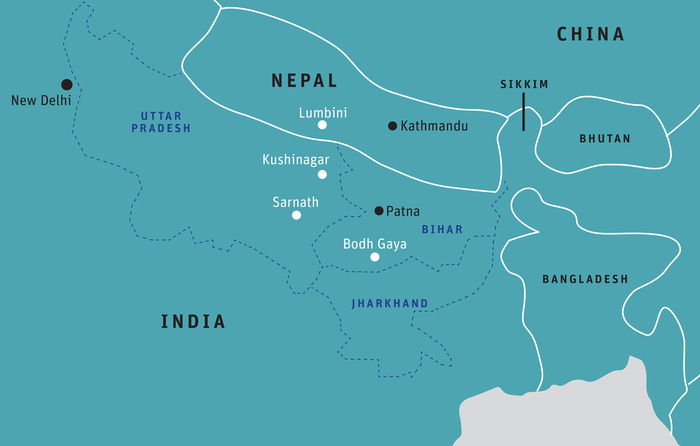
Although, when he attained liberation, the Buddha passed the ordinary death without control; However, at the age of eighty-one, the Buddha decided that teaching his disciples understanding of impermanence would be beneficial, and that he had left his body. Prior to doing this, He gave His attendant Ananda ( Kun-dga'-bo ) an opportunity to ask Him to live and to teach longer, but Ananda did not understand the suggestion. mind of the Buddha. This shows that a Buddha teaches only at the request, and if no one asks or cares anymore, he will go elsewhere, where he can be more beneficial. The presence and teachings of a teacher depend on the disciples. Then at Kushinagara, Ku-sha'i grong-khyer, gNas rtsva-mchog) , at the home of Chunda, the Buddha was seriously ill after receiving the meal because of his offering to him and his monastic group. In the last moment, the Buddha told the monks that if they had any doubts, or had questions that did not answer, they should rely on His teachings and the principles of their precepts. . Those things will now be their teacher. Thus, the Buddha pointed out that each person must answer his questions from these teachings. No one has absolute authority to give an answer. Then the Blessed One exiled. Sanya was completely distraught when she thought she had poisoned the Buddha. But Ananda comforted the host, saying that he had, in fact, created a great karmic force, or "great merit", when he offered the final meal to the Buddha before he died. The cremation ceremony was performed for the Buddha, and his relics were seated in the stupas - monuments containing sacred relics - especially in places where four pilgrimages were celebrated for Buddhists:
Lumbini, where the Buddha was born,
Bodh Gaya, where the Buddha attained enlightenment,
Sa-no, where he gave the first Dharma,
Thi Thi Na, where he died.
Conclude
Different Buddhist traditions have different accounts of the life of the Buddha. That difference shows how each tradition perceives the Buddha and what one can learn from his example.
Hinayan texts only talk about the historical Buddha. By exemplifying how well he has practiced to achieve enlightenment, we will learn how to cultivate ourselves.
According to the general text of the Mahayana, the Buddha has attained enlightenment from many a previous lifetimes. By showing a life with twelve enlightened qualities, He taught us that enlightenment requires constant practice for the benefit of all sentient beings.
According to the account of the anattarayoga tantra, the Buddha appeared as Shakyamuni preached the Sutra on Far-reaching Discriminating Awareness ( The Prajnaparamita Sutras) , At the same time, Vajradhara teaches tantras. This shows that Tantric practice is based entirely on the Madhyamaka's teachings on voidness.
Therefore, we can learn many useful things from each of the texts on the life of the Buddha, and get inspiration on many levels.
Summary
Buddhist traditions have different accounts of the life of the Buddha. This difference shows how each tradition perceives a Buddha and we can learn something from his example. Hinayana's explanation is only about the historical Buddha. Thanks to the description of how the Buddha practiced diligently to attain enlightenment, we understand that even ordinary people like us can do so, and we will endeavor to practice. According to the common interpretation of the Mahayana, the Buddha had attained enlightenment several times before. By manifesting life with 12 enlightened qualities, he taught us to serve forever for the benefit of all beings, to attain enlightenment. According to the Supreme Master Ching Hai's interpretation, the Buddha has manifested as Shakyamuni Buddha, At the same time is Kim Cang Tathagata. This shows that Tantric practice is completely based on the Madhyamika Mantra of Emptiness. So, we can learn many useful things from each one of the explanations of the life of the Buddha, and inspire on many levels.END=NAM MO SAKYAMUNI BUDDHA.( 3 TIMES ).VIETNAMESE TRANSLATE ENGLISH BY=THICH CHAN TANH.THE MIND OF ENLIGHTENMENT.VIETNAMESE BUDDHIST NUN=GOLDEN LOTUS MONASTERY=AUSTRALIA,SYDNEY.28.9.2018.

No comments:
Post a Comment