Buddha - a great teacher of humanity .
"Once upon a time, we only talk about the truth of suffering,
the cause of suffering, the end of suffering
and the path leading to the end of suffering."
the cause of suffering, the end of suffering
and the path leading to the end of suffering."
Full moon day of Vesak month (April full moon day), Buddha day. Often, many people see this day as the birthday of Shakyamuni Buddha. However, traditionally, this is the day of commemoration of three events - the birth, enlightenment and the passing of Nirvana - of the Buddha, called the Threefold Day.
This year, all over the world, countless people remember and commemorate the Buddha in infinite reverence, many of whom consider this to be a religious and cultural festival of communion. ally. In any form of memorial, whether collectively or individually, each person has a particular way of memorial. Here, the writer would like to share some of the ideas that he himself felt during the study of the Buddha in the most common language as a way to commemorate the grace of the Buddha and his teachings on Buddha's birthday. .
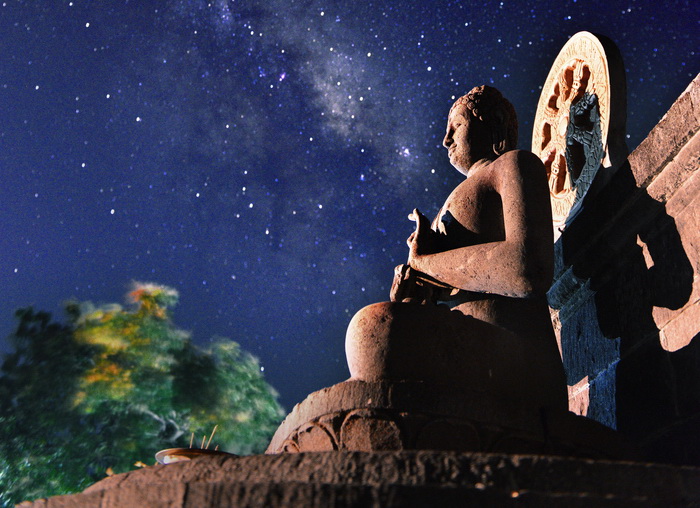
A historical Buddha
We are still used to accept the Buddha was born in 624 BC and entered Nirvana 544 BC and Buddhist calendar is calculated on the basis of the age of this theory. However, with the study of his feats, many researchers give different figures on the Buddha's birth and passing of Nirvana. Heins Bechert has compiled1 of 21 articles and recorded many conclusions about the Buddha's Year in Nirvana. The time difference between these researchers is quite large, from 2066 BC to 1807 BC (VGRAMACHANDANAN), 1168 BC (KDSethna), 544 BC (KCVarma) 487 tr.TL (Sonam Morup), 486 tr.TL (G. Yamazaka), about 483 tr.TL (AKNarain), between 420 tr.TL and 380 tr.TL (A.Bareau), about 404 tr.TL R.Gombrich), between 410 m.TL and 390 m TK (KRNorman), about 400 m T.TL (R.Hitaka), between 400 m T.TL and 350 m T.
The controversial date of the controversial Buddha to date has not come to an end.However, in terms of the application of Buddhist students, we do not need to care too much about this difference, what is worth remarking is his wonderful life in 80 years of life, then every year, then every year Billions of people happily welcome His birth date across the human domain.
The Buddha, a historical figure, today, the remnants of the ruined tower, even if there is time to blur, are enough to make a good impression on his face on this occasion. As a human being. He was originally a prince of the Sakya clan. Growing up, he left home, steeped and persevered on the path of transforming negative thoughts, promoting positive thoughts, perfecting oneself to the fullest. By the way of that transformation, he realized the truth and brought his experience to teach it to those who have affinity with him. After 45 years (or 49 years of Buddhist development) devoted to saving lives, the Buddha, like many others, sent his body to dust at the age of 80.
After the Buddha's passing away, His teachings continue to be handed down from one generation to the next, many of whom respond, learn, and practice all benefit. Until today and certainly long in the future, the teachings that transcend both space and time are always valid in the life of each person. The human, humanitarian and humanitarian values of Buddhism are manifested in every age, in every part of the world.
Many people worship the Buddha because he is the master of a big religion called 'Buddhism'; Some people admire the Buddha as a philosopher, and many people approach the Buddha as coming to a great teacher. For a true Buddhist teacher, the Buddha is always a great teacher and is often known as the "Teacher", teaching the bright path so that he will gradually follow and practice what he teaches. To have a happier, softer life. Within the scope of this article, the author shares only a few practical, practical values in the practice of the core teachings of the Buddha, the greatest teacher of all masters.
The Buddha says: live with the present
In the famous sutta ( Sutta 131 ), the Buddha emphasizes the value of the present:
The past is not traced,
The future does not wish.
The past is over,
The future has not yet come,
Only the present dharma,
Tidy state here.
He always reminds the obvious truth that few will accept, that is the past is over. No matter what it is, it has already happened and floated into the past. Do not regret, cling to or grieve over what has happened, since we can not go back in time to change the past, to be able to 'redraw' it. He also advised us not to pursue future fantasies, because the future is still as obscure as the unknown. Only the present is mysterious and let us live with this moment of reality to feel the full meaning of life. It does not mean that there is no programming for the future. I can plan for today, for tomorrow or beyond on the basis of the reality of the present, that 'planning' action is the present action.
The Buddha placed all of his teachings in order to solve practical problems in the present and his teachings are known for their unmistakable character with the religious systems of any other religion. Is to solve suffering in the present. The Dharma he says is " practical in the present, with no time, come to see, have the ability to navigate " ( Central Business No. 7: Kinh example cloth ). The use of measures that help to practice " an end to suffering right in the present " ( Central Business No. 9: trade chief knowledge ). The Buddha and the Holy Sangha attain liberation in the present without waiting for any realm,
Therefore, tu tu tu in the present, the bright future is made from the present good. " The failure to do good deeds in the future is due to the maintenance of the body, the maintenance of the word, the maintenance of the mind in the present, in this place " ( Sutra No. 14: ). All positive changes from the mind, speech or behavior are needed in the present and only the present is what we really are.
Dedicating the mind completely, focusing on what we are doing is called living in the present.To put it bluntly, when we do what we do to 'keep ourselves, that mind' means we live in the mysterious moments of the present. However, it is often normal people like us to lack this ability or have but not often. For example, is driving on the road in the head worry, before leaving the house, I turn off the guest house lights yet? When engaged in traffic without wholehearted attention to traffic, the body doing something that is busy for another is extremely dangerous. It is best to focus on the only thing that controls the means of transport you are using in your current environment, the roads you run.
In life, when we apply this, we have when we focus and focus on doing, sometimes not; It means to remember to bring the mind to the body, sometimes forget the mind to leave the body roaming around everywhere. When we maintain the mind in the body, the efficiency of work is much better and we do not have to waste effort and waste of time. More importantly, when we bring our mind to the body, we can better identify, monitor, control and control our minds, and this helps us avoid many mistakes and worthwhile things. Sorry in life. We will find life happier, happier and more meaningful when living with the present because it contains both past and future.
The Buddha taught the dialectical and scientific way of looking at the problem
The Buddha once stated, "In the past and in the past, we have only referred to the truth of suffering, the cause of suffering, the end of suffering and the path leading to the end of suffering. " ( V, Chapter XII, item 4) . To a large extent this is the way to deal with suffering, the end of birth and death. However, this is also a way to solve all the big and small problems in everyday life in a very dialectical and scientific way. These four basic steps are concretized as follows:
- The first step : According to the Buddha's teachings, when facing any problem in life, the first thing to do is to fix the problem, determine its nature, see what is needed. solve. Only when the problem is identified can the next steps be established and enforced.
- Second step : We need to identify causal relationships related to this problem. Finding the cause of 'why' for a problem helps us a lot in our lives. Once we identify the cause of the present situation, maintaining or stopping it is what we can do if there is enough effort and determination. If the problem you are experiencing is happy, true happiness, we will know how to nurture that joy. On the other hand, if it is pain and unhappiness, we can also endeavor to stop this situation.
- Step Three : After investigating and determining the cause, the Buddha teaches the third step is that we must see to see the perspective if this condition is to be terminated or condition ( Peace) will last as long as a destination to us. This gives us the motivation and belief to find the most effective solution, towards this happy, happy destination.
- The fourth step : The Buddha advised us to find the most appropriate solution to best accomplish our goal of ending the problem or maintaining this peaceful state. Most of the Buddha's sermons are devoted to this fourth step, offering different solutions to many situations in life so that each person applies and solves his or her own problems. Among them, the most basic are the eight true paths that represent all three aspects: pure virtue, tranquility and wisdom. They are righteous, righteous, righteous, righteous, righteous, righteous, righteous, and righteous.
The way of looking at it from the moment the problem is identified to the rational approach to the successful resolution of the problem is based on the basic principles of the Four Noble Truths. In Buddhism. Life will be much easier and more difficult if we look at and analyze the problem under this lens. Just stop at the first step is to see the problem and the second step is to see the cause of the problem that quickly concluded that Buddhism is pessimistic as some people are unfair and inaccurate.
The Buddha taught introspection, nourishing good seed
According to the Buddha's teachings, our minds change constantly, so we want to understand ourselves, we need to take care of our minds always. Just watch your mind every time there is a thought arises, we can actively monitor the path of the mind. This skill is called mindfulness awareness. Mindfulness is mentioned many times in the sutras. This is the factor that accompanies the practitioner. The goal of mindfulness of mindfulness is to be mindful and nourish mentally in good deeds, that " what is harmful to oneself, harmful to people, harmful to both, criticized by the mind, if accepted And doing so will bring suffering, suffering, and such actions as unwholesome actions, and we must eliminate that action.What actions are not harmful to yourself, not harmful to people, not harmful to both, is praised by the mentally ill, If accepted and done will bring peace of mind, happy heart. Such action is good deed and we must practice it. "( Sutra, Chapter III, Sut . No. 65: Kesaputta ).
The method the Buddha practiced and taught his disciples not to suppress the mind, not to suppress the mind, nor to react at all, purely to follow and observe the mind consciously. A good idea arises, we know, we have a good concept. When a bad thought arises, one realizes that we have an evil thought. Perhaps someone wonders, why just be aware of the thought that only positive seeds are good being nurtured?
In fact, when the evil and negative thoughts arise, only the clear awareness of it disappears.Negative thoughts can not live in a clear, intellectual environment. This can only be fully felt when practiced. But the problem is keeping the constant attention. This is extremely difficult, so we need to practice gradually, as persistently and persistently as possible, because the level of benefit we achieve is always corresponding to our effort through time trials.
The Buddha taught everyone to take responsibility for himself
The Buddha always reminds each individual to master himself, decide his own destiny and not wait on anyone. Each one is the light that illuminates our path. The Buddha said, " Be yourself a lamp for yourself, be self-reliant yourself, do not be like anything else. Use the Dharma as a lamp, use the Dharma as a refuge, do not rely on anything else "( Zhang's business No. 16: Great bowl of Nirvana, corresponding to the business, Volume III, chapter I, product V, doing it yourself island; Saṁyutta business, set V, chapter III, the I, of disease).
Using the Dharma as a means as the function of a "raft to pass" ( Trung sutra No. 22: Sutra for instance, the serpent ) to create happiness in peace itself, the idea of asking the Buddha to bless Protected as a complete divinity to the true Buddhist. Therefore, each individual not only the heirs of the industry but also the owner of the business ( Increase in the economic, Chapter Five, the VI, of 57 : Event must be consistent; Increase in the economic, chapter Year, Product XVII, Business No. 161: Exemption of restraint . Therefore, the change itself is completely in the hands of each individual. The Buddha is the only person who outlines the path, and walking on that road is a matter for everyone.
The Buddha advised us to accept his teachings wisely, selectively and with self-experience, see what is right to accept. Do not accept anything just because of the words of the ancients, or the majority of listeners, but only accept what you find right and benefit yourself, for people after a thorough review ( Sutra, Chapter III, Sutta No. 65: Kesaputta Sisters ).The Buddha's teachings need to be experienced through practical life, as goldsmiths use a variety of ways to determine the purity of gold. He often taught in the texts that the value of his teachings is " to come and see, and not come to believe " ( Central Business 38: Business segments take charity ).
Blind faith has no place in the teachings of the Buddha. We need to see our responsibility for each behavior of ourselves, not to blame, to blame external factors or to believe in luck with what happens in life. We will see a stronger, more energetic application of this teaching of the Buddha.
Say some people have to ask, so that the Buddha's teaching Buddha? Yes! But the followers of the Buddha's praises do not ask Him anything, simply before a great personality, we admire the bow. Ai asked, 'Do you believe in Buddha?', We boldly say, believe! We believe that He is a man of flesh and blood that can do wonders for us, and people of meat and bone can gradually begin to follow the way He has opened. Believing the Buddha to know how to rely on the map guide him to leave the next generation to step on his own.
Study the Buddha's teachings on the concept of good and evil
The Buddha taught that there is no good or evil, only good and evil. In the sutras, the Buddha uses the word "to do evil, to act evil, to speak evil, to think evil", which rarely uses the word "evil" because "evil" is not the dead mold to shape our personality. a person. Good deeds are the Buddha's likeness to light and evil deeds such as darkness. Those who do evil before, after doing good as gone from darkness to light and vice versa ( Increase spending sutras, chapter IV, the Ninth of the 85). With the vistas of vivid movement, "good" or "evil" are acts and ideas that exist in every human being, we should not identify the good person, the evil one.
A person doing evil is simply not at that time smart enough to be able to control and master his own actions and actions. In other words, it is an unconscious state and everyone can be affected. Only the liberation of consciousness is usually able to awaken when ordinary people like us have good ideas, sometimes arise unwanted ideas. Understood in this way, we have a positive and easy attitude that extends deep empathy with evil workers and gives them the opportunity to renew. This also means, we have a fair mind with others as ourselves. Everybody is so lacking in wisdom. We, like other people, once made mistakes need to be concerned, loved and helped to transform, to sublimate in life. Who is in a state of wobbling,
Therefore, no one is the enemy, but our enemy is ignorance. The Buddha advocated that, "Grace of resentment, resentment; Get resentment report resentment, resentment slack "(French phrase, number 5 ). This is a very active and peaceful way of solving problems in life, not as negative or as negative as many people mistakenly attributed to Buddhism. The boundary between good and evil is not as pronounced as white with black and its properties are unstable so that it can be easily identified. This creates the belief and optimistic attitude in the person who once considered himself to be evil to have the opportunity to change in a positive way, and remind everyone to protect their minds without being subjective because today We may be good, tomorrow may be different if our minds slide, and vice versa.
The Buddha taught to cherish the relationships in life
The Buddha has repeatedly said that, in the many lives we have been through, in this world, it is difficult to find a person who has never been a father, mother or relative. He says " it's not easy to find a being, in this long time, not once did the mother ... father ... do you ...., Do you ... " ( Saṁyutta economic, collective II, chapter IV, verses 4-7).
He talked about samsara, many previous lives, to remind us that all people are our relatives, who need to be treated with love and respect. We cherish the people around us and the human relationships because the Buddha also teaches that we exist not independently but that our existence is a link in relationships with many and many. Different elements.Respecting others and living environment is treating yourself. Living with mutual respect and respect for the right to life, the existence of human beings, other living creatures and the environment in which we live is our concern.
Each of us, if we take a hard look at each one, can feel the chain relationship. Once we understand and accept this principle, we value our relationships, appreciate our environment and find ourselves responsible for fostering our social and environmental relationships. To live for myself as part of a whole chain link chain.
Without hurting others, above and beyond, we bring real benefit to ourselves. If we look deeply into our relationship with each other and with the environment, we can 'live' with the principle of nature. "This one has; This birth, the other birth and this kill, the other kill "between people and things without obstacles. The spirit of non-violence and the love of all beings of Buddhism derive from this understanding of interdependent principles.
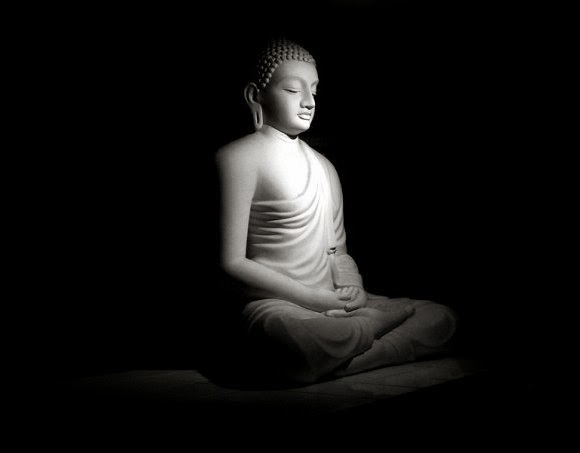
The Buddha taught life is always changing
The second method immediately after enlightenment, the Buddha's theory of impermanence. Prior to entering Nirvana, he kindly reminded "the dhamma is impermanent, be diligent to liberate yourself" (Business School No. 16: Sutra of Nirvana ).
Throughout the discourses recorded in the scriptures, the impermanent nature of life has always been of particular concern and reminder to the Buddha. This is a characteristic of life that we are not easy to feel deeply or only accept in theory that we have not really lived with this natural principle. When the Buddha speaks of the ever-changing and interdependent life of existence, its nature is transitory, fleeting, we do not hurry to label the 'pessimistic' for this teaching. Life has certain limits and this is a fact, not pessimistic nor optimistic. Pessimism or optimism depends on our attitude and behavior towards change, with the inherently short nature of life.
If we know that this life is unstable and short, we are aware that our time fund is limited and can be terminated indefinitely, so that we do not need to do anything. We can not be school immortal and then spend time wasting any money. Knowing the fragile nature of life, we will have a sense of rational time management, cherish what we have and cultivate better relationships with loved ones. Life is fragile, we need to be more cautious not to hurt the people around. Sometimes an apology can not say, a smile is not open and a forgiving thought not timely made us worry.
It is this fragility that we do not subject to self-reliance, such as holding a glass bowl or terracotta, we have a sense of caution rather than holding aluminum bowl, bowl in the hand.Conscious of certain limitations of human condition in this life, we will be more careful in thinking and acting to avoid many mistakes and waste.
There are many good things in the Buddha's teachings, and countless good deeds the Buddha has done to succeed in the path of inner transformation and teach the path of light to others that our whole life is not over. Above are just some of the things that every Buddhist writer thinks are trying to transform in their daily lives. These are the principles of beautiful life that by self effort, anyone can apply. With the view of people and life, practice brings us more positive change and more joy for our lives.
And more importantly, by applying these principles, we will gradually realize the meaning of life through the interdependence between ourselves and those around us as well as our environment. On Vesak day, the writer reviews these things in his heart to remind himself and share with the predestined people as a gift in the great festival. END=NAM MO CAKYA MOUNI BUDDHA.( 3 TIMES ).VIETNAMESE TRANSLATE ENGLISH BY=THICH CHAN TANH.THE MIND OF ENLIGHTENMENT.VIETNAMESE BUDDHIST NUN=GOLDEN LOTUS MONASTERY=AUSTRALIA,SYDNEY.23/4/2017.

No comments:
Post a Comment