Vietnam Buddhism - Chapter 37: The reasons for the campaign against Ngo Dinh Diem regime
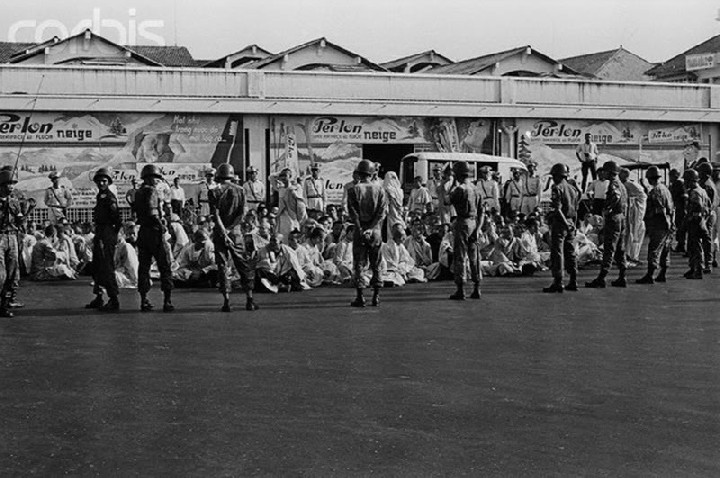
July 17, 1963, Saigon, Vietnam - Soldiers South Vietnam surrounds the faithful Buddhist sitting protest on the street (before the Ben Thanh Market) in July 16 - (Photo by Bettmann © / Corbis) - Source:
A SUPPORTING ENVIRONMENT
The 1963 campaign of Vietnamese Buddhism did not come from the dispute between Buddhists and Catholics. This campaign is only against the dictatorship of the group Ngo Dinh Diem. A corporation has gone too far in using its fellow Catholics, especially migrant Catholics, to consolidate its power and oppress opposition or independent organizations. This movement of Buddhists was supported by non-Buddhists, including many Catholics, priests and laypeople. They represent the majority of Catholics with a sense of justice and have the courage to resist what goes against the true spirit of the Gospel. Along with their fellow Buddhists, they were oppressed by the regime.
The document on this campaign is very plentiful, in national language as well as in foreign languages. The most precious piece of evidence is the evidence of people who directly participated in the campaign and have also been subjected to pressure, imprisonment or torture. As for the written materials, we try to use only the first documents, which are published by the Buddhist Interreligious Panels Committee during the campaign period and the writings of the Imagine being in the campaign. Most of these works were published in 1964, shortly after the campaign was successful. In the most decent works, we can say:
1. The Buddhist Sanhedrin of Quoc Oai, published by the Tan Sanh House (No. 12 Bui Vien Street, Saigon) was published December 14, 1963. The book is 174 pages long and has the following notes on the page. 8: "Most of the printed materials in this book are based on the printed edition of the Buddhist Interfaith Buddhist Coalition." This is one of the earliest works.
Nine Years of Blood under the Order of Ngo Dinh Diem by Nguyet and Than Phong, published by the author in 1964. 342 pages; In addition to the title of the author, the book also carries three other titles; one of Pham Van Hanh's bachelor's degree, one of Vu Cuc Son's doctoral students, and one of Van Trai's Nguyen Kinh. All three of them had served in the Nam Trieu government since Ngo Dinh Diem was also a minister at the Hue court, and there were direct conversations about Ngo Dinh Diem.
3. The Truth of the Buddhist Struggle of Nguyen Thanh compiled, Hoa Dao published in 1964 (No. 550 Tran Hung Dao street, Saigon). Book of 260 pages.
4. Vietnam Buddhist Painting of Compassion, compiled by Hoa Nghiem (75A Tran Binh Trong, Cho Lon) published in 1964, 446 pages thick, bearing the preface of Tam Giac, written on the day Buddha's birthday in 1964. The book was approved by the Department of Propaganda of the Institute of Chemistry.
5 The War of Buddhism in Vietnam From Buddha to the Revolution of 1963, written by Quoc Tue. 548 pages, no publisher, may be published by the author. The book was censored on January 28, 1964 and was printed around June 1964.
6. The Sacred Fire of Lan Dinh and Phuong Anh, without the name of the publisher, may have been published by the author. The book was censored on December 17, 1963, 138 pages thick and contained an anthology of Phu Tien Nguyen Duy Tinh.
7. Violation Des Droits De l'Homme Au Sud Viet Nam. Rapporteur de la Baptiste en 1963. (Human Rights Violence in South Vietnam, Report of the United Nations Delegation to the United Nations Delegation to the 1963 Buddhist Suppression. United Nations documents translated into Vietnamese by Vo Dinh Cuong and Hung Khanh published in Saigon in 1966. The book is 297 pages thick.
8. Nam Thanh's History of Vietnamese Buddhist History, published by VUS on the occasion of Buddha's Birthday in 1964, 34 x 24 cm large book, 56 pages long, compiled in Vietnamese and English. There are many pictures of the campaign. Page 3 of the book printed the introduction of the Pure Land Pure Land. The presentation of the book is very bright and neat, the image is very selective. The book contains the Charter of the Unified Buddhist Church of Vietnam.
ABOUT THE PHILOSOPHY
The framework of this chapter does not allow much of the advantages and disadvantages of President Ngo Dinh Diem. He came to power in the South from 1954 until 1963, 9 years later, the new Buddhists stood up against him, although from the very beginning of his administration he intended to exert Buddhism. During that time he was overwhelmed by many opposing forces, but he wisely beaten. He eliminated General Nguyen Van Hinh, Chief of Staff of the South Vietnamese Army, overthrew the head of Bao Dai, suppressed the Binh Xuyen, Cao Dai and Hoa Hao sects. He was assassinated at Ban Me Thuot on 21 May 1957. He was fortunate enough to escape the November 11, 1960 coup.
On February 27, 1962, he escaped death during the bombing of the independent headquarters of two South Vietnamese Army officers. To strengthen the government, Diem organized the Can Lao People's Revolutionary Party and the National Revolutionary Movement. The Lao People's Party was organized to become the sole party in the South: members of other party parties, who entered the party of Can Lao People, had to obey party law to control their party. And so no opposition party can survive. The party's flag is a green top with three red stars representing Can Lao, Revolution and Human. The national revolutionary movement is merely a party to the imperative of the party. The mission of this organization is political propaganda. Its affiliation with the youth organizations is Republican, Women Solidarity, Revolutionary Civil Service, etc. On the political front, the back of the government is migrant Catholics. On military grounds, first of all, Diem brought in nearly ten thousand soldiers who emigrated from the north to the south, among them Nung and Bao An. After defeating Gen. Nguyen Van Hinh, he recaptured the South Vietnamese army and began to militiate the army with US aid. In addition, Secret Service, military and civilian organizations, play an important and frightening role in the investigation, arrest and abolition of opposition elements. From an ideological point of view, the Ngo Dinh Diem government borrowed part of the doctrine of Emmanuel Mounier as a Person, in addition to the concept of spirituality inspired by the Christian faith. Since 1956, this theory has been taught by priests at Saigon University. The Vinh Long Personnel Center was founded by Archbishop Ngo Dinh Thuc when he was bishop in this parish. All public servants nationwide have to follow the Center for the Doctrine of the Spirit, whether Catholic or not. A large proportion of the faculty and staff of the center are bishops or priests.
Nguyen Dam and Than Phong's Nine Commentaries on Ngo Dinh Diem's regime, taken from Ngo Dinh Diem's Crimes Commission and from other public authorities, provided a wealth of information. the oppression and abolition of the independent and oppositional components and the corruption and misappropriation of individuals in the administration as well as in Diem's family. The authors have spent over 300 pages talking about this, here we do not need to repeat that job. We just need to recognize that the Buddhist movement that succeeds is thanks to the support of the entire people: Buddhist success is due to the support of the people: Buddhists succeeded because of the connection. Fight for religious equality with the struggle against dictatorship. Here,
1. Dictatorship of the regime. Ngo Dinh Nhu, Ngo Dinh Diem, Ngo Dinh Cun and Tran Thi Le Xuan have practiced the right in their hands, practicing the family policy, not really trusting someone else. No member of the Diem government was retained until the regime collapsed. Many people who helped Diem to dispose Bao Dai and stabilize the situation were also abolished at the beginning. All opposition parties, whether anti-communist or anti-communist, are subject to reparations or repression.
2. The cruelty of the regime. With the Secret Service and with the Special Forces, including the notorious villains such as Duong Van Hieu, Nguyen Tu Thai, Nguyen Thien Dzai, Phan Khanh, etc. the regime has arrested, tortured and detained. holding, exterminating and eliminating tens of thousands of opposition. On one occasion, the president ordered the sinking of a boat carrying political prisoners in Con Dao (156). On the methods of torture and abstinence, the nine books of fire of Nguyet Đam and Than Phong have given many specific cases. On the detention of the opposition, we can mention the cellar of the secret man Ngo Dinh Can that people commonly call the Central God. Nguyệt Đam and Than Phong wrote about these tunnels after observing:
"From the tunnel in the middle of the road to the cellar, where it was all wet, it burned a heavy, foul odor ...".
"There are nine tunnels. Each has twenty to forty cells. Want to get into the tunnel only a single door. Most ruthless are the nine tunnels held for hundreds of people, the Can only leave a vent ... ".
"The floor is damp and so, we see the brick. Perhaps the victim used to kneel or sit on it to sleep. Each cell is 1m50 long, 60 centimeters wide and about 1m50 high, on the top is the iron bar, above the roof of the cellar, the double cell is a door, the middle is a long narrow corridor. ).
3. The injustice of the regime. The fact that fellow Catholics migrated to support Ngo Dinh Diem's government is unmistakable. Diem was an anti-communist Catholic, in his position as governor, who was striving to protect the interests of migrant Catholics, and of course immigrant Catholics wanted to stand behind him. Along the Bien Hoa-Lam Dong National Highway, Catholic settlements, under the guidance of local priests, voted in favor of the regime. Ms. Ngo Dinh Nhu was elected MP in that environment. However, the government has gone too far in supporting migrant Catholics to create too much damage, abuse and pressure on local people. Based on the government's unyielding support, public money was used to build churches, Catholic schools, occupies a privileged position in the national administrative system, in the military, in the education, health and social sectors. They became a new, separate class, supporting each other to occupy the most important positions and positions in society.
In the belief that only Catholics are truly anti-communist, the government is not only willing to tolerate these abusive and oppressive actions, but also encourage and embark on that path. The La Vang Church of Our Lady of Guadalupe, a 17th-century pilgrimage center about thirty kilometers south of the capital, is a concrete example of the government's anti-communist approach to Catholicism.
Archbishop Ngo Dinh Thuc once called this church a spiritual outpost of the nation, and campaigned to elevate it to the Basilica. Published in 1961, the first issue of the magazine Mother Mary La Vang names donors willingly donate money to the construction of the Basilica: From Vice President Nguyen Ngoc Tho through all the ministers, to the general the chief of staff, etc ... Catholic or not, everyone is on this list. Policemen were allotted lottery tickets to Tombola to fund the construction of the church La Vang. Train tickets to La Vang for the pilgrims to attend the ceremony was reduced by 50%.
As we all know, public servants nationwide must go to study at Duy Linh Center in Vinh Long, whether Catholic or not. Those who express their opinions without adherence to this doctrine will be ignored and the result will be dismissed or transferred.
BUDDHISM PRACTICE
Bao Dai was expelled in 1955, but his No. 10 enactment on August 6, 1950, was executed by the Ngô Đình Di0m administration, because the doctrine did not bind Catholics to the institution of society and to refrain from other religions. In addition to oppressing Buddhist organizations, the regime also persecutes monks and laymen who are active in local Buddhist congregations, forcing Buddhists to apostatize. Some people have been baptized for the sake of losing their jobs. Some houses have to bring the altar or the altar from the middle of the house to the design at home to avoid looking. Some people who are determined to hold fast to the faith have been slandered and taken to long-term "learning" at the camps. In 1963, the Buddhist Association of Vietnam in Central Vietnam published two sets of documents recording human rights violations, Religious discrimination and Buddhist persecution from 1959 to 1963. The first volume was 49 pages and the second was 98 pages. This later edition also included records of discrimination, repression and repression, with full names, signatures, and seals of local Buddhist organizations (158). In Quang Ngai, for example, there are fifteen compulsory Catholic followers, a torture and imprisonment of monks after having slandered him as the "Viet Cong". In Binh Dinh, there are seven incidents requiring local Buddhist lay people to leave their homes to go to the plateau, while those belonging to the wealthy peasantry are not the unemployed people; five incidents of persecution, three arrests, torture and abduction of Buddhists, a burial of two Buddhists in a cellar ... (159) The first volume is 49 pages and the second is 98 pages. This later edition also included records of discrimination, repression and repression, with full names, signatures, and seals of local Buddhist organizations (158). In Quang Ngai, for example, there are fifteen compulsory Catholic followers, a torture and imprisonment of monks after having slandered him as the "Viet Cong". In Binh Dinh, there are seven incidents requiring local Buddhist lay people to leave their homes to go to the plateau, while those belonging to the wealthy peasantry are not the unemployed people; five incidents of persecution, three arrests, torture and abduction of Buddhists, a burial of two Buddhists in a cellar ... (159) The first volume is 49 pages and the second is 98 pages. This later edition also included records of discrimination, repression and repression, with full names, signatures, and seals of local Buddhist organizations (158). In Quang Ngai, for example, there are fifteen compulsory Catholic followers, a torture and imprisonment of monks after having slandered him as "the Viet Cong." In Binh Dinh, there are seven incidents requiring local Buddhist lay people to leave their homes to go to the plateau, while those belonging to the wealthy peasantry are not the unemployed people; five incidents of persecution, three arrests, torture and abduction of Buddhists, a burial of two Buddhists in a cellar ... (159) repression and repression, full names, signatures and seals of local Buddhist organizations (158). In Quang Ngai, for example, there are fifteen compulsory Catholic followers, a torture and imprisonment of monks after having slandered him as "the Viet Cong." In Binh Dinh, there are seven incidents requiring local Buddhist lay people to leave their homes to go to the plateau, while those belonging to the wealthy peasantry are not the unemployed people; five incidents of persecution, three arrests, torture and abduction of Buddhists, a burial of two Buddhists in a cellar ... (159) repression and repression, full names, signatures and seals of local Buddhist organizations (158). In Quang Ngai, for example, there are fifteen compulsory Catholic followers, a torture and imprisonment of monks after having slandered him as the "Viet Cong". In Binh Dinh, there are seven incidents requiring local Buddhist lay people to leave their homes to go to the plateau, while those belonging to the wealthy peasantry are not the unemployed people; five incidents of persecution, three arrests, torture and abduction of Buddhists, a burial of two Buddhists in a cellar ... (159) There were fifteen incidents involving Catholic followers, a torture and imprisonment of monks after having slandered him as "the Viet Cong." In Binh Dinh, there are seven incidents requiring local Buddhist lay people to leave their homes to go to the plateau, while those belonging to the wealthy peasantry are not the unemployed people; five incidents of persecution, three arrests, torture and abduction of Buddhists, a burial of two Buddhists in a cellar ... (159) There were fifteen incidents involving Catholic followers, a torture and imprisonment of monks after having slandered him as "the Viet Cong." In Binh Dinh, there are seven incidents requiring local Buddhist lay people to leave their homes to go to the plateau, while those belonging to the wealthy peasantry are not the unemployed people; five incidents of persecution, three arrests, torture and abduction of Buddhists, a burial of two Buddhists in a cellar ... (159)
In 1957, the government ordered the removal of Buddha's birthday from the official holidays of the year. This is a blow to the Buddhists. Buddha's birthday to the important Buddhist is no different Christmas day for Catholics. This government action gives us a clear idea of the regime's oppression and repression. Of course, the Buddha was resentful of the pressure. The Vietnam Buddhist Sangha (SLC) meeting in March 1957 heatedly discussed this issue and struck down the following message for the Vietnam Buddhist Congregation in Saigon. "The 25 th General Assembly of the Vietnam Buddhist Sangha consists of the parishioners who prove the great monk in the Sangha and delegates from 14 provincial associations representing 565 units meeting at Tuam Temple in Hue on the 8th, March 9, 10, and March 11, 1957, I placed my trust in the General Assembly. Request the Association to actively intervene in the Government and Congress to recognize the eighth day of the eighth lunar month as the eternal legal holiday of the nation. President of the General Assembly Thich Thien Minh "(160). That year, Buddhists all over the place organized mass loudly ten times every year to express the attitude. Under the pressure of the masses, the government recognized the Buddha's birthday after a year.VIETNAMESE TRANSLATE ENGLISH BY=THICH CHAN TANH.AUSTRALIA,SYDNEY.28/10/2018.

No comments:
Post a Comment