Reflect on the "law of impermanence" of Buddha Shakyamuni.VIETNAMESE TRANSLATE ENGLISH BY=VIETNAMESE BUDDHIST NUN=THICH CHAN TANH.

Buddha - the first great philosopher of mankind?
The ancient Greek philosopher Heralitus (c. 535 BC - 475 BC) is considered the ancestor of dialectic, with the famous saying: "No one bathes twice in the same river" expressing the worldview of things, phenomena are constantly moving, changing. Few people know that, in fact more than a century before, in 624 BC Buddha Shakyamuni Buddha in his view of the worldview, the worldview realized and declared an impermanent law.
In many of the oldest primitive sutras still found to this day, the Buddha is found to focus on impermanent awareness, recognizing impermanence so that man can master suffering, attain virtue. eternal true blessings through one's own cognitive transformation.
 |
When talking about the world and the people, according to the Buddha: This world is supported by the conditions of harmony, whatever dharma is conditioned by conditions, that dhamma is subject to birth and death, impermanence, decay and destruction. In the Sutta Pitaka (Sutta No. 61 quoted in Zhong A Ham), there is a passage as follows: "In the afternoon, that monk stood up from a quiet seat, went to the Buddha, bowed and bowed. sit aside and say: “Bach Duc The Ton, today in a leisure place, I sit and think, think like this: 'Is there any form that permanently resides, invariably, there is only bliss, eternal existence. reasonable? Is there feeling, perception, action, consciousness, permanent, unchanging, only blissful, eternal existence?
The Buddha told the Bhikkhu-stilts: “There is no permanent, unchanging, total bliss, eternal existence; there is no feeling, perception, formations, consciousness, permanent residency, immutability, totally only bliss, eternal existence ". Thus the Buddha asserted that there is no materiality, feeling, perception, formations, and consciousness which are permanent, unchanging, just bliss, which exists forever.
From the Buddha's point of view to Heralitus, one sees that impermanent truth is not limited by geographical or religious point of view. Because that is the law of the universe. When one realizes impermanence, then we are no longer attached to suffering and defilements.
"Law of impermanence" of the Buddha
The law of impermanence is divided into four phases by the Buddha: "becoming, staying, dying, not" or "being born, staying, or passing away". These transformations take place short or long depending on their nature. For example, there are animals that live a few days, some animals live for several decades, some old trees live a few hundred or a thousand years, a planet lasts for millions of years ...
The Buddha taught: man is a collection of the five aggregates: form, feeling, perception, formations, consciousness. Called otherwise, body and mind; viewed from the philosophical perspective is material and spiritual, and from a biological perspective, it is physiology and psychology. Each of us also cannot avoid the impermanent law, the law of birth - universe - singularity - passing between the infinite universe. Usually, the cycle of the rule of each human life exists for several decades.
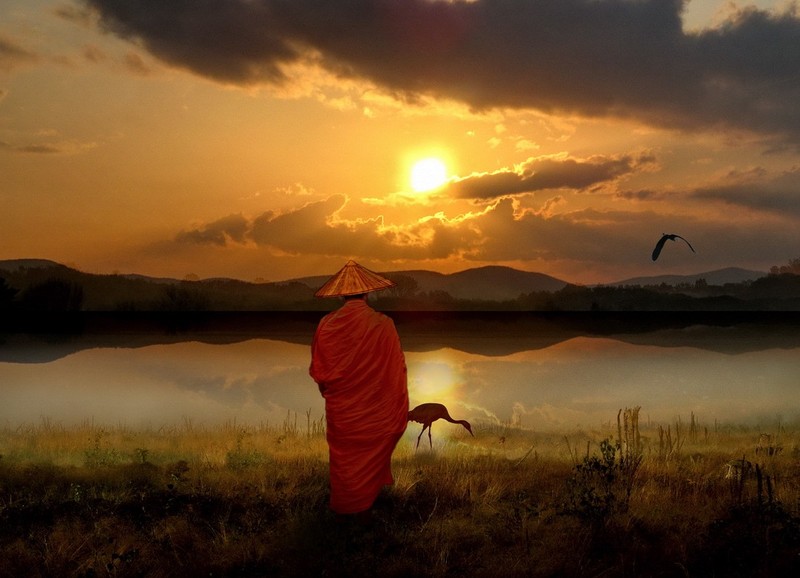 |
| Impermanent . |
But the reality is much harsher, under the view of the false intelligentsia, the false knowledge, the wise, the great wisdom, the great Arahants, the Right Enlightenment, can we see people and things change? cease. He saw four periods of "birth, stay, singularity, death" sometimes took place not full of blink, ie less than a second (moment, very short).
Buddhism teaches us, the way to liberation has many methods, depending on the karmic conditions of each person. That path is practice, cultivating body accumulation merit. In the Central Sutras the Buddha teaches: "I am the owner of karma, the heir of karma, karma is the womb, karma is a relative, and karma is the fulcrum".
He also taught that the human body is difficult to hear, the Dharma is hard to hear, practice diligently, get rid of suffering, reincarnate, and benefit sentient beings. Today, our body has been, the Buddha's teachings have heard, it only depends on whether we will practice, live an honest life, benefit people or not!
In humans, the Buddhist conception that impermanence will govern according to karma. So, let us accept and use these impermanent concepts to contemplate and practice, to ease our suffering and troubles, and to create good causes for subsequent lives to come.
For peace in the midst of impermanent life
Someone says life is deep in suffering. Some people say life is a happy paradise. So in the end life is happy or miserable? The answer is that sometimes the joy or suffering is due to each person's feelings.
For example, neighbors feel sorry for a woman divorced by her husband for having a child with disabilities. But the woman herself found herself lucky to have left the man with no good personality. She also feels content with the present happiness: her child, though not agile, in return she is healthy and innocent and she thanks the fate of giving her this child "no woman is unhappy for her. giving birth to children ”- as a mother shares.
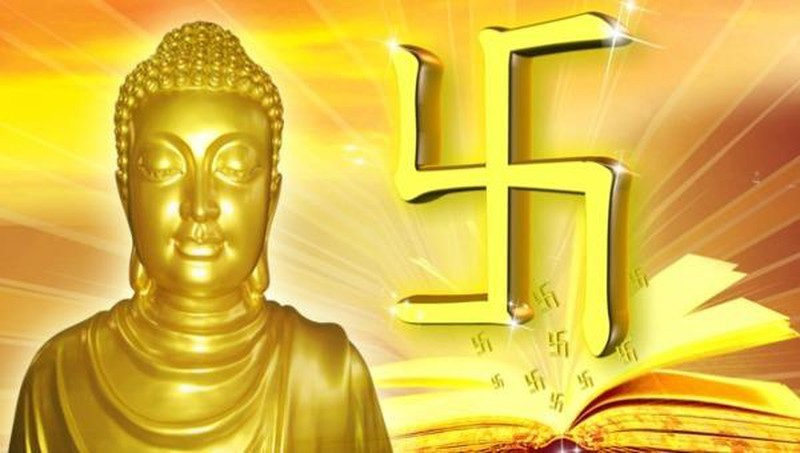 |
| Life moves non-stop like the endless rotation of the swastika according to Buddhist conception. |
Life moves non-stop like the endless rotation of the swastika according to Buddhist conception. No joy will remain, no suffering will exist for a lifetime if people do not embrace suffering and anger in their hearts. See clearly the finite shortness of life as taught by the Buddha so that we live more meaningful. As the character Paven Coocsaghin in the novel "Steel has me like that", then: "Each person has only one youth, please live without shame because of the wasted years of life".
A beautiful lifestyle is a way of living positive, knowing enough, knowing to live peacefully in the midst of impermanent life. Like a lotus over the mud to release incense As a symbol of the wheel according to Buddhist conception, although life in all four directions is difficult, the wheel is still spinning, patiently moving, moving forward. It is the nostalgia of the Buddhas of the three times ten directions, teaching people to see clearly and live rightly, to be safe to seek and enjoy happiness every moment.END=NAM MO SHAKYAMUNI BUDDHA.( 3 TIMES ).GOLDEN AMITABHA MONASTERY=VIETNAMESE BUDDHIST NUN=THICH CHAN TANH.AUSTRALIA,SYDNEY.24/8/2020.

No comments:
Post a Comment