rality to the people, but no one is obliged to convert. By extending the Buddha's message to the public, people were free to choose what was useful to them.
Historical summary
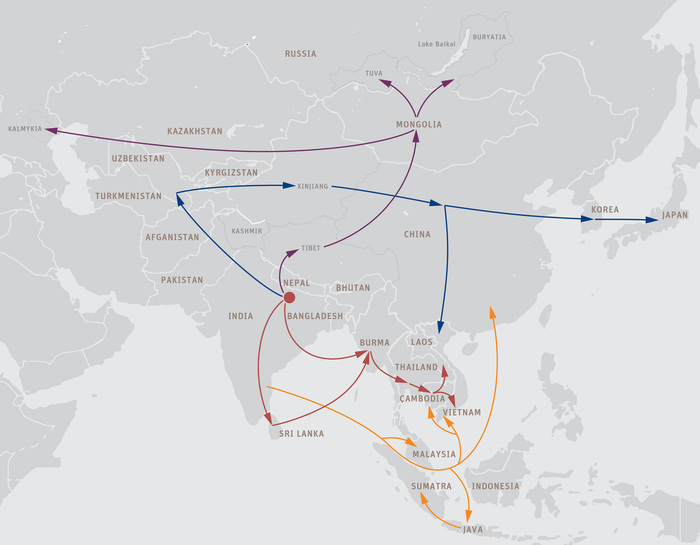
Although Buddhism has never developed a missionary movement, however, the teachings of the Buddha spread far and wide on the Indian subcontinent and from there, throughout Asia. When it comes to every new culture, the means and style of Buddhism are changed to fit the psyche of the locals, but do not affect the intellectual and compassionate points of compassion. . However, Buddhism has never developed a general hierarchy of power, with a supreme leader. Every country where Buddhism spreads has developed its own form, its own religious structure and its own spiritual leader. Today, the world's most respected leader among Buddhist leaders is the Dalai Lama of Tibet.
Buddhism has two main branches. Hinayana, or Small Vehicle, emphasizes individual liberation, while the Mahayana, or Great Vehicle, focuses on cultivating an omniscient Buddha to universalize beings. in the most perfect way. Each branch has many branches. However, at present, the three main modes exist: one is Hinayana, known as Theravada, in Southeast Asia, and two branches of Mahayana, the Chinese and Tibetan Buddhist traditions.
The Hinayana tradition spread from India to Sri Lanka and Burma in the third century BC, and from there to Yunnan, southwestern China, Thailand, Laos, Cambodia, South Vietnam and Indonesia (Indonesia). Soon after, the bags of Indian Buddhist merchants were found on the Arabian Peninsula coast, and even further as Alexandria, Egypt. Other forms of Hinayana spread from that time to Pakistan, Kashmir, Afghanistan, the eastern and coastal parts of Iran, Uzbekistan, Turkmenistan and Tajikistan today. These are the ancient states of Gandhara, Bactria, Parthia and Sogdia. From this base in Central Asia, These Hinayana forms spread more widely in the second century AD to East Turkistan (Xinjiang) and further into China, then to Kyrgyzstan and Kazakhstan in the late seventh century. Hinayana forms were then combined with Mahayana characteristics that also came from India, so that the Mahayana tradition became the predominant form of Buddhism in much of Central Asia.
China's Mahayana form later spread to Korea, Japan and North Vietnam. Another early wave of Mahayana, associated with the Hindu Shaivite forms, spread from India to Nepal, Indonesia, Malaysia and parts of Southeast Asia, beginning around the century. year. The Mahayana tradition, which began in the seventh century, inherited the whole history of Indian Buddhism, spread throughout the Himalayas and to Mongolia, East Turkistan, Kyrgyzstan, Kazakhstan, northern China, Manchuria, Siberia, and the Kalmyk region of Mongolia near the Caspian Sea, part of the European part of Russia.
Buddhism has two main branches. Hinayana, or Small Vehicle, emphasizes individual liberation, while the Mahayana, or Great Vehicle, focuses on cultivating an omniscient Buddha to universalize beings. in the most perfect way. Each branch has many branches. However, at present, the three main modes exist: one is Hinayana, known as Theravada, in Southeast Asia, and two branches of Mahayana, the Chinese and Tibetan Buddhist traditions.
The Hinayana tradition spread from India to Sri Lanka and Burma in the third century BC, and from there to Yunnan, southwestern China, Thailand, Laos, Cambodia, South Vietnam and Indonesia (Indonesia). Soon after, the bags of Indian Buddhist merchants were found on the Arabian Peninsula coast, and even further as Alexandria, Egypt. Other forms of Hinayana spread from that time to Pakistan, Kashmir, Afghanistan, the eastern and coastal parts of Iran, Uzbekistan, Turkmenistan and Tajikistan today. These are the ancient states of Gandhara, Bactria, Parthia and Sogdia. From this base in Central Asia, These Hinayana forms spread more widely in the second century AD to East Turkistan (Xinjiang) and further into China, then to Kyrgyzstan and Kazakhstan in the late seventh century. Hinayana forms were then combined with Mahayana characteristics that also came from India, so that the Mahayana tradition became the predominant form of Buddhism in much of Central Asia.
China's Mahayana form later spread to Korea, Japan and North Vietnam. Another early wave of Mahayana, associated with the Hindu Shaivite forms, spread from India to Nepal, Indonesia, Malaysia and parts of Southeast Asia, beginning around the century. year. The Mahayana tradition, which began in the seventh century, inherited the whole history of Indian Buddhism, spread throughout the Himalayas and to Mongolia, East Turkistan, Kyrgyzstan, Kazakhstan, northern China, Manchuria, Siberia, and the Kalmyk region of Mongolia near the Caspian Sea, part of the European part of Russia.
The Way of Buddhism
The spread of Buddhism in most parts of Asia has been peaceful, in many ways. Shakyamuni Buddha set the precedent. First, as a teacher, he went to neighboring kingdoms to share his insights with those who were interested and wanted to learn. Similarly, he instructs his monks to go everywhere to explain their teachings. He does not call on others to criticize and renounce their religion or convert to the new religion, for he does not seek to establish his own religion. He just tries to help other people overcome the unhappiness and suffering they are creating for themselves, for lack of understanding. The later generations of followers took inspiration from the Buddha's example and shared with others his methods that they saw beneficial to their lives.
Sometimes, this process also progresses systematically. For example, when the trader Buddhism visited and settled in different lands, some local people would naturally of course interested in the beliefs of the foreigners, as well as the way Islam is put into Indonesia and Malaysia. This process has happened to the Buddhists in the oasis countries along the Silk Road in Central Asia in the last two centuries AD. When the local rulers and their people know more about the religion of India, they came to invite monks natives of these merchants advisor or professor, and by the way, finally They accepted the belief in Buddhism. Another systematic approach is the long-term cultural assimilation of those who have invaded other countries,
Often, however, the popularity was initially due to the influence of a mighty monarch who accepted and supported Buddhism. For example, in the middle of the third century BC, Buddhism spread throughout northern India thanks to the personal support of King Ashoka. The king built this powerful empire without forcing his subjects to have faith in Buddhism, but by issuing decree carved in iron columns throughout his kingdom, living a moral life, and he himself followed these principles, the king made others accept the teaching of the Buddha.
Asoka was also actively evangelizing outside her kingdom by sending missionaries to distant lands. At times, the king performed at the invitation of foreign rulers, such as the case of Sri Lanka's Tishya. On other occasions, the king had the initiative to send monks as diplomats for him. However, monks visiting foreign countries do not put pressure on others to convert, but only teach the Buddha's teachings to the people themselves. This is evidenced by events in places such as South India and South Burma, where Buddhism has taken root, while in other places, such as the Greek colonies in Central Asia , there is no record of such immediate effect.
The king devotees, such as the dominance Altan Khan of Mongolia, in the sixteenth century, was visiting the Buddhist teachers to their kingdom and announced Buddhism is the religion official of the country, to help unify the people and consolidate their rule. In the process, they may have prohibited some religious practices of non-Buddhist, the indigenous religions and even persecuted the followers of this religion, but the action heavy handed that mainly because of political motives. These ambitious rulers have never coaxed their subjects into accepting Buddhist forms of worship or worship. That is not in the religion of this religion.
When Shakyamuni himself told everyone not to obey his teachings because of his blind faith, but to examine himself thoroughly before accepting his teachings, how could the people be able to Accept the teachings of the Buddha, only because of the pressure of the ardent missionaries, or because of the imperial edict. Therefore, as in the case of Neiji Toin, early in the seventeenth century AD, tried to buy off the nomads east of Mongolian Buddhism by offering them livestock for each segment of their The people complained to the highest authorities. Finally, this overbearing teacher was punished and exiled.
Sometimes, this process also progresses systematically. For example, when the trader Buddhism visited and settled in different lands, some local people would naturally of course interested in the beliefs of the foreigners, as well as the way Islam is put into Indonesia and Malaysia. This process has happened to the Buddhists in the oasis countries along the Silk Road in Central Asia in the last two centuries AD. When the local rulers and their people know more about the religion of India, they came to invite monks natives of these merchants advisor or professor, and by the way, finally They accepted the belief in Buddhism. Another systematic approach is the long-term cultural assimilation of those who have invaded other countries,
Often, however, the popularity was initially due to the influence of a mighty monarch who accepted and supported Buddhism. For example, in the middle of the third century BC, Buddhism spread throughout northern India thanks to the personal support of King Ashoka. The king built this powerful empire without forcing his subjects to have faith in Buddhism, but by issuing decree carved in iron columns throughout his kingdom, living a moral life, and he himself followed these principles, the king made others accept the teaching of the Buddha.
Asoka was also actively evangelizing outside her kingdom by sending missionaries to distant lands. At times, the king performed at the invitation of foreign rulers, such as the case of Sri Lanka's Tishya. On other occasions, the king had the initiative to send monks as diplomats for him. However, monks visiting foreign countries do not put pressure on others to convert, but only teach the Buddha's teachings to the people themselves. This is evidenced by events in places such as South India and South Burma, where Buddhism has taken root, while in other places, such as the Greek colonies in Central Asia , there is no record of such immediate effect.
The king devotees, such as the dominance Altan Khan of Mongolia, in the sixteenth century, was visiting the Buddhist teachers to their kingdom and announced Buddhism is the religion official of the country, to help unify the people and consolidate their rule. In the process, they may have prohibited some religious practices of non-Buddhist, the indigenous religions and even persecuted the followers of this religion, but the action heavy handed that mainly because of political motives. These ambitious rulers have never coaxed their subjects into accepting Buddhist forms of worship or worship. That is not in the religion of this religion.
When Shakyamuni himself told everyone not to obey his teachings because of his blind faith, but to examine himself thoroughly before accepting his teachings, how could the people be able to Accept the teachings of the Buddha, only because of the pressure of the ardent missionaries, or because of the imperial edict. Therefore, as in the case of Neiji Toin, early in the seventeenth century AD, tried to buy off the nomads east of Mongolian Buddhism by offering them livestock for each segment of their The people complained to the highest authorities. Finally, this overbearing teacher was punished and exiled.
Summary
Shakyamuni said that one should not listen to his teachings because of blind faith, but only after careful consideration of the teachings. Therefore, it is obvious that one should not accept the Buddha's teachings because of the zeal of enthusiastic missionaries, or because of imperial edicts. In the early seventeenth century, Neiji Toin tried to bribe the Eastern Mongolian nomadic Mongols by giving them animals for each verse they could memorize. Nomads have complained to the authorities, and the overbearing teachers have been punished and exiled. Buddhism has spread to the majority of Asian countries in a variety of ways, bringing the message of compassion and wisdom, while adapting the needs and the foundations of different kinds of people. .
Summary
Shakyamuni said that one should not listen to his teachings because of blind faith, but only after careful consideration of the teachings. Therefore, it is obvious that one should not accept the Buddha's teachings because of the zeal of enthusiastic missionaries, or because of imperial edicts. In the early seventeenth century, Neiji Toin tried to bribe the Eastern Mongolian nomadic Mongols by giving them animals for each verse they could memorize. Nomads have complained to the authorities, and the overbearing teachers have been punished and exiled. Buddhism has spread to the majority of Asian countries in a variety of ways, bringing the message of compassion and wisdom, while adapting the needs and the foundations of different kinds of people. .END=NAM MO SHAKYAMUNI BUDDHA.( 3 TIMES ).VIETNAMESE TRANSLATE ENGLISH BY=THICH CHAN TANH.THE MIND OF ENLIGHTENMENT.VIETNAMESE BUDDHIST NUN=GOLDEN LOTUS MONASTERY=AUSTRALIA,SYDNEY.30/10/2017.

No comments:
Post a Comment