THE BUDDHA OF THE BUDDHA .
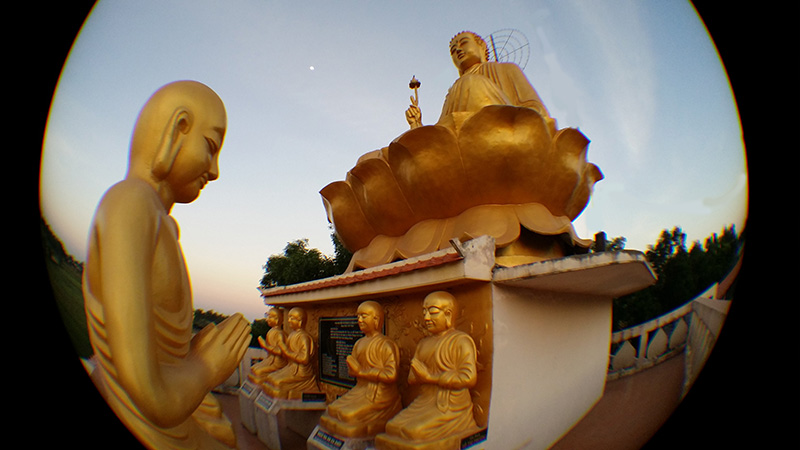
The name of the Buddha is "Shakyamuni" which means "Static Statue in Shakyamuni", "The quiet author in Shakyamuni", Sanskrit mauni meaning silent. The Buddha is also called "Mahamuni": the Maha is great, "Mahamuni" is "the Great Silent" or the "Great One of Silence". Indeed, the Buddha is a Silent Truth, and the Buddha's teachings are aimed at leading beings to a happy and peaceful, peaceful and peaceful world. All words are old and vanish, both birth and death, only silence is permanent and lively: the silence of the Buddha more than two thousand and five hundred remain in our hearts today, if we can see it and listen to its resonance in us.
That silence is evidenced by the way of living of the Buddha, manifested in every act of the Buddha, enfolded in the teachings of the Buddha. That silence is immense as space and timeless as time. Let's try to understand some of the meaning of that great silence through the Dharma of the Buddha, for knowing that boundless silence is liberation.
Quiet before the questions
Some questions were asked to ask the Buddha, but He did not answer because it was a false question and in vain. Clinging to these questions with rational arguments falls into the trap of conventional knowledge, formula and duality. This trap will lead to endless debate and questions that follow, distracting the practice. Many of the monks who lived simultaneously with the Buddha, that is, in the sixth century BC, have presided over many doctrines in the field of metaphysics. But the Buddha has protected his disciples from these pitfalls, not by prohibitions, by argument or by explanation, but by silence. There are 14 questions as follows that the Buddha does not answer:
That silence is evidenced by the way of living of the Buddha, manifested in every act of the Buddha, enfolded in the teachings of the Buddha. That silence is immense as space and timeless as time. Let's try to understand some of the meaning of that great silence through the Dharma of the Buddha, for knowing that boundless silence is liberation.
Quiet before the questions
Some questions were asked to ask the Buddha, but He did not answer because it was a false question and in vain. Clinging to these questions with rational arguments falls into the trap of conventional knowledge, formula and duality. This trap will lead to endless debate and questions that follow, distracting the practice. Many of the monks who lived simultaneously with the Buddha, that is, in the sixth century BC, have presided over many doctrines in the field of metaphysics. But the Buddha has protected his disciples from these pitfalls, not by prohibitions, by argument or by explanation, but by silence. There are 14 questions as follows that the Buddha does not answer:
1. Does the universe exist forever?
2. Universe does not exist immortal?
3. Universe at the same time both immortal and not-immortal-immortal?
4-Universe at the same time not-arena-immortal-immortal nor is-not-existent-immortal?
5. Does the universe have borders?
6- Are the dance boundless?
The universe at the same time has both limit and boundless?
The Universe is not limited at the same time, but is not without limits.
Life and body are the same thing?
Life and body are two different things?
Is a liberated being present after death?
12- A liberated being does not exist after death?
13. A liberated being exists but does not exist at the same time after death?
14. A living being is neither liberated nor non-existent after death.
The above is what the Cula-Malunkya-sutta notes, which presents the "Useless Questions" raised by a disciple of the Buddha named Malunkyaputta to ask the Buddha. He does not directly answer these questions, but addresses Malunkyaputta's inquiries in more practical terms: the suffering that is taking place in front of him and what is causing Malunkyaputta to mourn his mind:
2. Universe does not exist immortal?
3. Universe at the same time both immortal and not-immortal-immortal?
4-Universe at the same time not-arena-immortal-immortal nor is-not-existent-immortal?
5. Does the universe have borders?
6- Are the dance boundless?
The universe at the same time has both limit and boundless?
The Universe is not limited at the same time, but is not without limits.
Life and body are the same thing?
Life and body are two different things?
Is a liberated being present after death?
12- A liberated being does not exist after death?
13. A liberated being exists but does not exist at the same time after death?
14. A living being is neither liberated nor non-existent after death.
The above is what the Cula-Malunkya-sutta notes, which presents the "Useless Questions" raised by a disciple of the Buddha named Malunkyaputta to ask the Buddha. He does not directly answer these questions, but addresses Malunkyaputta's inquiries in more practical terms: the suffering that is taking place in front of him and what is causing Malunkyaputta to mourn his mind:
"This is Malunkyaputta, although there is a view that the universe is endless and has a different view that the universe is not infinite, but first of all to understand that there is birth, aging, death, suffering, there is mourning, pain, pity and despair. [For] I, I [only] preach to the cessation of these things in this world, in this very life. Therefore, Malunkuyaputta, keep in mind what I preach, as I preached, and what I do not preach, as I do not preach ... "
(Cula-Malunkya-sutta, French translation of Mohan Wijayaratna)
The book has the following story: a person is poisoned by a poison, but does not want to spit his arrows and bandages, just wondering what the arrows and bow are made of, how to prepare poison ... if you continue to wonder so, this person will die before finding answers to these questions. The Buddha is not a dogmatic subject to the imposition of dogmas, nor a philosopher or scientist to give explanations of the celestial or metaphysical arguments. The Buddha is a spiritual teacher. It teaches us to see the nature of our existence, and at the same time, the Buddha is also a healer who heals us from suffering to find true and lasting peace. The following is another passage from the Cula-Malunkya-sutta, which reiterates the futility of metaphysical and rational arguments:
(Cula-Malunkya-sutta, French translation of Mohan Wijayaratna)
The book has the following story: a person is poisoned by a poison, but does not want to spit his arrows and bandages, just wondering what the arrows and bow are made of, how to prepare poison ... if you continue to wonder so, this person will die before finding answers to these questions. The Buddha is not a dogmatic subject to the imposition of dogmas, nor a philosopher or scientist to give explanations of the celestial or metaphysical arguments. The Buddha is a spiritual teacher. It teaches us to see the nature of our existence, and at the same time, the Buddha is also a healer who heals us from suffering to find true and lasting peace. The following is another passage from the Cula-Malunkya-sutta, which reiterates the futility of metaphysical and rational arguments:
" Understanding these things does not help to advance in the path of cultivation, for it is of no benefit to peace and enlightenment. What benefits the peace and enlightenment that the Buddha preached to his followers are the following: the truth of suffering, the origin of suffering, the removal of suffering, the path leading to the abolition of suffering "
(Cula-Malunkya-sutta, translation of Etienne Lamotte)
Instead of the Buddha taking part in the endless arguments of duality and convention, he dragged Malunkyaputta back to reality to look directly at the true nature of reality. The Buddha gave the disciple Malunkyaputta and to us today a mysterious tablet, but the Buddha did not mention the size of the universe. When the pill of the Dharma has absorbed our minds, dissolving the toxins of ignorance, the cosmic nature will appear to us with transparency, without having to ask the Buddha whether the universe is eternal or are not.
Silence is an open door, an infinite space, rational inquiry is a closed act, a form of duality and bondage. If you reflect carefully, you will find that the characteristics are subtle in the presentation as well as the teachings of the Buddha in the book. For example, how to present the questions in the Cula-Malunkyaputta-sutta above, each question is raised sequentially with four questions:
(Cula-Malunkya-sutta, translation of Etienne Lamotte)
Instead of the Buddha taking part in the endless arguments of duality and convention, he dragged Malunkyaputta back to reality to look directly at the true nature of reality. The Buddha gave the disciple Malunkyaputta and to us today a mysterious tablet, but the Buddha did not mention the size of the universe. When the pill of the Dharma has absorbed our minds, dissolving the toxins of ignorance, the cosmic nature will appear to us with transparency, without having to ask the Buddha whether the universe is eternal or are not.
Silence is an open door, an infinite space, rational inquiry is a closed act, a form of duality and bondage. If you reflect carefully, you will find that the characteristics are subtle in the presentation as well as the teachings of the Buddha in the book. For example, how to present the questions in the Cula-Malunkyaputta-sutta above, each question is raised sequentially with four questions:
- the immortal universe?
- the universe is not immortal?
- the universe is both immortal and not immortal?
- the universe is not immortal nor is not not immortal?
If you ask only one question: is the universe immortal? The question will be "flawed", the one-sided nature will lead to constant controversy. The second part of the question; Is not the universe immortal? The two representations of the question raise the antithesis of dualism: yes and no. The third and fourth part of the question: The universe is both immortal and immortal, neither immortal nor immortal, is the total solution to the question, the question becomes meaningless. . In a nutshell, if "full" is available the answer is, the silence of the Buddha is so profound.
Let's look at the above in a different light. When asked whether the universe is immortal or not, it is Malunkyaputta accidentally entangled in the following errors:
- the universe is not immortal?
- the universe is both immortal and not immortal?
- the universe is not immortal nor is not not immortal?
If you ask only one question: is the universe immortal? The question will be "flawed", the one-sided nature will lead to constant controversy. The second part of the question; Is not the universe immortal? The two representations of the question raise the antithesis of dualism: yes and no. The third and fourth part of the question: The universe is both immortal and immortal, neither immortal nor immortal, is the total solution to the question, the question becomes meaningless. . In a nutshell, if "full" is available the answer is, the silence of the Buddha is so profound.
Let's look at the above in a different light. When asked whether the universe is immortal or not, it is Malunkyaputta accidentally entangled in the following errors:
- see the universe as a whole, while the universe is a complex assembly.
- to see the universe is firmly established, but the universe is only a product of impermanence.
- Seeing the universe as an entity outside of consciousness, but in fact the universe is just a photo of the mind.
Such crude errors suggest that Malunkyaputta's question was a misstep. However, as mentioned above, the third and fourth parts of the question concerning the question of the universe are both immortal and immortal, indirectly solving the yes and no solution, existing and non-existent, ie the abuse of binary language.
Malunkyaputta's question seems reasonable, but in fact meaningless, meaningless because it is based on conventional expressions, formulas and opposites. Let us also prove to scientists and philosophers that Buddhists seek the absolute truth, the true truth of reality, escape from the illusory nature, impermanence and change, the truth. That's what the Buddhists call the absolute truth of reality. They are not looking for relative truth, determined by observation, description, measurement, mathematical reasoning, or scientific hypothesis, and not based on rationalist arguments of philosophers.
In sum, the silence of the Buddha is a method of cutting off the rational thought process, breaking down the conventional and formative nature of the word, including the relative understanding of science and rational understanding. philosophers. The understanding in Buddhism is an empirical experience, discovered through cultivation and by spiritual transformation, a supernatural, clear and absolute understanding. That knowledge is called Wisdom.
The silence of sensual
There is a concept extremely important in Buddhism, but relatively few people understand the profound attention: the concept of bases (ayatana). Buddhism sees the brain as a sensation as other senses, for example the ear can hear the sound, the brain feels the mind and the emotions. What is the Green Sphere:
- to see the universe is firmly established, but the universe is only a product of impermanence.
- Seeing the universe as an entity outside of consciousness, but in fact the universe is just a photo of the mind.
Such crude errors suggest that Malunkyaputta's question was a misstep. However, as mentioned above, the third and fourth parts of the question concerning the question of the universe are both immortal and immortal, indirectly solving the yes and no solution, existing and non-existent, ie the abuse of binary language.
Malunkyaputta's question seems reasonable, but in fact meaningless, meaningless because it is based on conventional expressions, formulas and opposites. Let us also prove to scientists and philosophers that Buddhists seek the absolute truth, the true truth of reality, escape from the illusory nature, impermanence and change, the truth. That's what the Buddhists call the absolute truth of reality. They are not looking for relative truth, determined by observation, description, measurement, mathematical reasoning, or scientific hypothesis, and not based on rationalist arguments of philosophers.
In sum, the silence of the Buddha is a method of cutting off the rational thought process, breaking down the conventional and formative nature of the word, including the relative understanding of science and rational understanding. philosophers. The understanding in Buddhism is an empirical experience, discovered through cultivation and by spiritual transformation, a supernatural, clear and absolute understanding. That knowledge is called Wisdom.
The silence of sensual
There is a concept extremely important in Buddhism, but relatively few people understand the profound attention: the concept of bases (ayatana). Buddhism sees the brain as a sensation as other senses, for example the ear can hear the sound, the brain feels the mind and the emotions. What is the Green Sphere:
- Eye
base: hearing, ear
- Tumor: sense of smell, nose
- Sensation: Taste, tongue
- Body: touch, body
- perception (brain).
The above classification and definition is a peculiarity of Buddhism. The concept of sense-space is the core and at the same time the object of cultivation because they are the source of all error and chaos. The usual classification consists of the six sense organs, but if one goes into the details, the book will be distinguished into twelve types (dvadasa ayatana): one on the six senses and one on the other on the six types of objects or objects. Feelings, collectively called twelve worlds or areas of perceptual knowledge.
The six sensory organs are called the six internal origins of grahaka, including the caksurayatana, the earliest tracing (srotrayatana), the nasal (ghranayatana), the tongue (jihvayatana) ) from the body (kayavatana), the mental (mana-ayatana). The six external objects (grahya) of perception are: form (rupayatana), sound (sabdayatana), smell (gandhayatana), taste (rasayatana), structure (hard, soft, hot, cold ...) (sprastavyayatana ) mind (dharmayatana). They are called original sources because they play the role of generating the "grahya-grahaka" dualism, and mediate between the inner and outer objects.
On the other hand, however, the scriptures classify the six internal sources and the six external sources into three groups:
base: hearing, ear
- Tumor: sense of smell, nose
- Sensation: Taste, tongue
- Body: touch, body
- perception (brain).
The above classification and definition is a peculiarity of Buddhism. The concept of sense-space is the core and at the same time the object of cultivation because they are the source of all error and chaos. The usual classification consists of the six sense organs, but if one goes into the details, the book will be distinguished into twelve types (dvadasa ayatana): one on the six senses and one on the other on the six types of objects or objects. Feelings, collectively called twelve worlds or areas of perceptual knowledge.
The six sensory organs are called the six internal origins of grahaka, including the caksurayatana, the earliest tracing (srotrayatana), the nasal (ghranayatana), the tongue (jihvayatana) ) from the body (kayavatana), the mental (mana-ayatana). The six external objects (grahya) of perception are: form (rupayatana), sound (sabdayatana), smell (gandhayatana), taste (rasayatana), structure (hard, soft, hot, cold ...) (sprastavyayatana ) mind (dharmayatana). They are called original sources because they play the role of generating the "grahya-grahaka" dualism, and mediate between the inner and outer objects.
On the other hand, however, the scriptures classify the six internal sources and the six external sources into three groups:
The first group consists of five origins: eyes, ears, nose, tongue, body.
- The second group of five external sources: appearance (visible by the eye), sound, smell, taste, touching object (awareness) by touch.
- The third group is the source of inner knowledge and the source of its objects (mental phenomena).
The behavior of the brain and its mental objects is quite unique and complex, so the book is classified in a separate group as the classification above. The objects of the brain activity are often misunderstood as ego, ego, ego, atman ... The brain activity is nourished by the origin of the first and second groups. two (eyes, ears, nose, tongue ..., form, sound, smell, taste ...)
Is such a long gossip as if it is off topic or not? No, because the twelve origins of the senses above are twelve sources of pollution, ie, noises, noises that stir up the mind, lose the silence of the mind. Understanding the operation of the sense-door will make it easier to understand the meaning of the silence in the Dharma of the Buddha.
Let's take, for example, the case of the ear and the sound. Sound is the object of awareness of the ear. The ear recognizes the sound, the signal coming from the ear due to the stimulating sound transmitted to the brain, the brain senses the signal and recognizes or "understands" it as "sound". Sound is the wave of many levels from low to high, the ear just feel a certain layer of sound only. The hearing impaired does not hear sounds that are too weak and the deaf are not aware of the sound, and the deaf person is completely without sound experience. People are distracted, even if the sound stimulates the ear and the signal to the brain, but the sense is not sensed because of the distraction obscured.
When the brain senses the signal from the ear and "understands" it is sound, that knowledge is the most initial expression that arises from the mind or the perception. The expression of the brain, or perception, or, more generally, the mind, does not stop there. Why ? Because there are pure sounds of sound, there are sounds of cursing, laughter, crying, singing, the sound of praise, the scorn of reproach, crashes, guns, bombs ... The recognition and meaning of the sound is due to the idea. Expressions are not limited to such types of knowledge, as autosensing arises in connection with the expression of signals: such as joy, pleasure, anger, covetousness, hope, anxiety, fear, horror, etc.,
The silence of the mind or the mind is a form that removes all levels of speech as mentioned above. A consciousness that receives the outside world through the jhàa but does not express it is a calm, calm mind, a complete consciousness. Emotional emotions that lead to clinging or hating, from attachment or from hatred will lead to intent, from intent to behavior. The Four Suttas recorded the words of the Buddha Ca-lettuce (a past Buddha) through the Buddha's teaching as follows:
- The second group of five external sources: appearance (visible by the eye), sound, smell, taste, touching object (awareness) by touch.
- The third group is the source of inner knowledge and the source of its objects (mental phenomena).
The behavior of the brain and its mental objects is quite unique and complex, so the book is classified in a separate group as the classification above. The objects of the brain activity are often misunderstood as ego, ego, ego, atman ... The brain activity is nourished by the origin of the first and second groups. two (eyes, ears, nose, tongue ..., form, sound, smell, taste ...)
Is such a long gossip as if it is off topic or not? No, because the twelve origins of the senses above are twelve sources of pollution, ie, noises, noises that stir up the mind, lose the silence of the mind. Understanding the operation of the sense-door will make it easier to understand the meaning of the silence in the Dharma of the Buddha.
Let's take, for example, the case of the ear and the sound. Sound is the object of awareness of the ear. The ear recognizes the sound, the signal coming from the ear due to the stimulating sound transmitted to the brain, the brain senses the signal and recognizes or "understands" it as "sound". Sound is the wave of many levels from low to high, the ear just feel a certain layer of sound only. The hearing impaired does not hear sounds that are too weak and the deaf are not aware of the sound, and the deaf person is completely without sound experience. People are distracted, even if the sound stimulates the ear and the signal to the brain, but the sense is not sensed because of the distraction obscured.
When the brain senses the signal from the ear and "understands" it is sound, that knowledge is the most initial expression that arises from the mind or the perception. The expression of the brain, or perception, or, more generally, the mind, does not stop there. Why ? Because there are pure sounds of sound, there are sounds of cursing, laughter, crying, singing, the sound of praise, the scorn of reproach, crashes, guns, bombs ... The recognition and meaning of the sound is due to the idea. Expressions are not limited to such types of knowledge, as autosensing arises in connection with the expression of signals: such as joy, pleasure, anger, covetousness, hope, anxiety, fear, horror, etc.,
The silence of the mind or the mind is a form that removes all levels of speech as mentioned above. A consciousness that receives the outside world through the jhàa but does not express it is a calm, calm mind, a complete consciousness. Emotional emotions that lead to clinging or hating, from attachment or from hatred will lead to intent, from intent to behavior. The Four Suttas recorded the words of the Buddha Ca-lettuce (a past Buddha) through the Buddha's teaching as follows:
D ục birth u like the
Italy of course thought being
Nhi center of tranquility
Africa excellence kill astronauts
(quoted in Buddhist Dictionary of instruments Doan Trung As)
roughly translated means the following:
[Join] Education (clinging, hate is derived from the
idea (expression)
[if] both (mind and thought) [becomes] calm (silent)
[will] (craving) also does not act (optional)
The above verse summarizes the process of entanglement of the expression arising from the sixth sense, that is, mind or mind.
The silence of meditation
One of the goals of meditation is to reveal a calm and peaceful mind (samatha), so how can the calm and calm form of consciousness relate to the operation of the sense-doors? Zen or Zen is the practice of "mind settling down" or in other words "not thinking", do not understand in this case not to mind is dominated by all thoughts and emotionally entangled in order to arise and manifest. So, the form of "mind settling down" and "not thinking" is the "quiet".
The silence of Zen consciousness is a "primordial" or "pure" form before being stirred by the mind, by thought and concepts, reached. The form of the mind is not disturbed by any expression which is a form of balance, tranquility and clarity. It represents the "blocking" of the process of entanglement: sensation - expression - thinking - emotion - intent - words and behaviors. The silence of an undisturbed mind can be achieved through the "sitting meditation posture" and different ways of cultivating according to the sect. Sitting alone, leaving only the movement of the breath, will help the mind to settle down.
Let's take a practical example as follows. We are sitting quietly meditating, watching the operation of the mind, trying to follow and subdue all thoughts and emotions. But suddenly there is someone outside the door or next room to whisper, say bad or negative comments about us. We listen carefully, our face can heat up and it is very likely that we will stand up to find this person for dialogue, rectification or better. Or when we are sitting in meditation, we hear two neighbors arguing in front of the house, as they quarreled more and more, throwing out the vulgar words, appearing to fight or puncture each other. This case has nothing to do with us, but we will probably stand up to run out. All of the above reactions, ie, intentional behaviors, are due to birth expressions. Sound is an external source of stimulus that stimulates the inner source, ie the ear (ear), from the ear to the signal that is transmitted to the brain, to the receiving brain, to the testicle based on memory. and the binary experience, formulas and pre-cumulative conventions, the brain (the root cause) expresses these signals into voices and quarrels. Expressions continue to be pushed further: voices are bad words to us, the quarrels that are about to lead to conflict ..., these expressions lead to emotion: instant scold because of being talkative, curious about being about to see two people together. Emotions such as anger, curiosity turn into improper behavior that causes us to abandon the sitting position and stand upright. Why do we have to clearly define the behavior as an intentional behavior, since all intentional behavior produces karma, which means action. There are unintentional or intentional behaviors, such as digestion, belching, coughing, opening the eyelids, stretching, etc. These actions are called neutralizing. Though called neutralizing, it actually provokes the creation of karma, but the karma that arises is almost negligible. All movements produce the consequences ... except there is total silence, an absolute form of non-violence from the body to the mind, which does not produce karma.
So how does a meditator have to do to avoid being exaggerated and stand up? They must stop the process of expression from the mind. We can not stop the sound waves, nor can we prevent the ear from receiving those waves, nor can the brain stop receiving the signals. We can apply this example to other senses such as sight, smell and so on. In short, the operation of the green jutas associated with the external environment remains in the normal state of affairs, but the expression does not occur, the meditator is transparently conscious of the contact of the mind with the outside world, but the emotion and intention are not manifest.
When consciousness and initiative is achieved, the meditator can keep his / her mind balanced and calm in any situation, during normal activities, without having to sit still. This person may be working, going in the middle of the market, in the street, in the midst of the noise and fluctuations of the environment, but the mind is still quiet, as if working or walking in a scene. The world is calm, peaceful, peaceful and radiant. It is also necessary to argue that the form is not an unconscious and paralytic form of sensuality, but rather a form of enlarged and sharpened sense of greenness, a state of consciousness, distinct from state distraction, emotion, such as deafness, blindness,
The koan and the tranquility of Zen
Meditation is a silent method of practicing tranquility, the maximum limit of conventional language and duality. In addition to the basic texts of Mahayana Buddhism used in Zen Buddhism, the specific "sutras" of this school include only anecdotes, mondos and especially koan The Han Chinese name is gong'an, kongan is Japanese, koan is Japanese, but koan is not recorded in classical Sanskrit or Pali. The koan is a fresh application of the Buddha's teachings as Zen Buddhism flourished in China in the sixth century, especially from the tenth century to the present day. The koan is composed of thousands of short stories or quotations and quotations from the sutras, The Zen sutras recorded a total of 1700 kings, today one-third of which are still used in practice, on the other hand modern meditation teachers continues to innovate new koans. Each student is often given refuge by the teacher for a koan. What is koan?
The term from the chapter of the koan is a "decree", a "public record of events". For Zen, koan is a method used for spiritual practice. The teacher gives the disciple a koan and the disciple is free to inquire, to think and to find answers. Can view koan as a form of dialogue between teachers and pupils, but in fact the purpose of the koan is not used for dialogue because the meaning of the koan is often absurd, meaningless, unexpected, silly. ... is generally beyond all reasoning, conventional understanding and conventional reasoning. The koan may also be simply silence, which may be a single word, a cruel or very violent gesture of the teacher, possibly a beating, to help the disciple awake. . Here are some examples of koan:
Italy of course thought being
Nhi center of tranquility
Africa excellence kill astronauts
(quoted in Buddhist Dictionary of instruments Doan Trung As)
roughly translated means the following:
[Join] Education (clinging, hate is derived from the
idea (expression)
[if] both (mind and thought) [becomes] calm (silent)
[will] (craving) also does not act (optional)
The above verse summarizes the process of entanglement of the expression arising from the sixth sense, that is, mind or mind.
The silence of meditation
One of the goals of meditation is to reveal a calm and peaceful mind (samatha), so how can the calm and calm form of consciousness relate to the operation of the sense-doors? Zen or Zen is the practice of "mind settling down" or in other words "not thinking", do not understand in this case not to mind is dominated by all thoughts and emotionally entangled in order to arise and manifest. So, the form of "mind settling down" and "not thinking" is the "quiet".
The silence of Zen consciousness is a "primordial" or "pure" form before being stirred by the mind, by thought and concepts, reached. The form of the mind is not disturbed by any expression which is a form of balance, tranquility and clarity. It represents the "blocking" of the process of entanglement: sensation - expression - thinking - emotion - intent - words and behaviors. The silence of an undisturbed mind can be achieved through the "sitting meditation posture" and different ways of cultivating according to the sect. Sitting alone, leaving only the movement of the breath, will help the mind to settle down.
Let's take a practical example as follows. We are sitting quietly meditating, watching the operation of the mind, trying to follow and subdue all thoughts and emotions. But suddenly there is someone outside the door or next room to whisper, say bad or negative comments about us. We listen carefully, our face can heat up and it is very likely that we will stand up to find this person for dialogue, rectification or better. Or when we are sitting in meditation, we hear two neighbors arguing in front of the house, as they quarreled more and more, throwing out the vulgar words, appearing to fight or puncture each other. This case has nothing to do with us, but we will probably stand up to run out. All of the above reactions, ie, intentional behaviors, are due to birth expressions. Sound is an external source of stimulus that stimulates the inner source, ie the ear (ear), from the ear to the signal that is transmitted to the brain, to the receiving brain, to the testicle based on memory. and the binary experience, formulas and pre-cumulative conventions, the brain (the root cause) expresses these signals into voices and quarrels. Expressions continue to be pushed further: voices are bad words to us, the quarrels that are about to lead to conflict ..., these expressions lead to emotion: instant scold because of being talkative, curious about being about to see two people together. Emotions such as anger, curiosity turn into improper behavior that causes us to abandon the sitting position and stand upright. Why do we have to clearly define the behavior as an intentional behavior, since all intentional behavior produces karma, which means action. There are unintentional or intentional behaviors, such as digestion, belching, coughing, opening the eyelids, stretching, etc. These actions are called neutralizing. Though called neutralizing, it actually provokes the creation of karma, but the karma that arises is almost negligible. All movements produce the consequences ... except there is total silence, an absolute form of non-violence from the body to the mind, which does not produce karma.
So how does a meditator have to do to avoid being exaggerated and stand up? They must stop the process of expression from the mind. We can not stop the sound waves, nor can we prevent the ear from receiving those waves, nor can the brain stop receiving the signals. We can apply this example to other senses such as sight, smell and so on. In short, the operation of the green jutas associated with the external environment remains in the normal state of affairs, but the expression does not occur, the meditator is transparently conscious of the contact of the mind with the outside world, but the emotion and intention are not manifest.
When consciousness and initiative is achieved, the meditator can keep his / her mind balanced and calm in any situation, during normal activities, without having to sit still. This person may be working, going in the middle of the market, in the street, in the midst of the noise and fluctuations of the environment, but the mind is still quiet, as if working or walking in a scene. The world is calm, peaceful, peaceful and radiant. It is also necessary to argue that the form is not an unconscious and paralytic form of sensuality, but rather a form of enlarged and sharpened sense of greenness, a state of consciousness, distinct from state distraction, emotion, such as deafness, blindness,
The koan and the tranquility of Zen
Meditation is a silent method of practicing tranquility, the maximum limit of conventional language and duality. In addition to the basic texts of Mahayana Buddhism used in Zen Buddhism, the specific "sutras" of this school include only anecdotes, mondos and especially koan The Han Chinese name is gong'an, kongan is Japanese, koan is Japanese, but koan is not recorded in classical Sanskrit or Pali. The koan is a fresh application of the Buddha's teachings as Zen Buddhism flourished in China in the sixth century, especially from the tenth century to the present day. The koan is composed of thousands of short stories or quotations and quotations from the sutras, The Zen sutras recorded a total of 1700 kings, today one-third of which are still used in practice, on the other hand modern meditation teachers continues to innovate new koans. Each student is often given refuge by the teacher for a koan. What is koan?
The term from the chapter of the koan is a "decree", a "public record of events". For Zen, koan is a method used for spiritual practice. The teacher gives the disciple a koan and the disciple is free to inquire, to think and to find answers. Can view koan as a form of dialogue between teachers and pupils, but in fact the purpose of the koan is not used for dialogue because the meaning of the koan is often absurd, meaningless, unexpected, silly. ... is generally beyond all reasoning, conventional understanding and conventional reasoning. The koan may also be simply silence, which may be a single word, a cruel or very violent gesture of the teacher, possibly a beating, to help the disciple awake. . Here are some examples of koan:
- "Does the dog have buddha nature?": Zen Master of Triệu Châu.
- "The clap of one hand": the koan of meditation.
- "What was your original face, before you were born in this life?": The court of Huệ Nàng.
- "Buddha is what?" - "Three bales of thorns": the koan of Zen Son.
- "Meet the Buddha killed the Buddha, meet the kill the Patriarch" (Buddha close to the Buddha, the nest assassination): the teacher of the teacher Lam Te.
- "The clap of one hand": the koan of meditation.
- "What was your original face, before you were born in this life?": The court of Huệ Nàng.
- "Buddha is what?" - "Three bales of thorns": the koan of Zen Son.
- "Meet the Buddha killed the Buddha, meet the kill the Patriarch" (Buddha close to the Buddha, the nest assassination): the teacher of the teacher Lam Te.
- If anyone asks any question to Zen Master, he just puts a finger in place of the answer. One day a Buddhist asked his uncle, his disciples, what he taught the uncle, he immediately put a finger to answer. He heard this immediately to call him and suddenly grabbed his hand and suddenly grabbed his knife index finger. The student was too scared to hold his hands full of blood. The knife pursued, suddenly screaming out an hour, the disciple turned, he raised a finger. Disciples start to imitate even with no finger to bring up, suddenly suddenly reach enlightenment.
The sudden, mutiny, and irrationality of the koan are aimed at stopping the conventional expression of consciousness. Puzzling and unreasonable when confronted with a koan will cause the mind to fall into silence, away from all clinging standards. If a meditator deliberately continues to cling to rational or logical reasoning, the koan will be ineffective. With Zen Buddhism, words do not have meaning, can not be used to solve koans, kinds of questions such as "dog with Buddha nature or not?", "Clap of a hand", "mirror original face before birth "... there is no adaptive answer. "What is the Buddha?" - The sudden and absurdity between the question and the answer cut off all reactions of reason, all the rational expectations are in the mind. . Such an answer is an art of words that helps the mind to shed off all arguments to return to the peace, the original nature of the mind. The teacher found the Buddha in the Volunteer School is a kind of koan to help yen frightened to remove all clinging, whether it is Buddhist or Dharma as well.
The finger of Zen teacher Cha Chi takes up the answer, referring to the cessation of all ideas, all rational arguments, beyond the meaninglessness of words, bringing the question back to silence. However, the finger is still an expression, a basis for clinging. The urinate is cut off and there is nothing left to cling to, as he turns around to see his master holding a knife chasing after him and screams one at a time and lifts one finger, panic, suddenly the meaningless and empty of all the rational and conventional arguments, just like his fingers were cut off. It should also be noted that this monk later became a famous Zen master.
Let us return to the example of a meditator in the preceding passage, involving the notion of conventional, dual, and rational "thought". If the notion of stopping all thinking is quite theoretical, then the use of certain koans is a practical way of helping the mind not to express itself, to bring the mind or mind back to form. pure, peaceful and calm. Meditators who are meditating in the preceding example, without being disturbed by external disturbances, such as hearing others speak evil or listening to two quarrels, create disturbing emotion to stand up, But this person can react with two different attitudes.
The first is to keep your mind calm and calm, even if you hear people molesting you with malice and wrongness, or hearing two neighbors quarreling with each other. If you keep your mind clear and calm, the mind is aware of the sound or the voice but does not express, the silence in the mind is absolute and boundless, it is the "reaction" of an a la bans The second is the meditator who reveals mercy and boundless compassion for those who speak ill of malice, who are afflicted with negative karma, and who are quarreling for mercy. Because they are the prey of disturbing emotions, they are shaking with anger and are ready to hit each other. These emotions, however, are positive in compassion, but they are still emotions and emotions that will continue to bind the meditator in the world of samsara.
" Do not say the words of the Buddha "
"Entanglement" is an important sutra of Mahayana Buddhism, the presentation of Buddha nature and Enlightenment transcend all the binary concepts of the word. In this sutra it is clearly stated as follows: "From the moment of enlightenment to the day of death, the Buddha never said a word, nor will he utter a word, because not saying the words say of the Buddha. What does it mean? That is to say, all the Dharma teachings are based on dualism and convention, the ultimate nature of reality can not be expressed or described in words. Nibbàna is just a name, a formula, without any absolute value. Without the world of Nirvana as the opposite, the world of samsara or samsara does not mean anything, otherwise, if there is no Taisha world, only Nirvana, Nirvana does not mean anything. White and black, yes and no, good and bad, subjects and objects ... opposing each other, that is the duality of all our conventional understanding. By introducing dualism to carrying and expressing knowledge, that knowledge is no longer an understanding, since it can not adequately describe the true or true nature of the Absolute Truth. realistic. Only the practice, the silence of meditation and the pure intuition of spirituality, escape from ignorance can accept the absolute truth or the true nature of all phenomena, all objects and variables. Attempted by the laws of causation and impermanence, they are constantly changing around us. This is the duality of all our conventional understanding. By introducing dualism to carrying and expressing knowledge, that knowledge is no longer an understanding, since it can not adequately describe the true or true nature of the Absolute Truth. realistic. Only the practice, the silence of meditation and the pure intuition of spirituality, escape from ignorance can accept the absolute truth or the true essence of all phenomena, ie all objects and variables. Attempted by the laws of causation and impermanence, they are constantly changing around us. This is the duality of all our conventional understanding. By introducing dualism to carrying and expressing knowledge, that knowledge is no longer an understanding, since it can not adequately describe the true or true nature of the Absolute Truth. realistic. Only the practice, the silence of meditation and the pure intuition of spirituality, escape from ignorance can accept the absolute truth or the true essence of all phenomena, ie all objects and variables. Attempted by the laws of causation and impermanence, they are constantly changing around us. It can not adequately describe the true or true nature of the Truth. Only the practice, the silence of meditation and the pure intuition of spirituality, escape from ignorance can accept the absolute truth or the true essence of all phenomena, ie all objects and variables. Attempted by the laws of causation and impermanence, they are constantly changing around us. It can not adequately describe the true or true nature of the Truth. Only the practice, the silence of meditation and the pure intuition of spirituality, escape from ignorance can accept the absolute truth or the true essence of all phenomena, ie all objects and variables. Attempted by the laws of causation and impermanence, they are constantly changing around us.
The above is what is found in the Dharma of the Buddha, but in fact the Buddha also had direct sermon directly in silence. Once upon a mountain of Linhu, in front of a large audience silent look at the Buddha waiting for the lecture, but the Buddha only holding a petal raised and said nothing. Everyone was bewildered, there was only one disciple, Maharashtra, whose face brightened and smiled. Upon seeing the petals and the silence of the Buddha, Ma-Hakka awakens and attains enlightenment. Then the Buddha said to Ma-ha Ca-lettuce as follows: "I store the eyes of the treasure of Dharma, the subtle see of Nirvana, that transparency is the door to see it. Invisible to the general, it no longer depends on the script as well as words, it is transmitted above all creeds. That treasure, I give Ma-ha Ca-lettuce. The above is called "Flower Seal" (smiling flower). It refers to the transmission of the Dharma which transcends all the words of the convention, directly from the mind to the mind. Nirvana is also a concept in Buddhism that is expressed and defined differently depending on the case. The following is the definition of Nibbana according to the translation into Chinese in the Tang Dynasty: "Nirvana means seeing through to the abode of the essence, true to the essence." For Zen, seeing through the abode of essence is the form of the Brahma. This wisdom is received directly from the silence of the Buddha sitting meditation next to the sutra in the "Bat-elegant Bala-Mind-Mind". The above is called "Flower Seal" (smiling flower). It refers to the transmission of the Dharma which transcends all the words of the convention, directly from the mind to the mind. Nirvana is also a concept in Buddhism that is expressed and defined differently depending on the case. The following is the definition of Nibbana according to the translation into Chinese in the Tang Dynasty: "Nirvana means seeing through to the abode of the essence, true to the essence." For Zen, seeing through the abode of essence is the form of the Brahma. This wisdom is received directly from the silence of the Buddha sitting meditation next to the sutra in the "Bat-elegant Bala-Mind-Mind". The above is called "Flower Seal" (smiling flower). It refers to the transmission of the Dharma which transcends all the words of the convention, directly from the mind to the mind. Nirvana is also a concept in Buddhism that is expressed and defined differently depending on the case. The following is the definition of Nibbana according to the translation into Chinese in the Tang dynasty: "Nirvana means seeing through to the abode of the essence, true to the essence." For Zen, seeing through the abode of essence is the form of the Brahma. This wisdom is received directly from the silence of the Buddha sitting meditation next to the sutra in the "Bat-elegant Bala-Mind-Mind". Directly from the mind to the mind (the mind transmits the mind). Nirvana is also a concept in Buddhism that is expressed and defined differently depending on the case. The following is the definition of Nibbana according to the translation into Chinese in the Tang dynasty: "Nirvana means seeing through to the abode of the essence, true to the essence." For Zen, seeing through the abode of essence is the form of the Brahma. This wisdom is received directly from the silence of the Buddha sitting meditation next to the sutra in the "Bat-elegant Bala-Mind-Mind". Directly from the mind to the mind (mind transmitted mind). Nirvana is also a concept in Buddhism that is expressed and defined differently depending on the case. The following is the definition of Nibbana according to the translation into Chinese in the Tang Dynasty: "Nirvana means seeing through to the abode of the essence, true to the essence." For Zen, seeing through the abode of essence is the form of the Brahma. This wisdom is received directly from the silence of the Buddha sitting meditation next to the sutra in the "Bat-elegant Bala-Mind-Mind". "Nirvāna means seeing all the abode of the essence, true to the essence." For Zen, seeing through the abode of essence is the form of the Brahma. This wisdom is received directly from the silence of the Buddha sitting meditation next to the sutra in the "Bat-elegant Bala-Mind-Mind". "Nirvāna means seeing all the abode of the essence, true to the essence." For Zen, seeing through the abode of essence is the form of the Brahma. This wisdom is received directly from the silence of the Buddha sitting meditation next to the sutra in the "Bat-elegant Bala-Mind-Mind".
In the preceding passages, we find that the absolute truth of all phenomena, that is, the ultimate nature of reality, can only be seen in practice, in silence and intuition of spirit, but through the story. Here again one realizes that the ultimate nature of reality can only be transmitted in silence, between the mind and the mind, such as by direct reception between consciousness Enlightenment of the Buddha and awakened consciousness of Ma-ha Ca-lettuce.
After the Buddha's death, Ma-ha Ca-lettuce was seen as the head of the Sangha guide and at the same time was considered the first Patriarch of Indian Zen. The transmission of the bowl to the 28th root is the Bodhidharma (470-573). In 520, Bodhidharma traveled to China to fly to Guangzhou, where he met with the Liangying in Nanjing, but failed to convince the emperor. Yangtze River to Luoyang and reside in Shaolin Temple on Tung Son Ranges. After nine years of silence, not saying a single word, just turned to the wall to meditate until the day Huey asked to see the teacher and asked to be a disciple. Bodhidharma became the first patriarch of Zen Buddhism in China, and later Hui Kha was transmitted and became the second patriarch.
The silence of Hue
At the time of spreading Buddhism in China, Bodhidharma had returned to India once, and before leaving he called his disciples to investigate their knowledge. Each person stood up to present his knowledge of the Dharma, and each time Bodhidharma promised that he "attained his skin, flesh or bone." Hui Kha stood up, but just leaned and stood still, Bodhidharma immediately said: "You have achieved my marrow already." Indeed, Dharma or enlightenment can not be explained in words.
Words in Dharma are just a way to adapt to the individual's tendency, temperament, ability and level of knowledge, indirectly used to express something more profoundly, some aspect of the present It helps each individual to avoid being confused, dense, and deluded. The form that transcends all prejudices and formulas is to be "not locked" into a form that is free from the constraints of manipulation and rational argumentation. The process of inference or rational argumentation if directed inward will lead to confusion and impasse, if directed at the external argument will lead to a fruitless correction or endless talk of flowers. If the contingent receives the silence of the Buddha, all anxieties, inquiries due to impulse understanding will dissipate. The self that makes us hungry, even though it is craving for knowledge. Despite its noble character, craving for knowledge is still clinging to fear and fear before our dementia, a fear that causes Malunkyaputta to stop meditating on the Buddha and ask: do not know Is the universe immortal? If the reception is meaningful in the silence of the Buddha, we will feel secure, it seems that we are sitting next to Buddha, in the silence of the Buddha.
The non-expression of the mind is not a silence, it is not an alley, but rather a door that opens up another world, a world of unity, no subject and object. In that world there is no argument, no controversy, no inner and external. In that world we can talk to flowers, hear the sounds of insects in the weeds, the noise of a grain of sand in the desert, the conversation among the stars. We will receive the correlation in the most profound form: a petal, a star in the sky or a grain of sand in the desert is no different to us, they are in us and we are in them, They all integrate and harmonize.
Plot translation of a poem in the book "Grinding the Moon and Pulling the Plain on the Fields of the Clouds" (1200-1253), a great Zen master of Japan, as follows:
The sudden, mutiny, and irrationality of the koan are aimed at stopping the conventional expression of consciousness. Puzzling and unreasonable when confronted with a koan will cause the mind to fall into silence, away from all clinging standards. If a meditator deliberately continues to cling to rational or logical reasoning, the koan will be ineffective. With Zen Buddhism, words do not have meaning, can not be used to solve koans, kinds of questions such as "dog with Buddha nature or not?", "Clap of a hand", "mirror original face before birth "... there is no adaptive answer. "What is the Buddha?" - The sudden and absurdity between the question and the answer cut off all reactions of reason, all the rational expectations are in the mind. . Such an answer is an art of words that helps the mind to shed off all arguments to return to the peace, the original nature of the mind. The teacher found the Buddha in the Volunteer School is a kind of koan to help yen frightened to remove all clinging, whether it is Buddhist or Dharma as well.
The finger of Zen teacher Cha Chi takes up the answer, referring to the cessation of all ideas, all rational arguments, beyond the meaninglessness of words, bringing the question back to silence. However, the finger is still an expression, a basis for clinging. The urinate is cut off and there is nothing left to cling to, as he turns around to see his master holding a knife chasing after him and screams one at a time and lifts one finger, panic, suddenly the meaningless and empty of all the rational and conventional arguments, just like his fingers were cut off. It should also be noted that this monk later became a famous Zen master.
Let us return to the example of a meditator in the preceding passage, involving the notion of conventional, dual, and rational "thought". If the notion of stopping all thinking is quite theoretical, then the use of certain koans is a practical way of helping the mind not to express itself, to bring the mind or mind back to form. pure, peaceful and calm. Meditators who are meditating in the preceding example, without being disturbed by external disturbances, such as hearing others speak evil or listening to two quarrels, create disturbing emotion to stand up, But this person can react with two different attitudes.
The first is to keep your mind calm and calm, even if you hear people molesting you with malice and wrongness, or hearing two neighbors quarreling with each other. If you keep your mind clear and calm, the mind is aware of the sound or the voice but does not express, the silence in the mind is absolute and boundless, it is the "reaction" of an a la bans The second is the meditator who reveals mercy and boundless compassion for those who speak ill of malice, who are afflicted with negative karma, and who are quarreling for mercy. Because they are the prey of disturbing emotions, they are shaking with anger and are ready to hit each other. These emotions, however, are positive in compassion, but they are still emotions and emotions that will continue to bind the meditator in the world of samsara.
" Do not say the words of the Buddha "
"Entanglement" is an important sutra of Mahayana Buddhism, the presentation of Buddha nature and Enlightenment transcend all the binary concepts of the word. In this sutra it is clearly stated as follows: "From the moment of enlightenment to the day of death, the Buddha never said a word, nor will he utter a word, because not saying the words say of the Buddha. What does it mean? That is to say, all the Dharma teachings are based on dualism and convention, the ultimate nature of reality can not be expressed or described in words. Nibbàna is just a name, a formula, without any absolute value. Without the world of Nirvana as the opposite, the world of samsara or samsara does not mean anything, otherwise, if there is no Taisha world, only Nirvana, Nirvana does not mean anything. White and black, yes and no, good and bad, subjects and objects ... opposing each other, that is the duality of all our conventional understanding. By introducing dualism to carrying and expressing knowledge, that knowledge is no longer an understanding, since it can not adequately describe the true or true nature of the Absolute Truth. realistic. Only the practice, the silence of meditation and the pure intuition of spirituality, escape from ignorance can accept the absolute truth or the true nature of all phenomena, all objects and variables. Attempted by the laws of causation and impermanence, they are constantly changing around us. This is the duality of all our conventional understanding. By introducing dualism to carrying and expressing knowledge, that knowledge is no longer an understanding, since it can not adequately describe the true or true nature of the Absolute Truth. realistic. Only the practice, the silence of meditation and the pure intuition of spirituality, escape from ignorance can accept the absolute truth or the true essence of all phenomena, ie all objects and variables. Attempted by the laws of causation and impermanence, they are constantly changing around us. This is the duality of all our conventional understanding. By introducing dualism to carrying and expressing knowledge, that knowledge is no longer an understanding, since it can not adequately describe the true or true nature of the Absolute Truth. realistic. Only the practice, the silence of meditation and the pure intuition of spirituality, escape from ignorance can accept the absolute truth or the true essence of all phenomena, ie all objects and variables. Attempted by the laws of causation and impermanence, they are constantly changing around us. It can not adequately describe the true or true nature of the Truth. Only the practice, the silence of meditation and the pure intuition of spirituality, escape from ignorance can accept the absolute truth or the true essence of all phenomena, ie all objects and variables. Attempted by the laws of causation and impermanence, they are constantly changing around us. It can not adequately describe the true or true nature of the Truth. Only the practice, the silence of meditation and the pure intuition of spirituality, escape from ignorance can accept the absolute truth or the true essence of all phenomena, ie all objects and variables. Attempted by the laws of causation and impermanence, they are constantly changing around us.
The above is what is found in the Dharma of the Buddha, but in fact the Buddha also had direct sermon directly in silence. Once upon a mountain of Linhu, in front of a large audience silent look at the Buddha waiting for the lecture, but the Buddha only holding a petal raised and said nothing. Everyone was bewildered, there was only one disciple, Maharashtra, whose face brightened and smiled. Upon seeing the petals and the silence of the Buddha, Ma-Hakka awakens and attains enlightenment. Then the Buddha said to Ma-ha Ca-lettuce as follows: "I store the eyes of the treasure of Dharma, the subtle see of Nirvana, that transparency is the door to see it. Invisible to the general, it no longer depends on the script as well as words, it is transmitted above all creeds. That treasure, I give Ma-ha Ca-lettuce. The above is called "Flower Seal" (smiling flower). It refers to the transmission of the Dharma which transcends all the words of the convention, directly from the mind to the mind. Nirvana is also a concept in Buddhism that is expressed and defined differently depending on the case. The following is the definition of Nibbana according to the translation into Chinese in the Tang Dynasty: "Nirvana means seeing through to the abode of the essence, true to the essence." For Zen, seeing through the abode of essence is the form of the Brahma. This wisdom is received directly from the silence of the Buddha sitting meditation next to the sutra in the "Bat-elegant Bala-Mind-Mind". The above is called "Flower Seal" (smiling flower). It refers to the transmission of the Dharma which transcends all the words of the convention, directly from the mind to the mind. Nirvana is also a concept in Buddhism that is expressed and defined differently depending on the case. The following is the definition of Nibbana according to the translation into Chinese in the Tang Dynasty: "Nirvana means seeing through to the abode of the essence, true to the essence." For Zen, seeing through the abode of essence is the form of the Brahma. This wisdom is received directly from the silence of the Buddha sitting meditation next to the sutra in the "Bat-elegant Bala-Mind-Mind". The above is called "Flower Seal" (smiling flower). It refers to the transmission of the Dharma which transcends all the words of the convention, directly from the mind to the mind. Nirvana is also a concept in Buddhism that is expressed and defined differently depending on the case. The following is the definition of Nibbana according to the translation into Chinese in the Tang dynasty: "Nirvana means seeing through to the abode of the essence, true to the essence." For Zen, seeing through the abode of essence is the form of the Brahma. This wisdom is received directly from the silence of the Buddha sitting meditation next to the sutra in the "Bat-elegant Bala-Mind-Mind". Directly from the mind to the mind (the mind transmits the mind). Nirvana is also a concept in Buddhism that is expressed and defined differently depending on the case. The following is the definition of Nibbana according to the translation into Chinese in the Tang dynasty: "Nirvana means seeing through to the abode of the essence, true to the essence." For Zen, seeing through the abode of essence is the form of the Brahma. This wisdom is received directly from the silence of the Buddha sitting meditation next to the sutra in the "Bat-elegant Bala-Mind-Mind". Directly from the mind to the mind (mind transmitted mind). Nirvana is also a concept in Buddhism that is expressed and defined differently depending on the case. The following is the definition of Nibbana according to the translation into Chinese in the Tang Dynasty: "Nirvana means seeing through to the abode of the essence, true to the essence." For Zen, seeing through the abode of essence is the form of the Brahma. This wisdom is received directly from the silence of the Buddha sitting meditation next to the sutra in the "Bat-elegant Bala-Mind-Mind". "Nirvāna means seeing all the abode of the essence, true to the essence." For Zen, seeing through the abode of essence is the form of the Brahma. This wisdom is received directly from the silence of the Buddha sitting meditation next to the sutra in the "Bat-elegant Bala-Mind-Mind". "Nirvāna means seeing all the abode of the essence, true to the essence." For Zen, seeing through the abode of essence is the form of the Brahma. This wisdom is received directly from the silence of the Buddha sitting meditation next to the sutra in the "Bat-elegant Bala-Mind-Mind".
In the preceding passages, we find that the absolute truth of all phenomena, that is, the ultimate nature of reality, can only be seen in practice, in silence and intuition of spirit, but through the story. Here again one realizes that the ultimate nature of reality can only be transmitted in silence, between the mind and the mind, such as by direct reception between consciousness Enlightenment of the Buddha and awakened consciousness of Ma-ha Ca-lettuce.
After the Buddha's death, Ma-ha Ca-lettuce was seen as the head of the Sangha guide and at the same time was considered the first Patriarch of Indian Zen. The transmission of the bowl to the 28th root is the Bodhidharma (470-573). In 520, Bodhidharma traveled to China to fly to Guangzhou, where he met with the Liangying in Nanjing, but failed to convince the emperor. Yangtze River to Luoyang and reside in Shaolin Temple on Tung Son Ranges. After nine years of silence, not saying a single word, just turned to the wall to meditate until the day Huey asked to see the teacher and asked to be a disciple. Bodhidharma became the first patriarch of Zen Buddhism in China, and later Hui Kha was transmitted and became the second patriarch.
The silence of Hue
At the time of spreading Buddhism in China, Bodhidharma had returned to India once, and before leaving he called his disciples to investigate their knowledge. Each person stood up to present his knowledge of the Dharma, and each time Bodhidharma promised that he "attained his skin, flesh or bone." Hui Kha stood up, but just leaned and stood still, Bodhidharma immediately said: "You have achieved my marrow already." Indeed, Dharma or enlightenment can not be explained in words.
Words in Dharma are just a way to adapt to the individual's tendency, temperament, ability and level of knowledge, indirectly used to express something more profoundly, some aspect of the present It helps each individual to avoid being confused, dense, and deluded. The form that transcends all prejudices and formulas is to be "not locked" into a form that is free from the constraints of manipulation and rational argumentation. The process of inference or rational argumentation if directed inward will lead to confusion and impasse, if directed at the external argument will lead to a fruitless correction or endless talk of flowers. If the contingent receives the silence of the Buddha, all anxieties, inquiries due to impulse understanding will dissipate. The self that makes us hungry, even though it is craving for knowledge. Despite its noble character, craving for knowledge is still clinging to fear and fear before our dementia, a fear that causes Malunkyaputta to stop meditating on the Buddha and ask: do not know Is the universe immortal? If the reception is meaningful in the silence of the Buddha, we will feel secure, it seems that we are sitting next to Buddha, in the silence of the Buddha.
The non-expression of the mind is not a silence, it is not an alley, but rather a door that opens up another world, a world of unity, no subject and object. In that world there is no argument, no controversy, no inner and external. In that world we can talk to flowers, hear the sounds of insects in the weeds, the noise of a grain of sand in the desert, the conversation among the stars. We will receive the correlation in the most profound form: a petal, a star in the sky or a grain of sand in the desert is no different to us, they are in us and we are in them, They all integrate and harmonize.
Plot translation of a poem in the book "Grinding the Moon and Pulling the Plain on the Fields of the Clouds" (1200-1253), a great Zen master of Japan, as follows:
In the gentle spring wind,
the petals fall.
The words we just chanting,
There are few who can be,
Is the singing of flowers? The silence of a Tibetan monk
in a new book of French scholar Alain Grosrey, thicker than 900 pages, titled book is big on Buddhism (Le Grand livre du Bouddhisme, publisher Albin Michel) released in late 2007, narrated a dispute between a Korean Zen master and a Tibetan great master:
The meeting was held in the 1970s in the United States between Korean teacher Seung Shan and Tibetan Buddhist monk Kalou Rinpoché. Specialists in Buddhism and American Buddhists attended the meeting and looked forward to the development of the debate between the two professors on Buddhism. Each master was accompanied by a large number of his disciples, the two parties in their right school. The meeting started solemnly and solemnly.
The Korean teacher, perhaps, wanted to use the technique of meditation and inquiry to try Tibetan monks. He picked up an oranges in his sleeve and asked the monk Kalou Rinpoche, "What is this?" The attendant looked at the citrus fruit and then glanced at the Tibetan monk for the answer, but Kalou Rinpoche remained silent in his meditation posture without saying a single word nor showing any sign. both. The Korean monk stood up in the face of the Tibetan monk and said loudly, "What is this?" The Tibetan monk was still quiet and after a while, he fell silent to the interpreter's ear, sitting next to them, two small words. The Tibetan monk continued to sit still. The interpreter said to the audience: "Mr. Rinpoche said: Where is the problem then? There is no orange in Tibetan land. "
The meeting ended abruptly and unexpectedly. Author Alain Grosrey recounts the above story to conclude a segment on the teachings of Zen monks. Yes, the story deserves a true koan. However, we can broaden our understanding of the other aspects of the story:
- The debate is short but deep and rich.
- Zen Buddhism and Tan Tao are two completely different schools, developed in two different geographical locations, but all meet on the ultimate level of Dharma.
- The story reflects part of the story "Seamless floral", but much more noisy. When Master Seung Shan brought the orange up to ask. Everyone knows it's orange, because it's a conventional understanding, even waiting for an answer but the answer they already know (oranges), they expect something more interesting. is provoking them. But Kalou Rinpoche did not answer, if he answered "orange" then the debate would continue, if he answered "lemon", the controversy will arise, never know. new termination. Kalou Rinpoche said that in Tibet there is no orange, the meaning is "orange" is only a conventional understanding, not absolute, no value, not worth answering, a person Tibetans living on the Greek island did not know what the oranges were, Where is the truth? The second idea is that the answer to the question, not directly related to the question, is the way of cutting off the rational inference, stopping the expression of the mind. He used the method of meditation to answer the question of a Zen master.
The Silence of the Tathagata and the Noise of the Secular
Three Buddhas is the abode of silence, the enlightened stillness that the Buddha attained when Enlightenment and the Buddha also handed over to us, but we have Can you see that silence?
The first line of the Diamond Sutra depicts the Buddha as a simple monk, begging, eating, drinking and sitting down under a tree, his mind calm and calm. True, the Buddha went barefoot, only two cassocks to change, sewn with pieces of rags, and a bowl to beg for alms. The simple and static, the Buddha paid a very expensive price to achieve, the price of Enlightenment. It is not difficult to see the great contrast between the two existential phases of the Buddha: before and after Enlightenment. The life of the Buddha before Enlightenment is a noisy and lavish life in the palace, followed by an ascetic life full of suffering, the mind is always shaken before the suffering of sentient beings, in front of the screen dense beings are covering this world.
Then, in the forty-nine years of the Buddha's Dharma, he taught us the path of liberation from the suffering of this world, the path that leads us from joy to peace, from noisiness to silence, at the same time The Buddha also brought His own life as an example to us: the noisy life of the palace changed into the simple and calm life of a beggar monk. The silent way of living is the reflection of the Truth: Silence is Nirvana, Nirvana is silence. When old and weak, on the way to propagate the Buddha, stopped in a deserted forest, Buddha folded a private papa shirt to lie on his knees and lie on the ground between the two trees of sa-la. The Buddha lay on his side, his legs stretched, his legs set on the other leg.
Some of us claim to be Buddhists, but we always go against the path of the Buddha. We move from simple to complex, from poor to rich, from poor to rich. electricity, from quiet to noisy, whether that commitment is made in reality or just by wishful thinking and illusion. We need to have a loud, loud noisy birth, in every event of life, noisy when lying down. Although we have been lying down, we are still trying to be proud of the drum, the flower, the incense, the cry, the donkey, the thoughts, the supper ... We always go in the opposite direction with the Buddha, First, look into the illusion of a nirvana in the back.
In the fifth chapter of the Vajrayana, the Buddha asked a disciple of the Tathagata that the Tathagata was 32 good generals and 80 good generals or not, Bodhidharma answered no. Buddha said as follows: "Tu-Bo-thread, that is, all what the general are cheating. All that is not generals will not fool around. It is not through the generals that I recognize the Tathagata, all that is called emptiness, nothing but the so-called generals. " Apart from the so-called "generals," the Tathagata is empty, silent and quiet. We here, there is no good general, but try to find ways to add all the "generals" in front of and behind the nonsense names set by parents: any title, degree, medal, The "Prime Minister" is first used only to nourish and consolidate our self,
By Dharma, the Buddha opens to us a peaceful, peaceful and happy world, instead of stepping on us again. The door of the world that we do not see, we are attracted by the opposite world, noisy and fluctuating, is causing us to close our eyes. In the famous koan script, called Doi Quan (Do not enter the door) of Master Huệ Khai (1183-1260), writes as follows:
the petals fall.
The words we just chanting,
There are few who can be,
Is the singing of flowers? The silence of a Tibetan monk
in a new book of French scholar Alain Grosrey, thicker than 900 pages, titled book is big on Buddhism (Le Grand livre du Bouddhisme, publisher Albin Michel) released in late 2007, narrated a dispute between a Korean Zen master and a Tibetan great master:
The meeting was held in the 1970s in the United States between Korean teacher Seung Shan and Tibetan Buddhist monk Kalou Rinpoché. Specialists in Buddhism and American Buddhists attended the meeting and looked forward to the development of the debate between the two professors on Buddhism. Each master was accompanied by a large number of his disciples, the two parties in their right school. The meeting started solemnly and solemnly.
The Korean teacher, perhaps, wanted to use the technique of meditation and inquiry to try Tibetan monks. He picked up an oranges in his sleeve and asked the monk Kalou Rinpoche, "What is this?" The attendant looked at the citrus fruit and then glanced at the Tibetan monk for the answer, but Kalou Rinpoche remained silent in his meditation posture without saying a single word nor showing any sign. both. The Korean monk stood up in the face of the Tibetan monk and said loudly, "What is this?" The Tibetan monk was still quiet and after a while, he fell silent to the interpreter's ear, sitting next to them, two small words. The Tibetan monk continued to sit still. The interpreter said to the audience: "Mr. Rinpoche said: Where is the problem then? There is no orange in Tibetan land. "
The meeting ended abruptly and unexpectedly. Author Alain Grosrey recounts the above story to conclude a segment on the teachings of Zen monks. Yes, the story deserves a true koan. However, we can broaden our understanding of the other aspects of the story:
- The debate is short but deep and rich.
- Zen Buddhism and Tan Tao are two completely different schools, developed in two different geographical locations, but all meet on the ultimate level of Dharma.
- The story reflects part of the story "Seamless floral", but much more noisy. When Master Seung Shan brought the orange up to ask. Everyone knows it's orange, because it's a conventional understanding, even waiting for an answer but the answer they already know (oranges), they expect something more interesting. is provoking them. But Kalou Rinpoche did not answer, if he answered "orange" then the debate would continue, if he answered "lemon", the controversy will arise, never know. new termination. Kalou Rinpoche said that in Tibet there is no orange, the meaning is "orange" is only a conventional understanding, not absolute, no value, not worth answering, a person Tibetans living on the Greek island did not know what the oranges were, Where is the truth? The second idea is that the answer to the question, not directly related to the question, is the way of cutting off the rational inference, stopping the expression of the mind. He used the method of meditation to answer the question of a Zen master.
The Silence of the Tathagata and the Noise of the Secular
Three Buddhas is the abode of silence, the enlightened stillness that the Buddha attained when Enlightenment and the Buddha also handed over to us, but we have Can you see that silence?
The first line of the Diamond Sutra depicts the Buddha as a simple monk, begging, eating, drinking and sitting down under a tree, his mind calm and calm. True, the Buddha went barefoot, only two cassocks to change, sewn with pieces of rags, and a bowl to beg for alms. The simple and static, the Buddha paid a very expensive price to achieve, the price of Enlightenment. It is not difficult to see the great contrast between the two existential phases of the Buddha: before and after Enlightenment. The life of the Buddha before Enlightenment is a noisy and lavish life in the palace, followed by an ascetic life full of suffering, the mind is always shaken before the suffering of sentient beings, in front of the screen dense beings are covering this world.
Then, in the forty-nine years of the Buddha's Dharma, he taught us the path of liberation from the suffering of this world, the path that leads us from joy to peace, from noisiness to silence, at the same time The Buddha also brought His own life as an example to us: the noisy life of the palace changed into the simple and calm life of a beggar monk. The silent way of living is the reflection of the Truth: Silence is Nirvana, Nirvana is silence. When old and weak, on the way to propagate the Buddha, stopped in a deserted forest, Buddha folded a private papa shirt to lie on his knees and lie on the ground between the two trees of sa-la. The Buddha lay on his side, his legs stretched, his legs set on the other leg.
Some of us claim to be Buddhists, but we always go against the path of the Buddha. We move from simple to complex, from poor to rich, from poor to rich. electricity, from quiet to noisy, whether that commitment is made in reality or just by wishful thinking and illusion. We need to have a loud, loud noisy birth, in every event of life, noisy when lying down. Although we have been lying down, we are still trying to be proud of the drum, the flower, the incense, the cry, the donkey, the thoughts, the supper ... We always go in the opposite direction with the Buddha, First, look into the illusion of a nirvana in the back.
In the fifth chapter of the Vajrayana, the Buddha asked a disciple of the Tathagata that the Tathagata was 32 good generals and 80 good generals or not, Bodhidharma answered no. Buddha said as follows: "Tu-Bo-thread, that is, all what the general are cheating. All that is not generals will not fool around. It is not through the generals that I recognize the Tathagata, all that is called emptiness, nothing but the so-called generals. " Apart from the so-called "generals," the Tathagata is empty, silent and quiet. We here, there is no good general, but try to find ways to add all the "generals" in front of and behind the nonsense names set by parents: any title, degree, medal, The "Prime Minister" is first used only to nourish and consolidate our self,
By Dharma, the Buddha opens to us a peaceful, peaceful and happy world, instead of stepping on us again. The door of the world that we do not see, we are attracted by the opposite world, noisy and fluctuating, is causing us to close our eyes. In the famous koan script, called Doi Quan (Do not enter the door) of Master Huệ Khai (1183-1260), writes as follows:
Dai religion myriad subjects, messianic organic Highway
overrun particular objective, cosmos poison the tabernacle as follows:
The road wandering [though] not the day, [but] there are thousands of entrances
through which port it, the universe [sauntered ] one step at a time
But our step is the opposite step. From the pure nature of the Buddha nature we enter into the unconscious and disturbing form of consciousness, from the calmness and joy of life we insert into the world of intrigue and calculation. When we look at the Buddha statue, we do not recognize the depth and calmness of the face of the Buddha, we only hear the bells of the noisy and chanting chanting, and pay attention to read the name of our own recorded. on the flyer or not.
Replace the ending
Words are the source of controversy, noisy is the source of distraction and delusion, quiet is peace and happiness. Words are limited and cramped, but silence is boundless, beyond the dimensions of time and space. Silence is the essence of Dharma and Nirvana, manifested from the absolute form of non-violence of the body and mind, which is calm, peaceful and peaceful, simple and non-opposing. by absolute freedom.
Please return to the area of "Seamless flower" as a final conclusion. When the Buddha holds a petal, he is still a Buddha; The petals are still petals, neither beautiful nor bad, still as a petal; Ma-ha Ca-lettuce is still a disciple of the Buddha, smiling momentarily and turned off in silence. Between the Enlightenment of the Buddha, the quiet of a flower petal and the spiritual awakening of Ma-ha Ca-lettuce, no object also no subject: no Buddha, no disciples, no petals There is no preacher, no preacher, no hearer, all is the same, only the crowd is agitated, bewildered and waiting only. .END=NAM MO SAKYAMUNI BUDDHA.( 3 TIMES ).VIETNAMESE TRANSLATE ENGLISH BY=THICH CHAN TANH.THE MIND OF ENLIGHTENMENT.VIETNAMESE BUDDHIST NUN=GOLDEN LOTUS MONASTERY=AUSTRALIA,SYDNEY.28/1/2018.
overrun particular objective, cosmos poison the tabernacle as follows:
The road wandering [though] not the day, [but] there are thousands of entrances
through which port it, the universe [sauntered ] one step at a time
But our step is the opposite step. From the pure nature of the Buddha nature we enter into the unconscious and disturbing form of consciousness, from the calmness and joy of life we insert into the world of intrigue and calculation. When we look at the Buddha statue, we do not recognize the depth and calmness of the face of the Buddha, we only hear the bells of the noisy and chanting chanting, and pay attention to read the name of our own recorded. on the flyer or not.
Replace the ending
Words are the source of controversy, noisy is the source of distraction and delusion, quiet is peace and happiness. Words are limited and cramped, but silence is boundless, beyond the dimensions of time and space. Silence is the essence of Dharma and Nirvana, manifested from the absolute form of non-violence of the body and mind, which is calm, peaceful and peaceful, simple and non-opposing. by absolute freedom.
Please return to the area of "Seamless flower" as a final conclusion. When the Buddha holds a petal, he is still a Buddha; The petals are still petals, neither beautiful nor bad, still as a petal; Ma-ha Ca-lettuce is still a disciple of the Buddha, smiling momentarily and turned off in silence. Between the Enlightenment of the Buddha, the quiet of a flower petal and the spiritual awakening of Ma-ha Ca-lettuce, no object also no subject: no Buddha, no disciples, no petals There is no preacher, no preacher, no hearer, all is the same, only the crowd is agitated, bewildered and waiting only.
.END=NAM MO SAKYAMUNI BUDDHA.( 3 TIMES ).VIETNAMESE TRANSLATE ENGLISH BY=THICH CHAN TANH.THE MIND OF ENLIGHTENMENT.VIETNAMESE BUDDHIST NUN=GOLDEN LOTUS MONASTERY=AUSTRALIA,SYDNEY.28/1/2018.
No comments:
Post a Comment