I. EXCEPT THE BUDDHISM AND THE ORIGIN OF BUDDHISM.VIETNAMESE TRANSLATE ENGLISH BY=VIETNAMESE BUDDHIST NUN=THICH CHAN TANH.

1. Origin of Buddha
 Like a lotus sprouting out of the mud, blossoming to receive the heavenly air of heaven and earth, and spreading the fragrance to calm the hearts of people. The birth of Shakyamuni Buddha (Buddha) can be said to satisfy the desire to live in justice, wealth and happiness of most people. Moreover, He showed them the way of liberation from lust to reach the sublime nobility.
Like a lotus sprouting out of the mud, blossoming to receive the heavenly air of heaven and earth, and spreading the fragrance to calm the hearts of people. The birth of Shakyamuni Buddha (Buddha) can be said to satisfy the desire to live in justice, wealth and happiness of most people. Moreover, He showed them the way of liberation from lust to reach the sublime nobility.
On the full moon day of 623 BC, in the garden of Lumbini, in Kapilavatthu, Queen Mayã the wife of King Suddhodana gave birth to a prince Siddhattha. The prince is the hope of the people in the kingdom because he will later succeed the throne and make the country rich and strong, the life of the people full and happy.
There was no reason to prevent the prince from accepting the Brahmanic doctrine, which governed the entire cultural life, country and people of India at that time.
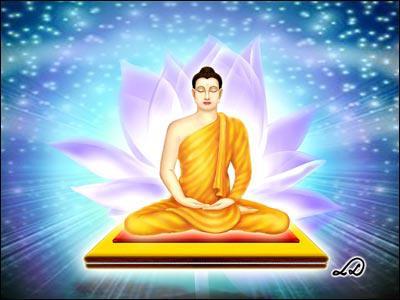 India is a vast land, endowed with many resources and majestic natural scenes. Located in a tropical climate, full of sunshine and rain. And one of the places in the world where many ethnic groups reside. Under the roof of India, many ethnic groups live together, making the culture more abundant and diverse, like the threads woven into a cloth with many harmonious colors.
May passed away, when sixteen years old, the prince married Princess Yasodhara. The peaceful, warm and happy life with a good wife and good children will quietly pass by if the heartless prince does not spy on the people.
It was four times to go out to find out the life of the people in the four gates of the city. Four events that make the prince think, because it happens not only in others but also in the prince himself. It raises many questions that the prince could not answer. The doctrine that the prince enjoyed also did not help the prince.
One day, at the age of twenty-nine, the prince decided to give up everything to find the answers to the burning problems of his heart.
The prince first went to Brahmin monks to continue deepening the doctrine that the prince was educated as a child. There, six years did not satisfy the prince. Finally the prince decided to meditate on his own. The prince decided to sit under the Bodhi tree and would not stand up until he found the truth. Forty-nine days sitting under the Bodhi root, the prince attained enlightenment to become Buddha, finding the source and path of liberation of suffering for man.
With generosity, the Buddha wanted everyone to become a Buddha. He went to preach. First of all, He reached out to five of his fellow practitioners. These five friends became the first five disciples of Buddha.
After forty-five years of spreading: "suffering and the path of liberation of suffering", in 483 BC, Buddha was under the Bodhi root, at the age of 80.
Before presenting the teachings of the Buddha, we should have a brief overview of the social and religious context of the Buddha. Then we will understand why the Buddha's teachings easily enter the hearts of people.
Before presenting the teachings of the Buddha, we should have a brief overview of the social and religious context of the Buddha. Then we will understand why the Buddha's teachings easily enter the hearts of people.
2. Buddhist origin
India is a vast land, endowed with many resources and majestic natural scenes. Located in a tropical climate, full of sunshine and rain. And one of the places in the world where many ethnic groups reside. Under the roof of India, many ethnic groups live together, making the culture more abundant and diverse, like the threads woven into a cloth with many harmonious colors.
Due to the wide terrain, cool, warm climate and cultural diversity have impacted on Indian people's character. In behavior, Indians are not passive but calm, thoughtful and fond of thinking. With such a temperament, it is easy to bring them to the inner depth. Therefore, religion has an important place in their lives.
According to history, Hinduism, also known as Hinduism, is the oldest religion in India. It affects every aspect of Indian daily life for centuries. A special feature of Hinduism is that there is no founder and no cardinal. Over time, it renewed itself, evolving to adapt to the new needs of the times but without breaking the tradition.
Along with the influence of religion is the formation of social order, which gradually leads to a caste division in society. Class is different from class. Caste is a regulation of status in a society, not based on education or a lot of money but on the place of origin. Just as a tree cannot choose its own seed, a father of any rank will have descendants of that level. Everyone is born at what level is due to karma. There are four main levels:
first). Brahmana are monks
2). Ksatrya is the royal lineage
3). Vaisya is a class of industry and commerce
4). Soudra is a working servant.
According to the law, the three upper classes are allowed to read the Vedas and attend festivals. The fourth rank must be enslaved for life.
Initially, caste division was appropriate to the social context but through growth the caste division became inhumane. It was this that caused the inequality in Indian society. Buddha saw injustice and spoke out against these unreasonable prejudices. Therefore we do not wonder what the teachings of the Buddha are so well received, most of them are poor. It can be said that this is the main factor causing the birth of Buddhism. Buddhism is increasingly spreading throughout the world.
3. General doctrine
The Buddha gave four truths: suffering, the cause of suffering, the cessation of suffering and the means of eliminating suffering to be liberated into Nirvana.
a. Soles
According to Buddha, the so-called vehicle is what is gathered by the wheels, wheels and trunks. Man is not self. The human being is a collection of mental and physical elements: aggregates, receptors, perception, aggregates and aggregates. Called the five aggregates.
People suffer: birth is suffering, sickness is suffering, old man is suffering and death is suffering, having to combine with what he doesn't like is suffering, away from what he loves is suffering and whatever we want but not suffering.
The Buddha explained the doctrine of dukkha with two dharma seals: all actions are "impermanent" and all phenomena are "non-self". This means that all things are not only constantly changing but also not having an independent, eternal entity.
That is the truth about the nature of misery, so what is the cause?
b. Tap base
Buddha taught about the causes of suffering. The cause of suffering in people is due to desire. It is desire that causes people to usurp what they love. Acts of appropriating that created karma for the afterlife. Pushing people into a new life to repay ... Just like that, birth and death, death and birth, people fall into a vicious circle called the Twelve conditions. People who want to get rid of this vicious circle have only one way to practice the third truth, that is to eliminate desire.
c. Kill the base
The cause of suffering is desire. According to the Buddha's teaching, people can recognize suffering and its causes. So people want to end suffering or not? If desired, the person who practices the third truth of Buddha is to destroy the base, that is to eradicate desire, to renounce Tham, San, Si in life. To destroy the grass must eradicate the root, man must eradicate the root cause of suffering. Then one can enter Nirvana, free from birth and death.
d. Religion
Usually people sleep more than waking. They were obscured by visibility, money, status, and fame. Therefore, it is difficult for people to eradicate desire and escape false consciousness. The Buddha saw clearly that people need to be awakened, that is, there are instructors to help people to attain Nirvana. Buddha proposed the Noble Truth as the path of cultivation. By faith, the Buddha advised his followers to have a mature understanding and thought so that they would lead to the right action. And always keep in mind the good, try to strive more and more.
The Buddha's teachings aim to promote the development of ethical behavior (Precepts) for spiritual discipline (concentration) and intellect (Wisdom).
The path of liberation by the Buddha opened to all men irrespective of cowardice. This is a simple and practical way of life in all social situations. The problem is whether people have patience or not.
4. Summary of Buddhist sects
Forty-five years of preaching, the Buddha did not leave any work at all. Shortly after Buddha's enlightenment, the disciples gathered to recall the Buddha's preaching. They discussed and then organized into three suttas written in Pali.
About two centuries ago, there was a disagreement between the disciples on the interpretation of the Buddha's teachings. Since then, it has been divided into many different schools. There are two dominant factions, the Hinayana and the Mahayana.
About two centuries ago, there was a disagreement between the disciples on the interpretation of the Buddha's teachings. Since then, it has been divided into many different schools. There are two dominant factions, the Hinayana and the Mahayana.
a. Hinayana
Do elders advocated in accordance with the teachings of Buddha. A special feature of this sect, firstly, only recognizes Nirvana. Nirvana is a state of tranquility, immortality, no desire, no difference. Secondly, only worship the Three Jewels and worship Shakyamuni Buddha.
b. Mahayana
Because the public advocates and takes the Buddha's guidelines only to expand the scope of the teachings to reach the absolute truth. Mahayana extends Buddhism into a philosophy that encompasses all things as vast as the sky, but withdraws only the word Mind. The mind of all things with the mind of Buddha is one. The mind is Buddha.
According to Buddhist researchers, the reason for the Mahayana and Hinayana is because the sentient beings' atmosphere is high, low and large, so Buddha depends on the bases, which the sect of the Tendai sect called "The five sermons of the sermon" ”.
II. THE BUDDHISM'S CONCEPT OF DEATH
 With an overview of Buddhism, from the identity of the Buddha, the situation comes, general teachings and sects. So in that teaching, how did Buddhism present its conception of death?
We know that the teachings of the Buddha were propagated into each place and according to each stage there was a slight change to suit the circumstances and needs of each time and each place. This can be expressed through the appearance and formation of sects. Therefore, when understanding the concept of death in the teachings of Buddhism, design also needs to follow the process of change over time and space. Therefore, it is necessary first to know how the Buddha - considered the ancestor of Buddhism - conceived of death, then how it was presented in the sects.
1. Buddha's conception of death
In fact, when studying the Buddha's conception of death is not easy, because his basic teaching as shown above, revolves around the Four Noble Truths, he does not discuss death alone. We can only draw from that teaching His concept of death.
First of all, the Buddha found that his teachings from death or death were one of the causes of his teachings. With four trips, he witnessed four aspects of human life through four scenes: the elderly, the sick, the dead and the spiritual. It is death that motivates Him to think and realize that death is suffering, from which He is determined to find a way to liberate from suffering, which is the Four Noble Truths. He contemplated the following: "It is we who must bear birth, old age, sickness, death, disturbing emotions and pollution. Why still love running after things that are still the same? Because we bear birth, old age, sickness, death, afflictions and pollution, we have realized the disadvantages of such things. Or we try to find the unfulfilled, the ultimate and the absolute fulfillment of Nirvana. The home life is very cramped, is a refuge of bare dust, But the life of the monk is indeed a vast sky! Those who are accustomed to family life will find it difficult to tolerate the spiritual life of holiness with all its perfection and purity. ”[1] . Buddha, after he attained enlightenment under a Bodhi tree, immediately thought of bringing the Dharma that he had just witnessed to spread to sentient beings. The Four Noble Truths are the sublime teaching of the Buddha, and have a very marvelous composition, arranged by the Buddha in a wise, logical, and orderly manner. The Buddha acted as a precedent physician to find the cause of those illnesses, and gave the cure.
In the Four Noble Truths, the Buddha dukkha that indicates to us that death is one of the aspects of the bowl format [2] . Of the four phenomena of impermanence, aging, sickness, and death, beings make the most fearful beings. Suffering death is not only physical but primarily spiritual. The physical suffering of a dying person is probably not as much as the mental pain. Suffering because of farewell, suffering because of fear, suffering because we know we have to die, that is "suffering", that is, suffering piles up on suffering, is one of the three suffering lines mentioned by the Buddha [3] . In the Kinh Te Kinh said: "all things that appear to be destroyed". The human body is governed by the impermanence. The cause of death is that everything in the universe is governed by impermanence, so it does not exist forever.
Death is suffering because it is seen under the eyes of the conditions stated in the Buddha's Noble Truth. The most unique and new discovery of the Blessed One is the law of the Twelve Causes, of which death is the twelfth affinity. These conditions are gathered and born forever called "Duyen Ha Man", or "Thuan Sinh Tu Luu". On the contrary, if one by one end of predestined relationship to other conditions, it is called "Duyen Ha Khuynh", meaning "Sinh Duyen Tilt Can", or "Nghuy Sinh Sinh Luu". The reason people keep wandering around in the Twelve Charming is due to affliction and delusion. According to the Buddha, there are ten root-delusion afflictions: attachment, hatred, ignorance, ignorance, doubt, incarnation, boundaries, ants, and precepts. Also according to the Buddha wants death is no longer suffering, it is necessary to eliminate the negativity, because "there are also afflictions, birth and death," no more defilements no longer weave samsara. " That is the way to kill the emperor.
To do so, one must have a method, which is the Noble Truth. In the Noble Truth, the four foundations of mindfulness (four things that austerities often keep in mind) teach us the need to "contemplate impure body" (concentrating on the thoughtful observation of the impurities of our body). ), "Contemplating impermanence" (the mind of impermanence means that the form of our mind always changes), "Contemplation of egolessness" (all things without self-appearance) and "Contemplation of suffering" is suffering). Having observed the impermanent mind and the method of non-self, we are free from samsara, so death is no longer suffering.
So when talking about the Four Noble Truths, the Buddha made it clear: human death is an obvious one, within the impermanence, death is suffering. The reason for dying is suffering because we are deluded and ignorant, wanting to break away from that impermanent law and always accepting ego. Removal of ignorance and delusion is the end of suffering, which is Nirvana.
With the passage of time, the Buddha's teachings have been explained and interpreted by posterity with differences in the schools. So the concept of death among the sects is also somewhat different. Here we learn about the teachings of the Hinayana and Mahayana about death.
With the passage of time, the Buddha's teachings have been explained and interpreted by posterity with differences in the schools. So the concept of death among the sects is also somewhat different. Here we learn about the teachings of the Hinayana and Mahayana about death.
2. The concept of Theravada Buddhism and Mahayana Buddhism about death
a. Theravada Buddhism's conception of death
Theravada Buddhism is derived from the group of Elders and thinks that the Buddha's teachings are only a small chariot, only austerities can free themselves from the suffering of "self-forgiveness". They believe that Buddha does not incarnate but only a Shakyamuni Buddha.
It can be said that Hinayana is a sect of faithful adherence to the teachings of the Buddha. Hinayana school advocates to follow the Buddhist scriptures and to follow the Buddha's words. This faction developed to the south, called the Nam Tong sect [4] . When studying Theravada Buddhism, one can only rely on the Tripitaka.
The basic teaching of the Hinayana in terms of awareness consists of three doctrines: impermanent action, the method of selflessness and Nirvana passed away, often called the three dharmas. In fact, that is just a way of deepening and emphasizing the teachings of the Buddha.
According to them, impermanence is an obvious truth, happening before our eyes, all things in the world are moving and moving, nothing is always immutable, nothing is there but not lost, there is no is because of the predestined relationship, once the predestined relationship dissolves, things will also dissipate, not when our being appears is called birth, and it is not when our life ends that we call death, In every moment, we have lived and we have died. So it can be said that "to live to die and to die to live", if there is a birth, there must be a death, and a city will also have cessation. head, singularity and cessation, that is impermanent law Whether long or fast, long or short, every life has a common aquatic life and made the impermanence period that the Buddha called "The most extraordinary". So, death can be considered as the end of "The most extraordinary period" and the opening of another "The most extraordinary period", which is an indispensable condition of the forthcoming birth. So death is indispensable in the impermanence of all things. People are suffering because of the misconception that everything is always immutable and that it always wishes, howling, even human life.
As for the theory of egolessness, the Hinayana teaching states that the "I" is false (hopeful), meaning that it is not without reality but when unconscious, it is "I" and when awakened, it is seen as " true nature, "is" true body. " What we call the "I" which is nothing but the back of the Five Aggregates case [5] . That form (body) which we call "mine" is united by the Four Elements [6]. When the four elements leave each other, there is no more form, the disintegration of the body is the death of the body, or in other words every time the four elements leave each thing returning to each of its categories, it is the death of the body. And the mind of "My" is expressed by the moral life, can be classified into four categories are: feeling, thought, action, consciousness all have nothing called "I" at all. When making the theory of non-self, Theravada Buddhism wants to say that in all things there is no eternal self as the soul in religions as well as other theories to keep moving in place of life and death, going in and out of heaven. or hell, but want to say that the self is the aggregates being aggregated by five aggregates in harmony. When the five aggregates disintegrate, the aggregates will be destroyed like smoke, not the legs. This is the essential thing that Buddha himself presented.
b. Mahayana Buddhist concept of death
Mahayana Buddhism was established by the Mahayana school and believed that the teachings of the Buddha were a great chariot, and spiritual practitioners must not only liberate themselves but also have the responsibility to liberate many people. On the big carriage there are many sentient beings who come up with Buddha. The Mahayana school advocates to understand the Buddha in order to practice the religion according to the conditions of sentient beings. Buddha is not one but Buddha incarnation, everyone has the Buddha nature "self-forgiveness, self-discipline, self-forgiveness". This faction developed to the North, called Bac Tong [7] .
It can be said that the Mahayana teachings contain the teachings of Hinayana, Mahayana are also synonymous with Hinayana in the sphere of awareness, but go beyond and go deeper into the essence of things, not merely. see things in terms of phenomena. So, in that basic teaching, what is the Mahayana concept of death?
In the "elite Buddhism" of author Thu Giang Nguyen Duy Can, the author shows that this sect advocates "impermanent things", always translating and constantly continuing with each other. If we research on the phenomenon of phenomena, it is clear that there is birth, there is complete cessation. But if you look more closely, when things are seen in terms of the phenomenon it was "Awareness of flowers" by us. Now it depends on our perception. Our awareness is limited only in the senses. So things have but according to the limited perception of our senses only. The reality as we know it has been "realized." We have just stopped at the external phenomenon of things without discovering its nature. Actually reality is reality, it is impossible to think about measurement with any idea. The original reality cannot be imagined, cannot be measured, so the Mahayana calls it "Truthfulness". What we see as arising and falling away, there is samsara is just fluctuations, arising and dying on the phenomenal side, while in reality, there is no reality that changes and arising and falling away. . Birth and death are just the premise of transformation and the being is never born and never changes. Therefore, it can be said that when looking at people with samsara, samsara is just stopped on the phenomenon scale, not going into human nature. In other words, in terms of phenomena we see death, but in terms of human nature is not. Birth and death are just the premise of transformation and the being is never born and never changes. Therefore, it can be said that when looking at people with samsara, samsara is only stopped on the phenomenon scale, not going into human nature. In other words, in terms of phenomena we see death, but in terms of human nature there is not. Birth and death are just the premise of transformation and the being is never born and never changes. Therefore, it can be said that when looking at people with samsara, samsara is only stopped on the phenomenon scale, not going into human nature. In other words, in terms of phenomena we see death, but in terms of human nature is not.
Also in this school, Tibetan Buddhism even more clearly describes the phenomenon of death in humans. Right in the Dalai Lama's introduction to Soyual Rinpoche's work "The Book of Life and Death," the author wrote: "I tend to think of death as well as changing clothes when it is older than one. something completely ends. Yet death cannot be foreseen, we cannot know when death comes to us, and how we will die. So it's better to take some precautions before what actually happens. ” Elsewhere he wrote: "Death is a natural part of life that we all will surely face sooner or later." In this work, Mr. Soyual also talks about the two causes of death, first of all, the Life of the Ended Life means that the karma of which we each have a life span, and when it ended, it was hard to extend life. However, people who practice Yoga can cross that limit and actually extend that life span. The second cause is timeless death, that is, death before the end of life.
However, it is said that if by some obstacle one could die unintentionally, that death could be easily avoided, as long as we knew in advance thanks to the signs, signs, dreams, “images. shadow ..., ... to be able to warn a person that their life is in danger, and to tell them that they should use the methods to extend their life before the obstacles come. Unfortunately, only a very small number of people have the expertise to be able to interpret all these signs.
Also in this work, the author also said the death process is explained in detail in many Tibetan books. At its core, it consists of two stages of disintegration: an external disintegration when the roots and the four elements are dispersed, and an internal disintegration belongs to the raw and subtle ideas and emotions. But first we need to understand the physical and mental components of things that will disperse at the time of death.
According to the author, death includes two stages of disintegration: external disintegration and internal disintegration [8] .
1) External disintegration
Occurs when the Faculties and the Four Elements are scattered. External disintegration occurs when the senses and the four elements disperse. The first thing we can realize is that our senses stop working.
The next four disintegration stages are accompanied by the disintegration of the four elements:
- Great Earth: First of all, our bodies begin to lose strength. We are exhausted and we have no energy left. We feel like we are being submerged to the ground or being crushed by a tremendous weight ... When the aggregates disperse, we become fragile. My mind is agitated, ...
That is a sign that Earth is receding into the Great Water. This means that the wind associated with the Earth is becoming less likely to provide a basis for consciousness, and the ability of the Greater Ocean is now more pronounced. So the "secret sign" is appearing in the mind, then we see a flickering image.
- Mercury: Next, we begin to lose the ability to control fluid in the body. The smell of death began to wander around. When Tho aggregates disperse, the feelings of the body weaken. Our minds stabbed in confusion, dissatisfaction, anger and temper. We feel like we have been submerged in the ocean or swept away in the great current.
The great ocean is disintegrating into the Great Fire, now the Great Fire wins and has the ability to lift the mind. So the "secret sign" is that the dying person sees a cloud like smoke.
- Fire: Next is all the warmth in the body begins to fade from the limbs to the heart. There may be a stream of smoke coming out of the top of the head. Cold breath through mouth and nose. Thought aggregates are scattered, and our mind is hovering between lucidity and confusion. It is harder and harder to recognize the outside.
The great fire is dissolving into Wind Wind, so now it cannot serve as a basis for consciousness anymore, but Wind's ability is more pronounced. So "secret signs" are flickering flickering spots on a fire that opens like fireflies.
- Windstorm: Finally we feel increasingly difficult breathing. The air is like escaping to the entrance to serve us We begin to pant. The breaths in are getting shorter and harder, the breath coming out getting longer, and we are completely motionless.
When the aggregates are scattered, the mind becomes wild, oblivious to the outside world. Our last sense of communication with the outside world is disappearing. We begin to have hallucinations and see scenes: If in our life we have created many bad karma, we can see horrifying shapes. The obsessions and terrifying moments of our life now return, and sometimes we try to cry out in terror. If we have lived with kindness and mercy, we can experience scenes of blissful paradise, dear friends or enlightened ones.
What is happening is that Wind energy is dissolving into consciousness. The winds are gathered in the "wind supports life" located at the heart. So the "secret sign" is seeing a torch or a red light. The more shallow the breath is, the deeper the breath is. Blood gathered into the "meridians of life". The three drops of blood gathered in turn, causing the last three breaths. Then suddenly our breath ends. Only a little warmth left in my heart. All signs of life no longer exist, and this is the point that the clinical examination considers "dead". But Tibetan masters speak of an inner process that is still ongoing. The time between apnea and internal breathing is thought to be about a meal, or about twenty minutes. But there is no certainty, and the whole process can happen very quickly.
2) Internal disintegration
At the same time as external disintegration is internal disintegration, it belongs to crude ideas and emotions. In the process of inner disintegration, where the mental and subtle emotions and emotions disintegrate, there are four layers of subtle consciousness. Here the process of death reflects against the process of reincarnation.
In the process of reincarnation, when our parents' blood meets, our mind is motivated by karma, pulled in. During fetal development, the essence of the father dwells in chakras at the top of his head. The essence of the mother who dwells in chakras is said to lie about four fingers below her belly button. It is from where these two essences lead to the stages of "appearance", "growth" and "achievement". And when we woke up a bit, the Basic Light flashed like an invisible sky without clouds. Sometimes it is called "mind with the clear light of death". The Dalai Lama said, "This consciousness is the deepest consciousness. We call it the Buddha nature, the true source of all consciousness. The continuous flow of this mind lasts even until the attainment of Buddha. ”
Then what happens when we die? It is like we return to our original state, everything falls apart, when the body and mind have been removed. Three poisons of greed, hatred and delusion die, which means that all the negative emotions, the root of samsara, really end. And where does that process take us? - Go back to the primordial basis of the nature of mind, in all its natural simplicity and purity. When greed, hatred and delusion die, the more we become pure.
Regarding the stages of death, there are slightly different descriptions of details and order. What is explained here is in the usual description, but it may vary from person to person, or changes may occur as a result of the special condition of the dead, and the condition of the acupuncture points, vigor and spirit. In the case of sudden death or accidental death, this process also happens but extremely quickly.
Our whole being is determined by the great races: earth, water, fire, wind and space. Thanks to these great races, the body formed and existed, and when they disintegrate, we die. We are often familiar with the external races, which determine how we live. But we should also know that they also affect the great strains within our bodies, and the potential and properties of these five great beings also exist in our minds.
Thus, the easiest way to understand what happens in the process of dying, with its internal and external disintegration, is to see it as a sequential development and the arising of layers of consciousness. more and more subtle. Each class emerges the continuous disintegration of the mind-body, as the sequential process moves towards it there manifests the subtler mind above all: the Basic Light or the Glorious Point.
The author goes even further to show us both near death experiences and escaping bodies. In near-death experiences, often beginning with an out-of-body experience: one can see their own body as well as the surrounding situation, which coincides with what was said in the Book of the Dead: "I remember I woke up from a coma and drifted off and found myself out of my body, floating in the air, looking down at my body. I only know I have a brain and eyes, but I don't remember having a body. In near-death experiences, the mind temporarily escapes the body and experiences some experiences similar to those experienced by a sentient being in the Bardo realm of rebirth.
Thus, there are similarities between the near-death experience and the teachings on the Bardo, but there are also differences. The biggest difference, of course, is that people who have near-death experiences don't really die, while Bardo teachings talk about what happens after the body actually dies, and when they are reborn. The fact that near-death experiences do not go further on their journey to death - some say they only "die" for a minute - partly explains the difference between the two.
Some argue that NDEs describe stages of the disintegration process in Bardo of death. As such, it may be too early to try to relate NDEs precisely to the descriptions of the Bardo, because people who have had NDEs only "almost" died. It is a phenomenon that belongs to the self-arisen realm of this life, because the mind temporarily leaves the body of the dead and wanders in the realms.
These experiences are generally intended to describe the phenomenon of impermanence; The impermanent phenomenon is death in humans.
These experiences are generally intended to describe the phenomenon of impermanence; The impermanent phenomenon is death in humans.
III. THE CONCEPT ABOUT THE BUDDHISM OF BUDDHISM
1. Buddha's conception of reincarnation
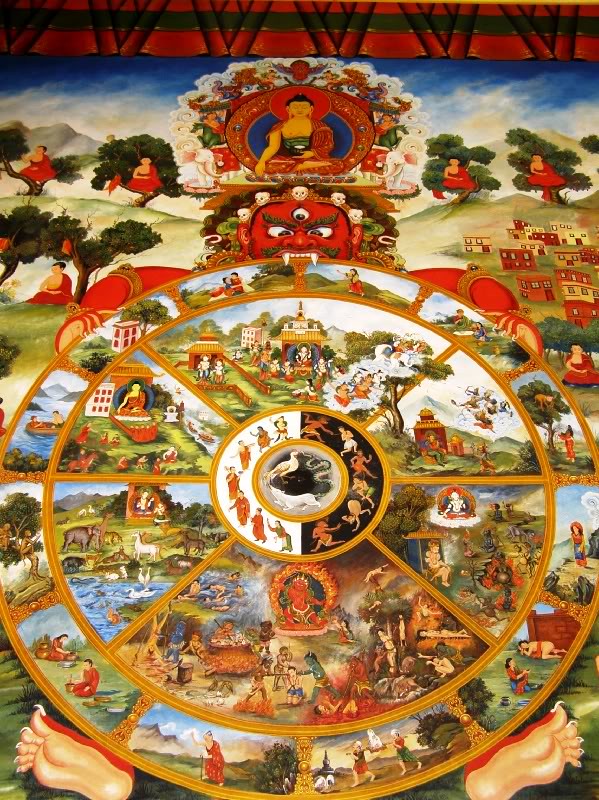 In the previous section, we have studied some aspects of Buddhism about death. Then what will happen after death? Buddhism Begins The Buddha addressed this problem with a doctrine of reincarnation, which we will explore in the following section.
In the previous section, we have studied some aspects of Buddhism about death. Then what will happen after death? Buddhism Begins The Buddha addressed this problem with a doctrine of reincarnation, which we will explore in the following section.
a. Why do we believe there is rebirth?
There were two powerful currents of thought that strongly influenced religious thought at the time [9] . According to the first movement, all sentient beings, including humans, are prisoners of samsara. The second trend affirms that conscious, positive or negative actions, of course, bring a result that will ripen into the afterlife. That is the law of karma that no one can avoid.
In this context, some people wanted to ask for sacrifices in order to look forward to a happy reincarnation in the next life, so they invited the Brahmins to offer them. Brazil is a member of the priesthood, and only they are eligible to perform sacrifices in traditional Vedic religion.
However, for some others, that process is clearly useless. Indeed, why go looking for a happy afterlife when all the sentiments that sentient beings experience will end with suffering and death? Only a permanent liberation from samsara can meet the real aspirations of man.
But how to get rid? The ascetics at that time hoped to break the law of reincarnation by not committing any negative deeds (no bad karma and no reincarnation). Others choose to practice meditation, so that they are always aware that each person's inner reality (atman) - which makes them exist as an individual - is identical to the ultimate reality (brahman), from there everything comes and comes back. The ideal is far superior, only those who are keen on the holy scriptures, the Brahmanes, can reach it.
Like his contemporaries, the Buddha shared his concern about how to be forever free from samsara (Samsara). But He rejected the dominion of the Brave class, and as such, rejected the existence of sacrifices. He denied all religious authority based on holy books. As for the ascetic path, the Buddha's stance is clear: anyone who is attached to an excessive ascetic life reduces his ability to meditate and act as selfish. As such, they will not escape imprisonment in samsara. The Buddha also condemned all efforts to attain the experience of unity between Atman and Brahman. According to Him, Atman is just an illusion. Attaching to it is turning itself back to the only truth that can lead to liberation - the truth that he discovers when he experiences enlightenment.
Thus, those who have understood the concept of reincarnation, realize that this roadmap really did not start in India 2,500 years ago. The beginning of the "sacred cause" of the Buddha originated in countless previous cosmic times, when he became a Bodhisattva (who dedicated his life to ultimate enlightenment).
For Buddhists, only the Buddha has the most authority to explain the issue of rebirth and reincarnation in Buddhist teachings. It is in the night that he attained the Chief Justice of Right Understanding. He said, "The Tathagata has recalled many past lives like this: first one, then two lives, then three, then four, five, ten, twelve, fifteen, then one hundred, one thousand, one hundred thousand,… ” [10]
Those are the Buddha languages that refer to the issue of rebirth. The canonical texts related to the theory of rebirth show that the Buddha did not rely on any available knowledge to explain this obvious truth. He is based only on his own experience and awareness, a superhuman awareness that each of us can achieve if we cultivate properly.
In the first poem, the Buddha taught: "Through many lifetimes, the Tathagata is wandering away, going forever to find a worker who built this house. Suffering instead brain constant birth and death. [11]
In the Zhuan Falun, the first discourse, the Buddha refers to the second truth as follows: "it is craving that leads sentient beings to rebirth". [12] And the Buddha concluded his discourse: "This is the last life of the Tathagata. From here Tathagata is no longer reborn. "
In many other passages, the Buddha clearly teaches that there are those who must be born into misery because they have lived a sinful life, and some, through good deeds, are reborn into leisurely scenes.
In many other passages, the Buddha clearly teaches that there are those who must be born into misery because they have lived a sinful life, and some, through good deeds, are reborn into leisurely scenes.
In the Gutta Sutta [13] , the Buddha also told Venerable ānada that in a previous life, during the time of Buddha Kassapa, he was Jotipala.
In the Anāthapindikovãda Sutta [14] also noted that immediately after being reborn in Heaven, the millionaire Anāthapinkida returned to visit the Buddha the following night.
In the Anāthapindikovãda Sutta [14] also noted that immediately after being reborn in Heaven, the millionaire Anāthapinkida returned to visit the Buddha the following night.
The Great Nirvana (Parinibbana) [15] notes that one day Venerable Aõnada came to the Buddha, inquiring about the fate of a number of dead people in a certain village. Buddha patiently described the case of each person, each situation.
Similar cases, many in the Tripitaka, show that the Buddha explained the doctrine of rebirth as a verifiable truth [16] .
In Bosat magazine [17] it is said that Pythagorean recalls the contradiction that he used in a previous life, when he besieged the city of Troie. In rebirths as Pythagoras, the buckler was still a shrine to Greek [18] .
According to Venerable Nàrada Mahã Thera [19] , there are outstanding supreme figures in the world, omniscient ones like Buddha, cases like Confucius, Pangini, Homère, Platon, ... and outstanding geniuses. such as Kālidãsa, Shakespeare, prodigies such as Ramanujan, Pascal, Mozart, Beethoven, ... Can it be only in the time of a lifetime that one can cultivate the intellect to such a super-perfection level? Of course, they have gone through many noble lives in the past and have collected similar experiences. The cause of that unusual development in certain individuals may also be the past karma.
Also, media theory is not enough to explain cases of prodigies. In order to explain that complicated problem adequately, we must add to the tradition of Karma and Rebirth.
Is there any reason to believe that it is only this present life that will determine eternal happiness or infinite misery in the future? How much effort in a short life, at most a hundred years can be an adaptive preparation for eternal life?
If we believe in the present and the future, we also believe in the past. It is the life of the past and the future that explains why in life, so many meek people suffer hardships, and there are wicked people who are rich and blessed.
b. Reincarnation
What is reincarnation?
Buddhism teaches, after death we remain in the state of intermediate existence in this life, after this time, depending on the karma that we have contained in the previous life, we will be reborn into another realm. If we die in an unenlightened state, the soul will return to the previous state of ignorance, reborn in the six realms of illusion, through twelve stages, and we will repeat this cycle until the end of time. This repetition of life and death is called reincarnation.
The Buddha said that reincarnation is the cycle of the Twelve Lovers. By twelve conditions, sentient beings have biochemical biochemistry forever.
The predestined theory is the proof of the selfless theory of Buddhism.
The Shakyamuni teaching teaches that ego is the source of ignorance, and ignorance is the focal point of samsara and suffering. When we talk about reincarnation, people often think that the self is transferred from one life to another. But Buddhism considers the concept of everlasting self to be a misconception and utter fiction. Reincarnation is to ask for liberation, that is to use it to destroy the Self (self) in order to escape from samsara.
The law of cause and effect in the field of moral morality is karma. Rebirth is the natural consequence of karma. Karma and Rebirth are two basic teachings in Buddhism, closely related to each other.
According to Buddhism, we are born from the fetus of action (Kammayoni). It is our past action or karma that the fetus nourishes and facilitates our rebirth. Parents constitute material foundation. Thus, before beings have beings. Before a being in the present life, there must be a being in the past life. At the time of conception, it is Karma that creates the first consciousness for a living source for the fetus. It is the invisible karmic force, which arises from past lives, that creates the Spiritual phenomena and the Phenomenological phenomena in an existing material phenomenon (sperm and lucidity of the parents), to include all three elements. - Tam Nguyen - constitutes a person.
Refers to the issue of conception. The Buddha taught, "Where there are three factors combined, there is a arising germ." If the parents meet but do not aim at the period of their mother's pregnancy and do not have a seed (Gandhabba) then there is no germ. If the parents meet during their mother's pregnancy without the coordination of a single seed, then there is no germ. If parents meet each other in order to have a mother's pregnancy and have a seed, then there is a germ, due to the combination of three factors ” [20] .
Thus, there is rebirth in this place, of course, there must be another being dead somewhere else. Strictly speaking, the birth of a being, or the arising of the Five Aggregates, or mental and physical phenomena in the present life, transitions immediately after the death of a recently deceased being, just as It is often said that when the sun goes down in one place, the sun rises in another. The seemingly mysterious statement may be clearer and easier to understand if we envision life as a wavy rather than a straight line. Waves emerge and then descend to begin new waves. Although the two wavy different but no interruption time. Birth and death are only two stages in a process. The endless flow of samsara, the birth and death of a long series of lives called samsara (Samsarã), is an uncertain, forever and purposeless journey.
What is reborn: Buddhism teaches a kind of psychology in which there is no soul. Buddhism advocates that we are the union of the two components of nama and rupa, mind and matter, and these two components are in a state of ever-changing state as an everlasting stream.
In addition to nama and rupa, mind and matter, which are the two constituents of sentient beings, Buddhism does not recognize an eternal soul or an everlasting ego that man has mysteriously received, from an origin. equally mysterious. A soul that is forever immutable of course, before and after. If the soul which one assumes is the essence of the human being is eternal, the soul cannot arise or destroy, but we cannot explain why “from the beginning, this soul was different. So far away from that soul. "
Once you have denied the immortal soul, then after death, what of man will go into the cycle of rebirth? If there is nothing, in the form of the soul, from one life to another, what is reborn? Such a question means of course accepting something reborn.
A few centuries ago there was the argument "Cogitô, ergo sum" [21] . Exactly. However, we must first prove that a "I" is thinking. And Professor James concludes the fascinating passage about the soul as follows: "It is the thought that is the one who is thinking" [22] , and that is the echo of the Buddha's teachings taught more than 2500 years ago, in Ganges valley.
According to the Buddha, people are a collection of the five aggregates. When death is death for the aggregate the other four aggregates exist. The four aggregates aggregate in the consciousness, creating karma to transform. When the karma merges with a nama rupa, it becomes a set of new skandha (new people). Thus only the Knowledge goes into samsara.
The whole process of these mental and physical phenomena always becomes and then dissolves, arises and passes away. Sometimes the Buddha used the usual nouns and called the process "I" or Attā. However, it is only an ever-changing process, not a permanent entity.
Buddhism does not completely deny the existence of a personality in its usual sense. Buddhism denies - in the ultimate definition (Paramattha Saccena) - an unchanging being, an eternal entity, not denying there is continuity in the process. The term Buddhist philosophy refers to an individual as Santati, a tributary, or continuity. That incessant tidal current or continuous continuity of psychophysical phenomena - facilitated by karma - originated in a distant past that we cannot conceive and will continue to continue in the future. endless hybrid, except when we apply the Noble Eightfold Path fully and properly. It is the constant tidal flow of that psychophysical phenomenon that is what other belief systems call the eternal "I" or the everlasting "soul".
If there is no everlasting soul, regarded as a mere, unchanging entity, then what is reborn?
According to Buddhism, birth is a combination of aggregates (khandas) or groups, unions (khandhãnampãtubhãvo).
Just as the arising of a material state must be caused by the prior state as a cause and condition, these psychophysical phenomena also arise due to the causes arising before the birth as a condition. The current process of transformation is the result of predestined desires according to the changes in the previous life, and the natural instinct of present desires will facilitate the coming rebirth. In one life, the process of life can proceed without a permanent entity moving from one thought moment to the next, a series of processes can also proceed without a something else moves from life to life.
The theory of rebirth in Buddhism is not a theory of soul reincarnation, understood as the movement of one soul from one life to another.
The Buddha argued that the impermanent character of the mind or consciousness was even more pronounced than the impermanence of the body. So reincarnation according to Buddhism is somewhat different from Plato and India, a transfer of nothing enduring.
c. The beginning and the end of the cycle of reincarnation The Buddha taught, "In the beginning, you friends, it is impossible to measure or calculate. The same goes for its schedule. The first point of the long, endless race of sentient beings hidden in ignorance and entanglement in craving is truly undiscovered ” [23] .
"It is impossible to conceive of the beginning of the cycle of reincarnation, not be able to discover the original starting point of beings, hindered in ignorance and attachment in craving, in a hurry, haste, to run wild through the cycle of continuous birth and death.
Samsãra, samsara, in the original sense of the word, is an uncertain and incessant hike. The Book of Atthasala has defined Samsãra as follows: "Reincarnation is the continuous continuation of the five aggregates, the four elements and the six bases" [24] .
Thus, the Buddha made it clear that limiting the flow of lives in samsara would not be possible. Beings, because the class of ignorance and being bound by the craving, wanders in samsara. The beginning of that distant journey is unrecognizable.
d. Realms of Reincarnation: [25]
There are four states of unhappiness (apāa) because both the mind and matter suffer. The four realms are:
1 / Hell (Niraya)
2 / Zoo (Tiracchachayoni)
3 / Demons (Peta-yoni)
4 / A-tu-la (Asura-yoni)
The seven realms of friendship (sugati) are:
1 / Scene (Manussa) [26]
2 / Four heavenly kings (Cãtummahãrãjika)
3 / Dao Loi (Tãvatimsa)
4 / I
5 / Duel-Xu-Đà (Tusita)
6 / Hoa Lac Thien (Nimmãnaratĩ)
7 / Falling into freedom (Paranimmitavasavatti)
Four scenes of suffering and seven blessed scenes are located in the Realms of Education (Kanaloka).
On Sex there is Lust (Rũpaloka), is the realm of the Brahma, the gods have renounced craving and are enjoying the happiness of meditation. There are a total of sixteen scenes, which are:
1 / Brahma they (Brahma Pãrisajja)
2 / Brahma Purohita: the realm of the gods close to the Brahma.
3 / Brahma Thien (Mahã Brahma)
Those are the three realms corresponding to the First Jhana.
4 / Thieu Quang Thien (Parittãbhã)
5 / Immeasurable photosynthesis Thien (Appamanaãbha)
6 / Optical sound Thien (Ãbhassarã)
Those are the three realms corresponding to the Second Jhana.
7 / Pure Land Meditation (Parittasubha)
8 / Immeasurable Pure Land (Appamanasubha)
9 / Variant Thien Thien (Subhakinha)
Those are the three realms corresponding to the Third Jhana.
10 / Quang Thien fruit (Vehapphala)
11 / Unbelievable Thien (Asannãsatta)
12 / Infinite Thien (Suddãvãsa), is a completely pure realm. This scene is further divided into five scenes, which are:
- Immortal realm (Aviha)
- The pure realm (Atappa)
- Beautiful realms (Sudassa)
- Clear view (Sudassi)
- The ultimate realm (Akanittha)
Only the meditators will be reborn in the sixteen Lama scenes above.
What about the end of the cycle of reincarnation? The Buddha taught, "Life is like a stream of water flowing on endlessly. As long as I receive the muddy water of ignorance and craving, the flow of life is still flowing, and only stop when ignorance and craving are completely cut off. Then there is no more rebirth. " The theory of rebirth is the basic teaching of Buddhism. The ultimate goal of Buddhism is Nirvana - the end of Rebirth - which can be achieved in this present life.
e. What is nirvana?
 Reaching Nirvana is free from birth and death, is the end of suffering. What is nirvana?
No matter how well and clearly one can write, no matter how many people use the glossary to try to describe the tranquil state of Nirvana, the text cannot help us realize how Nirvana. Nirvana is not something that can be described in black and white paper or perceived by reason. Nirvana is the supramundane method (lokuttara dhamma), which can be realized by insight. The Sanskrit word Nibbana (North Sanskrit: Nirvana) consists of two parts, "Ni" and "Vana". "Ni" is the negative form, no. "Vana" means passing, or craving. This craving is considered as the link between the two lives.
Called Nirvana because Nirvana is the removal, the separation of Ni from craving for craving, craving for sensuality. [27]
Every day there is craving or attachment, there is also creating new karma and this new karma must bear fruit in some form in the endless cycle of samsara. Until all forms of craving ceased, the capacity of the creator also ceased, of course, no more karma was created, and one attained Nirvana, free from the constant cycle of samsara.
 Because of the new Karma there is reincarnation. So what is karma?
There are also places explaining Nirvana are the extinguishing of the fire of lobha (lobha), anger (dosa) and si (moha).
The Buddha taught, "The whole world is in flames. What fire has ignited those flames? It was the fire of greed, fire of the yard, the ignorance, the fire of birth, the old fire, the fire of death, the fire of affliction, the fire of exclamation, the fire of pain, the fire of misery, the fire of despair, having gathered on those flames ” [28] .
Judging in a way, Nirvana is the extinguishing of those flames. But not so that it can be said that Nirvana is just the extinguishment of the flames. Should distinguish the means and objectives. Here, extinguishing the fire of greed, hatred and ignorance is just a means to go to Nirvana.
Nirvana is not nothingness. If only because the five senses cannot perceive that we assert Nirvana is nothingness, just as the blind man concludes that in life there is no light, just because he never sees light. So Nirvana is not nothingness. Nor is it just an end. Nirvana is not how we can say it with certainty. But if we have to describe exactly what Nirvana is, then the language of the world cannot be suitable, because Nirvana is absolute and unique. Be enlightened yourself (paccatam veditabbo).
Nirvana is not nothingness. If only because the five senses cannot perceive that we assert Nirvana is nothingness, just as the blind man concludes that in life there is no light, just because he never sees light. So Nirvana is not nothingness. Nor is it just an end. Nirvana is not how we can say it with certainty. But if we have to describe exactly what Nirvana is, then the language of the world cannot be suitable, because Nirvana is absolute and unique. Be enlightened yourself (paccatam veditabbo).
In fact, there are not two classes of Nirvana but there are two forms of experience of directing Nibbāna. Two different nouns refer to two forms of experience, one before death and the other after death. Results of Nirvana can be achieved in the present life. There is no point in the entire teaching of the Buddha that the goal of salvation can only be achieved after death. This is the difference between the conception of Nirvana of Buddhists and the conception of non-Buddhists, of an eternal heavenly landscape, which can only be achieved after a lifetime.
When the attainment of Nirvana is attained in the present life, that is, while still having the five aggregates, it is called: "Huu Du Nirvana". When leaving the body, the A-la-Han attained great Nirvana, no more material, then called: "Surplus Nirvana", and no longer create new karma. But wholesome or evil causes created in the past still bear fruit until their names and colors disintegrate.
What is the characteristic of nirvana?
The characteristic of nirvana is eternal (dhuva), desirable (subha), and happy (sukha)
The existence of Nirvana, the supramundane state, that the Buddhas and Arahants realize, does not depend on any cause. Therefore, Nirvana does not become, does not change, does not get scattered. Strictly speaking, nirvana is not a fruit, nor a cause. Therefore Nirvana is unique. What arises due to a certain cause must perish, and therefore, is not desirable.
Nirvana is any arbitrary method, invisible, not dependent on any cause. Therefore Nirvana is permanent, unborn, undying, desirable, and happy.
We should distinguish happiness Nirvana with happiness in the world. Nirvana happiness is neither fade nor boring. That form of happiness is not tiring, not changing. Transient happiness in the world is the satisfaction of some ambition (vedayita). On the contrary, Nirvana happiness arises because of the decrease of desire (vupasama). Buddha declared: "Nirvana is the ultimate happiness" [30] . Is the ultimate happiness because Nirvana is not happy being born by the five officials. Nirvana is the utterly true Dharma, which is the happiness arising from the positive liberation from all sufferings of life. It is the break of suffering that is often called happiness, although that term is not suitable to describe the nature of Nirvana.
Where is nirvana?
In the King Milinda Sutta (Milinda Pranga), Nāgasena answered that question as follows: “... as fire is not stored in any special place, but when conditions permit, fire arises. In the same way, one cannot say where Nirvana is, but when the path is sufficient, the result of Nibbana is achieved. And in the Rohitassa Sutta it is written in Buddha's words: "Tathagata declares that the world, the origin of the world, the end of the world, and the path leading to the end of the world are all within the body of a scepter. This, together with perception and thought [31]. In this passage we can understand that according to Buddha the world is suffering. So to end or destroy the world is to end suffering, that is, Nirvana. Nirvana is not what has been created or what needs to be created. Nirvana is not a certain scene dedicated to an outstanding individual, but a dharma (Dhamma), an accomplishment that every being can attain, and one cannot imagine a scene everlasting world no matter where.
It must be recognized that the issue of Nirvana is one of the most confusing points in the Buddha's teachings. The best way to understand Nirvana is to process your achievements with your own intuitive wisdom. The objective was obscured behind a cloud obscures, but the methods to achieve it is transparent, and when achieved, then the goal will appear as clear as "moon, not cloud judgment" [ 32]
f. Retribution
Because of the new Karma there is reincarnation. So what is karma?
Kamma (karma), according to the definition of nouns is action or deed.
The ultimate definition of karma is volition (Cetanã). Thoughts, words, and jobs are often motivated by the will to start. Buddhism called the will, or will, it is volition. All actions that are intentional, whether manifesting by body, speech or mind, create karma. All actions that are volitional, wholesome or unwholesome create karma. Unintentional, unintentional actions, although expressed by words or deeds, do not create karma. Thus, intention is the most important factor for creating karma. (p. 356)
According to Buddhism, karma is caused by onions, namely body, mouth and mind. Karma is action, doing, the force that creates samsara. We are born in a state that our past actions have created. If in the present life, even though we live a pure life and we encounter unhappiness, we should know that it was due to our negative karma in the past. On the other hand, if we live a life of filth and sorrow and we still enjoy happiness, wealth, and luck, it is also due to our good karma created in the past. Our good and bad deeds in the present will also produce results right away, when the causation is complete.
Since the time of Buddha, the two doctrines of Karma and Rebirth had been spread widely in India. However, the Buddha himself explained it in full and presented it fully, so far still handed down, to explain basic issues such as:
Why is there disagreement in humanity?
How do we explain such inequalities as injustice in the world?
Are there certain causes that make a difference in the world? If not, would these differences be a coincidence, caused entirely by chance?
The wise can not believe in the blind chance, and do not accept the explanation by accident. In this world, nothing happens to humans without any cause or causes. The joys and sufferings of those who are reaping are born of good or bad causes created, either in the present life, or in past lives.
When the Buddha was still in money, a young man named Subha wondered before the situation of disagreement between humans, wanted to find out the truth, approached him and said, "White Buddha, for any reason and reason there are people in life who die prematurely (Appādukã), some who live (Dighayukã), some who are sick (Bavhãbãdhã), and someone who is healthy (Appãdhã), some bad people (Dubbannã) and beautiful people (Vannavantã) , there are poor people (Appabhogã) and there are rich people (Mahãbhogã), there are ignorant people (Duppannã) and there are intellectual people (Pannavantã), ...
The Buddha answered this briefly: “All beings follow their own Kamma as an inheritance, as a hereditary, as a close body, as a refuge. It is because the karma of each person is different that there is a scene of differences between beings ” [33] . Then the Buddha explained to Subha case by case ... [34]
As in the case of the Buddha, he was born thanks to sperm, enlightenment and the genesis of his parents and all sentient beings. But physically as well as spiritually, in the nobility, down to his ancestors down to Him, no one can compare with Him. The Buddha once taught that he is not of the royal lineage, but of the Buddhas. Certainly Buddha is superhuman. He was born with the extraordinary karma that he himself has created from countless lifetimes.
The rare case of the Buddha proves that the power of karma not only dominates the body but also goes above, losing part of the performance of sperm, lucas and the inferiority of the parents. That is why the Buddha taught, "I am the one who inherited the results of my creation as a legacy from the past".
What we say, think and do is ours. It is thought, word and action that are karma. And it is the Karma that takes us up or down from one life to another, forever in samsara. Buddha taught:
“The blessings and sins that man creates are all that he owns, what he takes from one place to another…
“It is what always follows the heels of people like a figure.
“So from here on man, store the good and take them away, in the future.
"Create a strong foundation for the world tomorrow" [35]
In short, according to the Buddha, mental, moral, intellectual and natural differences ... largely depend on our actions, our tendencies in the past, present and future, i.e. So karma.
But all is not due to karma
Do we have to reap everything we sow? Not necessarily like that. In the A-Ham Monk Sutta, Anguttara Nikāya, the Buddha taught: "If one thinks that one must reap the results of all past actions, one cannot have a moral life, and one also There is no chance to eradicate defilements. But if it is said that the harvest is commensurate with the cause, there is a moral life, and man will have the opportunity to extinguish disturbing emotions ” [36] .
Although advocating that the main cause that makes a difference in life is the difference between the karma of sentient beings, Buddhism does not assert that it is all in the karma. In other words, karma is not the only cause that makes the difference between beings. The law of karma, though important, is just one of the twenty-four conditions (Paccaya) [37] in life.
In order to adjust the notion that good, evil, or unwholesome results, all of them arise due to past actions, the Buddha said, "If such comment is made and it is determined that actions In the past, when people became murderers, robbers, lustful, greedy, crafty people, ... we will have a reason to rely on the past without wanting to do it. try to perform, and do not see the need to perform, or not perform, an action, whether or not it is worth doing. " [38]
If the present life is absolutely driven by past actions or wholly independent of karmic action, then the law of karma is nothing but deterministic theory or predestination. No one is free to improve their lives, now or in the future, and free will is only an absurdity. Life becomes completely automatic and people are not much different from the machine. Such the theory of destiny is not the law of karma in Buddhism.
Thus, according to the Buddha's teaching, we can rectify our karma, because if we have to pay for all the past actions, sentient beings will have to live forever in suffering and cannot expect to have a day. rescue. Although we do not fully master the karma - because the cause has been sown - but we do not have to surrender completely and become slaves. Even the most despicable bad person can try to be morally clean. We are always transforming and always becoming something new, and that new thing depends on our own actions. Every second, every minute, we can transform ourselves, making us better or worse, even the most corrupt sinner is not despicable. On the contrary, we should give them confidence in their efforts to improve the nature of their being. Perhaps at some point in the past we have been in such a situation and we have improved. Today, in a low position, they can also try to follow us and maybe even more advanced than us.
Buddhism distinguishes the five laws (Niyama) [39] , or the five schedules that govern material and spiritual progress:
- UTU NIYAMA is a law related to physical progress of the non-body type such as weather, rain, heat, ... Four seasons and eight periods and the characteristics of each season.
- BIJA NIYAMA is a physical law related to the physical progression of organic matter, such as plants with cells. Because of this law, every breed is born like that. The law of yin and yang male, cell, and inborn conception in pregnancy is also governed by this law. So do the physical similarities of the twins.
- KAMMA NIYAMA is the law of cause and effect or progress from action, good or evil, to good or evil results. People sow, then bear fruit. Good causes good results. Evil causes bad results. That is the law of nature, must arise like that, not as a form of punishment. The evolution from cause to effect is as natural and necessary as the rotation of the moon around the sun. That is the cause and effect principle of the law of karma.
The law of cause and effect works in a very mechanical way. When the Ngiep is too heavy, even the people who want it cannot modify its rigor. But in those cases, the right view and the pure intention can partially fix the karma. Good karma can partly alleviate evil.
The second principle of cause and effect is continuous arising. A scientist in life, explores, learns, gathers a lot of knowledge and experience. By the time of death and rebirth, all these experiences and knowledge are also transferred from one life to another. Due to the principle of continuous causality there are cases of prodigies, ...
- DHAMMA NIYAMA is the law of all things, like the phenomena that occur when a Bodhisattva is mortal in the last life, the law of gravity and other laws in the universe can be listed in this progression schedule.
- CITTA NIYAMA is a psychological law, such as the schedule of the mind, the elements that make up the mind, the capacity of the mind, such as telepathy, knowing the past tense, the Hue eye, the atria, the compassionate mind and the Similar phenomena that modern science has not yet explained.
The five progression schedules above are themselves laws based on which we can explain all psychological as well as physical phenomena. Like all laws in the universe, the above five schedules are not created by any mysterious divine authority. Karma is only one of those five laws.
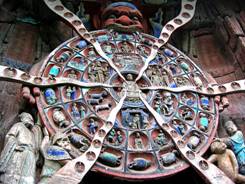 As mentioned above, we have mentioned the Buddha's conception of reincarnation, according to him, reincarnation is bound by karma, so we must be biochemical and biochemical forever, but we must bear all the afflictions in suffering. In other words. Reincarnation is the cycle of the Twelve Causes and conditions. Because of the Twelve Causes and conditions, sentient beings go on biochemical, in the end the Buddha said that the attachment of self is the source of ignorance, but ignorance is the focal point of samsara and suffering. People who want to get rid of samsara must eliminate the Self.
The law of cause and effect is a complex law. Because in addition to the aforementioned issues, there are also cases of fruit arising in contrast to the seed that was planted, or in the response of karma that also have the ability to support, support, and facilitate early flowering. and vice versa, there are also the ability to suppress, prevent fruit from being born. Only the Buddha can fully understand its origin and its ultimate goal is to eradicate karma.
Faith in Karma "raises the value of diligence and stimulates enthusiasm" because reason Karma teaches each person to take on his or her responsibilities. The law of cause and effect explains the problem of suffering, explains the mystery of the so-called Fate and Predestination of some religions, and above all, explains the difference in humanity. For the basic Buddhists, the Karma is a commandment. For the intellectual class, Karma is an encouragement.
2. The concept of Theravada Buddhism and Mahayana Buddhism about reincarnation
As mentioned above, we have mentioned the Buddha's conception of reincarnation, according to him, reincarnation is bound by karma, so we must be biochemical and biochemical forever, but we must bear all the afflictions in suffering. In other words. Reincarnation is the cycle of the Twelve Causes and conditions. Because of the Twelve Causes and conditions, sentient beings go on biochemical, in the end the Buddha said that the attachment of self is the source of ignorance, but ignorance is the focal point of samsara and suffering. People who want to get rid of samsara must eliminate the Self.
Based on the above teachings of the Buddha, the sects of Buddhism promoted reincarnation according to their own policy. We can mention the two major sects of Mahayana and Hinayana.
a. Hinayana
Before going into the Hinayana concept of reincarnation, we also need to identify the policy of this sect to follow the Buddhist scriptures and to follow the Buddha's teachings, so the Hinayana does not focus on the performance but only The explanation is relatively simple.
The Hinayana conceives that samsara and nirvana are two different "being" and "infinite" beings. "Being" is that which is in the world, that is, all things. That is, although impermanent and impermanent, it continues to transform, life after life, but it is still, there is a relative way, not the absolute one, ending this being, then entering Nirvana. The table is the "invisible".
In the Hinayana view, the liberation from samsara is to follow the Eightfold Path and fully grasp its wisdom through keeping the moral precepts and the mind going to enlightenment - reaching to Nirvana. In other words, the Hinayana aims for liberation from ignorance, hiding the true nature of all things and locking beings in samsara. Finally, the purpose of the Hinayana is to bring enlightenment to the path of Arahantship. Through the exercise of moral and mental discipline, people finally understand that nothing is permanent, that all is suffering and there is no true being. From there they are liberated from all systems of bondage (bondage) and permanently free from the cycle of birth and death. Therefore, the Hinayana promotes the practice of avoiding secular life [40] .
b. Mahayana
For Mahayana we also need to identify the policy of this sect to understand Buddha to practice the religion in accordance with the conditions of sentient beings. So the Mahayana promotes reincarnation in more detail.
According to Mahayana reincarnation proceeds according to a process as follows:
For most people, the experience of death simply means entering a state of oblivion at the end of the dying process. The three stages of internal disintegration can be very fast. The white and red essences of a father and mother meet at the heart, and the black experience is called accomplishment. Basic light appears, but we don't realize it, and we fall into a coma. This is the first direct miss. Tibetan language called Ma Rigpa, or Unconscious. In contrast to Rigpa's awakening of the mind nature. This marks in us the beginning of another cycle of samsara, only briefly interrupted during death. At that time, the dharmic Bardo appeared, and it just soared through like a flash of lightning, unrecognized, this was the second direct loss, the second stage of unconscious ignorance.
The first thing that we perceive as heaven and earth is again reminiscing. We suddenly wake up in an intermediate state between death and a new rebirth. This is called the Bardo of rebirth, Sipa Bardo, and is the third Bardo of death.
When we do not recognize the dharmakaya bardo, the seeds of our customary tendency arise. The reborn Bardo starts from this awakening until we enter the fetus of a new life.
The noun Sipa in Sipa Bardo translates as the Bardo of rebirth, which also means ability and being. In this Bardo, the mind is no longer limited and obscured by the physical body of this world, so possibilities are boundless for rebirth in the realms. And this Bardo has the outer being which is the psychological body and the inner being the mind.
The striking aspect of the reborn Bardo is, here the mind plays an important role, while at the stage of the Bardo of dharmata, everything takes place within the scope of the awareness of Rigpa, the core of the mind. So in the dharmata, we have a body of light, and in the reborn Bardo we have a body born of will.
In the reborn Bardo, the mind has infinite light and unlimited movement, but its direction of movement is completely determined by our old customary habits. So it is called the reborn Bardo, we are completely pulled by karma. At this point, the mind has reached the next stage of its opening. What opens up at this stage is a reverse disintegration process ... Then our memories of the past body-condition are still new, we carry a Body-intent.
Our will of birth in the Bardo of rebirth has some special characteristics. It has all the senses. It is extremely light, lucid and portable, its acumen is said to be seven times that of real life. It also has a kind of petty magical power, which is not consciously controlled, but gives the mind and mind the ability to read other people's minds.
At this time, this body and mind of birth has a form similar to that of the body in the last life, but there are no shortcomings, and are in the green spring, always perfect. Dzogchen tells us that the body and mind give birth to the size of an eight- to ten-year-old baby.
Because of the power of conceptual thinking, called the wind of karma, the body and mind cannot be left alone for just a moment. It keeps moving. It can go everywhere it wants. Because the body and mind of birth has no physical basis, it can pass through walls or mountains.
When you bear the birth of mind can see throughout the three-dimensional objects. But because of our parents' physical deficiencies, we don't have the sunlight, the moon, but the dim light that illuminates the space right in front of us. We can see other beings in the Bardo, but the living cannot see us, except those who have magical powers through meditation. So we can meet and talk for a few fleeting moments with the many people traveling in the world of Bardo, who died before us.
Due to the presence of the five aggregates being formed, the intention of being born to us seems to be real, and we still feel ravenous hunger. The Bardo doctrine teaches that this living being will live on the scent and extract nutrients from special offerings in its name. In this state, psychological activity is very fast, thought is constantly passing quickly, and we can do a lot of work at the same time. The mind continues to maintain its habit patterns, especially to cling to experiences, and to the belief that everything is absolutely real.
The experiences of the Bardo realm indicate that during the first weeks in the Bardo, we have the impression that we are a man or a woman, just like when we were alive. We do not realize that we are dead. We return home to meet our relatives and loved ones. I tried to tell them, but they didn't answer and didn't know we were there. No matter how hard we try, it doesn't get them to notice us. I helplessly watched them. We even tried in vain to use our belongings before. The place where we sit at the table is no longer reserved, and people are prepared to prepare to pay for our wealth. I feel angry, hurt, spiteful.
If you're very attached to your body, you're even trying to merge into it or loitering around it. There are cases of extremist intentions of being able to hang around their property or body weekly, every year and still not be able to think that they are dead. Only when they found that they had no shadow printed on the ground, no footprints, nor reflection in the mirror did they play the trick. And the horror of realizing he was dead was enough to make them faint.
In the intermediate state of rebirth, we relive all the experiences of the past life, review memories that have long faded in memory, and revisit old places. Every seven days, we are forced to relive the experience of death, with all its suffering. If one has died a peaceful death, then that state of peaceful mind is recurring; but if it is a mortal death, it will also be brought back. And remember, everything is recurring with a consciousness seven times stronger at life. And in the fleeting stage of the reborn Bardo realm, all the negative karma of the previous life comes back intensely and intensely, confusing our minds. Just like that, we wandered endlessly through the world of Bardo, horrified like a nightmare. And just like in dreams, we believe that we have a physical body, and we really are.
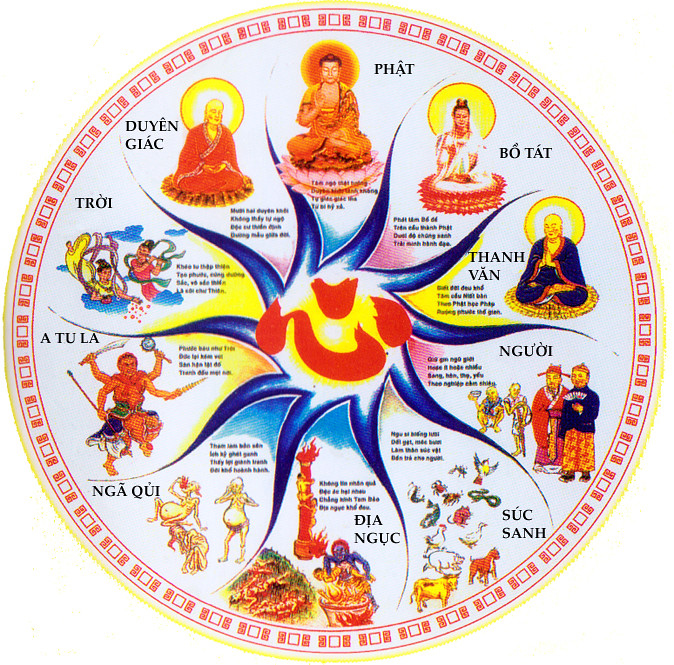 The Arahant path of Hinayana is not helpful for those who want to reach the enlightenment that Mahayana aims for because this enlightenment is in a completely different field. Only the Bodhisattva path - the path the Buddha himself pursued throughout his religious career - helps people to be enlightened. It must be noted, this path is always recognized by the people "according to the tradition". But these people consider it paths reserved for a very few individuals, such as the historical Buddha and those that preceded him. For them, this road is not for everyone. However, that is exactly what the Mahayana sect (Mahayana) has made this sect, called the path of the Bodhisattva (La voie du Bodhisattva) [42] .
 Having explored the Buddhist concept of death and reincarnation, we have a few thoughts on these concepts:
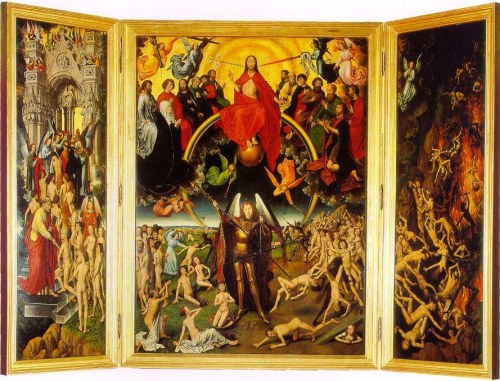 The Catechism of the Catholic Church opens to the believer a beautiful perspective of death: "Death in Jesus Christ" (CCC 1005). We do not deny death, even before death, the mystery of the person is at its highest (GS 18). It is natural for a man to die. But faith tells us that "death is a wages sin" (Rom 6:23). Although mankind must die by its nature, God wanted it not to die. Death goes against the will of the creative God, and it enters the world as a consequence of sin. Therefore, death is the last enemy of humans that needs to be destroyed. This reality gives us a more urgent view of life. Remembering death, we have to remember our life for a limited time (Acts 12: 1-7).
The winds of the four elements returned, and as Tulku Urgyen Rinpoche said, "people hear the tremendous sounds of earth, water, fire and wind. There is the sound of a mountain falling behind, the sound of a great river roaring, the sound of a giant fire like a fire of paint, the sound of a great storm. ” When I panicked trying to escape from these things, in a terrifying darkness, in front of me opened three deep, deep, white, red, and deep black holes. That's what the Book of the Dead says, our angry, lustful and ignorant mind. I was attacked by falling waterfalls, hail of blood, obsessed with the screaming sounds of headless demons; hunted by youkai and predatory beasts.
So on, we are constantly swept by the wind of karma, unable to cling to a base at all. The Prince said: "At that time, the typhoon of karma was horrifying, unpleasant, swirling violently, from behind pushing you forward", devoured by panic, blown back and forth. like flower seeds flying in the wind, we hopelessly walk through the Bardo. Suffering hunger and thirst, we seek shelter here and there. The perception of our mind changes momentarily, sometimes happy and sad. Suddenly our mind turned to the desire for a physical body, but could not find it, causing us to fall into suffering again.
The whole scene is created by our karma, just as the middle world can be filled with nightmarish images created by the delusion we create, if normally we live in positive action Our experience and awareness in the intermediate realm will be happiness and peace; if our life harms and causes others suffering, our experience in the Bardo realm will be painful and painful.
The entire Bardo of rebirth lasts an average of 49 days, and at least one week. But it depends, as there are now people living to a hundred years, while others die prematurely. Some are even trapped in the middle world to be devils. Dudjom Rimpoche often explained that during the first 21 days of the Bardo you still had a strong impression of your past life, so this is the most important stage for the living to help the dead. After that, your future life gradually takes shape and becomes the main influence.
We must wait in the middle world (Bardo) until our karma catches contact with our future parents. I sometimes think of this bardo as a transitional corridor in which you can wait up to 49 days before moving on to your new life. But there are two special cases that do not need to wait in the intermediate realm, because of the fierce character of karma they immediately push them into new rebirth. The first is those who have lived a very beneficial and positive life, cultivating the mind to the level that their enlightened power will lead them directly into a good rebirth. The second is the people who have lived negative life harm, they go very quickly down to the next rebirth, anywhere.
Some depictions of the Bardo realm refer to a trial scene, a kind of "film-turning hybrid" like post-death judgment in many cultures of mankind. Your good conscience, a white guardian angel, plays the role of an adviser, recounting the good things you have done; while bad conscience, a black demon submitted the case for trial. Good and bad are counted as black and white pebbles. "Death" or Pluto presiding at the hearing, then looking into the karma to make a judgment: "I found in this judgment screen some similarities in the" film of life "in near death experience . In the end, all judgments happen right in our hearts. We are both judges and defendants. Raymond Moody said, “What is remarkable is the judgment in the cases I investigate,[41]
The judgment scene also proves that in the ultimate analysis, it is the motivation behind our actions that is important, and cannot escape the consequences of our actions, words and thoughts. , and the imprints, habits of these actions in us. This means we are fully responsible not only for our present life, but also for our future lives.
The power of mind in the process of rebirth:
Because in the warm realm of our center is very light, flexible and sensitive, any thought that arises, good or bad, has tremendous influence and power. Without a physical body as a basis, ideas become reality. Imagine the intense anger and sadness we can feel when we see people living at our funeral ceremonies being too sketchy, or greedy relatives who are scrambling for our possessions, or our friends. Very loving, but we think we love us, now we are talking about us in contempt, hurt, insolence. Such a situation can be very dangerous, because our violent reaction can lead us straight to an unfortunate rebirth.
Thus, the intense power of the mind is a key issue in the Bardo of rebirth. This peak period completely exposes us to the inherent habits and tendencies we have allowed to grow and dominate our lives. If you do not control these inclinations right now while living, preventing them from invading your mind, then in the Bardo of rebirth, you will be a victim of their misery, driven by their might. A little anger in the Bardo state can also have a harmful effect; Therefore, according to tradition, the person reading the Book of Death for you at the time of your death must be someone with whom you have a good relationship; If not, the fact that listening to his voice is enough to make you angry, and this will have very devastating consequences.
The teachings show us many descriptions of the intimate nature of the mind in the Bardo state; the strongest description says that our mind is like a broken red iron that is ready to bend whatever you want until it cools down. Whatever shape it is shaped, it will quickly turn into the same shape. Also, a single positive thought in the Bardo state can directly lead to enlightenment, a single negative reaction may be that you sink into lasting suffering. The death penalty warns us strongly as follows: “Coming here is a fork, the road goes up and down; This is the time when I just need to glide a little bit lazily. You are also suffering forever; This is also the time when you just need to focus a little bit and you will enjoy lasting happiness. Please do not distract, try to extend the consequences of good karma! ... ”
The precarious nature of the Bardo period may be the source of many opportunities for liberation, and the mind's sharpness in this Bardo may turn out to be of benefit to us. We just need to remember the teachings; we just need to have a positive thought arise in our mind. If we remember a teaching that reminds us of our own nature, if we have even a tendency to practice or have a deep connection with the practice, we will be able to liberate it ... But remember though the possibilities are limitless, we still have to have psychological autonomy in this intermediate state, and this is extremely difficult, because our mind at this stage is very sensitive, dispersed and insecure.
Because in the intermediate state rebirth, the closer the time of rebirth, the more we yearn for a new body to take refuge, and we look for someone who can use it to be reborn there. The first signs appear, telling us the realm of being able to be reborn. Colorful lights radiate from the path of reincarnation, and we feel drawn into one or the other, depending on which negative emotions are strongest in our hearts. Once we're drawn to it, it's incredibly hard to turn back. Therefore, be careful not to blindly go into those blessed realms. The amazing thing is, the moment we become aware of what is happening to us, we can begin to influence, and that affects our destiny.
Pushed by the wind of karma, the mind of birth goes to a place where parents are having intercourse. Upon seeing them, it is pulled into that emotion; and due to the past karma, it naturally feels very loving or very hateful. The attachment to a mother and hatred and jealousy towards the father will result in the birth of a son; the opposite is girls. But if it collapses before strong emotions, it can be reborn in a vile realm.
According to the Mahayana, what the Buddha taught in the texts recognized by the Hinayana is only part of the truth in order to prepare people to receive the full truth in the Mahayana sutras, because in the sect This, liberating from the world of reincarnation by becoming Arahant is not the full vocation of man. Man is further invited, that is, to become Buddha himself, or rather to realize that he participates in the true Buddha-Self within the innermost nature of being.
The Arahant path of Hinayana is not helpful for those who want to reach the enlightenment that Mahayana aims for because this enlightenment is in a completely different field. Only the Bodhisattva path - the path the Buddha himself pursued throughout his religious career - helps people to be enlightened. It must be noted, this path is always recognized by the people "according to the tradition". But these people consider it paths reserved for a very few individuals, such as the historical Buddha and those that preceded him. For them, this road is not for everyone. However, that is exactly what the Mahayana sect (Mahayana) has made this sect, called the path of the Bodhisattva (La voie du Bodhisattva) [42] .
Because of the Bodhisattva path, Mahayana emphasizes the profound connection between all beings. All beings are in solidarity with each other because each participates in the Buddha nature (the true nature of the Buddha), and thus, in terms of ultimate reality, no one can have his own existence (ie independent of all beings). The industries that the great Bodhisattvas have established over many lifetimes can be passed on to the weakest to help them attain Buddhahood ... [43]
The Mahayana concept of liberation from samsara is described in more detail in the "Letter of Life and Death" they have put the following question:
How to avoid being reborn or guide our next rebirth? The teaching of the Bardo gives two special instructions: how to prevent rebirth, and if it does not, choose a good rebirth. The first is the instructions for closing the gateway into another life.
The best method is to give up emotions such as craving, anger, or jealousy, and realize that no state of Bardo has the ultimate essence. If you can take that truth, then rest your mind in its vacuum nature, then this will prevent rebirth.
The next best way to prevent rebirth is to look at those who can be your parents, such as Buddha, or your teacher, or guardian, Yidam. And at the very least, try to generate a feeling of giving up, not being drawn into sensual desires, and thinking of pure Buddha realms. This will prevent rebirth and cause you to be born in one of the Buddha realms.
If you cannot rest in peace of mind firmly enough to do so, then there are also methods of choosing a rebirth, related to landmarks and the different realms of different realms. If you absolutely must be reborn, or purposely want to be reborn to pursue the path of practice and benefit others, you should not enter any other realm of the human realm. Only there are conditions that are conducive to the advancement of karma. The teaching of the Bardo states that if you are about to be born in a good condition in the human realm, you will feel you are entering a beautiful luxury home, or into an urban area, or in the middle of a crowd. crowded, or see people who are having sex.
Other than that, usually we have no choice. We are drawn to our birthplace "like a bird caught in a net, like a caught hay, or a swamp animal". The martyr said, “O good men and women, even though you do not want to go, you have no autonomy; You are forced to go. "
However, as the doctrine always reminds us, there is still hope; Now is the time to pray. By intense desire and intense concentration, right now, you can still be reborn in a Buddha realm, or you can make a deep vow to be reborn in a human family, where you can Meet the path of practice and continue toward liberation. If you have a heavy karma that forces you to fall into a particular realm, then you may be out of options, however, your past prayers and wishes can help you to change your fate so that you can re-establish yourself. born into a life that will one day lead you to liberation.
Even if you are already pregnant, you can pray for this to happen. Even then you can visualize yourself as enlightened sentient beings, like the vajrasattva - as the traditional masters say - and transform the pregnant womb you are into into a sacred environment sacred "a heavenly sky", where you continue to cultivate
In the end, it was the urge of the mind to want to dwell in a certain realm, forcing us to go forward to rebirth, and it was the self-grasping tendency of self-consciousness that sought the manifestation of a reborn body. This is the next stage in the appearance process that we have seen happening in the Bardo scenes.
If you succeed in leading the mind towards a human birth, then you have completed the cycle. You will be born into the natural Bardo of this life. When you see your parents having sex, your mind is attracted, and you enter the fetus. This signals the end of the Bardo of rebirth. When your mind once again experiences very quickly the generals of the stages of disintegration, and the appearance of Anh to the basics. Then the dark experience of "accomplishment" arises again, and at the same time contact with the fetus begins.
In short, Mahayana concept not only frees from samsara but also cultivates straight to the Buddha realm. According to them, it took fifty-six realms from the mundane world to reach the Buddha realm.
The difference between Mahayana and Hinayana can be attributed to the following:
1. Hinayana is concerned about self-sufficiency, humility is only about self-awareness. Mahayana is not only concerned about self-sufficiency, but also about universal beings (enlightenment), generous energy included in the sentence: "Self-awareness of forgiveness." Both are complementary to each other, not against each other.
2. Hinayana is only concerned with breaking the ego, not about the mortgage; and Mahayana cum both breaking the ego and the law.
3. Hinayana is liberating the worldly world; Mahayana is not liberating the world
4. Hinayana is blunt, bored by the path of birth and death, suffering and desires for Nirvana, escaping samsara. Hinayana conception Nirvana separate life and death. And Mahayana is sharp, knowing the defilements are not inherent, not in samsara, nor in nirvana;
5. The extreme fruit of the remnant is La-Han (Arhat). The Mahayana fruit is Buddha. That's why it is said: Mahayana is the enlightenment of Buddha, Hinayana is the enlightenment of La-Han.
6. The policy of possession and non-duality of the two vehicles is also very different: Hinayana for all things is true, and everything is very different.
Mahayana has two sects: Water is Mahayana right, and Mahayana is Mahayana. The Mahayana right to all things is due to the mind, apart from the mind there is nothing real; while the Mahayana advocates Phi Huu Phi Khong and herons. Other Hinayana accept and other Mahayana rights accept.
Then Hinayana recognizes that all things are different but have never known the equality of being. The Mahayana power, while breaking the difference of all things and knowing the equality of being, has not come to the so-called center of the Mahayana: nature is a phenomenon; phenomena are essence, samsara is nirvana; Nirvana is samsara, meaning affliction ie Bodhi. All the essence of Mahayana Buddhism is that the realization of the equitable mind that the Mahayana practice is made clear in the sutras and solemn Sutras.
7. Hinayana is serious in writing, depends on each sentence word by word, the mounds constrict according to the scriptures; and Mahayana is liberal, despite writing. Mahayana goes deep into the nature, so it cannot be attached to the letter. The realm of scale is absolutely not the place where the language of words can be explained. Therefore, when coming to the Dharma flower in Buddha's time, he immediately denied what he had previously preached: "I have preached for about forty-nine years now without ever saying a word". It is also the meaning of the sentence "practice any language" of Lao Tzu.
In summary, the Hinayana and the Mahayana, although there are differences, but really there is nothing high and low but only a matter of progress and stage. Actually, only one vehicle is the Buddha vehicle , and the remaining three vehicles [44] are all means, should not be attached to and head.
IV. RECOMMENDATIONS
1. Some thoughts through Buddhist teachings on death and reincarnation
Having explored the Buddhist concept of death and reincarnation, we have a few thoughts on these concepts:
As we all know, Buddhism has discovered that the law of all beings is impermanent, nothing exists forever, and there is death and death. This law is not for one person, this law is not for a village, a country, but this law is for everyone. It is this impermanence that can be said to help people feel lighter when faced with death, because everyone must die. At the same time, when people realize their impermanent and limited nature, this will help them to reflect on their way of life, that is, not to cling too much to human life and to suffer forever, from which they are no longer be motivated by greed to create bad karma. On the other hand, when it comes to reincarnation, the teachings of Buddhism also mention the effect of karma on the rebirth process. If I created good karma past life, I would be reincarnated into a better life, and vice versa. This also works to make people more aware of their way of living in the present, in order to build a more just and kind life.
The purpose that the Buddhist brothers towards is not only to stop after death and reincarnation, but also to the place of liberation from samsara, samsara. The ultimate goal of Buddhism is to bring people to liberation. The Self-teaching doctrine promotes human consciousness, will and energy, which is a practical and positive teaching point of view, because in order to be liberated, more than anyone else, each individual must have the desire to be liberation and strive to the end for that legitimate aspiration. That is Nirvana.
However, we also notice problems in these notions:
If Buddhism says death is a common law for all species and humans are also governed by that impermanence law. Samsara is the law of impermanence, then what is the value of the physical body that every effort of each person and the whole society has focused on it: science, technology, culture, technology art, ... and religion as well.
To say death is suffering due to ignorance and delusion. An enlightened person will be liberated from that suffering, but in practice, try to get some people who are like that. It is not so pessimistic that it is easy to realize that such suffering will last forever in human life.
According to Mahayana Buddhism, in essence, there is no so-called "death", but only the rotation like waves, like replacing the old shirt with a new one, it is the wind of karma that drives the mind. awake reincarnation. So every time someone is born, there must be a person who no longer exists in the world (because the new clothes replace the old ones), is it true that all life on earth is always stable in number.
In the concept of reincarnation - rebirth of Buddhism, man can become a certain species depending on the karma that he created in a previous life. So what is the difference between human dignity and the other species! Also, if in the next life someone is reincarnated into an animal, has no intelligence to create good karma and still lives according to the instinct of the animal, then liberation in a certain life will be how to achieve!
According to the Buddhist concept of reincarnation, the present life is not unique but can go through many other lives, so do people need to try to live righteously in this life, while there are still many opportunity in other lifetimes! The value of affordable time is being denied, although not directly stated.
Finally, with the doctrine of "self-reliance," is there a supernatural power in a pure natural body for man to free himself? The Teachings of Compassion will have to explain how every effort to create good karma, including charity works in the end, is just about us, in order to liberate oneself. Humanity of society is a form of deception, unnecessary! And so who will control this universe and where human life comes from? There is neither one who rewards or punishes, nor one who is rewarded and punished forever. The state of Nirvana, though known as indefinable, is also very difficult to understand, even more difficult to understand without a lasting soul.
2. Some basic differences between Catholicism and Buddhism in the concept of death and after death.
Through the above-mentioned general comment, we should also compare that doctrine with the Catechism of the Catholic Church on eschatology, not to disparage him or to exalt himself for further understanding of absolute and complete salvation. perfect in faith in the Word of Jesus, and in the faith of the Church.
Indeed, the more people don't want to think about death, the more people will be fascinated by the afterlife. No less than once have we heard of the success of esoteric religions and gnostic teachings. Reincarnation, for example, borrowed in the Asian ideology system, is strongly attracting Europeans. [45]
Reincarnation claims to have a new life after death, by reincarnation into other bodies. This reincarnation makes the body only a temporary place, trivializes personal life and takes away from it the special value of the infinite dignity which God offers. Reincarnation eliminates the resurrection of the body and rejects the reality of forgiveness. Convinced that every person loved by God in a unique and eternal way is called to live in communion with God, Christian faith rejects the root of reincarnation.
a. About death
Here we do not discuss biological death, a disintegration of the body. But it is about the meaning of death. Through the above presentation, we see the Buddhist teachings with two concepts regarding death: death is the law of course "impermanence" of all things, and death is suffering.
1) Death is the law of course "impermanence" of all things
The body is the union of the five aggregates, and of course there will be separation. Impermanence is an obvious truth, everything in the world moves and changes, nothing is permanent. So death is considered as the end of one "Unusuality" and the opening of another "Unusuality". As in the Jing'an, it is said: "all things that have appearances are destroyed." The cause of death is that everything in the universe is governed by impermanence.
The Mahayana teachings go further when we think that what we call "death" is nothing but an external phenomenon. In essence, there is no such thing as "dead". The phenomenon is "perceived" by the limit of the senses, and the reality is "True as", can not be measured but can not be imagined. Birth and death are just the premise of transformation, the essence is never born and never changes. In other words, in terms of phenomena we see death, but in terms of human nature is not.
So, in fact, according to Buddhist teachings, does one have to die? Whatever the answer, the phenomenon of death - no longer in the process of metabolism in the body - is an indisputable thing. And because people cannot live completely apart from external phenomena, death is an evident fact: Death is real.
It is not important, more important is that following this line of thought, dying or living is a natural thing like the earth revolves around the sun, or just as a coincidence and then dissolution of the five aggregates, and somewhat depends on people: long or fast life, happy or miserable, beautiful or ugly, ... is partly due to karma. And so, life is no more noble than death because everything is nothingness, is misery.
The Catechism of the Catholic Church opens to the believer a beautiful perspective of death: "Death in Jesus Christ" (CCC 1005). We do not deny death, even before death, the mystery of the person is at its highest (GS 18). It is natural for a man to die. But faith tells us that "death is a wages sin" (Rom 6:23). Although mankind must die by its nature, God wanted it not to die. Death goes against the will of the creative God, and it enters the world as a consequence of sin. Therefore, death is the last enemy of humans that needs to be destroyed. This reality gives us a more urgent view of life. Remembering death, we have to remember our life for a limited time (Acts 12: 1-7).
Turning to the first page of the Bible in the Book of Genesis, we see that God created man in his image, and gave his life to man. Thus, both the body and human life are a gift from God. "Everything is good" because life is good. Now people must die because they have sinned. "By one man sin entered into the world and death through sin" (Rom 5:12). Thus, death is the consequence of sin, and life is forever of God. People do not have the right to increase or decrease their "life span". It is no accident, but God created man and gave life for love. Thus, we respect the lives of ourselves and others not for a mere moral reason, but because the body and soul of the person were honored to belong to Christ, to the Temple of God (1 Cor 6:13-15.19-20). Man must die for rejecting Love, rejecting eternal Life as God.
2) Death is suffering
Death is suffering because we are deluded and ignorant, because of the misconception that everything is always immutable, and our desire is to remain constant, even with human life. Therefore, people suffer because of farewell, suffering because of fear, suffering because they know they must die. Kill ignorance humans will end suffering.
Death is misery because people still keep spinning in the cycle of reincarnation, is to continue to suffer the eight sufferings of a new life. Only when one attains Nirvana is the person completely free from suffering. Buddha had to cultivate, contemplate in meditation for many years to realize that truth.
Every Catholic will also suffer like this before death and even more so if Christ did not rise again; although it has not been able to fully explain all the mysteries of the realms of the other world, because these realities are beyond the scope of human experience. But the Christian faith also allows us to assert ourselves on "the things that the heart has never dreamed of" (1 Cor 2: 9). Christian faith assures these things from Revelation and is based on Christ's Resurrection: "If Christ is not resurrected, then our faith will be in vain, and those who have died in him shall dissipated. If we rely on Christ only for this life, we are the more pitiable people than all "(1 Cor 15: 17-19). If "By one man sin entered into the world, and by sin there is death", now also "By one, righteousness has come into the world, and by righteousness everyone has salvation". The conviction in the joy of the Apostle of the Gentiles became the conviction of all believers: "For me to live is Christ and to die is a great gain" (Philippians 1:21). Death is "giving birth", is entering a new life, an eternal life. A new feature of Christian death is that the believer can transform his death by following the example of Christ, turning it into a final sacrifice. In the Christian sense, death for those who see it draws in, entrusting their whole life to the compassion of God, and accepting the grace of the watch-tree. Christianity gives new meaning to death: thanks to Baptism, Christians have "mysteriously died with Christ" to live a new life, the body ends daily "death with Christ" in order to complete our integration into him and his saving work. (CCC 1010) "Let me receive pure light, when I reach there, I am truly a man".[46]
b. Problems after death
Also through the presentation of the teachings on the reincarnation of Buddhism, we see this teaching leads to two conditions after death: start a new life, or reach Nirvana.
1) Start a new life again
This new life depends largely on the past karma and an important "decision" of the mind in the intermediate state. The wind of karma in the Bardo realm is hard to resist, and so I am again, because I am reincarnated; which is not Ta, because according to the doctrine of non-self, Buddhism does have what we have ever, what we are just illusions. It is not right to say dying is wrong, but after I die, what am I when the Self is not real, and the body is formed by the five aggregates according to a certain natural law, and again begins a life new biology (or organism). Well, this does not matter, the more important thing to mention here is that the concept of Buddhism after death does not have a so-called soul or Eternal existence, and the body in a new life is a new body. The dead body is never resurrected as it was! People do not have to live only once, but through many lifetimes; and not just die once, but many times.
Man is body - soul, the body is corrupted upon death, but the soul is immortal. The Old Testament asserts that the dead are not destroyed, they are still close to God, in some mysterious form (Rev 3: 9).
Accepting the truth: "after death, the life of man is not completely destroyed, but is transformed into a new communion with God", the Church advocates that "after the body has died , a divine element still exists. " That element is traditionally called the "soul". By everlasting contact with God, he created the soul forever, and he himself is immortal. [47] Endowed with immortal souls, man after death can meet his Creator, his God. [48]
Thus, a new life after death is one that is intimately united with God according to the degree of human response to his love. A life and only one, whether long or fast, talented or incompetent, ... God never demands too much benefit from the "capital" that He has given. Death is the end of the earthly pilgrimage, the end of the time of God's grace and mercy for man to lead earthly life according to God's will and to determine his ultimate destiny. At the end of this one earthly life (LG. 48), we will not return to other earthly lives. "Man only dies once" (Dt 9,29), does not "reincarnate" after death (Cf. 1013). Although it is not possible to fully grasp the state of the new life in God on how to explain the identity of the soul - body,[49] A belief that speaks of the supreme work of God, man, is truly beautiful; it is even better to be recreated a second time by the very love of the Death and Resurrection of the Two Divine Persons; A belief that finds a principle in Christ's Resurrection "The firstborn among the dead" (Col 1:18), "The first fruits of those who have rested" (1 Cor 15:20). In speaking of the resurrection of the dead, Paul made us realize a decisive point of the Christian faith: "Without the resurrection of the dead, Christ would not be raised. And if Christ is not raised, our teachings and your faith are in vain ”(1 Cor 15: 13-14). And "God is the God of the living" (Mt 22: 28-32)
2) Nirvana is the ultimate absolute happiness
Through the teachings of Buddhism, we see that the Buddha himself pointed the way, proposed the method for human life to break the u u, to eradicate suffering, this life has not been passed away, or after life or afterlife ... and destination the last of the Buddhist brothers is Nirvana, a state of no more suffering, because there is no longer being reborn between samsara, no more "I am disturbing and annoying" keeps pushing people into "lovelorn, miserable" . A situation that is truly desirable, and not only in dreams, but everyone who is capable and before or after will reach it (in a certain life) with their own karma, no salvation for us comes from outside us, everyone save themselves, every form of sacrifice, prayer, ... just a manifestation of a filial piety of the living. Thus the doctrine of "Self-sufficiency" has brought to humanity the main teaching of self-liberation while living in ignorance. Natural man is capable of attaining supernatural through his natural "substance"!
The doctrine of Self-Sacrifice is meaningful because it has helped people to be aware of creating good karma for themselves in order to attain the absolute happiness of Nirvana. But there is no way to understand the happiness that Nibbāna will enjoy. Or rather, there is nothing to enjoy because it is a condition "No status". A series of efforts to create good karma over many lifetimes to ultimately achieve absolute happiness is "we have no one" and "We have no one". The body is impermanent, the accidental dissolution of the five aggregates, without an immortal spiritual soul, then happiness will surely be vanity like that. Saying that does not mean to deny or condemn a macroscopic doctrinal system like that of the Buddhist brothers, and that each person's views on happiness are different.
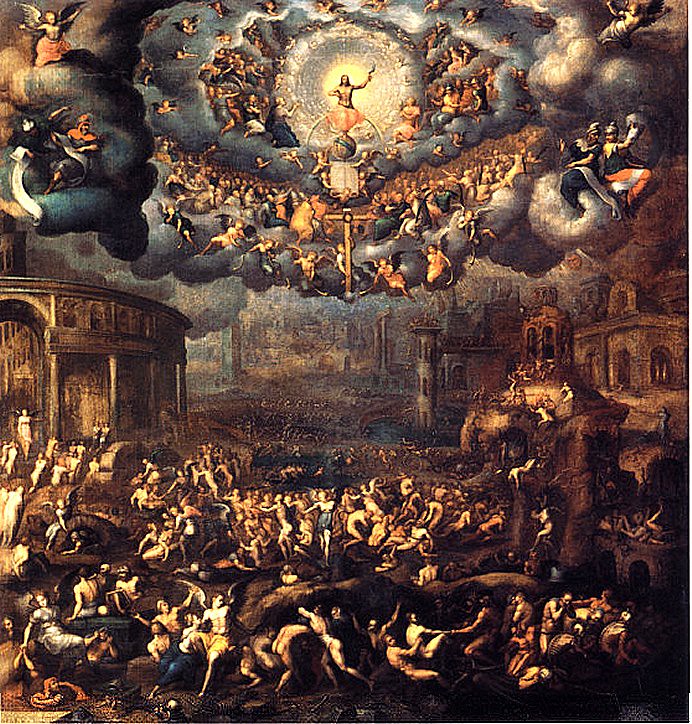 If the Buddhist Catechism teaches that after the "final" death of man there is only one condition, Nirvana, then the pages of the Bible and the Catechism of the Catholic Church show us judgment ( Common judgment and individual judgment) [50] work in the light of Christ and ultimately lead to two situations, two completely contrasting situations: Heaven and Hell. These are the realities of the Christian faith that are clearly attested in the Bible, even with a picture-rich language. The perspectives on human immersion show that people must be careful in their basic choices in a single life on earth (cf. Mt 5: 1-12; Jn 5: 22-30; Jn. 3.14). These choices are expressed in specific religious ways of life (Mt 25: 31-46).
If the Buddhist Catechism teaches that after the "final" death of man there is only one condition, Nirvana, then the pages of the Bible and the Catechism of the Catholic Church show us judgment ( Common judgment and individual judgment) [50] work in the light of Christ and ultimately lead to two situations, two completely contrasting situations: Heaven and Hell. These are the realities of the Christian faith that are clearly attested in the Bible, even with a picture-rich language. The perspectives on human immersion show that people must be careful in their basic choices in a single life on earth (cf. Mt 5: 1-12; Jn 5: 22-30; Jn. 3.14). These choices are expressed in specific religious ways of life (Mt 25: 31-46).
Heaven specifically refers to the world of God. In the same way we speak to God in the Lord Jesus taught: "Our Father in heaven". The New Testament also follows that meaning, sometimes the "Kingdom of God" and sometimes the "Kingdom of heaven." "Going to heaven" means going to meet Christ in "Heaven" (cf. Lk 23:43), to "be with him", "to dwell with him" (cf. Philippians 1.23; Rom 6: 6) ). Heaven is the perfect fulfillment of life in the love of God and in brotherhood. Heaven's happiness is not happiness alone. It is communion with God, with all those who live in love of God, love of the Holy Spirit, with those who pray in the world and those who have died. That happiness is a complete expression of the mystery of the Saints in fellowship [51]. Thus, "the communion between those who are on the road and those who have fallen asleep in Christ is not interrupted" (The Church, no.49). This teaching is also based on the practice of praying for the dead, as the Bible says: so Judas Macabea "offered penance to the dead so that they might be delivered from sin" (2 Mk 12, 2). forty six). The Church also advises us to give, to work to restrain ourselves, and to give amnesty to those who have died. (CCC 1032)
Hell is a consequence of the complete rejection of God and all his help, the denial of the life and joy that God offers that Revelation expresses "Second death" (Rev 2). , 11; 20,14). God does not intend for anyone to go to Hell. Those who voluntarily leave God with a serious and persistent sin to the end will go to Hell. In the Eucharistic liturgy and in the daily prayer of the faithful, the Church implores the merciful God, "He who desires not to perish, but to repentance" (2P 3.9). [52]. The affirmative words and the Church's teaching on Hell are an invitation to men and women to be responsible for the use of freedom to achieve eternal happiness; at the same time urging us to repent: "Enter through the narrow gate, and enter into the Kingdom, because the wide gate and the broad way lead to destruction, and many pass through it; and narrow gate and narrow way lead to life, but few find it ”(Mt 7, 13-14).
In addition, the Church teaches that those who die in the grace of God but have not been fully purified, even though they have been saved forever, must still be purified after death, in order to gain the holiness needed to enter. Heaven. The Church calls this last purification purgatory. “For some misdemeanors, it must be believed that before the common judgment there is purification. Jesus confirms: if anyone speaks against the Holy Spirit, he will not be spared both life and the future (Mt 12:31). Through this affirmation, we can understand that some sins can be forgiven in this life, but some others have to wait for the next life ”(CCC 1030-1031).
Because of the sin of the first man, he no longer has the ability to "save himself." To uphold the Grace of God is absolutely necessary for man to be saved, but he does not deny his freedom in responding to God's call. God loved man so much that he did not force him, God created man free. Because "For all to be saved" (1 Tim 2: 4), God makes every effort to draw them out of evil and sin, leading them to life. Yet God always respects the freedom of man and recognizes the importance of the decisions people make in the level of charity and their faith in Jesus Christ. “To those who believe in You, Lord, life is not destroyed, but transformed; and when this earthly life ends, they have a permanent abode in heaven. ”[53]
Happiness Heaven is not a place where only the soul has peace and happiness. God incarnated as a human, took on the condition of a human being, died and conquered death to save both soul and body, redeeming a good beginning of the creation which man exchanged for take the spoil. The term "body" refers to the person who is in a weak position to die (Gen 6: 6; Ps 56: 5; Is 40,6). "The resurrection" means that after death, not only the immortal soul will continue to live, but even the "dead body" (Rom 8:11) will rise again [54]. In an ancient sketch of what the Spirit of God did when he invaded our bodies and flesh, Paul emphasizes the radical newness of a spiritual body: "The thing that is sown in the earth returns to corruption; the resurrected one is indestructible; ... what is sown is a human body, but the resurrected thing is a spiritual body" (1 Cor 15: 42- 44). The body is risen in the framework of a new creation, entirely the work of God's power and like a new birth.
Through the above presentation, we see that the Buddhist Doctrine of death and reincarnation has unacceptable points in the faith of Catholic believers, and is in contrast to the Christological Doctrine we have. The summary of the four basic points is as follows: [55]
a / There are many existences on earth. Our present life is not the first and the last being. The physical body is always newly created.
b / The doctrine of reincarnation will lead to the conclusion: After a few centuries, all reached the final fullness of a pure spirit. And so denying the value of the present time, and denying Hell.
c / By virtue of one's own industry with which man reaches his ultimate goal, this doctrine of self-denial denies the salvation.
d / Also according to the doctrine of reincarnation, the soul (not eternal) tends to move towards independence from the body. On this path, the soul reaches a final state, completely liberated from the body and recited from matter, thus denying the resurrection.
These four factors constitute the life of a reincarnation, in stark contrast to the fundamental assertions of Christian Revelation, which is a duality in which the body is completely an instrument of the soul, which man must giving up after every mortal existence in order to receive a completely different body. In the field of eschatology, the theory of reincarnation denies the possibility of permanent exile and the resurrection of the body. The main error of this doctrine lies in denying Christian salvation. [56]
3. The attitude required for dialogue with Buddhism
Gone are the days of living together without knowing each other. It is also past a time when the clergy and laypeople may not pay attention to the Buddhist brothers, and live as if they had nothing to learn more, or to contribute to rebuilding the much-needed country in at this time.
We need to meet our Buddhist brothers, though only to live more closely with the instructions Jesus has laid out for us, and recorded in His Gospel. We need to meet them, so that we, along with them and with all other religious groups, learn the lesson of dialogue with humanity. We need to meet them, so that with them and with God, we build a future of more brotherhood, greater prosperity, which all, except for anyone, enjoy: “All nations only form one community. uniquely, having a common origin and a goal: God, Providence, who cares for all, who shows His goodness and salvation to all. " [57]
a. Respect
Every Christian clearly recognizes that there is a fundamental difference between God's direct intervention with Revelation and the noble efforts of man to reach the Absolute, inspired by the light of conscience. and motivated by the inner call of "the One who enlightens everyone" (Jn 1,9). Father Henri de Lubac saw there "one of humanity's greatest sacred events". Especially for Buddhism, we must recognize that: "it is seldom the hope of man in a purer dream; It is seldom seen that people have shown themselves to be more aware of their misery and closer to a more graceful religion. ” [58]

And how is this religion able to conquer so many millions of people and so many different countries, even in the country with the highest culture, if it can only provide one material of tracing and An inferior ideal? And how to recognize in these generous souls the encounter of the human experience and the saving activity of the Most Blessed One.
b. Unpretentiousness
Faced with that great human endeavor, the common virtues of which a Buddhist hero knows how to make the one who wants to achieve that ideal set up, we ask ourselves whether we can do so. , if not enlightened by Revelation and the abundant gifts that make us strong?
So we must not be presumptuous of those gifts of enlightenment and help, acting as our own; but we have to humble ourselves because we have done so little compared to that of support. The person who interacts with us feels very arrogant about his ideals; therefore they are very unambiguous. This attitude disappears only when they see we are not conceited.
So we must not be presumptuous of those gifts of enlightenment and help, acting as our own; but we have to humble ourselves because we have done so little compared to that of support. The person who interacts with us feels very arrogant about his ideals; therefore they are very unambiguous. This attitude disappears only when they see we are not conceited.
Humility requires us to recognize that others can also reach truth. It is for this reason that the Second Vatican Council invites the faithful to search for hidden "rays of truth and seeds of the Word" in other religious traditions. According to this view, Christians should let Buddhists question themselves.
c. Be smart and don't be too confident about your knowledge
If we are humble, we will be less confident about our knowledge, more wise and cautious. We must watch out for our values and levels of knowledge; Be prepared to learn, research and think endlessly. Instead of always presenting our points of view, we have to learn to listen, then ask clever questions to learn more. Buddhism has a natural state of thousands! And each person also understands Buddha in his own way, and that is what we have to learn more.
In dialogue, one must also be vigilant in choosing and estimating steps closer together, especially in the early stages. Do not "arbitrarily leave", the more should not penetrate the religion of others. Often the opening story must be initiated by the person we are talking to. But anyway, we still have a hunch that when the keys of their hearts have been given to us.
That key will undoubtedly be given to us if we gain credibility first of all by our exemplary life. The testimony of a life shows that the faith that guides us is truly noble. Therefore, you should live before what I mean. Pope John Paul II said in the Catechism Apostolic Exhortation: "needs witness more than teachers"
d. Try to understand them and help them understand us
d. Try to understand them and help them understand us
It is difficult to tell the Buddhists they can understand it, it's not just a change of words. In order to do that, we have to change our way of thinking. A person who only specializes in an Eastern language has to realize that he / she only makes real progress when it comes to thinking in that language. This is even more true when it comes to basic issues of metaphysics or typical religion of the East.
However, in the first stage, it is only necessary to objectively accept the thought of others, not to let such judgments stop our progress. Let's persevere in the line of thought and "forget that others have made a mistake at some point, when they explain the religion, forget even when we know they are wrong."
One of the conflicts is that we are assertive of self, that of self, and they are not. As far as the ego is concerned, it is the Gospel that offers us a device in the very catholic doctrine of self-giving: "Whoever wants to follow me, let go of yourself".
We must avoid presenting the self as an absolute, ultimate salvation. To depend on God for the gift of creation and redemption, it depends on Him in every enlightenment and strength. Conscience, ego, are all great things, from God 's perspective; but a order is also very small things, on our side. Therefore, there must be a humble and hidden attitude coordinated with confidence that we can do everything "in him who gives us strength" (Philippians 4:13).
A similar problem was posed toward "God." Buddhism advocates that people do not have the ego to maintain the relative thoroughness of all things, also rejects the ego in God, for it is an individualized way, is to place a boundary that contradicts with The absolute fullness of the Absolute. Humanity necessarily needs to act, but every action, for Buddhists, is like losing the fullness, as long as it is possible. Precisely because it is conceived as a state of tranquility, without any sense of dynamism, the Buddha's Nirvana is understood not necessarily to be full or empty, endless or void, or neither here nor there yet, by Nirvana is something separate from the essence or a defined characteristic.
Let us then explain that God is a pure being as well as being a pure being. He manifests himself completely in himself, but he also spreads outward without losing anything in his fullness.
Our doctrine of "Mystical Body" can also be a way to alleviate the astonishment of the Buddhist brothers, when they find us assertive about the self. They will see that, for us, the ego is not a closed and complacent end, that every member of the Church contributes to a great body, in which every element has a specific mission and mission to benefit the whole.
e. Make full use of all goodwill to learn and receive
Dialogue is exchanging with each other rather than giving one-way talks. The more each party is willing to receive the contribution, the more it sees its own values to be seen and welcomed back. Buddhism, especially today, can teach us the virtues that people today scorn; such as the abandonment of the world, living in a calm, contemplative monk, mysticism, ... On the issue of austerity in general, and autonomy, meditation in particular, Buddhism will offer us the the virtuous method is even more valuable to our followers and monks, where we find the appropriate spirit.
Do not put dialogue in the field of theological debate, because such theological arguments are very fortunate to produce results. Because our religion is completely immersed in the supernatural, we base everything on Faith and Grace; and the Buddhists are based on a conviction based on experience. They can no longer doubt what they believe in, nor can we be hesitant about faith. "Therefore, any dialogue between two believers, once they have entered the field of dogmas, no matter how willing they are to talk with all courtesy and goodwill, they can only take to a standstill. " [60] One thing to keep in mind, however, is that faith does not compromise nor compromise.
We should not assume that such dialogues are only for the special, have been prepared for a long time with scrupulous study of the fields of religion, theology and psychology (though not denying this), but everyone who is well-intentioned can do this job and have a task that suits their abilities, and don't overdo it. Everyone has the right to encourage himself with the words of Jesus: “Do not worry about what to say and how to respond. It is the Holy Spirit who will teach you the right things at that time. " END=NAM MO SHAKYAMUNI BUDDHA.( 3 TIMES ).GOLDEN AMITABHA MONASTERY=VIETNAMESE BUDDHIST NUN=THICH CHAN TANH.AUSTRALIA,SYDNEY.21/3/2020.


No comments:
Post a Comment