What is Buddha Nature?
Buddhadhatu (Tathagatagarbha - Buddha-svabhava) is one of the most important and inspirational foundations in Mahayana Buddhism. Lotus is the most prominent symbol to talk about Buddha Nature: Lotus (Buddha Nature) broke the mud underneath (impurity impurities) to crown to pick up the sun.
The quickest definition of buddhahood is: Mindfulness in the beings will eradicate all afflictions to achieve enlightenment. In other words, all beings have the potential to become Buddhas.
The sun may be obscured by clouds, but it is always there. Our Buddha nature is obscured by attachments and afflictions, but it is always there. It is not something we have (as a soul) but something we have.
All sentient beings have Buddha-nature, because they are obscured by craving and ignorance, but in the end, with compassion, practice, meditation and renunciation, we can "rise from the dirt" as pure lotus from the mud.
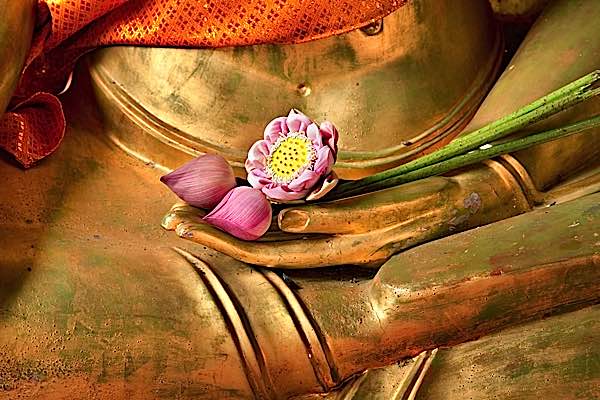
Pure lotus flower emerges from the mud. Similarly, our buddha nature will overcome obstacles caused by attachments, ego and negative karma.
Source
The concept of buddha nature can be traced back to what the Buddha Shakyamuni said, and it is recorded in the Pali Sutta (Pabhassara Sutta, Anguttara Nikaya 1.49-52):
This passage has led to many theories and interpretations in early Buddhism. The monks and scholars also have to grapple with questions about the theory of selflessness (anatta), and how a person with no ego to be reborn , affected by business, or become a the Buddha. This consciousness is present in every being, whether or not it is perceived.
Theravada Buddhism does not place faith in the Buddha-nature . However, other schools of Buddhism began to depict Buddha-nature as a subtle consciousness that is present in all sentient beings, or as a potential for enlightenment to spread.
In Mahayana Buddhism
In the 5th century, a text called Nirvana Sutra (Mahayana Mahaparinirvana Sutra) was translated from Sanskrit to Chinese. Nirvana is one of the three Mahayana scriptures that make up a collection called the Tathagatagarbha ("The Tathagatagarbha Embodiment").
Today some scholars believe that these texts have been developed from the earlier Mahasanghika texts. Mahasanghika was the first school of Buddhism that appeared in the 4th century BC and was the predecessor of Mahayana Buddhism.
The texts in the Tathagatagarbha are recorded as full interpretations of Buddha nature. Nirvana has a great influence on the development of Buddhism in China. Buddha nature is an essential teaching in some schools of Mahayana Buddhism .
Some texts in the Tathagatagarbha have also been translated into Tibetan language, probably by the end of the 8th century AD. Buddha nature is also an important teaching in Tibetan Buddhism , although some schools do not fully agree on it. The Sakya and Nyingma schools emphasize that the Buddha-nature is the essential nature of the mind, while the Gelugpa considers it a potential in the mind.
In Theravada Buddhism
Theravada Buddhism does not explicitly say that there is a Buddha nature. And sometimes, the Buddha-nature still faces opposition from some people in this school because they rely on selflessness and assert that there can be no "eternal self" in a fish. can be in the cycle of reincarnation.
However, like most Mahayana concepts such as Śūnyatā or Bodhisattva, the general concept appears in the Pali Canon.
What is "unconditional" here? Is the state beyond the cycle of samsara, no longer affected by impermanence and suffering?
Mahayana has specified it with a name - Buddha Nature. Meanwhile, Theravada only uses an adjective to describe the state of enlightenment - unconditional.
Buddha Nature is a self?
Sometimes the Buddha Nature is described as a "true self" and everyone has Buddha Nature. This can make people imagine that the Buddha nature is something like a soul, or some property we possess, such as intelligence or a bad temper. This is not an accurate view.
The dichotomy between " self and Buddha nature " seems to be an important point in the well-known dialogue between Chao-chou Ts'ung-shen 778-897 and a monk who asked: "A dog with Buddha nature?". The answer of the teacher is No! (no, or no) has been regarded as a koan for meditators.
Some people say that any creature has the Buddha nature, but because of past lives they do not realize that they have to do the birth of the animal, and the Buddha nature still persists with them for countless lives until consciousness. clear, enlightened.
Let us return to the original idea of a clear mind present, whether we are aware or not. Tibetan teacher Dzogchen Ponlop Rinpoche described Buddha Nature in this way:
Because the living beings cling to the false idea of an ego separated from everything else, they do not have the experience as Buddhas. But when the nature of existence is clarified, they realize that the Buddha-nature is always there. Each of us has the Buddha nature, and this nature is the same for each of us. So it is different from the idea of a self.
In the Lotus Sutra, the heart of the Mahayana, tells us that the Buddha and all Arahats still exist at another level, and we will meet them when we are enlightened. Therefore, our enlightened nature is eternal, even if it is not explicitly stated as an Atman (unchanging personal tinge in Hinduism).
If not the Self, So What is Buddha Nature?
Buddha nature is a noble concept, understood by the enlightened ones, but in a certain way, it is always present in the minds of the unenlightened. In Uttaratantra, it says:
Recognize it there, as received the teachings of the Buddha. But to understand exactly it is difficult. It can be discussed or taught, but it is the "ultimate" wisdom, far beyond our present ability to be fully grasped.
At that level, it requires faith. But, for those who accept the teachings of the Buddha , that is not faith, but the acceptance of truth, even if we do not understand it. Although we can not fully understand it, it is important for us to know that we have Buddha Nature.
Two Types of Nature: Nature and Development
The Dalai Lama: "Even Insects Have Buddha Nature."
At the same time, the Dalai Lama warned that a liberating experience can only grow on its own. No one can do it for you.
Conclude
In this sense, only human beings have the potential for enlightenment to become a Buddha, not all sentient beings! No matter how intelligent an ant, the training process can not be perceived as a human being.
For me, Buddha nature is just a metaphor for the potential of human enlightenment , not something that exists in all sentient beings. Buddha nature, Nirvana or enlightenment are all very difficult to explain, because we can not deeply interpret what we have not experienced, not verified. Searching for something that we do not even know what it is is not possible. So, to live happily in this life is to determine the cause of suffering and to handle it, that is what is important.END=NAM MO SAKYAMUNI BUDDHA.( 3 TIMES ).VIETNAMESE TRANSLATE ENGLISH BY=THICH CHAN TANH.VIETNAMESE BUDDHIST NUN=GOLDEN AMITABHA MONASTERY=AUSTRALIA,SYDNEY.11/11/2018.

No comments:
Post a Comment