Buddhist learning.VIETNAMESE TRANSLATE ENGLISH BY=VIETNAMESE BUDDHIST NUN=THICH CHAN TANH.
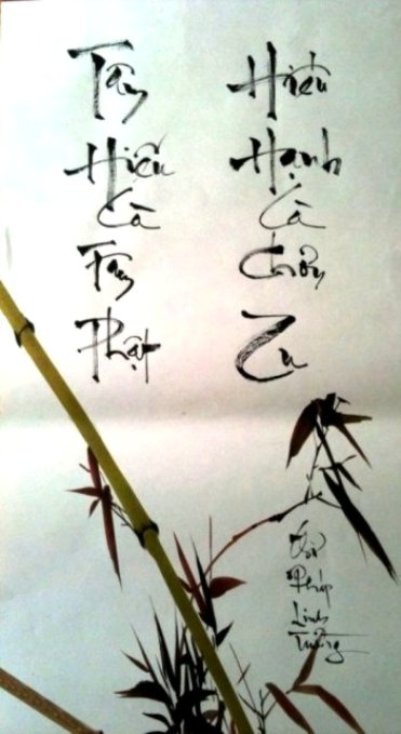
Hieu's Mind is Buddha's Mind
Hanh Hieu is Chon Tu
Photography all six apartments
Tinh Niem continued
Real independent means
Proudly, Tam confessed.
♣ Buddha used to sit in Meditation in Great concentration, contemplate the whole world to consider ... ..
♣ The Buddha taught: “One has four unbelievable things. What are the four things?
One is young and old, two are healthy and then die, three are familiarly gathered and will separate, four is treasure that has accumulated and will disperse.
Feeding is for force,
To wear is for color,
Car is lost,
The lamp is for the eyes.
Who gave the place of residence,
It tastes for all,
Who teaches Dharma,
The taste for immortality.
How to study Buddhism?
Every subject in the world has its own method. For example, in mathematics, the first student must know numbers, learn to memorize multiplication, learn to add and subtract multiplication, and further learn formulas, equations ... Literature, first must know letters, learn rhyme , writing spelling, learning grammar, practicing writing ... so learning Buddha also needs a method to correctly understand, practice the Buddha's teachings.
Buddhist method means 3 subjects of Hue study: Literature hue, Tu hue and Tu hue. Because wanting to enter the door of enlightenment, wisdom is the first requirement. As we know that the Buddhadharma are truths are truths, if we do not have the torch of wisdom to illuminate, how can we see all the truths around, without wisdom, only using faith in Buddhism? , to learn the Dharma, what a great mistake. This is a serious illness of contemporary Buddhists. Needing to heal this disease, we must thoroughly apply the three disciplines of Hue learning to the work of Dharma cultivation.
HOW IS VAN HUE.
Literature is listening, by listening to the Buddha's teaching, open wisdom, called Van Hue. We listen to the Dharma through the teachings of the monks, of the intellectual beings who have learned before us. These teachings come from the Buddhist scriptures, which contain all the true words, showing all the truth to sentient beings. The more I listen to wisdom, the brighter I am. Or we, directly reading the Buddha's scriptures to expand our wisdom, are also in wisdom. Hardly listening to teachings, studying the Buddhist scriptures, that is, people who know from the door of Van Hue go straight to the house of Dharma.
WHAT IS PRIVATE
Tu is judging judgment, due to judgment judging the teachings in the Dharma, the more wisdom increases. We are allowed to listen to the instructions of our teacher, take it from the Buddhist scriptures, but listen and believe it immediately is not qualified to learn Buddhism. Force us to judge whether it is right or wrong, if it is true, then we will believe. Only then can you practice correctly the phrase "you must light your torches yourself, and light the torch with the Dharma" in the Dharma Canon. We want to expand wisdom, but how to open it ourselves, we have to bait our torch of wisdom with the torch of Buddha's dharma, wisdom will glow.
How to bait?
For example, we hear the monk say that "all worlds are impermanent". Then we have to use our wisdom to judge right or not? We ask ourselves, is all the world impermanent, is there anything beyond that law? If yes, this statement is not true. Otherwise, to be true, we will completely believe. Then we self-examine:
Are people impermanent? From grandparents to our parents, we are born, grow up, get sick, grow old, and die. Even I, as long as I am small, grow up, get sick, get old, and then die. in the family of our kinship, it is the same in society, the same is true of humanity in the world, it is like that in ancient times, forever afterward. Indeed human impermanence.
To things, houses, furniture, cars ... are impermanent? my own house, when it was first built, was good and good, after a few years it grew old, and in ten years it collapsed. The writing desk is the same, when I first played it, it was shiny, I used it a few years old, peeled paint and frayed, then this would be ruined. The bike was brand-new, after a year of running, the shell was torn, the neck was loose, and the screws were ... in a few years it would be damaged. Thus, our homes, furniture, vehicles ... the things we need to use beside us are all dominated by impermanence. Up to hundreds of thousands of other objects, if surveyed, we found the same fate.
We can conclude that: "all the world is impermanent", indeed the truth. I firmly believe that this, no matter what anyone says otherwise, will not shake my faith. Because this belief has been filtered through reason, it is certainly not easy to shake.
As an example, we hear a monk teaching samsara, saying: "everything in the world revolves around samsara." We ask ourselves: Why does all things reincarnate? Is there anything that does not reincarnate? Let us start with plants:
Tree formation starts from seeds, germinating seeds, growing plants, blooming, bearing fruit; Fruit seeded, seeds sprouted again ... swirling around countless times.
Water evaporated by sunlight, slightly rising up to meet cold condensed gas, falling down into water; the water evaporates again ... not forever.
It was as big as a globe still spinning around the axis, morning and night, and light again. Based on its rotation, people divide the date, time, month, year, Spring, Summer, and Winter weather.
The same is true for human or animal bodies. After all, it is also due to the four elements (earth, water, wind, fire). Hard and plastic substances such as skin, flesh, tendons, and bones belong to the earth; wet substances such as blood, fat, sweat, and tears belong to water; breath in and out, heart jumps, lungs breathe, limbs move are windy; the heat inside is fire. As we have seen above, the four elements are reincarnated, the human body is due to the four elements, must also reincarnate. When the body dies and at the time of dissolution, hard plastic returns to the earth, wetness returns to water, heat returns to fire, breath and movement return to wind. Then, depending on the conditions, these four substances join together to form a plant or another person's body. When a person dies, those four substances also return to their old being. Floating in 3 paths, six paths (Heaven, Man, A Tu La, Hell,
Due to the above investigation, we affirm that "everything in the world revolves around the cycle of reincarnation" is the truth that cannot be doubted.
HOW IS TRUE
After judging that the Buddha's teaching is correct, we apply it in our daily lives, making the truth more and more clear, which is wisdom. For example, knowing "all the world is impermanent" we apply impermanence to our lives, in the following cases:
Knowing that the world is impermanent, when encountering impermanence comes to ourselves, we still remain calm without panic, fear. for knowing with certainty that in the world no one could avoid it, fear and terror would only make it useless. Because we are not afraid, our mind is calm and clear, handling everything in a good way. We are still wise enough to advise others in the same situation to lessen their suffering.
Knowing that the world is impermanent, all competition for fame, talent ... our heart is cold. Scrambling to do these temporary things, and then suffering about yourself, causing suffering for people, in the end it is just catching the moon and catching the ball. Greed won the worldly stray, because this is clean.
Because we see impermanence, we cannot sit still and wait for death. Must try to do all right, if the impermanence comes, we can't do it even if we want to. I know how to regret the time. One day passed, I could not find it again. Urgent efforts must be made to benefit others, and cannot hesitate.
Those are the 3 cases of "impermanent world" that we skillfully apply spiritual practice in our present life. How much good will you grow? That practice, accompanied by a clear mind, should be called "wisdom".
As another example, we realize "all things samsara", immediately apply the principles of reincarnation to our lives. If we have to reincarnate, we choose which reincarnation is better and safer. For example, knowing that herbs seed germination, plant maturity, flowering, fruit; The seeds will sprout again .. we should choose good seeds to be nourished so that the results will be delicious in the future, giving us and everyone a good taste. Also, in the cycle of reincarnation, I myself cannot escape, we need to create good causes, happy causes, so that tomorrow we will roll around in a good place, a happy place.
Having known all things reincarnation, we must find out what causes it to be attracted to it. Knowing the cause, must find a way out of samsara. Not surrendering, to bear rolling forever in samsara. know reincarnation to find a way out, is the spirit of "wisdom".
«Literature Hue», «tu hue» are very necessary, but tu hue is even more important. If there is wisdom, wisdom and lack of wisdom, it is only empty wisdom, not of practical benefit to human life. Thanks to Tue-hue, we can evaluate the values of the above literature and documents and help to achieve full results.
Therefore, the Buddha taught the Buddhists to go to the temple to meet the monks, nuns, to meet the monks and nuns, they needed to ask questions of the Buddha's teachings, after asking questions, they must memorize, memorize then need to judge, judge then need to progress. tu. That is the true Buddhist spirit (based on the sutra of Ma Ha Nam in Jawang. The Bodhisattva Avalokiteshvara also presented to the Buddha, in the long past he met the Buddha teaching the method of literature, privacy, and cultivation. Chief Justice and branded as Quan The Am.
These three disciplines are completely compatible with the current scientific spirit. Any subject that first learns theory, succession of theoretical criticism, after experimentation or theoretical practice. Theory is Van Hue, critique ie Tu Hue, experiments ie Tue hue. There is such a new subject to progress.
As we know that Buddhism turns inwardly, purifying and eliminating bad minds, creating a pure and happy, innocent mind.
Therefore, the 3 subjects are based on the principle of "reviewing yourself". Let us always actively study the scriptures, listen to the instructions of your teacher, then we must use contemplative thinking and in the end apply to real life so that it is not flat theories. Wisdom plus patience and belief in ourselves and having a method of studying Buddha (literature, private, and practice) will help us a lot on the path of practice as well as life. Grasping this principle, reading the Buddhist scriptures, we see that the judgment is not wrong.
Invaluable teaching about CHRISTIAN
In the Five Forces, including Faith, Force, Mindfulness, Jhana and Tue Power, the Faith is the first and the gateway to reach the following forces. Faith is not a blind, massive and unpredictable belief in doctrines and teachings that lead to misery, human suffering, and suffering for all beings.
Faith is a deep and strong belief in the Dharma of Shakyamuni Buddha, which is true belief, do not rush to believe, but come to see and experience for yourself, as the Buddha taught:
“But hey the Kālas! When we know for ourselves as follows:
These dhammas are unwholesome,
These dhammas are sinful,
These dhammas are criticized
by a mindful person.
In this time, Kālàm is, let go of them and should not believe '.
Therefore, every day and hour that we act, speak or think things without hurting us, without hurting people, without suffering all living beings, then immediately we can feel the serenity, peacefulness. , there was Chanh Tin and also the righteous human ethics - cause and effect by the Tathagata who was the first to declare.
BUDDHISM
IN THE NIKAYA SUTRAS
EPISODE 1
PREFACE
The Buddha's teaching in the Nikàya Sutras is a collection of articles in the Buddha's Teachings, published weekly in the Enlightenment newspaper . The Buddha's teaching is designed to introduce the teachings of the Blessed One in the Nikaya Sutras in a concise, original, easy-to-understand and most experienced way to readers.
The Nikàya Buddhist scriptures are a huge treasure of Theravada Buddhist texts (Pali visas), which have now been fully translated into Vietnamese, including Dìgha Nikàya ( School of the Ministry ), Majjhima NiKàya ( Central Vietnam ), Samyutta Nikàya ( Samyutta ), Anguttara Nikàya ( Sub-Department ), and Khuddaka Nikàya ( Sub-Department ). Compared with the Sino-Tibetan canon, the five Nikàya are not many, but with extremely rich content and considered the most primitive, the Nikàya Sutra is the basic foundation of Buddhist sutras.
Reading the Nikāna Sutras, we are as if we were living in the era of the Blessed One and the Saints with the context of contemporary Indian society nearly 26 centuries ago. The Blessed One was very wise and simple, wherever he went and what he encountered, his teachings were very close, transformed into human life at that time and still valid for mankind. nowadays.
Articles in the Buddha's teaching include two parts, the text and the discussion. The section of the text is mostly quoted from the original or an excerpt of the sutra or the whole passage, but there is a computation of repeating parts along with a specific, detailed origin of the passage. We consider this to be the most important and important part because it has contributed to introducing readers to the full text of the golden words derived from The Ton metal metal gate. The commentary, actually just a brief explanation of some words or the meaning of the scriptures or the proposal of a cognitive direction and relationship, comparing with reality according to the opinion of the editor, is part secondary for further reference.
Since all the Buddha's teachings were drawn from the Nikaya Sutras, they were assembled into a book called The Buddha's Teaching in the Nikaya Sutras . The content of the collection of Buddha's teachings in the Nikàya Sutras (volumes I, II and III) arranged according to each topic will be convenient for searching the Buddha's teachings on a certain subject which are scattered in many places in The Sutra Pitaka. However, the topic here is only temporary convention because there are the Buddha's teachings that are condensed but concise, covering the meaning of many problems.
Regarding the place of origin of each dharma talk, it is not always clear in the text. In the case that the Dharma talks do not directly place the location, when compiling the section of the Buddha's Teachings, we means by going backwards, then re-setting the location so that each dharma talk is completed and completed. strictly. This job is obviously relatively accurate, so by the way, we would like to tell you to pay attention.
With all the effort and sincerity, the Buddha's Teaching in the Nikāyas , Volume I, has made its way to the reader. To get this book, in addition to your own effort is the teaching and support a lot of the masters, Dharma pilgrims and the support of the readers. Sincere gratitude and admiration that the devas and readers will always enlighten and teach more.
INTRODUCTION
The Buddha's teaching is a sub-section in the Buddhist section of the Enlightenment report . This subsection was built in 2003, by extracting a verbatim or a segment of the Sutras of the Truong Bo, the Central, the Sangha, the Samyutta and the Sub (Nikàya Sutras) and together with the The comment is short, concise and practical.
The content of the Nikàya scriptures covers the basic foundation of the Buddha's teachings, is very close, close, easy to understand and applies to practice. Over the years, the Buddha's teaching has in turn introduced readers to many Dharma talks with many different topics. From basic teachings such as the Three Precepts, the Five Precepts to the Four Noble Truths, Dependent Origination, No-Self; from the methods of building a happy and happy family life for lay Buddhists, to the practice of transforming defilements in order to achieve the Saints for the monastic disciples, etc. are all taught by the Buddha conveyed to readers.
With the narrow framework of the page, it is certain that the content of the Buddha's teaching has not fully shown the meaning of the Sutra Pitaka. However, with a very elaborate investigation in the massive Sutra Pitaka, a collection of texts in accordance with the practice contents of each time of the year along with detailed footnotes of the origin of each text and especially the lyrics. The author's simple but profound table has helped the sub-section of Buddha's Teaching to be interested and supported by a large number of readers.
Now in order to meet the needs of learning, learning and experimenting with the teachings of readers, the author of the Buddha Teach sub-section gathers articles published on each topic and printed into the book of Buddhist teachings in the Sutras. Nikàya (volumes I, II and III). I think, this book is essential equipment for those who are interested in studying and learning the quintessence that the Buddha taught. With the oldest of the Nikāyas, it is hoped that the reader will be bathed in the magic scope of the Buddha, when he was still alive.
The Buddha's teaching in the Nikaya Sutras
There was a person who quietly searched for many years in the forest of Nikàya Sutras to penetrate the meaning of the words of the Buddha Shakyamuni once taught about birth.
The Buddha, after his enlightenment, had the means to use words to educate sentient beings during his lifetime. Therefore, among the still preserved Original Sutras, the Buddha's teachings not only contain the philosophy and methods of practice aimed at attaining enlightenment, but these teachings also fully reflect the picture of contemporary society. time.
Searching for the Buddha's words in the treasure of Nikàya sutras, the author of Quảng Tánh for many years as he set himself in the Indian space over 2,500 years ago, witnessed the birth of the Buddha's sermons, and contemplate what is hidden in the golden language of the Buddha.
People of the mind study the religion, based on the original texts and meditate on the teachings of the Blessed One with the desire to approach the most authentic teachings that are benefiting sentient beings for many generations. That deed was even more praised when the author Quang Tanh was not shy about himself, took up the section "The Buddha's Teaching" on the Enlightenment newspaper for the past 5 years.
The Dharma is hidden in all things, and the path of enlightenment that the Tathagata proclaims is for all predestined sentient beings to have access to Buddhism. The column "Buddha's Teaching" advocates extracting textual texts from the Nikàya Buddhist scriptures with the system of the topic as well as choosing the content suitable for the current current flow in the newspaper. In addition, there are short "commentaries", not intended to explain the Buddha's words, but the holder as if wanting to share his opinion on the content of the quoted sutra, and also related to the content of knowledge. consciousness needs a reference so that the student can understand more of the scriptures.
For example, in the article "Two classes of people worthy of offerings" from the Sangha Sutra, in the "commentary" the author has clarified more about the deeds of making offerings, what is "like the dharma of offering". ... help readers to refer to understand more texts.
This is also a way to sow conditions for those who are on the way to study Buddha, can approach the teachings of Buddha Shakyamuni from the perspective of "current news" today.
Maintaining such a column requires not only the devotion of the item holder, but the amount of knowledge acquired, the sensitivity before the time, the desire to induce the flow of Buddhism in sentient beings ... indispensable virtue.
Recently, the content of the column "The Buddha's Teaching" has attracted many readers. Researcher Huynh Ngoc Trang used to be interested in this column, especially the "match" between the content of the sutras and the issues of Buddhism that are of public interest in the newspaper.
Up to now, all content from this column has been compiled into the book The Buddha's Teaching in the Nikàya (*) is a good sign for readers who have been watching for a long time.
Getting rid of the current news, articles from the column "The Buddha's Teaching" transferred into this book are systematically divided into 12 topics: Faith; Almsgiving & offerings; Enrich; Asset; Lay people; Ordained; Light up the torch yourself; Cause and Effect; Piety; Gender; Dinh; Tue. These 12 topics can be viewed as 12 contents of the Buddha's teachings introduced in volume 1 of the series. For each content, the author intentionally chooses an article that is more or less enough for readers to understand the Buddha's teaching about that content.
For example, in the content "Getting rich", the author chose six articles about: Business success, No illegal business, Getting rich, getting rich easily disabled, Eyesight but blind, Poverty. With six such analyzed angles, readers easily recognize the Buddhist point of view (directly from the Buddha's language) on getting rich. This is the practical value of the booklet. Because all content is selected without leaving the problems that beings are facing everyday. In this way, new learners find the nearest path, right in their own living environment, and still follow the footsteps of the Tathagata.
In this way, the new Dharma does not leave the world of Dharma.
Precious lessons from the Nikaya Sutras
The Buddhist lessons from the Nikàya scriptures by the author Quang Tanh on the Enlightenment section are gathered into books for readers to present. "The Buddha's teachings in the Nikàya Sutras - volume II" (Religion Publishing House - Q2, 2009) are the sutras from the time of the Buddha, narrated in the same approach as with the stories of life contemporary with comments aimed at contributing to the application of Buddhist philosophy among the masses.
Approach to the Nikàya Sutta is to find the most reliable texts that record the sermons from the Venerable's needle. Among all the same scriptures, the selection of stories close to life, consistent with the way of receiving Buddhism and containing the practical benefits of the Vietnamese people when practicing, is an art.
With the selection and introduction of discourses that are both not too academic and difficult to understand and [to some extent] consistent with the current mainstream in media life, the column "The Buddha's Teaching" on Enlightenment has gradually becomes the point of interest of readers who are more or less interested in the Dharma and are looking for a healthy way of living according to the Buddhist teachings.
Now, the articles are gathered into books, readers have in hand the panorama of Dharma Tathagata forest, which the editor opens door by door and is aimed at everyone: Eating & health; Sleep, relax; Male; Women; Pray; Settlement; Old dead; Sermon & Listen to the dharma; Devas & Demons; Craving; Anger; Delusion.
The refinement of the original scriptures into a book with such chapters is a coherent way to put in the hands of the Buddha's learners specific, practical topics, with each discourse are commentary lines. , suggesting, analyzing, or suggesting some practice ... it is the work of knowledge. The remarkable thing is that the author's intention to work with readers to search in many corners of The Ton's teachings. The content of the book not only mentions the teaching and listening to the dharma, the story of praying and settling down, but the author also boldly mentions practical and practical contents such as: Ideal man, Birth of a son - Girl, The Bond between Men and Women ... (the chapter on Men), or like the teachings of the Blessed One on: The girl on the threshold of marriage, The ideal wife, Cute like a young wife ... (chapter Women) has "softened" the teachings of the Buddha. For example, the Buddha's teachings on the job of being a bride with the daughters of Uggaha: both instructing how to do the work in the husband's house, while showing how to behave in a way to plagiarize the daughter in law. Remind to be careful with the wrong people to keep the life of her husband's family safe ... The benevolence of the World Religion like that, presented next to the necessary comments of the author, really touched the reader. Thereby, the more we see that the Buddhist philosophy is not only a noble and lofty idea, but the words passed down by the Buddha to this day are still possible, still needed for those who are looking for a tranquilizer therapy in the midst of today's chaotic life. For example, the Buddha's teachings on the job of being a bride with the daughters of Uggaha: both instructing how to do the work in the husband's house, while showing how to behave in order to plagiarize the daughter in law. Remind to be careful with the wrong people to keep the life of her husband's family safe ... The benevolence of the World Religion like that, presented next to the necessary comments of the author, really touched the reader. Thereby, the more we see that the Buddhist philosophy is not only a noble and lofty idea, but the words passed down by the Buddha to this day are still possible, still needed for those who are looking for a peace of mind therapy in the chaos of life today. For example, the Buddha's teachings on the job of being a bride with the daughters of Uggaha: both instructing how to do the work in the husband's house, while showing how to behave in a way to plagiarize the daughter in law. Remind to be careful with the wrong people to keep the life of the husband's family ... The compassion of the World Religion like that, presented next to the necessary comments of the author, really touched the reader. Thereby, the more we see that the Buddhist philosophy is not only a noble and lofty idea, but the words passed down by the Buddha to this day are still possible, still needed for those who are looking for a tranquilizer therapy in the midst of today's chaotic life. again advises to be careful with the wrong people to keep the life of the husband's family ... The compassion of the World Religion like that, presented next to the author's necessary comments, really touched people. read. Thereby, the more we see that the Buddhist philosophy is not only a noble and lofty idea, but the words passed down by the Buddha to this day are still possible, still needed for those who are looking for a tranquilizer therapy in the midst of today's chaotic life. Again, advising to be careful with the wrong people to keep the life of her husband's family safe ... The compassion of the Blessed One, presented alongside the author's necessary comments, really touched people. read. Thereby, the more we see that the Buddhist philosophy is not only a noble and lofty idea, but the words passed down by the Buddha to this day are still possible, still needed for those who are looking for a peace of mind therapy in the chaos of life today.
The knowledge content of the issues mentioned here surpasses the framework of a booklet of more than two hundred pages. Perhaps, the author of the book also comes from the mind of indifference to study, so there are many problems of the Confucian's "children of the glass" type, here are also presented in the light of Buddhist philosophy. spear. Those are the articles in chapter "Devas and Demons". The concepts "inhuman", "ghost", "devil" ... in the Buddhist sermon thousands of years ago, will be very difficult to convince modern readers if the writer does not carefully analyze, and propose sensible way of understanding Buddha today.
Here, the author is not only cautious about these contents, but also dedicates all three chapters of the book to the presentation of greed, anger, and delusion - the deep deep exercises that make sentient beings sink in misery. Today, there are many businessmen and intellectuals who seek Buddhism as a tranquilizer, and after greed, listening to the lecture, also vaguely understand that liberation can start from the elimination of greed, anger, and delusion. . But in that regard, in the past how the Buddha taught, mentioned in what sutras, what the meaning, today we can still apply to practice ... are important concerns of many people. The author Quang Tanh did not hesitate to work, searched the scriptures, filtered the Blessed One's teachings on these topics, the system to introduce and comment to clarify the meaning of the scriptures, indeed. work brings many benefits to readers. Through each page of the book, the Buddha learners find it interesting as they are shared by the very vivid discoveries. Like other non-Buddhists, considering practicing the pure water will wash away sin, when listening to Shakyamuni Buddha said that, in fact,The Dharma is a pond / Morality is a clear water / Unsure, clean / Praised by goodness / A place of position / Often bathes to eliminate impurities / When hands and feet are clean / They cross the other shore ”, then develop the mind to take refuge in the Buddha. Buddhist students also gradually remove the layers of ignorance in themselves by the projection of light from such sutras. Good luck.
PART 1
BENEFITS OF BELIEVEMENT
A World Religion in Vesàli called the monks:
Monks, there are five of these benefits for good men to have faith. What is the year?
The Heavenly Sisters, the True People, first of all have compassion for those who have faith, not so for those who do not believe.
When they visit, first of all they go to those who believe, not so with those who don't.
When they accept real life, they accept first of all those who believe, not for those who do not believe.
They preach first to those who believe, not for those who don't.
People have faith, after the body dies in common, is born to the good realm, heaven.
These dhammas, the monks, are the five benefits for good men to have faith.
For example, on stilts, on a good plot of land, at the crossroads, there is a large eagle tree that is a refuge for birds. Likewise, monks and nuns have faith as the refuge for the masses, for monks, nuns, lay men and lay women.
TABLE OF CONTENTS:
Faith, according to Buddhism, must be righteous faith, pure faith, after being verified by wisdom. A belief that is superficial, ambiguous and permissive and ignorant about it is superstition. Therefore, believing must understand and understand in order to consolidate, increase faith is indispensable for Buddhist righteous beliefs.
First of all, Buddhists must establish pure faith in the Three Jewels, Because only the light of the Three Jewels can dispel the darkness of ignorance, quench craving and the cessation of suffering. The pinnacle of trust is faith, absolute confidence in a pure mind, and the eternal enlightened nature of one's own self. From then on, practice efforts to manifest the clear mind, the truth body.
When you have faith, the lay person gets five benefits. They are: being loved by the venerable Zen gods, visiting, coming to the house to receive a son, giving teachings and when the body dies in common being born to heaven. In particular, the faith itself is "the refuge for the masses, for monks, nuns, for lay men and for lay women".
Faith is the mother of all merit, the basis for generating all good dhammas. Therefore, if there is no faith, it must be established. Once a pure faith has arisen, then it should be strengthened and cultivated so that the belief will be more solid. Righteous faith and pure faith in the Three Jewels is one of the important issues that every Buddha must accomplish to serve as a basis for his cultivation, for his benefit. In the context of crisis of belief, skepticism of ethical values, following the current pragmatism, more than ever, Buddhists must deeply believe the Buddha's teaching to live towards goodness, altruism, peace and relaxation. escape, at the same time contribute to preserving ethical standards, traditional culture of the nation.
PRESENTATION OF THE NEWS
At one time, the Blessed One resided in Gomagga, in the forest of Simsapà, teaching the monks:
Due to these three events, monks, a person known to have faith. What is three?
Prefer to see people with virtue; love to listen to magic; with the mentality of not defiling greed, living in the house, giving generously with clean hands, enjoying renunciation, being ready when asked, likes to distribute alms.
Due to these three events, monks, a person known to have faith.
TABLE OF CONTENTS:
Faith, faith in the Triple Gem is an important factor that needs to be accomplished to be the foundation for the practice and direction of goodness. Faith inherent in the heart with different degrees of depth and depth. Therefore, based on the manifestations of cultivation in daily life, each person can test his or her own beliefs or evaluate others.
First of all, the concrete manifestation of belief is respect and practice of moral standards and values. When a fan, praises and admires a person with virtue (morality), shows that he is directing good, wishing to be friends with goodness, fear of evil, deep belief in cause and effect. The closeness and respect for the true cultivators, always pay attention to the issue of "good people, good deeds" in society to study, imitating as an expression of people who have faith.
The belief of the Buddha's children, according to the insight of the Buddha, is always accompanied by understanding. If we want to believe deeply, we must clearly understand the Dhamma, open our eyes to see clearly and believe that is righteous faith and pure faith. Therefore, enjoying studying the scriptures, passionately studying the Dhamma in order to have a deeper understanding of the Buddha's teachings and applying them to life for the benefits, are the second manifestation of faith.
When understanding the magic of the dharma, seeing the fragility of human existence, life should vow not to hold, grasp and detach. Giving, giving, letting go, letting go ... .. all happily, naturally because there is clearly nothing worthy to hold. To live is to give, to be to worship is the noble and holy wisdom of faithful hearts. Only those who have achieved immovable belief in the Three Jewels can do this complete giving.
It turns out that belief is in the heart, but it is also easy to see through the expressions and behaviors in life. And more importantly, the achievement of belief is also the accomplishment of insight. Therefore, the Hoa Nghiem sutra says: "Faith is the mother of all merits".
FAIRES
At one time the World Religion traveled among the people of Kosala, in the Kālāmā town, in Kesaputta. Then the Kālāmā went to pay homage, sat down on one side, and Bach Thế Tôn:
There are a number of subjects, She is the subject, White World Religion, goes to Kesaputta. They clarify and brighten their views, but they decry, scorn, disparage and distort the views of others. We have doubts and doubts among these people, who tells the truth, who tells the truth?
Behold the Kālas, do not rush to believe because of listening to the legend, do not rush to believe because according to tradition, do not be in a hurry to believe because of being told by the sutras, do not rush to believe because of metaphysical reasoning, do not rush to believe because of following a position, Do not rush to believe because it is consistent with prejudice, do not rush to believe because it comes from a place of authority and do not rush to believe because the monk said those words is his guru.
The Kālāmas, when they themselves know as follows: These dhammas are unwholesome, are sinful; these dhammas are criticized by people of wisdom; If accepting and performing these dhammas lead to unhappiness and suffering, Kālā is, renounce them.
This Kālāmā is, when they themselves know the following: These dhammas are good, there is no sin; these dhammas are praised by those with wisdom; If these dhammas are accepted to lead to happiness and bliss, then Kālā is, be attained and dwell.
TABLE OF CONTENTS:
The human habit is that whatever our capital, related to us is always supreme. The shadow of the self is always covering and obscuring, hindering the incarnation of truth and at the same time the source of all suffering. Therefore, making an effort to clarify our views and stances in order to promote self and ours is an inherent world thing. However, along with defending one's views is the act of condemning, denouncing and contemptuous of other people's views, especially progressive views; clear manifestations of ego-clinging, fanaticism and ignorance.
According to the Enlightenment of World Religion, for all views, thoughts should be careful, do not rush to believe, need doubting and review all. Although doubt is one of the defilements is a holy obstacle, but in awareness, doubt is an expression of wisdom because "great doubts are great enlightenment". After skepticism comes to firm belief is the roadmap of righteous faith and pure faith of the Buddhas. If it is not suspected, not reviewed, and only with closed eyes, then that belief is just a superstition, extremely naive and dark.
In his opinion, The Blessed One has never judged and forced everyone to bow their heads to believe, at the same time always allowed and encouraged disciples to discuss and discuss His teachings. The disciples' belief in dharma is achieved after contemplation, reflection, and contemplation. Especially when knowing that it is good, there is no sin, the practice brings happiness, happiness and especially on the level of recognizing those who are wise, then believe, attain and settle. If the opposite is true, then definitely give up.
Faith must go with wisdom that is righteous faith. So Buddha people are not in a hurry to believe anything, they only believe after practice and that brings happiness and happiness to themselves and others, now and in the future.
RELIABILITY IS A SUBJECT ASSET
At one time, World Religion resided in Àlavi, in the land of Da Xa Alavakka. Then Da Rubie came and said to Thế Tôn:
Hey Monk, I will ask you a question. If you cannot answer me, I will make your mind go crazy, or I will break your heart, or grab your feet, I will throw you across the river bank.
Hey Sage, I do not see anyone in the gods, demons, Brahma or with them Sa Mon, Brahmin and human beings can make My mind crazy or break My heart, or grab my feet and throw Me over across the Ganges river. However, Sage, ask if you want.
This Monk: "What for you, is the ultimate property? What is skillful practice, bringing peaceful feet? What between you is the ultimate sweetness? How to live, called the ultimate life? "
This Sage: "Trust in people, is the ultimate property. Dharma skillful practice, bringing peaceful feet. The truth between them is the supreme sweetness. Must live with wisdom, called the ultimate life ”.
TABLE OF CONTENTS:
People living in ordinary life wish to have many things such as possessions, fame, happiness, etc. However, when asked which of these things is paramount, most of them are embarrassed because of human desires. infinite capital, there is no stop. Most of the time, for those who are mature and calm, they simply answer: What meets the most essential needs of the present is paramount.
Nightmare Alavikka also possesses many things but still has not satisfied his inherent ambition and arrogance, angry at not knowing what is ultimate to possess, intellectually appropriated.
Of all the assets, according to the Enlightenment of the Buddha, faith is paramount. This conception is also strange, but if you contemplate the Buddha's words carefully, you will see that property is only the latter, the result of faith. Because "faith is the mother of merits", having faith has everything.
What to do for long-term happiness is also a big problem? Because the joy that people have is quite a lot, but all are temporary, passing quickly and the joy is difficult to find but easy to lose. With the Blessed One, only Dharma practice can be lasting happiness.
The sweetness of life is also very much, but most of it is like a little honey stuck on the blade, people who greed for that sweet honey will hardly avoid the scourge of virtue. Behind that sweet taste are always pitfalls and dangers lurking. Also because of chasing after the sweetness of life, many relatives fail, even list, and even die. On the contrary, the happiness of the experience of the truth, liberation and enlightenment, is eternal, and peace should be called the supreme sweetness.
To have a true life, only living with wisdom and wisdom. Because, in the absence of wisdom, it cannot be called a high life, civilized even though fully material. On the other hand, only wisdom is capable of overcoming suffering, breaking wrong views, achieving self-control and freedom.
Therefore, each Buddha must realize the true value of life in order to have faith, practice the Dharma, promote wisdom and experience liberation.
TRUST ONE ONE
A World Religion in Kimbilà, at Veluvana, taught the monks:
There are five harmful this, monks, in the heart of a pure faith. What is the year?
Hey, monks, who is a pure believer, then that person commits a mistake and they increase depending on the fault that he stopped his post, forced him to sit at the end. Again, someone who is a pure believer, and then he goes somewhere else, or he has a psychosis or his / her life is shared.
This person thought: "Someone that I love, like, now he has been suspended by them, forced to sit at the end; Now that person has gone away, has a disorder of mind, has a common network "and this person is no longer faithful to the monks. Due to no longer contact with other monks, this person does not hear the magic of the dharma, because he does not listen to the magic of the dharma, so this person rots from the Dharma.
This, monks, this is a dangerous year for just the pure credit for a person.
TABLE OF CONTENTS:
Faith in the Three Jewels, especially the Sangha, is considered an important factor of faith, to increase the merit and uplift one's own spirit. The Sangha is a pure and harmonious organization, believing in Sangha properly means sending all your faith in that organization. Based on the Sangha's beliefs, a Buddhist can be close, close to be guided and cultivated with a monk. But only believing in a single monk and almost ignoring it with the Sangha is dangerous.
Monastic community today can not be called ultimately pure, because some of them have not fulfilled their ordination duties. This fact, though significantly affects the reputation of the monks in general, is personal, not related to the pure and harmonious Sangha being. That is why, at present, the phenomenon of some people (who may not have profound understanding of the teachings or the biased guidance of their teachers) only believe in only one person who is my teacher, my master, My true monk…. and lose confidence in the Sangha.
This way of believing easily falls into an outrageous devotion, unavoidable attachment to believers and increases complacency towards the believer. According to the Buddha's wisdom, those are the dangers. Because when only putting faith in one person, then that person unfortunately ups and downs, declines according to impermanence, leading to wobble, shortages, loss of spiritual support and corruption in the Dharma.
Therefore, a Buddha must build trust and respect in the Sangha. His master is just a leaf of the Sangha tree, a cell of the Sangha body. The Tang tree is always big, with luxuriant branches and leaves, and strong roots. The leaf may turn yellow and fall, but the longevity is always firm. Leaving the big tree to capture the leaf is a disadvantage, mistaking the leaf for a big tree is even more pitiful. And this is also what elementary students need to think about to achieve Sangha's purity of faith. 1 .END=NAM MO AMITABHA BUDDHA.( 3 TIMES ).GOLDEN PRAYED AMITABHA MONASTERY=VIETNAMESE BUDDHIST NUN=THICH CHAN TANH.AUSTRALIA,SYDNEY.11/10/2020.



No comments:
Post a Comment