The drum bell is one of the types of Dharma in Buddhism. The reason is called Prajnaa (transliteration of the word "prajnaa" (S) means "wisdom") because their function is to awaken people's hearts, able to touch the spirit of the listener.
Bell.VIETNAMESE TRANSLATE ENGLISH BY=VIETNAMESE BUDDHIST NUN=THICH CHAN TANH.
Regarding the request of bells, in the past in China, depending on the sect, each locality, the regulations were different, but in general, when it started sometimes 3 hours and when it ended, beat quickly 2 hours or 3 times, nine hours for different types of bells. small when chanting. Number of hours is usually 18, sometimes 36 hours, 108 hours. Occasionally 108 hours signify the practitioner's efforts to alleviate the 108 kinds of inner afflictions. Eighteen hours signifies the purification of the 6 sense bases, 6 ceilings, and 6 consciousness.
In addition, during the peak period of Zen Zong, the bell of peace in the meditation hall, the bell of the road called "bell of increasing the road", "bell of the son"; The bell in the main hall is called the "electric bell" ... Those who take care of this bell are called "head together".
According to the belief that the echo of the bell can penetrate the dark hell realm, any being perverted in hell through hearing this bell is freed. Again, the elegant bell of the pagoda can help hungry devils alleviate their greed and anger and free them from the life of hungry ghosts. At present Vietnamese temples as well as ancient Chinese temples or pagodas of Mahayana countries such as Japan, Korea, etc., there is usually a big bell to call in two mornings during the day. prayer. Time to call the bell in the morning at 4:00 or before the elaborate morning time, depending on the regulations of each temple.
Empty
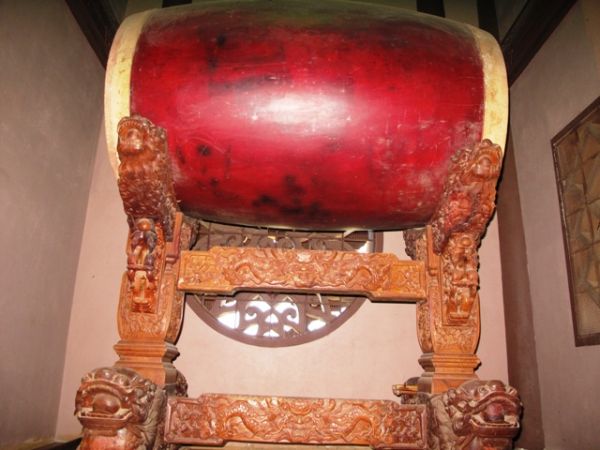
The drum is one of the musical instruments, usually made of stone, tree, copper, etc. In the past in India, it was used to indicate the time, to warn. When the Buddha was in the world, use it to assemble them, Increase the Bo-slaps, listen to the Dharma ... The Five Laws have recorded: "monks, monks, they are real time. Buddhist language: weakness, depression, ancient weakness ... ”. Ancient China used it in festivals, festivals ... The type is big, small, hung or put on a shelf ... Big drum is called a pipe drum, small drum is called a drum, hanging to beat is called a hanging drum ...
From the Duong dynasty onwards, according to the rules of the Zen Gate, the drum is one of the types of legal qi used as a signal for early evening. Later, Chinese Buddhism took a further step to coordinate the rhythm, the sound of the drums in harmony with the words of praise, spectrum into music, called "offering music, solemn religion", using sound. to be the Buddha, help the masses to develop devotion to the Three Jewels.
Based on the 820-era translation of the Zen Master Dai Dien and Han Du of the Tang Dynasty, we find that bells and drums are widely used in Buddhist rituals. Therefore, at least we can guess that before 820, drums were brought into the temple to be used as a dharma qi.
In a Buddhist house, every buddha has a special meaning. The sound of drums or bells in the meditation door when beaten implicitly means that everyone should wake up to practice. Each thing when used, has its own formula.
Meaning
The bell drum is very important in meditation. Bat elegant drum bells are often beaten on special dharma ceremonies, such as sermons, ordination, confession, etc ... At the same time, bow to the Buddhas of Ton Duc and also let everyone pay attention to return to mindfulness. Specifically the important ceremony hours.
In terms of meaning, in addition to the resonance of the drums in the scene, it also expresses a special transcendent meaning. The purpose is to remind people to equip themselves with full wisdom. Because wisdom is so important. No matter what a practitioner practices, but lacks the wisdom to direct, it is considered that the practice has not had good results. If we do not have the wisdom and wisdom to discern righteousness and false truth, then while applying the practice of practice, we will easily go wrong and go into the evil path.
Because Prajñā is so important, so the Patriarchs borrow the form of a drum, so that when beating up, to wake up to remind everyone as well as customary to always remember the Prajñā mind available in themselves. This elegant Tri, also known as the Supreme Master. But to realize this No-mindedness, practitioners need to rely on the organic mind, which is learned from your teacher.
At a lower level, when listening to the sounds of those dharmas, such as drums, bells, knots, etc., the listener quickly awakens to try to cultivate and cultivate. Be diligent in doing good to avoid evil, should not cause negative karma but must take the fruit of suffering. So when we come to the temple every time we hear the sounds of the above, let us immediately return to mindfulness. Or to be more specific, to always light the torch of mindfulness.END=NAM MO SHAKYAMUNI BUDDHA.( 3 TIMES ).GOLDEN AMITABHA MONASTERY=VIETNAMESE BUDDHIST NUN=THICH CHAN TANH.AUSTRALIA,SYDNEY.18/8/2020.

No comments:
Post a Comment