Prepositions.VIETNAMESE TRANSLATE ENGLISH BY=VIETNAMESE BUDDHIST NUN=THICH CHAN TANH.
SUTRASIAN VUNGTAIN FORGETS CHRISTMAS.
VOCABULARY LANGUAGE (expected speech)
Scriptures:
1. Phonetic:
From the sentence "Ruo Buddhists ..." to the sentence "... the Bodhisattva Ba La Di".
2. Translation meaning:
If the Buddhist speaks his own language, tell the speaker to speak the language, the means of the object, the predestination of the language, the way of expectation, the karma, ring to not see, to see, to see, not to see. Or the body of speech, or the mind of speech. Being a Buddhist should always have right speech, right view and also make all sentient beings have right speech and right view, but on the contrary, it makes people wrong, wrong views, this Buddhist commits the crime.
Lecture: The
word "expectation" every day Buddhists we often hear referred to as teachers of the disciple: "You should not be expected, you should not arbitrarily say echo". Thus, the expectation is definitely not possible, because there is only harm that is not helpful. So in the Dharma realization of hope is a crime and is extremely forbidden.
What is it like to speak an echo?
- Words that do not fit the truth are Vọng.
- The speech that makes the receiver is Speech.
For the person to be honest, it is not only essential to initiate a religion, but to be a righteous person in life must also be honest. Speech is false, not moral.
A vow is to know for yourself that it is not true, because you want to deceive, fascinate people, you should say it without fear. Although seeing is deceiving people, but looking deep into the core is deceiving yourself.
Isn't keeping a sincere attitude a good thing? Why are you telling lies, deceiving people?
Consider carefully the cause that is not out of the hope for fame, greed for benefits, is not a good thing, so it is very important to prohibit it. Saying the language to pray for honor and nurture is a crime, but it is the discretion to talk, slap, and swear, that does not prevent karma.
When the Buddha was in the world, Luo Maa, after being ordained, did not know how to carefully keep his speech and karma when he was young. Like when Buddhists come to ask: "Is the Buddha in the monastery today?"
Luo Luo knows there is a Buddha, but just arbitrarily lie is no. When the Buddha went to propagate elsewhere, Buddhists came to ask, sa said he had. Luo Luo lied like that many times, someone told the Buddha.
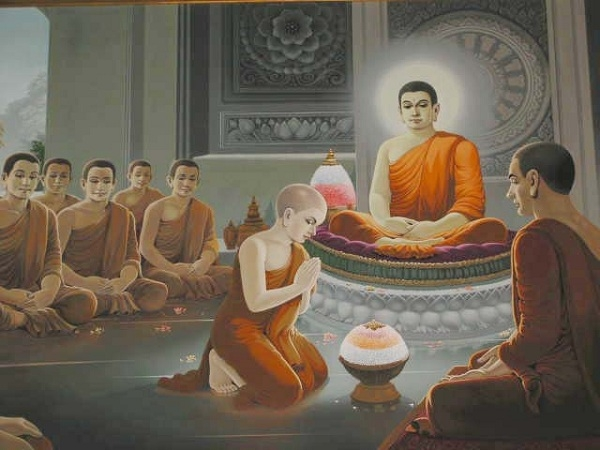
One day, the Buddha took alms back to bring the bowl, told La Ma La to bring water for him to wash his feet. After washing, he asked Rahula, "Can this water be used for tea and rice cooking?"
Luo Luo replied, "Respectfully, Blessed One! No, because making tea or cooking rice requires clean water. This water has already washed the feet, it becomes dirty and can not be used.
The Buddha said: "Yes! So is he. He often tells lies to people like water that has washed the dirty feet and cannot be used to make tea or cook rice. He often lies, so he cannot cultivate illegal religion ”.
Buddha taught like that and then told La Hau La to pour water and put the sink back in place. La Hau La obeyed, the Buddha told La Ma La to bring water to pour into the basin, the water only saved a little bit on the bottom of the basin.
Buddha knew well, but deliberately asked: - Why is not water poured into the sink?
La Hau La Bach: - Respectfully, World Religion! Water is no longer in the tub because the sink is upside down.
At that time, the new Buddha sternly rebuked that: "He is a person without shame, due to the sin of hope filling his mind like water does not flow into the sink, he does not absorb the religion as well".
Luo Luo received the Buddha's instructions, knowing hope is the thing not to do. From then on, never said an echo.
Dai Tri Do Luan said: “The expectant person first deceives himself, and then deceives himself. To be real is to be vanity, to be to be to be to is to be real Crazy reality is not able to receive good dhamma, like an upside-down pot, water cannot flow in. The speaker says the language of the mind without shame, sealing the path of the human genius and the gateway to Nirvana. Contemplating this sin already, so do not speak objections ”.
In the sutras: Once there was a monk named Ha Da who was very talented in declaring the Dharma and often declared the dharma. This great merit should have received good retribution, but unfortunately! This bhikkhu, after discharging his body and falling into hell, suffered various dramas, why? Is it contrary to the law of cause and effect or not?
The Buddha told the monks, "Bhikkhu Ha Da fell to hell not by declaring the Dharma, but by speaking in speech". Disaster of hope clearly see here!
You should not assume that it is irrelevant to just speak arbitrarily a little. Should know the crime of killing, stealing, adultery has preached, mostly due to the language support. So when we speak the language, the gods and demons all know. They originally wanted to support us, but because we spoke with hope, they alienated themselves and did not want to support.
Imagine how much of a sin of disappointment tells us. So in the sutras, the Buddha declared that: "It is better to sacrifice one's own life, not to violate the expectation".
Speaking honestly at times of disadvantage, disgrace or condemnation, in itself it is a great sacrifice. However, for the Dharma it is still necessary to say the truth. I can't because I am at a disadvantage without saying honestly.
In the commentary Bodhidharma said: "Even if you have to die by saying your words honestly, you will lose your position as Zhuan Luan and the gods, but you must also speak honestly". The preciousness of the true word, the righteous word, is completely apparent here.
Contrary to the expectation is the sincere, sincere words that arise from within. The person who works to the level of sincerity is not true when he, never saying a myth to deceive him. So whether for Buddhism or Confucianism, sincerity is paramount. Sincerity is not only an indispensable righteousness between people and people who deal with each other, but also a factor in building trust with each other.
Sincerity stems not only from truth but also from sincerity. Sincerity is also a great impetus for people, it can make people become brave, fearless, capable of being so bad that no hard thing can stand and keep. .
So ancient Chinese people have said: "The spirit of the spirit, the solid stone of the openness" (wherever the city goes, everything is as hard as stone gold, must be shattered), which is the above idea.
Again human beings live together, building a foundation on the two words Truthfulness. If there is no sincerity, how can humanity live together? Why does a gentleman see Sincerity as a very valuable thing?
Because sincerity is the only origin of morality (pure virgin is the source of the stream, or the source of the water stream, using this noun refers to sincerity as the source of morality).
The personal mindfulness of cultivating an individual depends on sincerity. The mutual treatment between ourselves and people is maintained through sincerity. So it is necessary to show a degree of sincerity that is human morality.
Again, only those who are truly sincere in the world can bring out their full power to promote their own nature. When using sincere hospitality to people, naturally people will receive their feelings and have the intention of enjoying being assimilated with them.
Because of this, we see the great power of sincerity that ordinary people cannot understand. So, saying, "Sincerity is the premise of the right mind, the basis of self-cultivation, is what all religions use, is a prerequisite of spiritual practitioners."
Buddhism considers the sin of hope to be the basis of serious sin, so it attaches more importance to sincerity, for sincerity to be human religion. If not sincere, not eligible to be human. The Buddha said to the masses again, "If you are a Buddhist, you should be able to use a sincere mind to touch sentient beings. Because only sincerity will make sentient beings receive their teachings. If we do not do that, we often say false words, one day, when sentient beings know, who else will believe their words? So regardless of the language expectations, teachers expectation, means of language expectations, are not possible, so must be strictly prohibited, left out. "
* What is the self-language?
Being yourself to the people, saying that you have attained the dharma, is the legal practice of the holy person. The Dharma practice includes 37 Bodhi products and the three subjects; forensic evidence includes positions in Tam Hien, Thap Thanh.
How to say great language?
It is to say that you have attained the Ten Realms, the Four Fruits, the Four Directions, the Four Jhānas, the Four Empties, the accomplishment of the impure contemplation, the dharma of the Book of News, the Six Paths of the Four-Truths, the Four-Direction of Liberation; Heavenly dragons come to ask, and the devil comes to question me. Or say that he himself has passed the history, has permanently separated from the three things ... The above things are untrue and untrue, only the desire for honor and nourishment, should be called "great speech".
In the Law teaches, when saying that we have attained the above-mentioned dharma, it is said to complete the basis of serious sin. If you have attained enlightenment, the practice or the Department will only know it for yourself, like a person who drinks hot and cold water by himself or herself.
Ancient ethics teaches: "Righteousness, immorality, self-confidence" (whether or not there is a religion, know it by yourself, you don't need to tell people). Do not say the language that you have attained, in case if you really have attained, you should not tell others.
Due to what reason, to say objections, not true?
The greatest disease is due to the desire for honor, goodness. Because many people in life really like to respect and make offerings to those who have attained meditation, miracles, and results. If we show people that we have attained these dhammas, honor and benefits will be hastily brought on.
Truly, we can see innumerable honor and benefits from the outside, but we have truly created infinite poverty of ourselves. Why so?
Be aware that it should not be arbitrary, because words do not match the truth. Therefore, the honorable nourishment will be lost quickly, but it also carries the crime of great speech, harming the world, causing a bad impression on the Dharma, and rotten the trust of sentient beings towards Buddhism. Try asking this to the Buddha how much damage?
So expectation for myself has not benefited nor benefited the Dharma, so why can we arbitrarily speak nonsense? Like people who shoot arrows at night, not sure who hit, come back to harm me?
* What is the aspirational teacher?
The teacher of the hope language (tells the person who speaks the language), this category includes two things:
- Tell the person to other people who say that he is really a noble spiritual practitioner, has attained the legal upper ... or ask people to praise their own virtues; Or tell the disciples to go to the public places to say that my master is a highly virtuous spiritual practitioner, or ask his friends to respond to each other to say: He is the only contemporary great virtue, possessing miraculous powers. magic use. Thanks to that, to be honored, to be nourished means to have committed the felony.
- Tell the person to say to another person; He should go out to preach to everyone that he has witnessed the supreme dharma, sometimes he is talking with the angels and demons, at times he is with the dragon king. Sometimes the demons come to him and raise many questions. He is able to answer them very much, then farewell ...
Thanks to saying like that, the other person gained a lot of honor and nourishment, completely not being himself at all. Everybody says it everywhere he goes. Because the cause of inciting people, even though it does not constitute the basis of a felony, it is inevitable to commit contempt.
Therefore, a true Buddhist, not only should not arbitrarily praise his or her virtues, or ask others to praise their virtues for self-benefit.
* What is the means of echo?
It is the time to say vow, first of all, to borrow cunning and cunning words such as saying: "I practice, one day while meditating or reciting Buddha's name, chanting a divine flower from nowhere is scattered down" makes the listener feel confident.
By itself, such means of speaking will commit the basis of serious sin, even send others to go to public places to speak like that, or write letters to places that show their virtue, or use hands and feet ... Signing, or doing an act of intent to make the person understand, are also guilty of a felony.
Outside, fake to borrow a speech to praise others, but the inner truth implies that he is a virtuous person ... There are other bizarre cases such as: first using honey to apply on the trunk of a tree. , thus attracting many honey bees to fly, then not ashamed, to the person who says: "I can lead the honey bees to fly", to deceive ... all commit the crime of felony. .
In addition, we also borrow the demon god, heavenly fairy ... the superstitious methods say that they are inviting gods, or say this great fairy forest teaches us to do this and that. Or say Te Cong The Venerable Lam dan, Ngoc Hoang Dai Lam dan, even say the Bodhisattva Avalokiteshvara, Maitreya Bodhisattva ... the forest. The types of religious groups, religions, superstitious and feudal organizations in previous times often used these things to deceive people.
Because of borrowing the excuse of demons, fairies, and forestry Buddha said this, another, telling people to donate a generous amount of money. All of that, the Buddha's law attributed to the crime of means of speech and considered it a very great crime.
Normally, people do not know that this is a way to deceive the superstitious person, claiming that the real thing does not solve its truth, but also thinks it is a thing in Buddhism. Thus, it is impossible not to say that there is a hopeless harm in the Dharma (hopelessness here is the opposite of hopelessness; the real meaning, clearly in reality, is not nonexistent). Therefore, the righteous Buddhists absolutely must not go to the toilet. If superstition wants to pray for honor, benefits are all guilty of felony.
The Bodhisattva Sutta says: "If the Bodhisattva is praised by the people, he has attained the Ten Pillars, A Arhat ... but quietly receives his life, that is, he commits a serious crime. If he is a noble monk, though he does not have a deceitful mind, he also commits contempt, because he only possesses a little, has claimed himself as a testimony! "
What is the monkhood?
That means that normally can not be said, yet to testify to testify. Actually, it is not that the supreme monk who does not have the effort to practice, but makes use of their spiritual practice slightly corresponding to the dharma, hastily considers themselves to have actually attained what dharma, or what attainment of results ... such an increase in mind, but not completely intentionally want to deceive people to claim the honor of benefit. So no matter what the speaker says, what the fruit ... just committing a misdemeanor, not committing a serious crime.
Conclusion into the crime of expectation must meet four conditions: human, predestined, legal, karma as follows:
- Vong language (human expectation): by the seed of greed from the beginning of deception. Now arose the mind wants to lie to people to look forward to many honors and benefits. That is the human language.
- Vọng language predestined (predestined expectation): the person currently in front of you to deceive is a very good predestined relationship, supporting the expectation. Or use other means such as speaking, silence, moving, tranquil, passing, walking, walking, standing, showing dignity ... to prove you are holy. All are predestined predictions.
- Aspect grammar (the way of expectation): The rules used when using the language. There is a place to explain that the expected solution is only for the Cross, Four Fruits ...
- Vong language karma (expectation karma): due to the above three things combined into the sin of expectation, there is a place where the explanation is from the mouth. speak clearly, making the other person perceive it, so it is called echo.
So, to conclude a sin of hope is not simple, must have the conditions to form. Not only the above-mentioned crime should not be arbitrary, but other hopeful sins should not arbitrarily want to say how to say.
Therefore, the next sutra is taught: "No matter what language, knowledge of opinion, body, mind and mind" These little expectations should not be said.
* How is it called not seeing and seeing?
Like I have never seen other people do improper things or crimes. As if I was dealing with those people with a bad feeling, or a little troublesome in my heart, then I went on my own and said, "I saw him doing such cruel things with my own eyes ..." into such crimes, called "do not see said."
* What is called seeing say not seeing?
As I see myself doing good deeds, useful for people and society. But because I do not have sympathy towards that person, or are led by jealousy, want to cover up his good deeds and extract his crimes, and then go and say: "I have never seen him do the something good… ”is called seeing say no seeing.
In addition to the aforementioned, there are other echoes such as:
- No hearing, no hearing.
- Inexplicably senseless, senseless.
- Can't say, know how to say.
- Really said no, really didn't say yes.
- France says it is illegal, illegal says it is legal ...
In short, the expectation has a lot, when it comes to (contrary to) the mind belongs to it.
Verbose is the word that is not really coming out of the mouth, but how is the action of body and mind manifested as an expression?
- Body speech: as the body acts or shows an attitude to someone who knows a certain thing. For example, someone asked if you had attained such fruitfulness or not? Although you did not say, but nodded and the other understand that you want to say is a witness.
- Consciousness: it seems like asking a practitioner that has reached the level of a pure body and mind, right? You do not respond, but because you want to show that you have been purified, you are quiet, it means acknowledging and the person in front of you has understood what you mean.
Such types, due to the mind of deceit, manifest the appearances, causing the opposite to support their intentions. Although not opening a word or a sentence, but the karma was finished. This is called the object of the object and the mind.
Whether it's great or small language, rightly speaking, it can't be arbitrary. In fact, the aspiration language is not much, the hope language is not many. Especially the case of false witnessing to people in this day and age.
For example, a person who did not steal things, but unhappy for him when he went to a place where someone was stolen and the security guards were looking for the thief. When the police asked a neighbor, "Is this person stealing things or not?" This person is the unjust confrontation of the pedestrian. Because you want revenge, you know that this person has never stole, but you just testify that this person stole.
So the passersby were arrested, brought in a dangerous accident and suffered extremely miserable. In the Dharma, false witnessing to such a person is a huge, intolerable crime.
So being a human, especially a practitioner of Bodhisattva, must not only produce right speech, right view, must not confuse it as holy, false hope for right is evil, and also need to be righteous. language, right view for all sentient beings, can clearly reveal the benefit of the Bodhisattva's birth.
- Right Speech: correct speech, also known as sincere words, do not say false words, not truth, should be called Chanh Speech.
- Right view: the correct interpretation, is the steadfast policy of immutable immutability. For practitioners of Buddhism, the sole purpose is to wish for the escape of samsara and to benefit all sentient beings on their own. Having such knowledge is called Chanh Kien.
If the practitioner practices the Dharma but wants to benefit, calculate and seek for his own rights and status, it proves that your views are not appropriate. Thus, Right Speech manifests from the outside, Right View is concise inside, so we never dare to say right to fruit, white to black, wrong to say righteous, evil to say good, to bring mortals to say holy.
Self often born the right view, the right language is the self-interest, helping people born right speech, right view is beneficial to tha. Having full of self-interest, taking advantage of such new style of a Bodhisattva. Failure to properly practice the true spirit of a Bodhisattva, on the contrary, also causes sentient beings to arise wrong speech, wrong view, wrong karma, of course, this Buddhist commits the Bodhisattva Ba La Di sin.
Why so?
Because the wrong view of the books inside, naturally uttered the evil language of false expectations, anything, nothing, creating crimes outside evil industry. Due to evil evil behavior, this evil karma will employ future suffering.
Bodhisattva transforms sentient beings, intentionally allowing sentient beings to leave all suffering, to be happy to the scene of Nirvana. If the present has not been able to fulfill that purpose, on the contrary, it would also suffer great suffering for all beings, then it is not the desirable behavior of a Bodhisattva.
A Bodhisattva's gesture, a deed, a word must be an example for sentient beings to know and follow. If the Bodhisattva himself has illegal actions, causing new Buddhists to feel confused, lose their place of support, do not know where to proceed. That is, "when the gods lie, charm the human mind", above, then committing crimes against the Buddhas, under the confusion of sentient beings, how great is this sin! Therefore, should commit a serious crime.
Ancient Chinese said: "Torn language is fully enlightened, people are born with love" (a mistake can cause harm to the whole nature of the world). This meaning demonstrates the importance of words that both the Buddha Thich Ca Mau Ni and the holy philosophers in the world have commanded us to be very careful.
About expectation also has enough Tam Gathering Pure World:
- Body and mind do not expect language belongs to the Law of the World Photography.
- Often born righteous speech and right view belong to Photography Compassion Dharma Realm.
- Make beings have right speech and right view that belong to Samsara.
So if the Bodhisattva speaks aspirations, it will be completely destroyed with the Three Pure Land. Therefore, the status of the Bodhisattva is also completely lost. Thus, Buddhists have developed the mind to cultivate the Bodhisattva, why should not be careful with words?
Vọng language that becomes a serious sin is not simple, but must have all 5 conditions, distinguished briefly as follows:
1. Thi beings (being beings): divided into 3 products:
- High-class beings: as for parents, monks who speak the language of the language, commit serious crimes. Because monks and parents are both superiors and have grace and virtue with them. The duty to be a son, to be a disciple, dare to even tell them false words, how serious that sin is! If you speak an echo to the saints, if the saints are not deceived by you, they will also use divine powers to prevent others from hearing your lies, and not be deceived. or just condemn the vehicle. If the saints have not yet attained Tha Tam Thong, don't know if your words are deceitful or true, then commit a serious sin.
- The product of sentient beings: for sentient beings in the human realm, the heavenly realm, that speaks with them. If they are deceived, you are guilty of a felony. If the gods in the celestial world have forgiven your mind, know your untruthful words without being mesmerized, they will only be guilty of means.
- Lowering beings: for a tu la, demons, animals that speak language expectations. In the business there is a place to say that is guilty of serious crime, some say only into fiction.
Committing the serious crime is the discussion of the inborn nature of sentient beings, being able to understand the teachings of the Dharma master and the precepts of the Bodhisattva precepts. If intentionally speaking the language to fascinate demons, animals to gain a lot of honor and benefits on their own, they commit a serious crime, but the difference is that they do not lose the precepts. Or lose the precepts but still can re-life. So it is important to see if the level of the living being is deceived by you or deeply deceived.
2. Beings (thought being beings): This second condition has 3 types. Each category is divided into many specific cases:
* Thinking beings have six cases:
- Beings think being beings: committing felony.
- Beings are suspected of being sentient beings: committing a serious crime.
- Beings thought non-beings (unintentional species): do not commit but the opposite.
- Not sentient beings think as beings: sin contemptuously.
Non-sentient beings are suspected of being beings: guilty of contempt.
- Non-beings think non-beings: do not commit.
* Thought a saint also has six cases:
- As a saint thought to be a saint: for example, in a large group of people, in which there is an Arahant, you know exactly like that but speak with him. Because he was a saint, he was not deceived and you were committing a crime of contempt.
- It is a saint who suspects to be a saint: As there is an Arahant mixed up in the crowd, you cannot accurately judge. In your mind you think like this: "Is the person in front of you an Arahant, not Arahant?" In the end, whether or not the person is, you just keep saying words of hope, and think that no matter what, this sin is heavier than the previous sin, but still condemns contempt.
- A saint thinks that he is not a saint: Because you are not aware that he is a saint, even though some say that this person is an Arhat, you still do not believe that he is a saint. Thus, this case compared to the previous case, your sin of hope is worse.
- Not a saint thinks to be a saint: If there is a mortal person that you consider a saint and speak with him, you will commit contempt.
- It is not that the saint thinks that he is not a saint that speaks expectant will commit a serious sin.
- Not a saint who suspects is not a saint and speaks hopefully will commit a serious sin.
*
The idea that there are also six cases: - The person who thinks is the one who speaks the language, and that person understands the meaning of your words, you will commit a serious crime.
- Person who suspects: for someone, who you suspect is not human or inhuman, speaking with that person you will commit a felony. Because the person is truly human and understands your words.
- The person thought was inhuman: speaking with that person, this crime is somewhat lighter than the previous sin.
- Non-human thought to be a human: for that person speaking, although he is not human, but because you have viewed him as a person, this sin is worse than before.
- Non-human suspects: you cannot know exactly whether the person is human or not, or the birth suspects that you do not know if they are human or not. This crime is a bit mild.
- Non-human thought is inhuman: in this case, it is expected to be a misdemeanor.
Here, there is a point to add clearly:
- Thinking beings: only about sentient beings.
- Non-beings: only for unconscious species.
Friendship, accidentally contrasting each other, so in 6 cases of being beings, there are two cases of not committing. In the part of the idea of people, the word "person" here refers to humanity. Non-human beings are demons, animals. Although these two classes are compared with people with differences, they are sentient beings. The contrast between people and non-personnel is only relative, so when speaking the language, they must be guilty of contempt, not at all.
4. When stalking the mind (deceiving mind)
Stalk: lying (other than crazy: crazy).
The motivation stemming from the desire for honor and nourishment is the main thing that results in the sin of hope. Normally most of humanity in this world, no one does not expect honor and benefit. So it could be said that people are rolling around in fame school all day long. Nho thi has the sentence:
Thien hi hi, famous name,
Thien humble, and good taste
Translation:
Heaven is jubilant because the name comes,
Heaven is bustling for the sake of it.
But the list is not sure to win, the profit is not sure to benefit. Because praying is not allowed, bad ideas arise, which leads to the search for methods of fascination, to deceive people, to gain much fame. That is called the deceit mind. The main purpose is to completely want to deceive people, not just laugh and laugh for fun.
5. This deceitful mind has two types:
- Mindfulness : you do not have to expect to deceive a person, but hope that many people will listen to your lies. In this case, depending on the person who heard your lies, more or less that becomes the basis of felony.
- Mind style: you use a lie to expect to deceive someone. But this person does not listen to your lie, while another person obeys you. Because you do not have the mind to deceive this person, even though this person has heard, but you do not sin. As for the other person, because you intentionally want to deceive, even if they do not obey, for that person, you are still condemned to be a means of means.
6. Precautions specific:
Talk about eyewitness. For example, I said I attained the Four Fruits, the Ten Areas, the Eight-Deeds, and the divine powers; or say "I see gods, dragon kings, demons ... come to me". The results, the dhammas, the people mentioned above are called "great tools".
The Ten Land, Four Fruits, the Buddha's Pratyekabuddha, etc. are saints of the Mahayana and Theravada in Buddhism. If you arbitrarily lie that you have attained that accomplishment, you will commit a serious crime. As for the Noble Truths, the Four Jhānas, and the Four Empties of sublime, non-Buddhists can cultivate, although not through these dhammas, they are freed from samsara, but are victorious in the world, if you arbitrarily say The expectation is to have attained these meditations, also committing to a serious crime.
Coming as the impure bar, So Instant shop, are two nectar dishes in the Dharma. If the practice is accomplished these two dharma s can also enter Nirvana, enjoy the magical feeling of nectar. Now you arbitrarily say to the person, "I have achieved the impure dharma, I have skillfully cultivated the method of contemplation", proving that you have attained, but the truth has absolutely no attained place so you commit it. felony conviction.
As saying: "The gods, the dragon king, the demons, etc., come to my place to make offerings", you must have enough divine virtue to make the heavenly dragon, the demon god move to make offerings. It's not that simple. People heard that, thinking that you must be an extraordinarily high spiritual practitioner, so they also had to compete to make offerings to you. So you must assume the basis of serious sin.
There is also the case of telling people: "I have cultivated to the level of eternal devotion to the three disciples, I have eliminated all afflictions ..." work in the fruits. You have not had any results, defilements are still the same, the three clothes cannot escape. Therefore, if you say so to the world, you will of course commit a felony.
If it is to someone who says, "I have achieved the general of mindfulness, the special form of mindfulness." I have cultivated the Dharma of the Arhat, the Discourse, the First World, etc. The above measures are very difficult for practitioners, but ultimately belong to the ordinary people, so even though the person who still concludes with the basic duty of the crime is committed, the world is not lost, or the false is not committed, only into a misdemeanor.
If people say, "All of the earth spirits come to me, they love to hear me, I want them to work, they all obey". Or say, "I, with respect to the precepts of Tathagata, keep exceptionally pure. Even though it is the Dai, Tieu, and how gross, I absolutely do not dare to violate a bit ".
Or say, "I can communicate the Tipitaka of Tathagata, whatever problems I have in the Buddha Dharma, I am able to answer them skillfully. If you have any doubts in the Dharma, you can come and feel free to ask me, I will give you a satisfactory answer. ”
Say that to show that you are a master of the three Sutras, or say: "I can practice meditation skillfully, how much time I plan to do prostration each day, how much to recite Buddha's name, how much to chant, to recite how many mantras, I have to cultivate mantras every day.
Such words, but the reality is completely not like that. Those are just words of aspiration, not true, so they are guilty of Confession.
Again if you start the mind deceives. Duty wants to say they have proven Sisters Results, but they say they have proven Nhi Results, want to say they have proven Nhi Results, wrongly say Sisters Results; want to say proof is the third result, wrongly say testimony of Four Fruits, want to say proof of the Four Fruits, wrongly say proof is the Three Fruits etc ... kinds of things like that, because they have not yet achieved their goals. should only be guilty of means.
7. The recipient of the prize (the person in front of the audience receives the explanations)
No matter how they say their utterances, the person who is mainly understood by the opposite person can be deceived by the speaker. Deceiving false words, whether they speak for themselves, tell the speaker, or even write letters ... you and your faith. This is when you are condemned to the basis of a felony.
Suppose you say vain words that the person in front of you doesn't understand your intentions, doesn't believe in your words, is not deceived by you, then it only ends up in a fictitious crime. Or fake to people, you say false words, at that moment, the listener does not understand, but later on, they will recall your words and understand your idea of the future. At that time, the basis of serious crime.
If you do not go to people to say that you have attained divine results, meditated, or you have obtained divine powers, but people come to ask if you have attained holy results, attained meditations, or attained miracles? You really do not have attained, you should honestly say that you have not attained, but because you are motivated by your desire for honor and benefits, to the questioner, you nod once. prove you have attained, attained ... and he admitted the same way, proving you have attained, attained. Although you did not open a password, but nodded in recognition, should still commit a serious crime.
Or, after the person has asked, do you not nod your head to acknowledge, nor say that I have not yet attained, just say nothing and make the other person not aware of your attainment? In this case, though not a serious crime, but the crime of contempt is inevitable because even though you say nothing, but have shown an attitude of dishonesty.
In addition to the above-mentioned crimes, there are many things that are expected to be expected. Some people say that speaking a little object language does not matter; But not knowing that, when you say every single parable, you must be charged with a misdemeanor. And based on the extent, the recipient understands your words more or less badly but condemns more or less contempt.
Like there are 500 people who perceive it, understand it, it results in 500 sins of contempt. The new hope language seems to have nothing to do with it, but if it is due to the wrong history of the disturbing monk, it is often violated forever. Again very interesting, interested in echoing; without shame at all, also lose the Bodhisattva world. Therefore that becomes the basis of serious crime.
Bodhisattva world is gone, you do not know enlightenment, so wherever you go, you speak the language hope. Because there is no world on your body to control, you only commit sin, but not sin.
If when you speak the language, you often have a mind of discovering, knowing that it is not the human character, it is not the recommended behavior of a Buddhist practitioner of Dharma. Therefore, the birth of mind is very ashamed, immediately from then on, dare not speak the language; then even if your world has been lost, but you can still be re-ordained as a Bodhisattva, it is not necessary to first have to repent to show that the new master can be re-ordained.
In fact, the crime of great speech, not seeing the Buddhist practice in the home and ordination, because we all know that the crime of great speech "has not yet attained, has not witnessed" has an unpredictable end. . For the crime of hope, in daily life, depending on the time and locality, it is difficult to avoid the violation. Although it doesn't seem to be a very important relationship, when you talk too much, it will turn into a great sin. From contempt to felony. So we need to be very careful!
At this point we would like to ask: How do we avoid committing the crime of hope?
For example, a Sorcerer promotes the Dharma, because the masses say how to achieve the attainment of the Ten-Tails, how the results of the Ten Cross are, how to cultivate the four results, how the fourth week of the four results ... to teach how to practice impure practices, how to practice the window, how to practice the four meditation, how to practice the four things ... Everyday because the audience listens to say that But never said that if you have attained yourself, you are not guilty of honor.
Again cases of joking, joking, speaking alone, misleading but not intended to deceive anyone, nor violation. Either by yourself while inside is hysterical, insane, unable to control, or due to a disease that causes serious loss of inner clarity. In this situation, even speaking untruthful words is not a crime.
In the case of letting go of the body, passing birth to another life is not self-remembered nor guilty.
In summary: The
crime of aspirational speech in Buddhism is very important. Not only speaking in the mouth, but inwardly speaking, aspirational speech also belongs to the basis of serious sin.
In the text of Van Thuat said: "The first one starts the idea of hope, commits Ba La Di sin" (if the mind starts a thoughtful thought, then commits Ba La Di sin).
Why must be aware that much?
A Buddhist who has received the Bodhisattva Precepts, in any case, must be separated from the four faults of the expectation, even in a dream, one should not lie to another person, let alone in the ordinary time deliberately say the expectation. So should always say truthful words, should not say bad words. This is for a bodhisattva that beings are very urgent.
The Bodhisattva needs to because the sentient beings are speaking the Dharma, beings have faith to attain the purpose of their being. If the previous Bodhisattva had spoken the word with sentient beings already, then later on, no matter what he said, sentient beings could not believe it. So, try to ask how to change sentient beings?
The Nirvana Sutta says: "All sentient beings, even though they have enough Buddha nature, need to be able to see Buddhahood by the pure precepts. Human see the new Buddha Tanh attained A-nậu-multi-la tam-mieu tam-bod-subject ".
According to the above sutra, it is known that: Although everyone is ready for Buddha nature, from beginninglessness has been restrained by repetition, Buddha nature has never been seen. Even though it is physically said to be Buddha, but in reality is still an afflictive nature. So in order to see Buddhahood, complete the ultimate Buddhahood, it is necessary to cultivate virtuous actions to overcome all kinds of defilements. When the defilements have been cleared up, the whole Buddha nature manifests, hoping to attain the attainment of unsurpassable Bodhi results.
If you do not practice like that, everywhere you go, you will say, "I have achieved A-nậu-da-la-tam-tam-tam-Bodhi". If anyone asks the unsurpassable Bodhi how to be fulfilled, say: "Because I have enough Buddha nature, I attained the superior Bodhi". Should know the person who uttered that word violated Ba La Di guilty about great expectations.
So, in any case, it is not allowed to speak the language?
Is not! Must see depending on the field, which aspect should or should not be said. If it's for yourself, even if it's dangerous or you have to sacrifice your life, you should also sacrifice, do not speak hope. If for the sake of being, it is truly beneficial for sentient beings, nor does it hesitate, so the skillful means of speaking speech. Saying such language, not only do we not sin but also produce much merit.
This Buddha Shakyamuni is a very good example. When He was still alive, one day a rabbit was chased by a hunter. It fled into Buddha's ashram. He clearly saw the rabbits run in, but when the hunter came to ask him, he said that he had not seen any rabbits running into the nunnery. Because he wanted to save the life of the rabbit, the Buddha, though he could not see it, did not violate the precepts of speech, and gave birth to a lot of merit.
In the Bodhisattva Bodhisattva, it is very clear: “If you meet predestined conditions and die, because you want to save those sentient beings from the loss of your life, you should think like this: This although I know it well, I cannot tell the truth, because it causes sentient beings to suffer, but if we hide it, it is difficult to avoid mistakes with our own mind. Thinking like that, because you want to free all beings from suffering, you have to say it contrary to your own mind ”.
You should know that Bodhisattva says such aspirations, not because of the desire for honor and personal benefits, but completely derived from self-pity. So although speaking the language, but for the Bodhisattva's world, not only does it not violate a bit, but also gives birth to a lot of merit.
Vigilance is not because of mind pollution, but because of compassion, of course, innocence. If due to the heart of honor and nourishment, the crime is extremely heavy, it will be highly courageous. Talking about the Chief Justice of the crime is expected to fall into the three evil paths, suffering from suffering. About the forecast, when out of the three evil paths, being born in this world suffered two consequences:
- One is often scorned by people. Like there are people who really make no mistake, but people say badly wherever they go. It is due to the prediction of the guilt of past life.
- Secondly, people are often deceived, charmed, and they lose a lot of assets.
What is the benefit of telling a lie that has such karmic retribution, but what is the benefit if you do not lie and say a truth?
In the Mahayana Sutta, the Pure Precepts say, "Ly breaks the language of herons of four strains of newspaper" (apart from the lie, four results are retribution). Briefly distinguished as follows:
1. A person who speaks honestly, the gods, the dragon god are all compassionate, always follow the defense, so that, without being harmed unreasonably. There are pitfalls in this world, wherever we go. Just be careful a little, then get entangled in the trap and fall. At the moment, when you practice the merit and keep the pure speech, you should be protected by the gods, naturally not afraid of getting lost in others' circles. Of course, gods protect you because you often say sincere words. Hence, we find sincere speech so essential.
2. The person who speaks the truth is never used to deceive the person, so whatever he says is also the trustee. It is not an easy thing to do. Because over a long period of time, the two sides interacting, people know that your words are all true, grounded, not arbitrarily speaking stubbornly. From time to time, your words will be unquestionably trusted.
As a lucrative Bodhisattva, because the person who proclaims the Dharma of the Tathagata, has completely separated from the false words, so sentient beings who hear the Dhamma immediately develop a deep heart, acknowledging that the teachings of the Buddha are very reasonable. , the intention to obey the teachings that practice. So you can both get rid of the waste of effort and reach the purpose of your blood method of birth.
If the words of a magician promoting the Buddhadharma were not received by the audience's trust, what would that magician accomplish? Ordinary people when talking still need to make others trust their words, with the propaganda of the Tathagata, the sermon benefit, what makes the people trust their words even more important again.
So, how to have the sermon to be trusted by everyone?
This is only so far away from expectations.
3. The person who speaks the truth because he has separated from the lie, so any being born in the mouth often gives off the pure flavor of flowers.
Speaking of which, I (mage) firmly believe that you are like me, but when we talk face to face, if the person's mouth is a bit stinking then we definitely don't like talking to that person. . On the contrary, the human mouth often emits a floral scent, even though he says things that are not right where we like to hear, but we still intend to talk with him and such people are always available. respect.
Again, because where I am honest, I am not spoiled, I believe that people never tell a lie to me, so I do not suspect that other people are lying. I am towards someone with such a sincere attitude, so naturally people will also believe my words are true. Thus, the two sides have been compatible with each other, completely put their trust in each other, it does not happen that you doubt, I suspect, each layer arises. That is a good result by stepping away from the lie.
It is very difficult to do for people to make prestige with each other. A person who has a good reputation can go anywhere. So we need to speak honestly, to stay away from false lies.
4. People who say the truth, then whatever you say, naturally get the confidence of everyone, especially a Bodhisattva who teaches birth. When you say any dhamma, all beings will listen and feel very happy. If you bring the merit, those sincere words dedicate to the unsurpassable Bodhi results will be the true speech of the Tathagata, attained the unsurpassable Bodhi. Far away from false lies can reap vengeance such victory.END=NAM MO SHAKYAMUNI BUDDHA.( 3 TIMES ).GOLDEN AMITABHA MONASTERY=VIETNAMESE BUDDHIST NUN=THICH CHAN TANH.AUSTRALIA,SYDNEY.6/8/2020.

No comments:
Post a Comment