The Maha-Parinibbana-sutta , called Nirvana Sutra, is a relatively little-known sutta among Buddhists and is rarely taught and recited in temples. That is not surprising to us, because this sutta takes an important position, it can be said to be unique, in the treasure of Buddhist scriptures, for a number of reasons: first, it is a gift. precious historical and social data about the end of Buddha's life; secondly, the sutras contain in a concise manner the basic and essential points of Buddhist teachings; and thirdly, the sutta shows a transformation from a path of liberation under the guidance of a teacher, to a folk tradition with the cult of the relics of a Buddha.
Origin of the Sutra
The Great Nirvana Sutta is a sutta to the end of Buddha Shakyamuni's life, from six months ago until his death, that is, the passing of Nirvana.
First, let us learn about the meaning of the sutta: "The Great Bat Nirvana" (Maha-Parinibbana) .
Maha in Pali means great (Chinese is Dai), pari is complete, nibbana is Nirvana. Parinibbana (translated into Chinese as Bat Nirvana) is the complete passing away (extinction complète), the complete and permanent cessation of the cycle of birth and death. It is the word used to designate the departure and departure from the life of the Samsara Buddha (samma sambuddha), Buddha Single Enlightenment (pacceka-buddha) and Arhat (arahant) (note 1), other with the death of ordinary people (marana) .
In addition, the concept of "complete annihilation" ( parinibbuta ) is also used to designate the spiritual states of the Buddhas, Pratyekabuddhas and Arhats, while still alive.
Therefore, we find the two-word canonical:
1) sopadisesa parinibbana , the cessation completely, the eradication of cankers, pollution, fetters, but still the physical life (Seoul: Organic Balance y Nirvana) .
2) anupadisesa parinibbana , which is the complete annihilation, even the physical substances of life (Han: the immeasurable medicine of Nirvana) . That is when the Buddhas, Pratyekabuddhas and Arahants leave their bodies and beings.
Sopadisesa parinibbana is also known as kilesa parinibbana , the complete abolition of defilements, fetters, and anupadisesa parinibbana as khandha parinibbana , the complete removal of aggregates.
Thus, it is not only Shakyamuni Buddha that enters Nirvana, but the Great Nirvana Sutta (the word for designation of reverence) is a sutta to Shakyamuni's entry.
To avoid all misconceptions, we must immediately say that there are two suttas called the Great Bat Nirvana :
- a post belonging to the Buddhist Theravada (Note 2) (
- a post belonging to the Buddhist Mahayana (Mahayana), Originally written in Sanskrit (Sanskrit) , translated into letters Han and letters Tibet . It must be said that it is one of the rare Sanskrit texts that still exist, most of which have been lost and are left only in Chinese and Tibetan translations.
The Original Great Nirvana Sutta , written in Pali (Maha-Parinibbana-sutta) , is the longest sutta of the Tipitaka , belonging to the Sigh school (Digha-nikaya) . It is thought that the original scripture was formed decades after the Buddha's passing away, in Prakrit , a language very close to Pali , and then changed over a period of one or two centuries depending on the The catechism and organizational needs of the Sangha body. The sutta was passed down from generation to generation, and was only recorded around the 3rd century BC. Whole Pali Sutta was recorded around the 1st century BC, but still continues to be oral for many years.
The Mahayana Mahayana Sutta , the original text in Sanskrit (Maha-Parinirvana-sutra) belongs to the Mula-Sarvastivada school , a branch of the Sarvastivada sect , appearing quite late and long-lost. The Sutta was translated into Chinese characters from about the 3rd to the 5th centuries AD, under various titles (Buddha Theory of Equation Bat Ne Hoan Kinh, Dai Bat Ne Hoan Kinh, ...). One of them was taken by Dharma Master to Sri Lanka and translated with Buddhabadra in 417. In 421, in Northern China, the Indian monk Dharmaksema also translated a longer version, supplemented by a the number of passages in a manuscript found in Khotan (western Xinjiang).
In the West, the Great Nirvana Sutta has been paid special attention to scholars since the late 19th century through translations from Pali into English by TW Rhys-David (1881, 1910), through research works. German studies of E. Waldschmidt (from 1944 to 51) and especially through the work of the French Buddhist scientist André Bareau (from 1970 to 75).
Among Western scholars, André Bareau was probably the most elaborate researcher on the Sutta of the Great Nirvana. He compared seven different texts, one written in Pali , one in Sanskrit and five in Chinese characters , drafted in different periods and belonging to different schools.
As mentioned above, we should note that there are two different suttas, one on the Theravada system, and one on the Mahayana system .
Although both are related to the end of Buddha's life before he entered the Eightfold Path, there are many differences in form and content. The Mahayana Sutta is much longer than the Suttas, because there are many more. In the Theravada Buddha taught to Ananda (Ananda) , both cousins, attendant and disciple closest he, while in Mahayana, the Buddha taught for Maha-Kassapa (Oscar Laughter), is his great disciple. We will discuss later on the differences in the content of those teachings.
In the context of this article, we will mainly talk about the Pali Great Nirvana Sutta , for the following reasons: firstly, it is the earliest present sutta in history, the second (also related to points above), historical and social events most likely to be described faithfully, and thirdly, the discourses in the suttas are most likely to be close to the Buddha's last teachings.
Limitations on objective information in the sutras
In the classic Tripitaka, on the principle of Sutta (sutta) are the teachings of the Buddha. In fact, everyone knows that these are just the records of Buddha's teaching.
Therefore, like most suttas, the Great Nirvana Sutta begins with: "I sound like this" (Pali: evam me suttam , Han: Like a self- proclaimed text ), meaning the beginning of the author - or rather writers - before recording what they have been heard, over and over.
It is one of the memorable features of the Pali canon . Before being fixed and reprinted as a scripture, as early as the 1st century BC, the prayer was passed down by word of mouth, recited, aggregated from generation to generation, and thus cannot be avoided. from being less or less, accidentally or intentionally changing. Moreover, many sentences are intentionally repeated many times, for educational purposes, to be memorized and learned to master by monks and nuns.
The Mahayana Mahayana Sutta is translated from Pali into Sanskrit , then from Sanskrit into Chinese , so it is even more likely to be changed, with time and space. Therefore, as mentioned, we may think that the Pali Sutta is closer to historical, social events and to the original teachings of Buddhism.
However, for the reasons mentioned above, we must be very careful about the historical and social information contained in the sutras, just as the Buddhist scientist André Bareau has humbly acknowledged: "All is only are hypotheses, more and more doubtful to consider when they become more daring "and" Writing about Buddha's life is a hopeless project "...
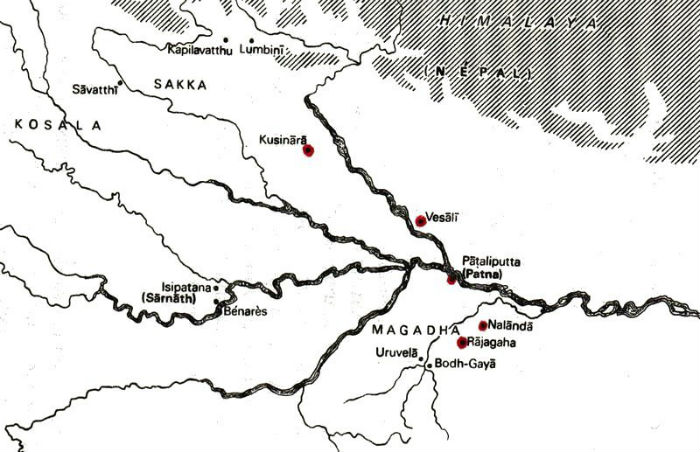
The Pali Nirvana Sutta , consisting of six items, elaborately recounts the final journey of Buddha Shakyamuni to some of his disciples, in six months, from Rajagaha, the capital of Maghada, to Kusinara, a small town of the Mallan people, about 450 km apart (see map). He went through places like Nalanda, later became a famous Buddhist center, Patali-gama (becoming Pataliputta, the later capital of Maghada), and Vesali (capital of Vajji) (footnote 3) . At that time, he was old and frail, seriously ill, but he did not stop preaching until he passed away, ie entering Nirvana, leaving his body cremated in a solemn way.
We will turn to learn about three aspects: history - society, psychology - emotions, and teachings - the last teachings of the Buddha.
About the sickness and the passing away of Buddha
At that time, the Buddha was very old and weak, as his words said to Ananda: "Hey Ananda , I am now old and tired of the burden of time. I have reached the last days of my life, eight 50 years old. Just like an old car that can only run thanks to the full seconds, the Tathagata's body can only walk thanks to medical treatment. " In Samyutta-nikaya (Samyutta-nikaya) , there is also a paragraph of Buddha talking about his health: "Indeed, Ananda , old age replaces youth, sickness repels health, death stops life. Our skin color is no longer as good and pure as before; our limbs are weak and our skin is wrinkled; our bodies are leaning forward; the change is also visible in our senses ... "
At the end of the second volume, the Buddha's illness is described as follows: "While the Blessed One began to settle in the rainy season (note 4) in the village of Beluva, near Vesali, a serious illness arose, causing him to enter But he kept his mindfulness, awareness, and suffering painfully calmly, and then he thought, 'It is not right if we enter the Eightfold Path without notice to the disciples. near death and talk to the Sangha; we must try to suppress the sickness, stay in the world by restoring vitality '. Thanks to that, his illness improved.
At level 4, his disease recurred, when he and his monks went to Pava, in the mango forest of ironman Cunda . He was invited by Cunda to eat, and the special dish he used only was sukkaramaddava (a wood ear mushroom growing on sandalwood). "After that, the Blessed One was seriously ill and had hemorrhage, almost painfully dying. He was still mindful, aware, and tolerated the disease calmly."
On the way to Kusinara, the Blessed One felt tired and wanted to rest. Sitting under a tree, he felt thirsty and wanted to drink water. After drinking the water, he taught the dharma to Pukkusa , a Mallan prince, and he, after taking refuge in the Three Jewels, offered him a pair of metallic colors. Dressed on his body, his skin color became clear and bright.
After that, the Blessed One went down to bath on the Kakuttha River, then he felt tired and lay down, leaning on his right hand, in a lion position. Finally, (item 5), he went to the sala forest of the Mallan family, near the town of Kusinara, lay down between the two large salas in a lion position, and passed away at the end of the night (item 6).
Although the sutta does not contain much detail about the Buddha's illness, we can also surmise that he suffered from a serious chronic digestive illness, since only digestive illness caused severe pain and hemorrhage, in the acute phase. While it is not possible to dismiss the colon cancer hypothesis, it is more likely to be a gentle disease, such as gastro-duodenal ulcer, or colite hémorragique. The disease may be triggered by the fungus he ate, because there have been scientific studies showing that the wood ear fungus (or "cat ear") has antiplatelet and blood thinning effects, Thus can cause bleeding in a digestive lesion. The reason for death can be hemorrhage, which causes fatigue, thirst and makes the skin pale due to anemia. Final,
Of course, all of the above is just a reckless conjecture of a physician holding only a sketchy and vague medical record, handed down from 2,500 years ...
About the funeral of the Buddha
One thing that we see very clearly in the sutras is that the Buddha was greatly respected by the people while he was still alive. Typical:
- When King Ajatasattu , of Maghada, at that time was very powerful after conquering Kosala, he wanted to raise soldiers to conquer the people of Vajjin, immediately sent a great god to consult the Buddha (item 1). After hearing the Buddha analyze 7 reasons why the Vajjin people continued to be prosperous, immoral and invincible, the king gave up his intention to invade Vajji. This fact demonstrates the vast influence of Buddha on the field of politics, society, and the admiration and trust of the rulers at that time on him.
- Wherever the Buddha is, he is welcomed with respect (note 5), such as the great deities Sunidha and Vassakara of Maghada, the princes Licchavin , or the rich like Ms. Ambapali , the ironman Cunda , competing to invite him to eat, with very hearty feasts.
- The two above chiefs also said, "Today, if Mr. Gotama can go to the city by any gate, we will call that door Gotama 's door , if you cross the river by any wharf, we will call that wharf the wharf. Gotama "(end of product 1).
- After Pukkusa , a Mallan prince, a disciple of Alara Kalama , saw his calm attitude with superiority over his teacher, he immediately took refuge in the Triple Gem, and offered to the Buddha a pair of bright yellow metallic tops (item 4).
Therefore, we are not surprised to see his funeral being celebrated in a solemn way. And also for that reason, the funeral organization is no longer the work of the sangha but is entrusted to the laity, to the villagers to take over (item 6).
After the Buddha passed away in the sala forest, the Mallan people in Kusinara gathered together, pay homage to his physical respect, with dances, music, flowers, and scents for a week. His corpse was then carried through the gates, then questioned by five hundred layers of new cloth and cotton, placed in an oil-filled tin box, and then in another tin. Finally, the chest was put on a fire rig with many fragrant woods and cremated.
Thus, according to the writers of the Sutta, the Buddha's funeral was celebrated not only in a solemn way, but also in a very special way, such as a cakkavatti , or the dharma king (roi universel), rule the world not with violence or law, but with virtue and compassion.
The presence of Master Sakka , Brahma Sahampati , and many other gods at his funeral is a completely different thing from Brahmanism, because for this religion the human body is impure and must be avoided by the gods. The meaning of this presence is that, when a person reaches the Samyaksambuddha, he surpasses both the gods and Brahma, and when he enters the Eightfold Path, then even the spirits must come. prostrate place.
The second difference is that his relics, physical relics, as well as those of the Samyaksambuddha, the Pratyekabuddha, the Arahant and the Zhuan Falun, will be worshiped in stupas (thupa). . At the same time the localities where Shakyamuni Buddha was born, enlightened, transformed the Dharma, and entered the Eightfold Nirvana (Lumbini, Bodh-gaya, Sarnath, Kusinara) will become holy places, pilgrimage sites for Buddhists, marking the beginning of a folk belief.
Immediately after the cremation, the struggle for the relics of the Buddha by the kings and the patriarchs in the region almost caused a major war, but thanks to the skillful intervention of Brahman Dona , so amnesty His benefit was divided into 8 equal parts, plus the rest of the ashes and the relics urn, all into 10 towers built and worshiped each.
We can see that the Buddha Shakyamuni was originally a royal prince, then lived a life of monkhood, alms, and eventually died and was cremated as a Wheeled King. .
The solemn funeral celebration, as well as the relics of the relics in the stupa, are definitely not the will of a completely liberated person like Buddha. Therefore, we may think that the words attributed to him in this regard have been solemnly added by the writers of the sutta. Besides, in another paragraph, the Buddha said, "Hey, Ananda , it is not like that is respecting, worshiping, paying homage to the Tathagata. If a bhikkhu, bhikkhuni, male or female lay person goes Following the path of the Dharma, living harmoniously in the Dharma, and practicing rightly with the Dharma, one respects, adores and prostrates to the Tathagata. That is the ultimate prostration "(p. 5).
About the supernatural phenomena
In the suttas we see many supernatural and miraculous phenomena occurring, though not as much as in the Mahayana Mahayana Sutta.
These supernatural phenomena can be divided into two categories: one is the special ability, due to the supernatural power of the Buddha, and the other are supernatural phenomena in addition to the above.
In the first type, we can list what happened at Patali-gama (Pataliputta), while two Maghada princes were building a fort to stop the Vajjin people, the Buddha used Hue to see thousands of gods. gather here. Later, when he came to the banks of the Ganges River in the high water season, he passed by, like people stretching his arms, while others were looking for boats to cross the river (item 1). And when Ananda asked him about the descendants of some monks, bhikkhunis, laypeople after their general destiny, he asked Hue for a good eye to see the descendants of each person and answered clearly (item 2). By the time his illness arose in Beluva, the Buddha used mindfulness, awareness to regain pain, and maintain his life (item 2). But then he also decided, at the encouragement of the Demon King (Mara Papima), no longer maintain his life, and will die three months later, although he has the ability to extend his life if requested by Ananda (item 3).
When the Buddha's illness recurred, making him thirsty and wanted to drink water, the river water had just been stirred, muddy suddenly became clear. Another supernatural phenomenon took place after the Buddha put on a pair of metallic colors that he had just been given: his skin color became clear and bright, obscuring the whole metallic coat (item 4). And when he came to the sala forest at Kusinara and lay down between the two salas, the tree blossomed out of season, spread all over and scattered on his body, along with the flock of flour, and the music of nothingness emerged to offer him. (item 5).
Finally, before he died, he entered the first jhana, then the second jhana, then the third jhana, then the fourth jhana, and then without boundless origin, then awakening boundless land, then possessing the land, and then non-imaginary, , then kill the thought, then go back again until the fourth meditation, before entering the Bat Nirvana (item 6) (note 6).
Immediately after the Buddha entered Bat Nirvana, the ground suddenly shook in a terrible way, causing hair to stand upside down, along with resounding sky drums. It also happened when he decided he would die three months ago and will no longer sustain his life. At the same time that he passed away, Brahma and Brahma Sakka both uttered a poem, and together with the devas to pay homage to him.
While celebrating the Blessed One's funeral (article 6) there were also some supernatural phenomena: that when the eight Mallan chiefs tried to lift his body, it could not be carried, because the gods did not want to. his body was transported out of the city to the south but wanted to transport his body to the north of the city gate, then into the center, and then to the east of the city gate. And when they set the fire to burn the fire, the fire did not burn, also because the gods wanted the great disciple Maha-Kassapa to come to the mass of monks to worship him first. After paying homage, the rig of natural fire caught fire. After the World Religion had burned out, the waterfalls from above poured down and from the ground sprayed out to shut down the rig.
The presence of these supernatural, miraculous phenomena in a sutta to the Theravada system may surprise us, but it can in fact be reasonably explained by the following reasons:
- Immediately after the Buddha passed away, and especially in the following centuries, there was a significant change happening, which is the appearance of a folk belief based on the worship of the Buddha through the His relics are in stupas (thupa) and holy places. A typical sign is that his funeral is celebrated not by the sangha but by the laity.
- Therefore we can surmise that supernatural and miraculous phenomena have been added and embellished by the composers of the sutta, in order to increase that devotion and belief and at the same time to dealing with contemporary opponents, is Brahmanism.
- We can also see these supernatural phenomena as symbolic images, that is, figuratively used. For example, when the Buddha passed by on the other side of the Ganges, while others were looking for boats to cross the river, as he said (end of item 1):
"Those who have bridged, gone through the flood of craving,
Avoided the swampy soil, achieved liberation.
While the ordinary people are tying rafts,
To cross the small river,
Then the wise, through the river of craving floods,
Crossing small rivers easily. "
And when a person like the Buddha attains the Right Samyutta, or attains the Eightfold Path of Nirvana, there is a once-in-a-lifetime memory, it is not an earth-shattering thing, causing the earth and sky to shake, all the ten worlds. have to pay homage to that? The image of sala blossoming in the off-season, scattered and scattered on his body, along with the flour of the sheep, and the music in the sky rose up, is it only a symbol of the homage of nature for a person divine intelligence has transcended it all, heavenly people?
Psychologically, emotionally
The Sutta of the Great Nirvana is perhaps the most emotional and of a "human" nature, because it causes a lot of emotion to the reader, and has a heavy sense of teachers and students. There are paragraphs that make readers suddenly feel choked, tears in their eyes, even crying!
When seeing his beloved teacher grow old, sick, and suffer unbearable pain, Ananda , the close disciple of the Buddha, visited him and said, "I see the Blessed One has become stronger. But when I saw that the Blessed One was sick, I felt weak as a climbing branch. To me, the direction was not clear and it was all dark "(item 2).
And when Ananda saw his teacher's health declining, he went into the monastery, leaned on the doorstep and stood crying: "I am still a beginner, there is still much to practice. I am about to enter the Eightfold Path of Nirvana. Then here, there will be no one to guide me anymore! " (item 5). The Buddha was told, immediately sent someone to call his dear attendant, and comforted him: "Well, Ananda , do not be sad, mourn. How many times, I have not told you that all what should you, good must change, must perish, must destroy it? How could it be otherwise, Ananda? What has been born, existing, compounded, is impermanent, so how can one ever expect that: "That will always be so, and never disappear. "? Later, the Buddha praised the merit and praised the attendant's virtues: "Be courageous, Ananda , you will soon be free from smuggling or yourself."
As at every funeral, many people mourn after the Buddha entered Bat Nirvana (item 6). There were monks and laymen who lamented, struggled or rolled back and forth: "The Blessed One ceases too soon! Goodness ceases too soon! The worldly eye (dhamma cakku) disappears too soon!" are those who have not uprooted the craving root (avitaraga) , and those who have uprooted the craving root (vitaraga) are seated in mindfulness, awareness and telling themselves: "The onions are impermanent. that? "
What is also touching and remarkable in the sutta is the kindness, dedication of a teacher towards his disciples. Although the Buddha was old and sick, he did not manage hard, difficult, traveled a long distance of 450 km, in 6 months, through 15 localities, large and small, constantly lecturing, even if he felt either tired or just out of a serious illness.
At the very last moment, when his illness was serious, he still tried to answer Brahmin Subhadda's questions , and then accepted him as his last disciple, who would become Arhat. .
Most especially, he took advantage of the last moments to explain to those in the monk community who are still a little questioned (item 6):
"Bhikkhus! There may be, at least one person, doubts or doubts about Buddha, Dharma, Sangha, religion (magga) or method (patipada) . So please ask questions. Later Don't regret this, "The master stood before us, and we could not ask him directly." They finished keeping the bhikkhus keeping silent. After the Buddha repeated a second time, then a third time, the monks remained silent, saying, "You may not ask questions in respect of the guru. In that case, please ask one fellow practitioner asked, "The monks remain silent.
Thus, the sutta shows us that the Buddha is first and foremost a caring, devoted, loving, and close teacher.
He was also full of kindness, when he instructed Ananda to make the ironman Cunda dissolve regret, for inviting The Blessed One to eat wood ear mushrooms that cause serious illness, causing him to die (end of product 4).
Doctrinally
The Great Nirvana Sutra contains a brief and complete basis of the basic teachings of Buddhism, through sermons given by the Buddha Shakyamuni to the monks accompanying him, or at the gatherings of monks. and local laity. The Sutta is also a collection of many suttas in other suttas, such as those similar to the Samyutta-nikaya and the Anguttara-nikaya.
What the Buddha repeatedly mentioned is sila , samadhi , pañña , three lessons that lead to smuggling: "This is the precept, this is concentration , and this is hue. Results and great benefits if developed with the precepts, Hue will bring great results and benefits if developed with concentration, the mind developed with Hue will be freed from the illegal or (asava) , ie gonorrhea (kamasava) , smuggled property (bhavasava) , smuggled knowledge (ditthasava) and ignorance (avijjasava) "(footnote 7).
He also repeated the reason why people are forever bound in samsara (sansara) . That is because the four truths are not understood clearly: dukkha , the cause of suffering, the cessation of suffering, and the path to cessation of suffering (item 2).
And with the monks living near Vesali, he also talked about the 37 assistants (bodhipakkhiya-dhamma) (footnote 8), which he realized and taught, and advised them to learn, practice, practice prosper and develop (end product 3).
He especially emphasized the importance of the four foundations of mindfulness, saying to Ananda (end of chapter 2): "Hey Ananda , make yourself the island (dipa) (note 9) for yourself, as a refuge for yourself, do not rely on anyone else. take the Dhamma as their island, as shelter for yourself, do not rely on any other place. Somehow a monk to do so, Ananda? As for the body, he is contemplating the body, with regard to feeling, the person is contemplating the life, with regard to the mind, he is contemplating the mind, with regard to the dharma, he is contemplating the Dharma, being diligent, aware, mindful, and admiring all craving, si in the world. Ananda, those who make their own islands, take Dharma as their islands, take refuge for themselves, rely on no one else, those diligent monks, right now and after I kill, will be the ultimate in my monks. "
In another paragraph, we seem to hear the Buddha's advice to the people of Kalama village (item 4): "Monks, for example, there is a monk saying: 'I hear from the Buddha's mouth , learned from the Blessed One, or from a monk. This is the Dharma, this is the Law, this is the teacher's teaching, 'you should not accept it, nor should you immediately reject those words. , but must carefully study, compare and contrast with the Sutras and the Laws. If it is suitable to the Sutras, the Law should be accepted, otherwise reject the monk's words. "
But the most important feature of the teaching in the Great Nirvana Sutta is probably the aniccata of all compounded phenomena . All the events that took place, what was described in the sutta contained that silver of impermanent teachings: the old age, the sickness of the Buddha, and finally his passing, as well as all the What exists.
Let us remember the last words of the Buddha: "All compounded phenomena are impermanent. Be diligent, don't be distracted" (item 2).
And along with when he passed away , the God of Sakka said the verse:
"The onions are impermanent,
There must be necrosis.
They self- destruct. Being a
president is happiness."
Teachings in the Mahayana Mahayana Sutra
The differences of the two Theravada and Mahayana texts are mainly within the teachings. While the Theravada Sutta presents the basic teachings of Buddhism, with "Precepts, Concentration, Wisdom, 4 truths, 8 righteous paths, 4 mindfulness," etc., the Mahayana Sutta emphasizes the concept of "Ordinary". , Lac, Nga, Tinh ".
In this sutta, the Buddha explained in detail about the Self or Buddha Nature or Tathagata, which is the constant, pure essence of all sentient beings, beyond the ordinary, dualistic thought. for. The essence is always tranquil, present everywhere, but sentient beings are bound by afflictions, greed, and defilements, so they are invisible (Kim Cang Than 5th and the Tathagata Tathagata twelfth).
In addition, the Buddha also taught that all four Buddhists (including Bhikkhus, Bhikshunis, men and lay men) have the duty to uphold the Dharma, that is, keep the Dharma from being carried. unjust because those who break the world, making people lose confidence, lost the opportunity to imbue Buddhism. Thus, the word Sang in respect of the Buddha respects the Sangha, which means the pure Sangha (footnote 10).
Regarding the issue of Shakyamuni being born seven steps away and saying "Heaven and the Earth only the unique", he also made it clear that this is the Tathagata, the True Heart, the Buddha Nature, the indestructible body of Kim Cang, rather than the Fall of Prince Siddhartha (7th Gen. Four Generals).
Finally, the Buddha also advised that because the means depend on sentient beings and depending on the opportunity, sometimes he had to rise up in a simplified manner, not in the end, and call these sutras an immoral meaning. So sentient beings must only experience willow meaning, that is, to understand the ultimate goal of the sutta, that is, the Buddha Nature of sentient beings, with the wisdom of Bat Nha (the Fourth Noble Food).
Thus, we realize that although based on the fact that the Buddha's destruction is the same, the teachings of the Mahayana Mahayana Sutras are closer to other Mahayana sutras than to the Dharma Sutra. teachings of the Theravada Nirvana.
About organizing the sangha
Before the Buddha passed away, the Sangha's anxiety was expressed by Ananda 's question when he saw the Buddha had just recovered from the illness: "For me, the direction is not clear and all is dark. But even though Why, I also comfort myself that the Blessed One will not enter the Nirvana before giving instructions to the Sangha "(2).
The Buddha immediately replied, " Ananda , what are you waiting for me for the Sangha? While teaching Dharma, I do not distinguish what is esoteric and what is not esoteric. unlike the teacher's clenched fist (acariya-mutthi) (footnote 11), and the Tathagata never thinks: 'I control the Sangha body' or 'the Sangha community depends on me'. then, Ananda , is there any reason for the Tathagata to instruct the mass organization? "
Thus, it is clear that the Buddha did not have a successor to control the sangha, either because he did not want it or because no one was able to keep this responsibility. Among his great disciples, the person with the most intelligence and organizational talent was Sariputta (Xa Loi Phat), but older than him and who had passed away six months ago. The second was Moggallana (Maudgalyāyana) who had long been injured. Only Maha-Kassapa remains (Dai Ca Lettuce) is the most respected person, designated to lead mass monks to pay homage to the Blessed One. He also presided over the First Gathering in Rajagaha a few months after the Buddha's death (footnote 12). The need to gather the words of the Buddha became urgent when signs of division of monks started to appear. Immediately after the Buddha's extinction, Subhadda , an old monk who became an old monk, loudly declared: "Well, friends, don't be sad and cry. We have been completely liberated from the taste. In the past, we were troubled by thoughts like 'this is right, this is not right', etc. Now we can do what we want to do, not do. what we do not want to do "(article 6).
In Buddha's last words about the sangha, there are two sentences worth noting:
1- "After we leave, Ananda , if the Sangha wants, can leave in the precepts small and insignificant things".
But when Maha-Kassapa and the other disciples asked Ananda these small and insignificant things, the attendant did not know how to answer, because the Buddha was so tired at that time that it was inconvenient. asked. Maha-Kassapa and the other disciples immediately rebuked Ananda for that, as well as for not pleading with the Buddha to stay on earth for a while longer.
Ananda is also considered to have not ceased from all contraband or has not attained Arhat result, so he had to return to study quickly to be able to attend the Gathering with 500 other Arhat disciples.
2 - "Until now, you called each other with 'brothers', but after we left, it was not possible to continue like that. An older monk must call the young monk 'brother' or 'friends,' but a young monk must call the old monk 'Venerable' or 'Venerable'. "
That verse tells us that during the time when Buddha was alive, there was no hierarchy within the sangha as it was later, and that the division was due to the necessity of a solid Sangha organization. with a clear hierarchy. It is likely that this verse has been attributed to the Buddha by the writers of the sutta.
Buddha's attitude towards women
In the sutta, there is an exchange between Ananda and Buddha, often used to present the Buddhist attitude towards women (item 5):
- "White World Religion, how do we behave towards women?
Hey Ananda , avoid looking at them.
- But World Religion, if we see them, then what to do?
- Hey Ananda , avoid talking to them.
-World Religion, if we have to talk to them, then what to do?
- Hey Ananda , if you talk, you must be alert, alert. "
The strange thing is that the question poses nothing to the stories before and after (such as about the holy places, how to deal with the physical Tathagata), seemingly this paragraph was added awkwardly.
Someone explained the advice of the Buddha, saying that they are only for Ananda , a handsome, sentimental, cute monk, loved by the monks and nuns, and always ready to help. monks and nuns. Perhaps the Buddha said so to alert him, advised him to stay away from women, to preserve the virtue and avoid breaking into gender identity.
But on closer inspection, this explanation was not very satisfactory, because at that time Ananda was too old (he was born on the same day as the Buddha), so physiologically as well as spiritually (he was almost reached to be blessed with Arhat), how could he still be attracted by sexuality?
This exchange must have been "orchestrated" by the writers of the sutta, to remind the monks of the next generations to be self-aware, alert to the charm of women.
In fact, the Buddha for women has a completely equal spirit, no contempt, no discrimination, but respect women and see them as those who have the ability to enlightenment not unlike men. The evidence is in two passages:
1. When Ananda asked the Buddha about the posterity of a number of bhikkhunis, bhikkhunis, male laity, and layperson (item 2), the Buddha said: "... Nanda monks have eradicated the year lower the fetters, and thus have reincarnated and will enter the Nirvana, because no longer have to return to this life (anagami) .The lay man Sudatta has eliminated the three lower fetters, and minimized greed , si, thus having attained Nhat Lai (sadakagami) , only coming back to this life once more and will eradicate suffering.Fri Sujata has eradicated the three fetters, thus witnessing the Save Result (sotapatti). ) , will not be reborn into evil, and will achieve Enlightenment. The layman Kakudha , Kalinga, Nikata , Katissabha , Tuttha , Santuttha , Bhadda and Subhadda have eradicated the five lower fetters, thus reincarnating will not return to this life, and from there will enter the Eightfold Path ... "(note 13) .
Thus, on the spiritual aspect there is no difference between men and women, between monks and laity , it is an important thing to emphasize in Buddhism.
2. When Ambapali female prostitutes (rather than a courtisane, an upscale prostitute) (footnote 14) invited the Buddha along with a group of monks to come and have lunch the next day (2nd product), then Buddha did not accept what she was a nun and accepted her invitation. Even when the Prince Licchavin personally invited him to dine on the same day, he refused because he had received his advance. For him, it was nothing important for Ms. Ambapali to be a nun, but to be a devout person towards the Dharma.
This story demonstrates the spirit of equality, not attachment, appreciating the woman of the Buddha.
Conclude
As we have seen, the Great Nirvana Sutta is a very rich and varied sutta, covering three aspects: history, affection and doctrine.
The sutta helps us learn a great deal about the historical and social events surrounding the destruction of Shakyamuni Buddha, his final teachings, and the rapid transformation of Buddhism, from a path of study to a folk religion, very soon after the Buddha entered Bat Nirvana.
In the suttas, there are rich emotional details, very "human", at the same time, there are supernatural and mysterious phenomena, added by the composers, to arouse beliefs or symbolic.
The idea that we should not take into account these supernatural aspects, but should only keep in mind the basic, practical lessons that are present throughout the sutta, that is, the impermanence of all phenomena, and the need to study diligently according to the Precepts, Dinh, Hue, is the path of liberation laid out by the Buddha.
The sutta can be summarized by the verse he says, at the end of item 3:
"My age is old,
This life is over.
Those who stay, I am leaving.
Ready to take refuge in me.
Monks!
Mindfulness, awareness,
Morality, concentration, and attention.
Whoever strives in the Dharma and this Law,
Will leave the cycle of birth and death, end suffering. "
Note
(1) In the Pali Sutta there are three types of people who attain complete enlightenment (bodhi) , namely: Samma sambuddha ( attainment of sambodhi) , Pratyekabuddha, or Pratyekabuddha, or Pratyekabuddha. (pacceka-buddha , attain pacceka-bodhi) and Arhat or Thanh Van (arahant , attain savaka-bodhi). Arhat or Thanh Van is the one who listens, understands, practices the Dharma by the Buddha, and has liberated himself from all contraband, fetters and attains enlightenment. Single Enlightenment Buddha is the one who has found the path of liberation on his own and attains enlightenment on his own, but does not teach the world that path, has no disciples, so it is called Enlightenment (éveillé solitaire). ). The Buddha of Right Enlightenment (éveillé parfait) is the one who has found the path of liberation, enlightenment himself, and is able to spread that path to the world. Those Buddhas in a new life have only one person.
(2) The word "originel" (originel) in Buddhism is still causing many misconceptions. To avoid the word "Hinayana Buddhism" (Hinayana) , which is disparaging, people often use the word "Theravada Buddhism" to designate Theravada, which is Buddhism still prevalent in Southeast Asian countries like Sri Lanka. Lan, Burma, Thailand, Southern Vietnam, etc. In fact, Theravada in Pali (Sthaviravada in sanskrit) means "the school of the elderly and the elderly" (Ecole des Anciens), only appearing when Buddhism began to divide into two sects: Theravada (Elder) and Mahasanghika (Dai Bo Ministry), after the Second Meeting in Vesali (see article "Try to learn about the appearance of Mahayana in the history of Buddhism, Trinh Nguyen Phuoc, http://cusi.free.fr/ lsp / lsp0050.htm "). Theravada also divided into many schools, before becoming a fixed Theravada to this day. Therefore, to avoid all misconceptions, we should call Buddhism from its inception until about 2 centuries later as "originel Buddhism" or "ancient Buddhism" or "preliminary" (primitif) ), instead of "Theravada Buddhism," dedicated to Theravada today.
(3) The journey of the life of Buddha Shakyamuni: after leaving Kapilavatthu, he passed through Kosala (the capital of Savatthi) and to Maghada (the former capital Rajagaha, later Pataliputta) to find a religious teacher. After enlightenment at Bodh-gaya, and turning the wheel of dharma at Sarnath, he returned to live in Rajagaha in the early years. Next, he took Savatthi as the center of his activities (therefore, he was considered to be the people of Kosala. After he entered the Bat Nirvana, the role of the Buddhist center returned to Rajagaha. At the end of the Buddha, looking closely at the map we will immediately see that Kusinara is located on the road towards Kapilavatthu (only about 200 km apart), making us inevitably wonder: if the Buddha wanted to return passed away in his native country?
(4) About the time: the rainy season in India occurs in the months of September, October and November. At the beginning of the sutta we know that Ananda is behind the Buddha and fans for him, so that means it is in season. summer. He came to Vesali at the beginning of the rainy season, which is about September. Thus, we have to depart from Rajagaha about 2-3 months ago (June - July), because the road to Vesali is quite far. When he died at Kusinara, the sala bloomed out of season, that is, in the winter, about 3 months after his decision, which is December. So the Buddha's journey can be estimated to last about 5 - 6 months.
(5) Actually, during the 45 years the Buddha preached, he was not always well received. Because his teachings were contrary to Brahmanism, many Brahmins hated him. One day he was scolded badly, some days he did not receive food when he begging for alms in a Brahman village, even one day the people in the village closed all the wells to protest his coming to the sermon. lecturing.
(6) After 4 status or level of meditation (jhana , absorptions) in gender identity (rupavacara, Sphere des FORMES materielles), then to 4 Origin (ayatana , recueillements) in the formless realm (arupavacara , Sphere des FORMES non materielles) , is: boundless origin (akasanancayatana, sphère des espaces infinis), boundless consciousness (vinnanancaytana, sphère de la conscience infinie), non-possessive origin (akincannayatana, sphère du néant), non-idealistic non- terrestrial origin (nevasanna) -nassanayatana, sphère sans perception ni non-perception). Some places do not divide like that, but consider the four states in the formless world as a transition after the fourth level of Zen. However, jhana , as well as ayatana, are not the critical stages of achieving Nirvana.
(7) Obstacles on the path of practice include: 4 contraband or (asava , écoulements mentaux toxiques) as illegal sex (kamasava , désir ) , smuggled possession (bhavasava , devenir), smuggled ants (ditthasava, opinions ) and ignorance (avijjasava, ignorance); The five hindrances (pañca nivarana , entraves) are craving (kammachanda , convoitise sensuelle), anger (vyapada , malveillance), drowsiness (thinamiddha , torpeur langueur), chanting (uddhaccakukkucca , inquiétude agitation), doubt (vicikiccha , doute); 10 fetters (kilesa , souillures mentales), divided into 5 lower fetters (orambhagiya samyojana , liens inférieurs) are wrong views (sakkaya ditthi , vue fausse de la personnalité), doubt (vicikiccha , doute), precepts (silabbata paramasa , attachement aux préceptes), craving (kamaraga , désir pour le plaisir des sens), hatred (patigha , aversion), and the five fetters (uddhambhagiya samyojana , liens supérieurs) are craving (rupa raga , désir d'existence des formes subtiles, arrogant greed (arupa raga, desire for formless existence), kiêu mạn (mana, pride), trạo cử (uddhacca , worry), vô minh (avijja , ignorance).
(8) 37 assistant products (bodhipakkhiya-dhamma) , including the Buddha's teachings, are factors that lead to enlightenment. They are divided into 7 groups: the four foundations of mindfulness (cattaro satipatthana , bases de l'attention) are the body shop (kaye kayanupassi , observer le corps), the longevity (vedanasu vedananupassi , observer les sensations), mindfulness (citte cittanupassi , observer la pensée), french shop (dhamme dhammanupassi , observer les objets mentaux); The four righteous thoughts (sammappadhana , efforts corrects) are the effort to prevent unwholesome dhammas from being arisen (samvara), the effort to kill the unwholesome dhammas that have arisen (pahana) , the effort to bring about the unwholesome dhammas (bhavana) , the effort to uphold the good dhammas that have been reborn (anurakkhana) ; 4 ideals (iddhipada , bases de puissance surnaturelle) are sex (chanda , intention), mind (citta , pensée) , effort (viriya , effort), zeal (vimansa , investigation); 5 forces (pañca bala , forces) are also 5 bases ( pañca indriya , facultés), believers (saddha , foi de confiance) , effort (viriya , effort), mindfulness (sati , attention), concentration (samadhi , concentration), lily (pañña , sagesse profonde); 7 Bodhi part (satta bojjhanga, facteurs d'éveil) is mindfulness (sati , attention), dhamma (dhamma-vicaya , analyse des choses) , effort (viriya , effort), joy (piti , joie), contempt (passaddhi , sérénité), samadhi (samadhi , concentration), equanimity (upekkha , équanimité); and 8 Eightfold (ariya magga atthangika) is right understanding (samma ditthi , vue correcte), right thought (samma sankappa, pensée correcte), right speech (samma vacca , parole correcte), right action (samma kammanta , action correcte), right livelihood (samma ajiva , moyen d'existence correct), mindfulness (samma sati , attention correcte), right concentration (samma samadhi , concentration correcte). However, we may find that there are a number of assistants present in many different groups, such as "diligence", "reciting", "concentration", etc., so they are less than the total of children. number 37 more.
(9) The word dipa is sometimes translated as "the lamp", but according to the Buddhist scholars Walpola Rahula and Mohan Wijayaratna, the translation is wrong, because dipa means "island". Perhaps it is not an island at sea, but an island in the middle of a large river, where people can stop by to avoid floods.
(10) The word Sangha (sangha) is often understood in the narrow sense of the Buddhist monk community (bhikkhu sangha) . In fact, in the ancient Pali sutras, sangha consisted of four components (the four elements): bhikkhu , bhikkhuni , bhikkhuni , upasaka , and laywoman . or favor di di (upasika) , and synonymous with ariya-sangha (often translated as "holy sage increase") and savaka-sangha (increased text). Ariya actually does not mean saint, but true, righteous, supreme (noble, sublime). Savaka (vocal bars) are not just disciples who listen to the Buddha's teachings (auditeurs), but are people who follow the teachings they have heard and learned. The word ariya-savaka is also used to designate all of the Buddha's disciples, renunciants or laymen, male or female, who have attained one of the four stages of liberation (see note 13).
(11) This sentence is very important, because it is clearly affirmed that the Buddha taught all that he could teach, did not hide anything from his disciples, did not keep a secret. Whichever transfer, so that the latter can be exposed to light. It is the attitude of Theravada Buddhism, in contrast to Mahayana Buddhism, that because of the teachings that were so sublime and difficult to understand in the earliest stages of Buddhism, it was kept secret or was only kept secret. transmitted to a few disciples, for later presentation to the masses centuries later.
(12) Contrary to the legend of the Mahayana Mahayana tradition, making Maha-Kassapa (Mahāshapa) venerated as the first Zen monk, this great disciple was in fact a serious man, austere, respected by the monks. In several passages of the Pali Sutta , the Buddha spoke of him as an equal to his own. He was born into a noble Brahmin family, and was educated in the Veda tradition. He was forced to get married by his family, but the couple stayed together as brothers for 7 years. After that, both of them decided to become a monk, before taking refuge in the Buddha. At that time, Ananda and Anuruddha , two of Buddha's cousins, were both his disciples. According to the scriptures, because living in a remote area, so Maha-Kassapa did not live near Buddha in the last years of his life.
(13) According to the Pali canon , there are four stages of liberation, each divided into two states: on the way (magga, virtue), and has arrived (phala , fruit): 1- Sotapatti (Luu Luu, celui qui est entré dans le courant). To achieve this stage, must kill 3 out of 5 lower fetters, ie wrong views, suspicions and precepts. The person who attains the Save Project will not be reborn in a bad situation (evil), and if diligent practice will go to the next stage. 2 - Sadakagami (Nhat Lai, celui qui ne reviendra qu'une fois). To achieve this stage, one must eradicate part of the remaining 2 lower fetters, ie craving and hatred. The person who attains Nhat Lai will only be reborn one more time, and if diligent practice will go to the next stage. 3 - Anagami (Immortal, celui qui ne reviendra plus). Want to achieve this stage, must completely eradicate 5 lower section fetters (but still 5 upper fetters). The person who attains the Precepts will no longer have to be reborn, and if diligent practice will reach the final stage. 4 - Arahant (Arhat). To reach this stage, all fetters, including the remaining 5 fetters, must be eradicated, namely, greed, non-attachment, arrogance, arrogance, and ignorance. So that is completely freed from the fetters, smuggled or (Arhat also known as khinasava , who eradicated the smuggled or), as the sutra often repeated: "Rebirth has ended. Pham Hanh has finished. What has to be done is done. There is nothing more to be done. "
(14) Ms. Ambapali was once the most beautiful woman in Vajji, so fascinated by many princes that she fought with each other to fight for her heart. Later, the leaders of Vajji found a solution to appointing her as the main courtian (courtisane), reaching the regal and merchants. She became rich and luxurious, and owned many houses and lands, including a large mango forest near Vesali. Her only son will become a renunciant disciple of Buddha.END=NAM MO SHAKYAMUNI BUDDHA.( 3 TIMES ).GOLDEN AMITABHA MONASTERY=VIETNAMESE BUDDHIST NUN=THICH CHAN TANH.AUSTRALIA,SYDNEY.24/5/2020.

No comments:
Post a Comment